ABM and High Growth Companies

Account Based Strategy Adoption Rates (DiscoverOrg and Smart Selling Tools)

A joint study by DiscoverOrg and Smart Selling Tools of 200 sales and marketing organizations found that high growth companies with at least 40% growth over the past three years are 2.5 times more likely to have adopted an Account Based Marketing (ABM) strategy.  Furthermore high growth companies are twice as likely to have successful cold calling programs and are more likely to have a dedicated outbound prospecting team.  High growth firms are also more likely to hire sales reps based upon their “tech-savvy” than experience and have adopted twice as many sales technologies than their slower growth brethren.  With respect to MarTech, high-growth companies have adopted 24% more marketing solutions.

The study also found that fast growth companies provide at least three hours of coaching or training per week to their sales teams.  At slower growth companies, training appeared to have less of an effect.  According to the report, “While an increase in training hours correlated with a rise in growth rates for the high growth group, it did not with low growth companies. This suggests that training may not in of itself cause growth, but it is critical in sustaining it. Fast growing organizations need to train constantly to maintain momentum and enable teams to perform at a high level. Companies that err on the side of less training and coaching do not appear to set their teams up for the same level of success.”

“The findings clearly demonstrate that achieving fast growth is not as simple as having a great product and hiring experienced sales reps.  Sales and marketing teams that are true revenue-generating engines take risks and do the hard things – like cold calling, focusing on data quality, and heavily aligning sales and marketing teams across account-based strategies.”

– DiscoverOrg CEO Henry Schuck

“Technology proliferation in the sales and marketing industry is both a challenge and an opportunity,” added  Nancy Nardin, CEO of Smart Selling Tools. “The fastest growing companies are investing in technologies that make their sales and marketing teams more productive and more insightful, while recognizing it is equally as important to have highly trained team members who know how to leverage that technology to its fullest power.”

The primary inhibitor of even faster growth at high growth companies was data quality issues concerning accounts and contacts.

The top technology available to sales reps were CRM (52%) and LinkedIn (free LinkedIn was deployed at 45% , premium LinkedIn at 33%, and Sales Navigator at 27% of sales teams).  Pipeline and Opportunity Management software was third at 42%.  Rounding out the top five were compensation/commission software and sales intelligence, both with a 38% deployment rate.  Surprisingly, 37% of sales teams still employ account and contact data providers / list providers.  As sales intelligence vendors support list building along with sales intelligence (and some also data hygiene), there are likely ongoing opportunities to move sales teams up the value chain from list purchases.

Predictive analytics / predictive intelligence placed 36th out of 37 technologies with only a 5% deployment rate.  As Gartner estimated the total global market for predictive analytics technology to be between $100 and $150 million, this low penetration rate should not be overly surprising.

The study, conducted in November, used 40% growth between 2013 and 2016 (estimated) as the high growth cutoff as it is represents the recent growth floor for Inc. 5000 membership.  Of the 200 firms studied, 17% fell into the high-growth category, 69% fell into the low-growth category (1-39%), 13% had flat revenue, and 1% had declining revenues.  The survey was over weighted to technology companies with software, IT Services and Telco as the top three industries surveyed.  82% of the firms were B2B and 85% were headquartered in the US.

2016 in Review: Sales Intelligence Functionality

InMail 2.0 provides full profile access, a signature block, attachment support, shared connections, icebreakers, and synch to CRM.
LinkedIn Sales Navigator InMail 2.0 provides full profile access, a signature block, attachment support, shared connections, icebreakers, and synch to CRM.

In yesterday’s blog, I discussed how expanded content is a common path for adding value to sales intelligence services.  Today, I am looking at how functionality, which usually leverages new or existing content, added significant value to product offerings in 2016.

Many of the vendors covered in my new 2017 Field Guide to Sales Intelligence Vendors added new feature functionality to their service:

  1. LinkedIn Sales Navigator: LinkedIn rolled out a series of enhancements to their service:
    1. Sales Navigator introduced InMail 2.0 with support for signatures, attachments, and conversational insights.
    2. Sales Navigator updated its prospecting user interface and added additional searching tools and screening variables. Sales Spotlights are LinkedIn specific variables that are displayed on top of screening results allowing for additional filtering:
      • Accounts with senior leadership changes in the last three months
      • Lead changed jobs in past 90 days
      • Leads with TeamLink Intro
      • Lead mentioned in the news the past 30 days
      • Lead posted on LinkedIn in past 30 days
      • Lead shares an experience with the sales rep
      • Leads that follow rep’s company on LinkedIn


    3. New prospecting filters include
      • Department [Job Function] employee ranges
      • Department [Job Function] employee growth (plus or minus 100%)
    4. Lead search results have been expanded to include a previously viewed flag, tenure at current company, and a quick drill down to TeamLink introductions.
    5. The Sales Navigator app added a new Discover tab which acts as a “Tinder for leads.” The tab provides five daily new lead and account recommendations.
    6. Sales reps may now add tags (e.g. Qualified) and notes to leads and accounts. Tags are searchable and synch with Salesforce.
    7. The Sales Navigator Android and iOS apps now display up to ten daily account or lead recommendations based upon user preferences. Recommendations will expire after 24 hours and be replaced with fresh recommendations.
  2. Artesian Solutions: Artesian rolled out V14 and V15 of its platform. New features include
    • Salesforce Opportunity rollup information in Artesian and Artesian intelligence within SFDC Opportunity records.
    • Improved Company Searching rolls up companies into a group
    • Improved de-duplication logic reduces news duplicates and rolls similar articles into a group.
    • Added North American prospecting filters for counties, business type, and the presence of specific job functions at a company.
    • A redesigned CRM connector for SFDC and MS Dynamics
    • Full sales trigger customization
    • Market sector alerts
    • An updated employees page which supports executive filtering by job role and seniority.

    Artesian rolled out version 3.0 of the Artesian Ready mobile app which provides company and executive insights synched with the mobile calendar. Ready also supports collaborative note taking and a “360° comprehensive profile of customers and prospects.”  New Ready features include company searching, company add to Watchlists, Twitter timelines and Twitter sharing, social links (LinkedIn, Twitter, Facebook, AngelList, Crunchbase), job information, and a data quality form for reporting incorrect information.

  3. DueDil: Along with entering the US market, DueDil implemented a series of product enhancements.
    • Export Custom Company reports in PDF format.
    • DueDil Connect helps users identify and connect to decision makers, map and understand their network connections, and alert users on company news related to their contact network. Users can also filter by colleague connections within Advanced Search.
    • An ownership tab which makes it easier for users to perform due diligence (e.g. Know Your Customer compliance) and assess a firm’s governance structure. Ownership content includes directorship information, shareholders, and portfolio companies. The new tab also contains a Related Companies widget which identifies companies which are not formally linked but which have a high likelihood of sharing an economic interest. Related Companies may be registered at the same location, share several directors, have a set of similar investments, or have name similarities.
    • Dynamic company lists automatically update allowing firms to keep tabs on customers, prospects, partners, and competitors.
    • Alerts are provided on lists, with notifications displayed in a new DueDil dashboard which breaks events into news, opportunities, and risk sections. DueDil event alerts include changes in leadership or ownership, recent news, updates to budget windows, changes of address, changes in employee number, company blog posts and changes in credit score.
    • Upload a file into a list for matching, deduplication, and enrichment.
    • Custom list formats may be downloaded as CSV files.
    • Segment reporting on uploaded lists
    • Match and enrich functionality against uploaded files.
  4. Avention: Avention had a series of enhancements including content, UI, new products, and new connectors.  As each of these categories is being covered under a different blog, the number of strict functional enhancements is more limited.  These included
    1. New list management features including rename, pin to desktop, delete, modify criteria, and clone list.
    2. When lists are uploaded for match and append, improved matching heuristics and a larger reference database result in significantly higher match rates. The system now also tracks unmatched records.
    3. Expanded notification functionality which allows reps to manage new company and sales trigger alerts from a centralized location. This Watchlist supports filtering by read/unread notices, priority flag, trigger type, and list. A new flag allows users to mark notifications as important.
  5. Data.com: Salesforce began offering a two-part account record data assessment report. The new Lightning report analyzes both data quality and segmentation. The data quality section begins with a Data Health overview score which assesses account data quality across three factors: Matchability vs. Dun & Bradstreet WorldBase data in Data.com, Accuracy vs. WorldBase, and Uniqueness (lack of duplicates).  In Data.com Clean, Lead records are now enriched with the Dun & Bradstreet WorldBase file.  Finally, Data.com announced a new Data Exchange with three partners: HG Data, Bombora, and MCH.  Bombora released their integrated intent file service just before the end of the year.
  6. DiscoverOrg: In September, DiscoverOrg launched Deal Predict which ranks prospects on a one to five-star scale based upon a set of firmographic, technographic, and biographic variables defined by marketing or sales operations. Deal Predict scores are displayed in both DiscoverOrg and CRMs.
  7. Dun & Bradstreet: Hoover’s doubled the Build a List download size to 10,000 records.  Meanwhile, the NetProspex Workbench data hygiene platform added company record enrichment. The service also added profile discovery and TAM analysis to its set of marketing capabilities.
  8. Infofree:  Infofree added support for text-only email templates to its CRM101 platform. Users may send up to 25 emails in a single blast and up to 250 emails per day from Infofree’s SMTP server.  Infofree also now lets users integrate their Outlook or Google calendar accounts with CRM101.
  9. Zoominfo: Zoominfo released a set of enhancements to its service in March 2016 including a country select field in its List Builder. Other new features include contact Send to Salesforce and email an electronic business card to the user’s inbox.
  10. Owler: Owler implemented a set of advanced heuristics that help personalize the service. Stories are displayed according to interest in a topic and frequency of stories for tracked companies (i.e. rarely covered companies are given higher priority).
  11. Salesgenie: Salesgenie launched a Custom Fields service which provides scoring and custom analytics models. Infogroup builds custom models for cross-sell, upsell, acquisition, and at risk accounts. Scores are based on deciles and available for screening within Build a List.

So it was a busy year on the functionality front.  As I have broken out integration connectors and the user interface as separate topics, you should view this as a sub-list of product enhancements.  Thus, even though Bureau van Dijk did not make this list, they introduced a new user interface for Orbis (Global) and Fame (UK) this spring.  Likewise, InsideView rolled out additional connectors and refreshed their CRM connector user interfaces.

2016 in Review: Sales Intelligence Content

InsideView Coverage as of April 2016.

One of the most straightforward ways to increase the value-add of a Sales Intelligence Service is to expand the content it delivers to its users.  Generally, a vendor can license additional content within the same general category (e.g. more contacts) or expand coverage into new content categories not previously supported by the product.  The first approach is usually faster and less expensive as there is limited development involved in adding additional coverage within a currently supported category (assuming the vendor is not hitting up against platform limits), but there are still costs involved with licensing, de-duping, and merging content sets.  As such, it is much more common for firms to increase the scope of current data sets than to add entirely new content categories to their services.

So which of the fourteen sales intelligence vendors discussed in my new Sales Intelligence book invested in increasing their depth of coverage?  Basically, all of them.  Of course, the scope of content investment varied greatly:

  1. Avention roughly doubled their global company, contact, and email coverage.  Their product now spans sixty million companies, eighty million contacts, and twenty million emails (US and UK).  I previously discussed their AsiaPac expansion, but the coverage expansion was global with most of the new content outside of the US, UK, and Canada where they already had significant depth.
  2. DiscoverOrg also greatly increased its coverage as it grew to 60,000 editorially researched company profiles and one million researched contacts.  Over the past twelve months, DiscoverOrg had a 91% increase in company coverage, 134% increase in contact coverage, and a 371% increase in non-IT contact coverage (numbers supplied by DiscoverOrg). The non-IT increase was due to an expansion of their job functions datasets to include Product Management (TEDD), Sales, CxO, and HR.  The firm also continued to invest in their marketing dataset.  CMO Katie Bullard noted that “the Marketing budget has begun to meet or exceed the IT department budget in many companies and vendors” while “service providers selling into marketing continue to proliferate.”
  3. RainKing continues to build out its company and contact coverage and expects to hit one million executives by the end of 2016. The firm roughly doubled the number of decision makers in its database while extending its international coverage. They also have increased the number of marketing, finance, and HR decision makers.
  4. InsideView’s executive coverage grew to 17 million US contacts and 8 million European contacts. Total global contacts more than doubled to 31 million and global emails grew by 10 million to 17 million.
  5. Bureau van Dijk added RepRisk environmental, social, and governance (ESG) risk reports to their service while continuing to build out their company database.  At the end of the year, Bureau van Dijk provided close to 210 million active and inactive company profiles
  6. DueDil rolled out enhanced financials for UK and Irish registered companies. Along with performance and growth metrics such as EBITDA and multiple CAGRs (compounded annual growth rates), DueDil is providing historical graphs for key metrics. In total, six new metrics and 12 key performance indicators (KPIs) have been added.
  7. Data.com expanded the Dun & Bradstreet content displayed in a new Prospect Insights view.  Extended company intelligence includes D&B WorldBase firmographics and linkage, Hoover’s top company descriptions and competitors, and First Research industry overviews with call prep questions and industry summaries.
  8. Infofree grew its executive email file to 26 million.
  9. Salesgenie raised its business email count to 58 million US contacts.
  10. Owler’s primary focus in 2016 was to expand their Competitive Graph and gather additional company intelligence. The Competitive Graph improved as the user base has grown and the firm has implemented a set of data cards (simple user queries such as is company X a competitor of company Y) which help refine sizing data, competitors, and a few other firmographic topics.  Revenue and employee figures have grown to 2.7 million companies.
  11. Zoominfo expanded its set of company enrichment variables with the addition of 200 new Company Attributes in October 2016.
  12. LinkedIn continues to add two members per second.  At the end of the year, they delivered 467 million global profiles across ten million companies.
  13. Dun & Bradstreet grew its WorldBase file of global companies to 265 million active and inactive firms.  Over the past few years, they have also focused on improving the depth and accuracy of their international file.

So who did I omit?  Technically Artesian Solutions did not make the content list, but that is simply because their new US edition will be discussed in the new product category.  Likewise, InsideView’s Tech Profiler Premium is also being discussed as a new product.

LinkedIn: Now Part of Microsoft

On December 9th, Microsoft announced closure of its $26.2 billion LinkedIn acquisition following EU approval.  The full approval process took just about six months.  Microsoft CEO Satya Nadella is “even more enthusiastic” about the transaction than he was in June.

Nadella listed the following “immediate term” integration scenarios:

  • LinkedIn identity and network in Microsoft Outlook and the Office suite
  • LinkedIn notifications within the Windows action center
  • Enabling members drafting résumés in Word to update their profiles, and discover and apply to jobs on LinkedIn
  • Extending the reach of Sponsored Content across Microsoft properties
  • Enterprise LinkedIn Lookup powered by Active Directory and Office 365
  • LinkedIn Learning available across the Office 365 and Windows ecosystem
  • Developing a business news desk across our content ecosystem and MSN.com
  • Redefining social selling through the combination of Sales Navigator and Dynamics 365

The emphasis on expanded opportunities for individuals to learn, compete, network, collaborate, and find jobs was a key justification of the merger.  “While technology tools are not a panacea for current economic challenges, we believe they can make an important contribution,” said Microsoft’s Chief Legal Officer Brad Smith.  “Microsoft and LinkedIn together have a bigger opportunity to help people online to develop and earn credentials for new skills, identify and pursue new jobs, and become more creative and productive as they work with their colleagues. Working together we can do more to serve not only those with college degrees, but the many people pursuing new experiences, skills and credentials related to vocational training and so-called middle skills. Our ambition is to do our part to create more opportunity for people who haven’t shared in recent economic growth.”

The LinkedIn and Microsoft Graphs complement each other and will help build LinkedIn's vision of an Economic Graph.
The LinkedIn and Microsoft Graphs complement each other and will help build LinkedIn’s vision of an Economic Graph.

LinkedIn CEO Jeff Weiner views the transaction as an opportunity to expand LinkedIn’s Economic Graph “and ultimately help create economic opportunity for every member of the global workforce.”  LinkedIn will operate as an independent division with “the same mission and vision, the same culture and values, the same brand, and the same leadership team.”

Weiner reiterated LinkedIn’s commitment to its members, their privacy, and information security.  The firm “remains focused on growing LinkedIn and creating value for our members and customers with a focus on integrating LinkedIn products with Microsoft.

The EU placed a few requirements on the deal, but did not view the transaction as anti-competitive, a position held by Salesforce.com.  The EU evaluated the impact on professional social networks, CRM solutions, and API access.  As an accommodation, Microsoft committed to a five year period in which it will

  • Ensure that PC manufacturers and distributors would be free not to install LinkedIn on Windows and allowing users to remove LinkedIn from Windows should PC manufacturers and distributors decide to preinstall it.
  • Allow competing professional social network service providers to maintain current levels of interoperability with Microsoft’s Office suite of products through the so-called Office add-in program and Office application programming interfaces.
  • Grant competing professional social network service providers access to “Microsoft Graph”, a gateway for software developers. It is used to build applications and services that can, subject to user consent, access data stored in the Microsoft cloud, such as contact information, calendar information, emails, etc. Software developers can potentially use this data to drive subscribers and usage to their professional social networks.

Margrethe Vestager, EU Commissioner in charge of competition policy, said: “A growing number of Europeans subscribe to professional social networks. These networks are important for professionals to connect and interact and to find new career opportunities. Today’s decision ensures that Europeans will continue to enjoy a freedom of choice between professional social networks.”

Data on employees by function from beta company profile page.
Data on LinkedIn employees by function from beta company profile page.

LinkedIn has 467 million global members and supports two dozen languages.  The firm continues to add members at the rate of two per second.  Last quarter, LinkedIn earned $960 million across three divisions: Talent Solutions ($623 million), Marketing Solutions ($175 million), and Premium Subscriptions ($162 million).

Conversation Starters

LinkedIn rolled out a new Conversation Starter feature to promote system messaging via a lightbulb icon.  The feature analyzes the target individual’s profile to provide a series of conversational options.  After selecting a potential opener, the user can modify the text to their voice.  Starters include recent profile updates, work anniversaries, recent posts, mutual connections, and shared backgrounds (e.g. alma mater, former employers, groups).

li-conversation-starter“We know that reaching out to reconnect, ask for advice or network for potential job opportunities can be intimidating, so we’ve added personalized conversation starters in LinkedIn messaging to give members authentic ways to break the ice,” the company said in a blog post.
Unfortunately, the Conversation Starters on their marketing video are mostly focused on connections.  This could result in a spate of similar sounding openers that could quickly become SPAM.  This focus could be simply a marketing oversight, but variations on “Hi Suzi, I noticed you have X connections at Google.  Have you heard…” seem like a weak set of Conversation Starters.  While better than cold messages such as “Hi Suzi, I’m reaching out to you because my company…”, their sample seems uninspired.  Furthermore, the Conversation Starters do not contain any stored messages from the sales rep to expedite the message creation process.

Meeting Scheduling

LinkedIn will soon be rolling out a bot to assist with multi-party meeting scheduling.

Decommissioning Professional Edition Features

According to Intero Advisory, a LinkedIn coaching service, LinkedIn is looking to migrate sales clients from their Professional edition to Sales Navigator.  As part of this effort, LinkedIn is dropping two features from the Pro service: 1) Premium Search Filters and 2) Notes and Tags for connections.  LinkedIn said these features will be available through the end of March.  Users have until then to download any Notes and Tags.  To help accommodate users, LinkedIn is offering a free three-month trial of Sales Navigator which includes the transfer of Notes and Tags.

LinkedIn Salary: Expanding the Economic Graph

LinkedIn continues the build out of its Economic Graph with the launch of LinkedIn Salary.  The new tool provides salary data alongside other elements of the Economic Graph including jobs, employees, organizations, skills, and educational institutions.

“This includes salary, bonus, and equity data for specific job titles, and the different factors that impact pay such as years of experience, industry, company size, location, and education level — all of which becomes critical knowledge as you navigate your career,” LinkedIn wrote. “Also, rest assured that when you enter your salary, it’s immediately encrypted and remains private.”

LinkedIn Salary
LinkedIn Salary

The service provides a set of salary analytics related to job, experience, industry, and location.  The user begins by specifying the position and location.  They can then quickly filter by industry and experience.  Both median salary and median compensation are immediately displayed along with a compensation histogram.  Other details include annual bonus, commission, restricted stock units, and stock options.  Other salary analytics include base salaries by company size, industry, education level, field of study, and top locations.

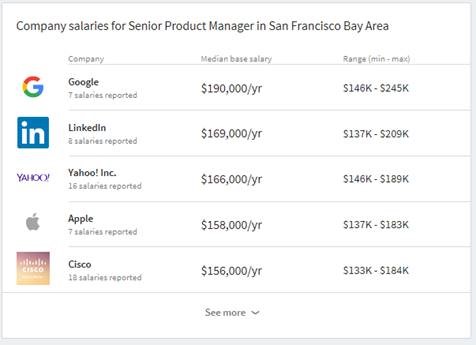
Another valuable tool is compensation data by position for key employers in a metro area.

LinkedIn Salary data at top companies by title and location.

The service is currently available in the US, UK, and Canada with plans to expand globally in 2017.  To obtain full salary details, users must provide their salary details or have a LinkedIn Premium subscription.

Other vendors providing similar data include Glassdoor and Salary.com.

Other recent LinkedIn developments in the news:

  • LinkedIn anticipates that the Microsoft acquisition will close by the end of 2016.  They are awaiting approval from the European authorities and then should be ready to complete the $26.2 billion transaction.
  • LinkedIn was blocked in Russia last week after they failed to comply with Russian rules concerning the housing of data related to Russian citizens.  The service has six million Russian members.  The block goes back to a 2014 law which was enacted after social media-fueled protests against the Putin regime.

Note: The link to the Glassdoor salary site was added on December 1st.


LinkedIn InMail 2.0

I’ve never been fond of LinkedIn’s InMail service which is limited in its utility.  However,  InMail claims to have a 15% response rate which is 5x that of email.  What’s more the top ten percent of InMail senders net a 30% response rate.  According to Doug Camplejohn, Head of Products at LinkedIn, this disparity demonstrates that there are a set of best practices which improve rep response rates.  LinkedIn is rolling out a 2.0 version of InMail which assists with sales rep personalization.

“The best InMailers don’t treat InMail as a SPAM cannon, they really think about it as a handwritten note,” said Camplejohn.  “They take a little time to personalize things and we want to make it easy for all of you to be that good at InMail.”

li-inmail
InMail 2.0 provides full profile access, a signature block, attachment support, shared connections, icebreakers, and synch to CRM.

The first step was making the InMail box smaller so that it doesn’t cover up the recipient’s profile.  Thus, it is easier for reps to identify a personal hook to the recipient.  InMail is also providing a set of icebreakers (e.g. recent posts and updates) and shared connections to assist with messaging.  A critical new feature is the option to synch the email to CRM, providing an audit trail for InMail communications within SFDC.

InMail 2.0 also supports a signature block, attachments, and a new Inbox with threaded messages.  There is also a pending tab for tracking InMails that lack responses.

InMail 2.0 Inbox
InMail 2.0 Inbox

InMail is included as part of the Sales Navigator service.  Professional users receive twenty InMails per month while Team accounts are granted thirty InMails per sales rep per month.

Improving rep messaging is a key aspect of their Navigator product strategy.  LinkedIn is also working on integrating the PointDrive sales messaging service into Sales Navigator in Q1.

LinkedIn has begun rolling out InMail 2.0 to users.

LinkedIn: PointDrive-Sales Navigator Integration

LinkedIn is planning to integrate the recently acquired PointDrive sales engagement solution into Sales Navigator in Q1 2017.  PointDrive, which was acquired in July, helps sales reps package, share, and track sales presentations which are distributed via the PointDrive web app or an email link.  The platform then gathers viewing analytics.  Content includes images, video, embedded maps, and documents which are mobile optimized for presentation.

Bill Burnett, Director of LinkedIn Sales Solutions, said that PointDrive is designed to solve two email problems:  attachment laden emails lack “control over narrative” as emails provide little flow, story, and “experience for the buyer.”  Also, they provide no visibility into who is viewing the email.  Thus, post-demo messaging is haphazard as emails don’t communicate a story very well.

PointDrive Embedded Contact Profile

According to LinkedIn, there are 5.4 decision makers involved in the buying decision which means that there is a high probability that sales emails with rich media attachments are being forwarded to others.

Burnett stated that the goal of PointDrive is to “turn this [email] exchange into a truly more engaging experience” which provides real-time sales signals about what content decision makers are viewing.  Instead of sending long emails, buyers are directed to a PointDrive landing page which allows the sales rep to control brand, content, and commentary.  PointDrive was designed as a “mobile first” interface with landing pages supporting both traditional and mobile browsers.

Brand and product information are “now presented in a way that truly differentiates and engages the buyer” through personalization and organization.  PointDrive also provides easy access to sales rep bios and contact information (see image on left).  Each attachment is displayed in a framed box with sales rep narratives and document descriptions alongside the marketing piece.  PointDrive supports embedded collateral, pricing sheets, presentation decks, multimedia, and images which are all displayed within the PointDrive landing page.  Users do not need to download content or window out to other documents.

PointDrive is customized to the seller allowing firms to convey their brand identity.  Burnett claims that creating a PointDrive is “as simple as creating an email.”  Users upload content and grab links, videos, and Google Maps.  “We’ll lay your brand and identity on top of it for you so that when you are ready to share with your leads [and] share with your connections,” said Burnett.

Sales reps have control over actions taken on PointDrive embedded content.  They can block downloads, password protect the element, set expiration dates, and track forwards.

An embedded User Guide is displayed within a PointDrive page.  Commentary is provided by sales reps.

Real-time alerting metrics are provided for each document view.  Thus, PDF analytics indicate who viewed the document, when viewed, how much total time buyers or influencers spent viewing the document, total pages viewed, and how much time was spent on each page.  It even captures the viewing browser and location of the viewer.  This intelligence is available for both the original recipients and any forwarded viewers.

Burnett calls this a “new way for sellers within Sales Navigator to engage with customers and prospects much deeper into the sales funnel.”  The service also provides “tremendous value for account managers or anybody inside of your organization that’s communicating on a regular basis” with customers and prospects.

The firm plans on rolling PointDrive into core Sales Navigator Team functionality at no additional cost.  LinkedIn sales reps are already using PointDrive with their customers and prospects.

“The new Sales Navigator features are to enhance the overall customer experience of Sales Navigator, and to integrate it into daily workflows to get people the information they need as easily as possible,” said LinkedIn Senior Marketing Manager Derek Pando.

LinkedIn’s System of Engagement ties together email, CRM, and LinkedIn workflows. (Source: LinkedIn Sales Connect 2016)

LinkedIn Head of Products Doug Camplejohn noted that sales reps live in three applications: their email, CRM, and LinkedIn.  LinkedIn’s objective is to become the “System of Engagement” that manages the workflow of sales reps.  Expanded functionality such as PointDrive, connectors, and InMail 2.0 (see below) will sit between the system of communication (email) and the system of record (CRM).  Thus, InMail, PointDrive, CRM uploads (InMail, Notes, Tags), email and Chrome integrations, and the CRM partnerships should be viewed as part of LinkedIn’s broader workflow strategy.

Sales messaging and analytics tools are becoming much more prevalent in sales intelligence, sales acceleration, and ABSD platforms.  That will be discussed tomorrow.

Sales Intelligence Vendors Still Don’t Get Social

For some reason, sales intelligence vendors have never properly understood social selling and how to integrate social media into their products.  This has long amazed me.  Instead of building an integrated social media viewing tool with sharing and feedback, they all seem to nibble around the edges. You’ll find social hyperlinks directly from company or contact profiles, but these simply window out to the social media site.  Also fairly common is the inclusion of corporate blogs into their news and sales trigger feeds, but fully integrated social media tools have yet to be offered by vendors.

The closest any of them have come is InsideView which added a Buzz Tab about five years ago to its InsideView for Sales product.  The Buzz Tab provides a consolidated view of blogs, Facebook, and Twitter feeds.  However, the social content remains segregated from their other discovery tools and the population of Facebook and Twitter feeds is limited.  Other social tools include a Who Knows Who “Six Degrees” tool and the inclusion of Personal Tweets from business executives in their alerts.

The InsideView buzz tab supports keyword searching and filtering for company blogs, Facebook, and Twitter.

There are also a set of social selling tools that focus on social media, blogs, and news but which are light on company and contact information.  As these tools improve, one of the sales intelligence vendors is going to make a build vs. buy decision and either OEM the upcoming service or buy a social selling service outright.

What tools such as Artesian Software, Owler, Contify, and Trapit do isn’t revolutionary.  They basically provide a unified view of news and social content.  Users can filter the feeds and interact with the posts.  If a free service such as Owler can build such functionality, why can’t the sales intelligence vendors?  Core functionality could provide the following features:

  1. A deep set of direct links for companies and executives to LinkedIn, Twitter, Facebook, YouTube, G+, etc.
  2. A unified view of the corporate social media content across Twitter, Facebook, SlideShare, YouTube, Vimeo, corporate blogs, business blogs, etc.  This view would be easily filterable by source, date, keyword, etc.
  3. Social Media Metrics for a company charted over time.  If the company is also selling into the marketing department, then comparative metrics should be available.
  4. When filtering Twitter, allow the user to see both the Tweets from a company and mentions (these are separate options).
  5. Support basic widgets from the major social media vendors.  These are small applets that display key statistics along with a brief description and logo/headshot.
  6. Allow any news article, sales trigger, or social media post to be shared via social media, enterprise social (e.g. Chatter, Yammer), and email.
  7. Support expanded alerts that include targeted social media alongside sales triggers.  Thus, an alert could consist of the half dozen most important sales trigger topics, Twitter posts from the company, Blog headlines, and YouTube / Vimeo uploads.
  8. Executive alerts based upon social media posts and news mentions.

Who Know Who Six degree tools are also worth considering, but this functionality is so well locked up by LinkedIn that relationship discovery tools have remained a standalone category.  Amongst Sales Intelligence vendors, only InsideView and DueDil Connect have built relationship finder tools in competition with LinkedIn.

To be fair, the sales intelligence vendors all understood early on that they needed to work with LinkedIn.  Most of them adopted the LinkedIn widget or the LinkedIn API to provide relationship and executive intelligence into their service.  But then LinkedIn decided it was going to offer its own sales intelligence service called Sales Navigator and began blocking sales intelligence vendor access to LinkedIn.  Since then, with the exception of InsideView, the sales intelligence firms have done little to integrate social content into their services.  Hopefully, the vendors begin to see this gap in their offerings and begin to address it.

Sales Navigator Gmail & SFDC Connectors

LinkedIn rolled out a trio of enhancements to its Sales Navigator offering to assist with Salesforce synchronization, Gmail integration, and mobile app discovery.

To improve the Salesforce experience, Navigator is no longer requiring sales reps to manually identify which contacts should be downloaded from SFDC to Sales Navigator.  While SFDC describes this as improved synchronization, it basically downloads leads and accounts to Sales Navigator.  Unlike sales intelligence services which support bisynchronous data sharing, no LinkedIn account or lead intelligence is uploaded or available for updating SFDC records.  The system does flag which records are in SFDC so that reps can manually key information from LinkedIn to SFDC.

Sales Navigator provides automated SFDC synching and flags which leads are available within SFDC.

To assist with messaging, LinkedIn now offers a Chrome extension for Gmail.  The extension provides integrated access to public LinkedIn profiles and social contact information as a right-handed information bar.  If a contact is not in Navigator, users can quickly add him or her as a lead without exiting the Inbox.  Icebreakers such as shared connections, experiences, and interests help shape account or prospect messaging.  TeamLink information is also displayed.

The Gmail Chrome extension provides LinkedIn contact intelligence within the Gmail Inbox. Users can identify icebreakers and TeamLink connections.

The final enhancement is to the Sales Navigator Android and iOS apps which will now display up to ten daily account or lead recommendations based upon user preferences.  Recommendations will expire after 24 hours and be replaced with fresh recommendations.

LinkedIn noted that over 25% of Sales Navigator users “solely” use the Navigator app for account intelligence.

“Our goal for Sales Navigator is to be an important part of the daily lives of sales professionals, and we believe these enhancements will get us that much closer,” said Senior Product Manager Tom Lee.  “Ultimately, we want to help sales professionals build deeper relationships by working smarter, not harder, and this reinforces our commitment to make them more efficient and effective every day.

Bill Gates on LinkedIn

Microsoft co-founder Bill Gates supports the LinkedIn acquisition and views it as an opportunity to build a Facebook for business professionals.  This perspective is in line with LinkedIn CEO Jeffrey Weiner’s vision of an economic graph that captures the broad scope of business activity.

“This professional feed in LinkedIn, that is how I want to learn about my career, my company, my industry, and I’m going back there,” Gates told Bloomberg last month. “If we can make that as valuable as the Facebook feed in the social world, that’s huge value creation and that’ll happen over a period of years.”

Gates contends that Microsoft and LinkedIn are more valuable together than as separate entities even though Microsoft stock slipped two percent on the announcement.  “I certainly think that the value of the two companies combined is greater than the two by themselves, but I love the idea that the market wants us to show that,” he said.

Gates remains a member of Microsoft’s Board and is formally listed as a Technical Advisor to CEO Satya Nadella.

Dynamics 365 and AppSource

In other news, the firm continues to enhance the Dynamics platform (CRM and ERP) with the introduction of Dynamics 365 and Microsoft AppSource.  “Dynamics 365 provides business users with purpose-built SaaS applications. These applications have intelligence built in. They integrate deeply with communications and collaboration capabilities of Office 365,” said Nadella.  “Dynamics 365 along with AppSource and our rich application platform introduces a disruptive and customer-centric business model so customers can build what they want and use just the capabilities they need.”

The new Dynamics 365 platform will be available this fall.

Merging the Microsoft and LinkedIn graphs to advance the Economic Graph (Slide from Fair Disclosure call on June 13, 2016).

Nadella views Office 365, Dynamics 365, AppSource (a newly launched SaaS app ecosystem for businesses), and LinkedIn as all working together to provide “services in the cloud where you can reason about the activity and the data underneath these services to benefit the customers who are using these services. So that’s what this notion of a graph represents.”

Nadella continued, “The professional cloud or the professional network helps usage across all of that professional usage. Whether it’s in Office 365 or whether you’re a salesperson using any application related to sales, you want your professional network there. Of course, it’s relevant in recruiting, it’s relevant in training, it’s relevant in marketing. So that’s really our strategy with LinkedIn as the professional network meeting the professional cloud. And so you were right to point out that these are all part of one overarching strategy, and ultimately it’s about adding value to customers.”

On Microsoft’s Q4 2016 earnings call this week, the firm reiterated their belief that the LinkedIn acquisition will close before the end of the calendar year.