Radius and Leadspace quietly called off their merger back in August, agreeing not to point fingers at each other and continue supporting joint customers.
“At the end of the day, private to private mergers are incredibly hard to pull off. In this case, despite all of the best intentions in the world, we could not get to something that would work for all sides,” Leadspace CEO Doug Bewsher told Demand Gen Report. “We are excited to see the evolution and clarity around the whole customer data platform really starting to define itself in B2B.”
Bewsher remains bullish about Leadspace and the Audience Management space:
Leadspace pioneered this space when we launched our Audience Management Platform two years ago. We continue to see great success with customers as they both simplify their data management processes and bring additional data driven insights and recommendations into their activities. Whether driving an ABM strategy, a content marketing / inbound lead driven strategy, or outbound prospecting, the right data and insights deployed into systems of engagement is typically the first step in any company’s success…
We look forward to working with you to develop, build and lead this category as we continue our mission to help B2B sales and marketing teams drive a new level of engagement, targeting and resulting revenue for their organizations.
Leadspace had a strong Q2 with its “best ever revenue growth.” New customers include SAP and Splunk. Growth was driven by the increasing recognition that B2B firms require a data-agnostic Customer Data Platform “which brings together many different data sources at the company- and individual-level, drives recommendations, insights and a single source of truth through AI, and then has a single point of integration into multiple executions systems (CRM, MAP, Ads etc),” said Bewsher.
“Radius and Leadspace agreed to continue operating independently and are now partnering to support joint customers,” said Radius. “Radius’ customer data platform is the first for B2B, and we will focus on offering enterprise companies integrated, unified and trusted data across all go-to-market systems, while Leadspace’s audience management platform will continue to equip companies with audience enrichment and analytics.”
Demand Center is a Predictive Audience product that helps marketers generate the right audience for each campaign.
Predictive Analytics company Mintigo unveiled its new MintigoAI service. Mintigo describes their solution suite as “a comprehensive intelligent customer engagement platform powered by AI” for mid-size and enterprise companies to “drive greater pipeline and revenue.” The “customer lifecycle solution” includes CRM and MAP connectors, ABM targeting tools, inbound lead enrichment and prioritization, upsell / cross-sell recommendations, and a new Buying Stages capability.
Buying Stages determines where accounts and leads are in their buyers’ journey. The solution assesses lead enrichment, fit, intent, and behavior data to determine customer intent and stage. Data is sourced from 1.7 billion user interactions per day spanning 13 million global companies. Buying Stages tags accounts into three categories: Target (based on fit), Awareness (based on intent), and Consideration (based on behavior). Buying Stages evaluates the “aggregate actions of leads” and weighs both anonymous web traffic and site visit activity. Mintigo also factors in firmographic, technographic, and social intelligence.
“To plan, strategize and execute B2B marketing effectively in today’s world, marketers need a high-definition view of their customers,” blogged CEO Jacob Sharma. “Using AI and predictive analytics, we built MintigoAI to mine billions of data points and identify the set of insights that make a company’s actual customers unique. These insights range from hiring patterns to technology installs to firmographic data, and much more. The result of this process is the ICP, which MintigoAI uses to identify right targets within existing marketing databases and proactively discover new high-propensity targets that display the ICP characteristics.”
NoteNinja transcribes calls, tags them, and supports quick topic searching for insight discovery.
Sales Engagement vendor SalesLoft acquired B2B SaaS Collaboration tool Noteninja. Durham-based NoteNinja provides meeting intelligence which transcribes, tags, and annotates meeting recordings. The service is managed by an AI bot which recognizes upcoming meetings on the rep’s calendar and attends the meeting.
“I realized our category of software was missing something important,” said SalesLoft CEO Kyle Porter. “Neither us nor other engagement solutions were solving an additional problem. Customers told me they need more insights on what’s actually happening during sales meetings. They realize (and Gartner reports) ‘three out of four customers report spending more with a company because of a positive buying experience’. Modern revenue organizations need meeting intelligence software to solve painful problems.”
SalesLoft listed a set of sales challenges that are addressed by meeting intelligence platforms:
Meeting Challenges. Source: SalesLoft Blog.
Tagging assists with meeting review, helping users search for key moments such as pricing discussions or prospect objections. According to Noteninja, “No longer do you have to click around a meeting aimlessly looking for the right spot. Save time and quickly hone [sic] in on the moments that matter for you and your team.”
Comments can be shared with co-workers or management, providing “game-film for meetings.” These excerpts can also be used for new hire training, objection handling, and learning from top reps.
“I’m incredibly proud for what this means to our customers and the advanced opportunity they will now have to deliver a better selling experience to their customers. With the acquisition of Noteninja, SalesLoft is providing our customers with the first full suite Sales Engagement Platform that combines sales cadences with sales intelligence, serving AEs, SDRs, CSMs, managers, and execs to generate the most revenue.”
SalesLoft CEO Kyle Porter
Noteninja supports major web conferencing services including GoToMeeting, Zoom, JoinMe, and WebEx. Google Calendar, Exchange, and Office 365 productivity applications are also supported. While a SalesLoft connector already exists, the firm is working on a native integration of NoteNinja capabilities which will be offered as a premium feature set within their product line. SalesLoft is targeting August for native availability.
SalesLoft complies with state privacy laws. “We deploy call recording governance for our current dialer and will be incorporating our technology across the platform as we integrate,” said VP of Product Strategy Sean Kester. “We also work alongside the governance and compliance assets deployed by screen sharing technologies.”
NoteNinja does not automatically join meetings with generic (consumer) emails nor does it join meetings with only internal staff. However, this rule can be overridden by including the Noteninja assistant in the attendees list.
Acquisition terms were not disclosed.
SalesLoft has grown to 277 employees with offices in Atlanta, Durham, and San Francisco. SalesLoft supports over 2,000 companies including Square, MuleSoft, Alteryx and Dell.
SalesLoft is ahead of plan in 2018. Q1 was above a “very aggressive” revenue plan to once again double revenue in 2018. Q2 is tracking 120% of plan.
Approximately one-third of NoteNinja customers are joint licensors of the SalesLoft solution.
A few weeks ago, I wrote about enterprise software vendors calling for an American version of GDPR with Microsoft announcing that it was building GDPR into its global product line as its standard privacy protocol.
On the Salesforce earnings call last week, CEO Marc Benioff observed that the software industry has been going through a “crisis of trust for the past six months” related to privacy and data ownership:
“From the European perspective the way they look at data is data belongs to you, it’s your data. Now for us at Salesforce, we understand that. We’ve had that position from the beginning. Our customers’ data belongs to them, it’s their data. I think in some cases, the companies that are start-ups and next generation technologies here in San Francisco, they think that data is theirs. I think the Europeans with GDPR have really flipped the coin, especially in advertising but in another areas saying hey, this data belongs to the consumer or to the customers, you guys have to pivot back to the consumer, you have to pivot back to the customer.”
Benioff once again called for a US privacy law similar to GDPR which provides “guardrails” around trust and safety. “This is going to help our industry,” said Benioff. ”It’s going to provide the ability for the customers to interact with great next generation technologies in a safe way.”
Benioff also warned that when AI technologies are indistinguishable from humans, trust will also be an issue.
Outreach Amplify provides response analysis, helping firms select the most effective message.
Sales Engagement vendor Outreach is teasing a new predictive analytics capability called Amplify which leverages the history of a firm’s sequences and workflows. The firm will not be employing a black-box AI strategy but providing recommendations with explanations.
CEO Manny Medina faults deep learning strategies which lack “the ability to make inferences, such as the ability to figure out why things work” and require users to trust the recommendations without providing a basis for the suggestions.
“We believe we need to tackle this problem following general scientific principles. Hypotheses need to be testable, data should be very carefully examined to verify the quality of the data.”
Yifei Huang, Machine Learning Lead, Outreach
“When we built Amplify, we built it with the core belief in mind that, the human needs to understand why things work so that machine can understand why things work so that the machine can get better at helping the human,” said Medina.
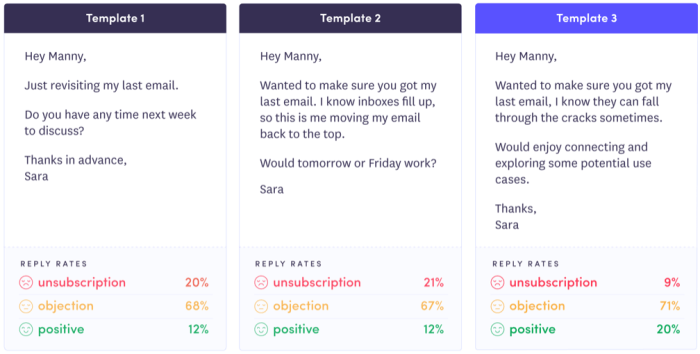
For example, Amplify deploys natural language processing (NLP) around email responses to help identify whether responses are unsubscribes, objections, or positive. Outreach claims that their NLP classification is 92% accurate, only three points behind manual classification.
NLP will also be used to assess objection handling to identify reps who handle objections well and which ones need improvement. This feedback is then available to managers to assist with coaching.
Amplify addresses two key managerial questions: “Is my team adopting the new technology? Is the new technology delivering a measurable lift?”
Amplify will be unveiled at their May Unleash conference.
Artesian CEO Andrew Yates recently discussed Artesian Solutions with Sudipto Ghosh as part of the MarTech Interview Series. Artesian was founded to help resolve the disparity between B2B buyer and seller tools. “We saw that businesses had transformed the way they buy, but that sellers had not adapted. This mismatch led us to create a vision of better B2B sales engagement that is customer-centric at its heart, and to develop the world’s most powerful customer intelligence application to support it.”
Yates described technology as “the biggest disruptive force in the world” and his entrepreneurship as “a desire to disrupt the status quo, solve problems, remove complexity and make a difference.” He sees Artesian Solutions as a “disruptive force for good in our sector, providing engagement smarts for companies and markets in the same way that LinkedIn has done for people insights.”
Artesian is incorporating new AI technologies into its platform including the Arti chatbot based upon IBM Watson. As they are doing so, they are repositioning from Social Selling to “A.I.-powered sales intelligence.”
Yates warns that businesses look for CRM platforms to help customer facing departments build customer-centric businesses and a full customer view. Often, though, they become frustrated when CRMs do not provide the desired customer experience and engagement. But CRMs are only as good as the data entered into them and are subject to ongoing data decay. Further compounding this issue is
“the sheer volume of data businesses need to grapple with. Often unstructured, this data is increasingly hard to find, rationalize and interpret. Inaccurate or out-of-date data has several inevitable consequences. Take-up and enthusiasm for CRM input wanes as the volume of data increases, and time spent just keeping up-to-date with existing customer data impacts negatively on time spent researching and acquiring new ones. Opportunities to respond to real-time customer news and market insight are missed, and customers looking for instant action and results are left disappointed. Likewise, deals are lost through mistakes, and errors in messaging and targeting become more frequent. Forecasting accuracy diminishes as emerging trends go unnoticed.”
Yates recommends working with a data partner that provides a full view of customers and contacts, including contextualized customer insight; news, market trends and social media monitoring; real-time intelligence; and single sourced company and contact profiles with “social profiles, opinions, and expectations.”
Predictive Analytics and Audience Management vendor Leadspace completed its Series C. The funding round was led by Arrowroot Capital and joined by JVP. The $21 million round will be used “to grow our customer team in San Francisco and Denver, and our AI and data management product teams in Israel.”
The firm is assessing additional locations, including possible offices on the East Coast and Europe, “perhaps” London.
Arrowroot has taken a seat on Leadspace’s Board. The firm wanted growth equity advisors instead of traditional VCs for Round C. “At this point the investment is not just in the idea and the team, but also the underlying metrics and performance of the business,” said CEO Doug Bewsher. “Once you have “Product/Market fit”, the kinds of questions investors ask are whether you are ready to scale; what are the opportunities for further growth; and apart from additional investment can we be an investment partner that can help you address these opportunities?”
Bewsher noted that marketing has been transformed over the past seven years since Leadspace was founded. Firms are switching from tactical demand generation programs to targeted Account Based Marketing (ABM) communications. “No longer is it OK to just send out blanket “nurture” emails to everyone and hope that will generate positive customer engagements. No longer can you rely on a single data source as the basis to know your customer. No longer is it enough for marketers to just think of leads — they need to market to accounts, and teams of people. Neither can marketers afford to ignore intelligence and information from external parties, and simply rely on the limited info they gather internally.”
Not only has the nature of B2B marketing been transformed, but “world class B2B sales and marketing organizations” need to become more like consumer companies with a deep understanding of the account at multiple levels. Echoing Sirius Decisions, Bewsher said that B2B marketers need to “really know your customer at the account, demand unit and individual level, and then target and personalize your messaging to cut through the noise. And think customer-first.”
As an analytics company, Bewsher talks up the value of AI for sales and marketing as it begins to address specific problems and workflows:
AI is everywhere. While there is no doubt that it is going to change every corner of our life, both as private users and business people, I think we will start to move from the promise to the reality in 2018. In business-to-business sales and marketing in 2017, it was enough to say: “We have a ton of great data scientists who are working on new ways to better engage your customers.”
But in 2018 customers will look to see actual results — like the 90 percent increase in email connection rates we have seen from the deployment of AI to recommend the right way to engage a specific user. This will require a maniacal focus on specific use cases from the emerging area of AI.
One area where AI will improve revenue generation effectiveness is in ABM programs which has been limited by the human ability to consume information and the historical lack of data availability. However, “AI is changing all this, with the ability to consume and understand unprecedented amounts of information and turn this into action at scale and in real time. So sales and marketing teams now have the opportunity to drive much more relevant and effective engagement programs for their entire potential target audience.”
According to Leadspace, they are trusted by over 130 B2B brands and seven of the top ten enterprise software companies. Clients include Microsoft, Marketo, Oracle, and RingCentral.
Arti responds to “How many companies do you cover?”
British sales intelligence vendor Artesian Solutions announced that it received £3.5M in expansion capital from Columbia Lake partners. The funds will be used to refinance current debt obligations and provide working capital for “further growth and expansion.” The refinancing also provides better terms and business flexibility after the firm reached a profitability milestone in July.
Artesian has begun integrating artificial intelligence into its tools. Earlier this year, it launched Insight Agent, “the first step in a series of intelligent chat bots aimed at automating many of the tasks carried out by B2B professionals” along with Arti, the firm’s interactive digital assistant.
“This is an exciting milestone in our company’s history and positively reinforces the leadership position we have attained. We are constantly looking at the ‘what next’ scenario, pushing boundaries to establish our business as one of the leading innovators in B2B software for commercial teams, this has paved the way for our new risk mitigation capabilities which will be released in the New Year.”
Artesian Solutions CEO Andrew Yates
The firm has recently shifted its positioning from social selling to “A.I. powered sales intelligence.”
“Social Selling sits at the heart of Artesian’s founding principles,” explained Yates. “But as sales best practice has evolved, so has Artesian. Our goal is to be at the forefront of technology evolution for enterprise B2B, delivering a suite of A.I.-powered tools to make prospecting, engaging and closing deals easier. As our forthcoming risk mitigation capabilities demonstrate, we will continue to evolve to ensure we remain a trusted partner of our enterprise customers and to maximise the impact of their business relationships”
Artesian offers products for both the British and American markets.
The Artesian Opportunity View ties together Salesforce Opportunity data by stage with Artesian Sales Triggers, helping surface key opportunity insights in context.
Recently, I had the opportunity to sit down with Artesian Solutions CEO Andrew Yates and discuss topics including artificial intelligence and risk tools they are integrating into their social selling service. This is the second in a series of interview excerpts I am publishing this week. On Monday, Andrew discussed Artesian’s 2016 entry to the US market.
Michael: You have recently begun to introduce AI capabilities into your platform.
Andrew: What we’ve done in our first incarnation of bot-driven AI is we’ve created something that we call an “insight agent” that, through an API into Salesforce, can build you a view of threats and opportunities within your pipeline. Which, in itself, is pretty damn useful; much more useful than a forecast report or a dashboard which is the way you see it in Salesforce today. Then we’ll lay out all of those deals by stage and value and overlay today’s new social and demographic context on top. That’s pretty useful.
With the latest release, we’ve created a bot which literally reads and interprets the news in relation to the stage of the sales process that you’re at. And, where it sees a particular trigger that has meaning in relationship to a particular stage, it flags that. Most organizations have implemented the concepts of sale stages when they’ve implemented CRM.
Typically, when I ask somebody, “how many stages do you have?” They’ll say, “between five and seven.” The system automatically builds you a view depending on how you’re implementing Salesforce, however many stages you’ve implemented and what you call them. Then what the bot does, is it crawls all over the news looking for things that could impact those opportunities at the stage they are at.
Let’s say, I’ve got a six-stage process where stage six is closed and stage five is a negotiation. Artesian’s insight agent finds out about a CIO who has left the business. The insight agent will notify the user that there’s a potential problem with the deal in their pipeline. The agent will tell them why there is a problem and how it’s been categorized. There’s half a dozen next-best actions that we bundle up with the insight as we deliver it. That’s our first attempt at taking the concept of machine-based learning and natural language processing, combining it with an AI bot, and trying to make that useful for customers.
We’ve introduced the ability for the user to customize their own topics, keywords, and trigger events. We offer a bunch out of the box, and we also wrap a managed service around it and easy implementation to every customer.
We’re also seeing a lot of activity in the “RegTech/RiskTech” arena with the growth of cybercrime and terrorism, and the sensitivity around regulation of any financial, FCA [UK Financial Control Authority] regulated [business]. There are regulations that organizations need to comply with. We’re increasingly being asked by our financial services customers, particularly the banks, to get deeper into being able to provide those capabilities inside of Artesian.
Organizations want to mitigate risks. They want to fall within the arena of whatever the regulation is and comply with the law, but they also want to exploit the technology as best they can to make sure they write the best business that they can. We’re doing some work at the moment in conjunction with one of our demographic data suppliers. What we’re looking to do is extend the capabilities in Artesian to provide some of the capabilities that our customers are asking for in the RegTech / RiskTech environment. We’re going to introduce risk agents. Risk agents look at the real-time present and it looks at the past. It specifically looks at things that are in-line with the regulations and also in-line with the stated risks that the customer has mapped out.
What that translates into is a service that is not only compelling in terms of customer acquisition, customer retention, and yield, but also compelling from a kind of, you don’t go to jail if you’re using Artesian because it’s doing the regulation and risk job for you as well.
Michael: When you say risk app, are you talking more about supplier risk, compliance risk, credit, reputational?
Andrew: There are 40 or 50 pretty big companies doing this thing already. What we’re talking about is company-centric intelligence, but also the people associated with that company and the intelligence that we’ll need to derive around whether something is risky or not. It could be the performance of a business. It could be some adverse news in relation to that performance. Or it could be that an individual who has a beneficial ownership, more than a 5% stake in a business, happens to be on a naughty list in terms of the PEP [Politically Exposed Persons] or sanctions.
At the moment, we have risk triggers in the opportunity view. They’re not compliance risk triggers. If you’re going to a client, they need to know about key beneficial ownership.
Michael: Is that part of the opportunity view or is that a new type of view?
Andrew: A new type of view. We have risk triggers in the opportunity view, but they’re not compliance risk triggers. If you go into a bank, they need to know about beneficial ownership, adverse news going back three years, PEP, sanctions, real-time alerts from stock exchanges. None of that is feasible within a generic instance of Salesforce.com in an opportunity view.
Michael: It sounds you’re looking to move beyond the sales and marketing teams to start to get to into things like onboarding, KYC [Know Your Customer], AML [Anti-money Laundering], PEP, and other compliance aspects that really go into monitoring of clients as well as the initial onboarding.
Andrew: Yes, if you go back to the whole customer curious mantra and deep relationship management, we like to say that we put the R back into CRM. We are all about that relationship.
The conversations we are having with our large customers would indicate we are on the right track with that.
The interview will be continuing over the next few days with discussions of what it means to be a “customer curious” business and how Artesian maintains a very high engagement rate amongst its users. Monday’s blog discussed Artesian’s 2016 entry into the US market.
Artesian Insights Agents for Salesforce Opportunities
US and UK social selling vendor Artesian Solutions claimed that their 16.1 software release was their “biggest ever.” The release included functional upgrades, expanded content, user experience improvements, and new artificial intelligence (AI) capabilities.
The new Insight Agents are their first step towards delivering “intelligent chat bots aimed at automating many of the tasks carried out by B2B professionals daily.” The new AI tool combines advanced natural language processing and behavioural analytics. The goal is to “deliver commercially valuable and immediately actionable insights, telling the user what they need to know and what action they need to take.”
The evolution of Natural Language Processing, Machine Based Learning and Artificial Intelligence technology is set to have a profound impact on the activities of those in commercial teams. This product release is a significant stepping stone towards an AI future, the culmination of months of behind-the-scenes R&D based on an incredibly rich understanding of the enterprise B2B landscape through the eyes of some of the biggest and most influential companies in the world. We have been working closely with them to understand what their future looks like and where the biggest gains can be made.
Artesian CTO Steve Borthwick
Continued Borthwick, “Artesian has been evolving and improving its relevance and analytic algorithms over the last 10 years, benefiting from the feedback and success that our trusted customers have provided, and that has always kept them one step ahead of the sales intelligence race.”
Insight Agents are initially available within the AppExchange as Salesforce Opportunities. This feature surfaces trigger events based upon the opportunity stage and preferences of each client. “It provides a step change in productivity and customer engagement, enabling you to focus on the most important aspects of your most critical deals,” said VP of Product Management Rich Clark.
For example, Insights for Sales Opportunities will place higher emphasis upon opportunity alerts at the front of the pipeline and risk-based alerts during later stages.
“This latest release without doubt places Artesian at the leading edge of innovation for enterprise B2B,” said CEO Andrew Yates. It delivers the first milestone on our road-map to predicting customer needs, automating and directing pipeline activities, and the delivery of hyper-personalised communications and custom marketing.”
Administrators can now tailor the trigger topics available to their users including adding custom topics and constructing a topic taxonomy focused on industry-specific triggers.
User experience improvements include easier access to topic filters, color-coded triggers in email alerts, and adaptive HTML design for improved mobile navigation and display.
Other design upgrades include the social media viewer which now surfaces social media links alongside inline blogs and tweets and a social selling leaderboard at the team or corporate level which benchmarks Artesian usage versus peers.
“Hotness” flags were added to the US service. They have long been available in the UK edition.
In the UK edition, Artesian partnered with Blue Sheep to add three million contacts and double the number of emails to 875,000. The additional executives were focused on non-directorial positions, helping expand coverage beyond filed corporate directors. The new set of contacts raised the UK contact count to 9.7 million. Furthermore, the new execs were matched against the Full Contact file, providing additional social media links and biographic relevance to contact profiles.
The expanded contacts and social media links are also available to users of the Artesian Ready mobile app which combines mobile calendars with Artesian insights. Ready helps reps prepare for meetings by supporting on demand company and executive research, sharing meeting notes with colleagues, and reviewing the latest attendee triggers and social media posts.
The firm also added Auditor Fees as a new UK select. Auditor Name was already supported.
For the US edition, Artesian now supports a “Hotness” indicator highlighting firms with recent key trigger events and improved event prospecting (see image above on right). The Hotness indicator was already available in the UK edition.
Artesian has formalized its training and certification program with an integrated leaning management system. The older training was more PowerPoint oriented but the new system is more blog-like with videos and quizzes. Along with tool certification, Artesian includes annual refresher courses.