2016 in Review: Sales Intelligence Content

InsideView Coverage as of April 2016.

One of the most straightforward ways to increase the value-add of a Sales Intelligence Service is to expand the content it delivers to its users.  Generally, a vendor can license additional content within the same general category (e.g. more contacts) or expand coverage into new content categories not previously supported by the product.  The first approach is usually faster and less expensive as there is limited development involved in adding additional coverage within a currently supported category (assuming the vendor is not hitting up against platform limits), but there are still costs involved with licensing, de-duping, and merging content sets.  As such, it is much more common for firms to increase the scope of current data sets than to add entirely new content categories to their services.

So which of the fourteen sales intelligence vendors discussed in my new Sales Intelligence book invested in increasing their depth of coverage?  Basically, all of them.  Of course, the scope of content investment varied greatly:

  1. Avention roughly doubled their global company, contact, and email coverage.  Their product now spans sixty million companies, eighty million contacts, and twenty million emails (US and UK).  I previously discussed their AsiaPac expansion, but the coverage expansion was global with most of the new content outside of the US, UK, and Canada where they already had significant depth.
  2. DiscoverOrg also greatly increased its coverage as it grew to 60,000 editorially researched company profiles and one million researched contacts.  Over the past twelve months, DiscoverOrg had a 91% increase in company coverage, 134% increase in contact coverage, and a 371% increase in non-IT contact coverage (numbers supplied by DiscoverOrg). The non-IT increase was due to an expansion of their job functions datasets to include Product Management (TEDD), Sales, CxO, and HR.  The firm also continued to invest in their marketing dataset.  CMO Katie Bullard noted that “the Marketing budget has begun to meet or exceed the IT department budget in many companies and vendors” while “service providers selling into marketing continue to proliferate.”
  3. RainKing continues to build out its company and contact coverage and expects to hit one million executives by the end of 2016. The firm roughly doubled the number of decision makers in its database while extending its international coverage. They also have increased the number of marketing, finance, and HR decision makers.
  4. InsideView’s executive coverage grew to 17 million US contacts and 8 million European contacts. Total global contacts more than doubled to 31 million and global emails grew by 10 million to 17 million.
  5. Bureau van Dijk added RepRisk environmental, social, and governance (ESG) risk reports to their service while continuing to build out their company database.  At the end of the year, Bureau van Dijk provided close to 210 million active and inactive company profiles
  6. DueDil rolled out enhanced financials for UK and Irish registered companies. Along with performance and growth metrics such as EBITDA and multiple CAGRs (compounded annual growth rates), DueDil is providing historical graphs for key metrics. In total, six new metrics and 12 key performance indicators (KPIs) have been added.
  7. Data.com expanded the Dun & Bradstreet content displayed in a new Prospect Insights view.  Extended company intelligence includes D&B WorldBase firmographics and linkage, Hoover’s top company descriptions and competitors, and First Research industry overviews with call prep questions and industry summaries.
  8. Infofree grew its executive email file to 26 million.
  9. Salesgenie raised its business email count to 58 million US contacts.
  10. Owler’s primary focus in 2016 was to expand their Competitive Graph and gather additional company intelligence. The Competitive Graph improved as the user base has grown and the firm has implemented a set of data cards (simple user queries such as is company X a competitor of company Y) which help refine sizing data, competitors, and a few other firmographic topics.  Revenue and employee figures have grown to 2.7 million companies.
  11. Zoominfo expanded its set of company enrichment variables with the addition of 200 new Company Attributes in October 2016.
  12. LinkedIn continues to add two members per second.  At the end of the year, they delivered 467 million global profiles across ten million companies.
  13. Dun & Bradstreet grew its WorldBase file of global companies to 265 million active and inactive firms.  Over the past few years, they have also focused on improving the depth and accuracy of their international file.

So who did I omit?  Technically Artesian Solutions did not make the content list, but that is simply because their new US edition will be discussed in the new product category.  Likewise, InsideView’s Tech Profiler Premium is also being discussed as a new product.

MarketLine Advantage Research Database

MarketLine, formerly known as DataMonitor, is expanding the content and functionality of its MarketLine Advantage research database.  The service is designed for management consultants, investment bankers, trade agencies, lawyers, and academic research.  While its company and industry content has long been licensed by the sales intelligence vendors, the additional datasets found in Advantage provide only limited incremental value to sales teams.

MarketLine is expanding profile coverage of both companies and industries, but not expanding the licensed dataset it makes available to sales intelligence vendors such as Factiva, Bureau van Dijk, LexisNexis, and Avention.  Industry coverage has roughly doubled to 6,000 country/industry pairs.  For company intelligence, they are trebling the number of company profiles to at least 100,000 firms; likewise, the number of company profiles with SWOTs is quadrupling to 12,000.

Company profiles are available in multiple formats and can be selected at the table or chart level.  Thus, users can perform a one-click export of a company or industry table to PowerPoint, Word, PDF or Excel files.  Unfortunately, company and industry news is maintained separately from company and industry profiles; thus, users cannot create a unified report containing editorial research plus news.  This lack of unification adds to the search and export work of researchers.

Marketline is one of the few vendors that provides global and regional industry research across a broad set of industries.  Most vendors focus on a subset of countries (e.g. emerging markets, United States) or industries (e.g. Consumer Products).  MarketLine publishes industry research at the country, regional, and global level allowing users to compare the same industry in different countries or many industries within a country.  This ability to compare across countries and industries – with standard terminology, methodology, industry definition, and economic assumptions – assists with market entry analysis, whether it is researching new sectors or researching new countries.  It also helps sector-focused sales reps adjust their messaging and targeting across markets.  Furthermore, by including Five Forces Analyses and the top company profiles for each country, it is possible to determine whether new companies should be added to your ABM target list as well as assess potential obstacles when entering a new market.

MarketLine Industry Research provides a half dozen Spider Charts (The Five Forces Summary with sub-category detail) along with short explanations of each sub-category.

Because MarketLine research covers so many regional / industry pairs, the reports should not be considered detailed industry research.  Industry specialists generally write technically oriented reports on specific industry topics.  Instead, the focus is on market size, key segments, current trends, top competitors, and market growth projections.  MarketLine focuses on actionable information that can be understood by industry generalists and researchers operating across many industries.

MarketLine also offers a set of country profiles which assist with market entry decisions and help users develop a basic understanding of local dynamics and risks.  Country profiles utilize a PESTLE framework.

Each of the major profile categories contains a standard Competitive Intelligence / Strategy tool employed by B schools and analysts:

  • SWOT – Strength, Weakness, Opportunity, Threat analysis looks at a company versus its competitors and the overall market.  Thus, opportunities might include emerging technologies or newly opened markets while threats cover exogenous variables such as government regulation, market substitutes, and competitor actions.
  • Five Forces – This industry tool was developed by Michael Porter and covers Buyer Power, Supplier Power, New Entrants, Threat of Substitutes, and Degree of Rivalry.  Within each of these elements, a set of sub-topics is covered.  The Five Forces analysis is discussed at the sub-section level and displayed as a spider web graph.
  • PESTLE — Political, Economic, Social, Technological, Legal and Environmental analyses for 150 countries.

Other MarketLine Advantage datasets include:

  • Deal profiles spanning venture capital, private equity, mergers & acquisitions, partnerships, private placements, and joint ventures.  Deal profiles are generally available within one business day of the transaction announcement.  The deals database is screenable and goes back at least three years.
  • Country and city demographic datasets gathered from governmental resources (e.g. OECD, Eurostat, CDC) covering 750 macroeconomic and demographic variables.  Launched just a few months ago, the cities database covers approximately 2,000 global metropolises and can assist with initial planning intelligence for locating international offices and projecting which regions are poised for rapid growth.  Multiple visual formats are supported including bar, line, and pie charts.  The datasets are exportable at the field and location level, allowing users to build custom datasets.
  • Company News written by MarketLine’s analysts.  MarketLine reports on 11,000 companies with 60,000 articles per annum.  The current archive exceeds 300,000 articles.
  • Market Data Analytics for major consumer product categories including food, drink, and personal care products.
  • Company and investment prospecting.

The Home Page is a bit flat with no dynamic content.  Users are presented a single Google-style search bar along with database browsing options.  This format is in line with a reference service, but the layout indicates a lack of personalization for frequent researchers.  This is a missed opportunity.  Frequent users should be able to track specific companies, industries, and countries with homepage and email alerts.  These alerts could cover both company news and updates to key reports.

The MarketLine Advantage Homepage focuses on quick search but lacks dynamic content.

MarketLine Advantage customers benefit from access to MarketLine’s team of 178 researchers that conduct both primary and secondary research.  Users may pose questions to the researchers subject to a 24 hour SLA.  Other benefits of directly licensing the Advantage service is data currency (aggregators generally receive monthly report updates), broader content sets, custom screening tools, and the ability to quickly export report sections in multiple formats.

MarketLine Advantage is sold on a named user basis with annual subscriptions subject to volume pricing.  Users have unlimited access to reports, datasets, and downloading.  Pricing for MarketLine Advantage was not disclosed.  When MarketLine Industry reports are sold on the GlobalData store, they are priced at $350 for single user access to a report, $700 for a site license, and $1,050 for an enterprise license.

Advantage is available via web and mobile browsers but the service lacks CRM connectors and mobile apps.

LinkedIn Premium Insights: Hiring & Employment Analytics

LinkedIn announced immediate availability of a set of company insight analytics to its premium products including Sales Navigator, Business Plus, and Talent Solutions.  The new reports provide company employment intelligence from the LinkedIn database which competing sales intelligence vendors would be hard pressed to replicate.

Product leader and strategist Megan Kamil blogged, “The use cases for these insights are limitless. From the market research associate gathering relevant information on key market and competitive landscapes to the investment professional trying to uncover the next ‘hot’ company, this information will be valuable to any business professional.”

The new Total Employee count provides a two-year graph of LinkedIn employment trends.  The trend data can be quite useful for evaluating a company’s recent trajectory.  LinkedIn also provides the average tenure.  Low tenure needs to be interpreted carefully as it could be a sign of either rapid growth or an unhappy workforce.  Had they also included an employee churn rate this issue would be clarified.

LinkedIn Total Employee Count provides two years of data, growth rate, and average tenure.

While employee counts are available in other services, the LinkedIn data is likely to be more accurate for companies with a high percentage of professionals.  Firms with a high percentage of blue collar, seasonal, or part-time workers are more likely to be undercounted.  Be aware, though, that larger companies often appear as multiple companies (e.g. overseas subs, major divisions, or acquired companies) in LinkedIn, so they could also be subject to an undercount.

Also quite useful is employment by job function as it allows sales reps and analysts to evaluate where the bulk of employment is within an organization and how it is shifting.  This information is particularly valuable at startups as it provides an indicator of product maturity.  For example, a firm that is engineering focused with few sales and marketing positions may be pre-revenue.

LinkedIn Employee Distribution by Function provides insights into the relative size of departments over two years.

However, if sales and marketing functions spiked last quarter, the firm may be readying a product launch.  Such a shift can be detected in the New Hires report.


New Hires shows overall hiring trends with a focus on senior management.

The other two new reports are Notable Alumni and Total Job Openings.  Alumni may be useful for tracking former execs at a long-standing client to their new place of employment.  Such tracking may find new startups not on a sales reps’ radar along with potential connections or talking points.

Total Job openings are displayed by month and broken out by function and seniority.

Total Job Openings details monthly open positions for two years and current openings by function and level.

LinkedIn is beginning to leverage its 433 million profiles to provide unique insights for its premium services.  A logical next step for them to take would be predictive modeling based upon their executive data.  For example, an analysis of the hiring ramp at retail and logistics companies in November provides insights into how optimistic the industry is about the upcoming holiday season.  Similarly, unannounced layoffs at companies just before the quarter ends might be picked up well before public companies announce their earnings.  As LinkedIn also has a large dataset of hiring data, the firm could also begin providing insights on the open positions at companies.  Unfortunately, the Job Openings report does not link to position details or allow for prior period analysis.

“This is just the beginning of the deeper, more advanced company insights we aim to deliver as part of our Premium experience on LinkedIn,” said Kamil.

If Microsoft is to obtain a strong ROI on its pending LinkedIn acquisition, it needs LinkedIn to more broadly develop analytics and tools which leverage the unique LinkedIn crowdsourced dataset.  Imagine the value to sales and risk departments (e.g. credit, purchasing) of providing hiring trends over time and by position within Microsoft Dynamics.

One firm that is already providing hiring data analytics in their sales service is CB Insights for Sales which uses the Indeed hiring database for its reports.  Users see a report similar to the LinkedIn Total Job Openings report, can view the open positions by function and level for current and prior periods, and drill down to both open and closed positions.  Thus, a sales rep could view the required skillset for the new VP of Product or CMO to better understand her mandate.

BvD: New UI for ORBIS

Bureau van Dijk (BvD) is releasing a new user interface for their ORBIS financial analysis product.  The ORBIS product line provides global company financial analysis tools with very deep financial coverage of European privates.  This platform is also employed for regional products such as Amadeus (Europe), Oriana (AsiaPac), and country specific products within Europe such as Fame (UK), Markus (Germany, Austria, Luxembourg), and Ruslana (Russia, Ukraine, Kazakhstan).

The modernized UI is fast to use and supports tablets.  New features include an icon-based navigation panel along the left edge and improved multi-step searches.  Users can also group their favorite search steps together and adjust list layouts.

The new ORBIS UI provides streamlined searching and list building.

New report types include a visual profile and “Excel-friendly financial worksheets.”  Users can also quickly share searches, results, and reports with colleagues.

A new Tools Zone provides a set of analytical tools for peer analysis, pivot-table building, ownership research, and Excel plug-ins.

The new ORBIS Toolbox

Both the old and new UI will be available while users migrate their saved searches and reports to the new ORBIS.

The firm did not indicate whether similar enhancements were planned for the MINT sales product line.

ORBIS is the leading financial analysis tool for European and AsiaPac companies.  They have been rapidly expanding their global company coverage and now span 200 million companies (roughly 3/4 of which are active) with market leading company linkage (ownership) intelligence.  This dataset is available in ORBIS, their regional financial analysis editions, MINT sales intelligence editions, and their line of Catalyst workflow tools (e.g. credit risk analysis, transfer pricing, valuation).

News Aggregators: Who Do I Use?

FR
FirstRain coverage of Lattice Engines includes web volume, business influencers, market drivers, Twitter trends, recent stories, related topics, and subject filtering.

The following is a Quora post I wrote concerning news aggregators…

As an industry analyst that publishes a weekly subscription newsletter on the information industry, I follow companies and industry topics related to my industry.  Coverage spans about fifty companies across North America and Europe with many of the firms having global footprints.  As such, press releases are likely to come from North America and Europe but news coverage needs to be global.

Alerts are basically a distraction so I employ daily push (email alerts) and pull (portals) approaches.  I only want alerts for major events (e.g. PE/VC fundings and M&A activity).

Also, I am not performing due diligence or media analysis, so duplicate filtering and high precision are critical.  I do not want five variants on the same AP story or passing mentions of companies in the twelfth paragraph of an article.  I also am not interested in stock market news as it is ephemeral.

I provided the above as I use information services to meet specific workflow needs.  Your needs may differ.  Here is how I achieve the above objectives (in order of importance):

  • FirstRain – I have used FirstRain for five years.  They have extremely high precision meaning that stories are almost always about the topic in question.  They include a FirstTweets feature which provides ten Tweets about my subject.  Instead of simply looking for Twitter keywords, they follow the Twitter links and analyze the linked content.  Thus, FirstTweets provides me with side door access to blogs, company website posts, and social media.  I am setup to receive daily news for companies and industries and can explore their news archive by company, industry, or business topic.  SUBSCRIPTION SERVICE
  • Owler – Owler combines semantic mining of open web news with social media crawling (Blogs, YouTube, and Vimeo), polling (e.g. CEO and transaction favorability), crowdsourcing (e.g. company size estimates and competitors), and editorial resources.  Editors review story tagging to improve precision and collect funding and M&A information.  I receive daily alerts of news and social media that complements FirstRain well.  I also receive editorially created M&A and funding alerts that provide transaction details and company overviews along with curated story hyperlinks.  FREE SERVICE
  • Feedly – I use Feedly as my RSS portal.  I have it setup for company blogs, industry analysts, trade publications, and a few individual bloggers.  I generally use Feedly as a backup system to make sure I haven’t missed a story or for when my newsletter is short and I’m looking for additional ideas. FREE SERVICE
  • Seeking Alpha – I have a short list of public companies that I cover with earnings news flashes.  Seeking Alpha provides me with alerts on transcripts, filings, and investor analysis (I generally ignore the investor analysis).  The key things for me are the earnings bullets and transcripts. FREE SERVICE
  • Trade Publications – I am setup for weekly feeds of a few trade publications.  FREE SERVICES
  • Factiva – Factiva is a subscription service, but I can access it through my alma mater’s library.  I generally access Factiva only a few times per quarter for archival research (they go back over thirty years) or Wall Street Journal articles (Factiva and the WSJ are both owned by News Corp).  SUBSCRIPTION SERVICE
  • YouTube – I have setup the corporate YouTube sites for many of the companies I follow.  YouTube provides corporate positioning videos, product demos, webinars, conference keynotes, and training tips.  I live in YouTube the week of Dreamforce (SFDC’s annual show) as I am not able to attend the show. FREE SERVICE

I also have licenses to various sales intelligence services but do not use them generally for my newsletter as it could bias my research.  If you have access to a subscription sales intelligence service (e.g. InsideView, Avention, Hoover’s) or news service (e.g. Factiva or LexisNexis), it can also be part of your aggregation mix.

GIGO: Did We Lose on Price Again?

Loss Reason

Steve Silver, a Research Assistant at Sirius Decisions, recently blogged about a client where the overwhelming reason for losing deals was price.  But the client had a differentiated service where price should not have been the primary factor.

Silver discovered the reasons for this anomaly:  The field was not used by any departments at the firm.  Without an owner, the path of least resistance was selected — the first choice in the picklist.  And in the case of the client, 90% of the losses were flagged as price-based.

Did we establish value?

Silver omitted a third reason, and one which is common amongst sales reps.  Price is an easy scapegoat for lost opportunities.  But if your service is well differentiated and you focus on your value proposition, price should not be the primary loss driver.  Yes, some deals will be lost because a competitor low balls the deal (a true price loss), or the prospect simply does not have the financial means to purchase your service (a poorly qualified prospect), but in most cases, losing on price is a failure on the part of sales reps.  If they thought about it more, they would realize that price is not an exogenous variable outside of their control.  That’s because price is tied to value.  Price is the critical variable if your value has not been established.

This isn’t to say that pricing could be wrong.  If your competitors are quickly moving up the value curve, your historical price may no longer be sustainable as you become less well differentiated.  With good data and analytics, you would capture this shift in the competitive marketplace and act accordingly (e.g. R&D to better differentiate your service, better product bundling, or reduced prices), but price should only dominate the loss reasons in a commodity business.

GIGO

So what else could be gleaned from this situation?  First, somebody needs to own data quality within the CRM.  If a field is viewed as busywork, your sales reps will populate it with junk data.

Garbage in, Garbage out.

Managers should also be pushing back on reps to better understand why deals were lost so that mistakes can be avoided in the future.  Does the sales rep need additional training or coaching?  Are additional sales tools needed for competitor handling or establishing value?  Are we poorly qualifying opportunities or failing to identify the key decision makers?

Yes, it is easier to move onto the next deal without taking the time to analyze deal losses; but a learning organization needs to understand its failure points.

Sales Operations

Sales Operations should be cross-checking fields.  If the loss reason is price or features, then a competitor had a better offering.  Was the primary competitor recorded in the CRM?  If the competitor is blank, then additional explanation should be required.  Did you really lose on price or features if you don’t know who the competitor was?

Or did you lose to no decision or the incumbent because there was insufficient value established to warrant funding the purchase or sustaining the switching costs?

If you don’t collect the data or you allow a field to be treated as busywork, it won’t be available for analysis.  I have had several instances where my clients did not record the loss reason or the competitors.  I have also had others where the fields were usually blank.  In short, the firms were operating in a competitive fog and not using their CRM for market monitoring.

In the end, it is important to not only gather win/loss information, but to use the data for sales training and coaching, marketing communications, sales enablement, and product development.  When information is valued by the organization, then sales reps are less likely to blithely skip fields or enter the first field in the required picklist.

First Research: Plain English Industry Primers

FR

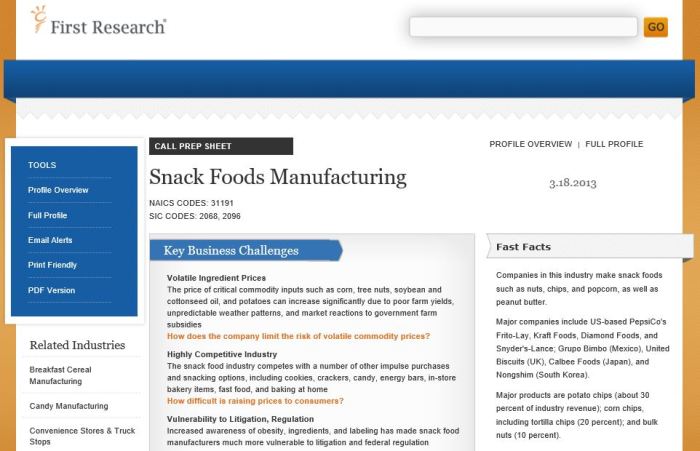
I’ve long respected the First Research industry overviews assembled by Dun & Bradstreet.  While most industry research runs from complex to arcane, First Research reports serve as industry primers providing plain English overviews of an industry.  If you were to read the report for your own industry, you would probably find it useful only for new hire training.

And that is the beauty of the reports.  They are for novices lacking an understanding of an industry which makes them perfect for territory sales reps or relationship managers.  In fact, they were originally designed for relationship managers at banks before First Research realized that sales reps were equally in need of their research.  If your job requires you to interact with individuals across many industries, then First Research may be the perfect resource for “getting up to speed” on an industry.  They can also be valuable for job hunters looking for a basic set of questions to ask about an industry.

Content includes an Industry Overview containing the following sub-sections:

  • Competitive Landscape
  • Products & Operations
  • Technology
  • Sales & Marketing
  • Finance & Working Capital
  • Regulation
  • International Insights
  • Regional Highlights
  • Human Resources

along with these additional sections:

  • News and Social (FirstRain)
  • Quarterly Industry Update
  • Industry Forecast
  • Industry Growth Rating (High, medium or low)
  • Industry Indicators
  • Company Information
  • Critical Issues
  • Business Challenges
  • Business Trends
  • Industry Opportunities
  • Executive Insights and Questions
  • Financial Information
  • Call Prep Questions ƒ Websites & Acronyms

First Research contains several sections of Q&A content including Call Prep Questions and Executive Insights which are questions specific to C-level executives.  Sometimes in life, you need to “fake it until you make it” (i.e. develop expertise) and First Research is designed for this purpose.

Through an OEM deal with FirstRain, high-precision industry news is included in the service along with FirstRain topic tagging and visual tools.  FirstRain content includes Latest News, Top Business Tweets, Management Changes, Event Timeline, Industry Health Indicators, Analyst Commentary, and Recent Transactions.  FirstRain does not archive this content but provides six months of open web news links.

FR News
FirstRain industry news is OEM’d within First Research reports providing six months of news, business tweets, an event timeline, analyst commentary, health indicators, transactions, and management changes.

First Research covers over 500 US and 35 Canadian industries spanning 1,000 NAICS codes.  While the reports are US-centric, they have recently begun adding international sections to the reports.  As a bonus, the product includes regional reports for US states, the District of Colombia, and Canadian provinces.  Country briefs are also available.

Other tools include a set of sales and marketing templates providing examples of how to use First Research content in various scenarios and an industry prospector tool for assisting with market development planning.

First Research reports are available as a standalone offering or integrated into the Hoover’s database, D&B360 CRM connectors, and the D&B Direct API.  A subset of the content is also being delivered via Data.com.  For library patrons, Dun & Bradstreet has partnered with Mergent to deliver the reports as a standalone offering or integrated into some of their products such as Mergent Intellect.

First Research should be viewed as industry insights for non-experts.  You won’t find depth on key trends or issues, but the service is easily accessible and walks the user through industry basics.  You generally don’t find industry news or Q&A sections in other industry services.

If you are looking for more advanced cross-industry research, you can step up to

  • MarketLine (global and regional research)
  • Euromonitor (global and regional research)
  • IBISWorld (US, Australian, Chinese, and global research)
  • Freedonia (US)
  • BMI (emerging markets)
  • EMD (emerging markets).

These services provide more complex reports while retaining readability.  While you won’t find as much handholding (e.g. Q&A sections), you will find broader industry trend and forecast content along with profiles of the top three or four competitors in the market.  As many are globally focused, they may be better sources for international market entry decisions.

You can find a full review of First Research at FreePint (Note: I am a contributor to FreePint, but the review was written by a different author)

Sales Intelligence Vendors’ Twitter Followers (Source: Owler)

Twitter Followers for four Sales Intelligence Vendors (Source: Owler.com)

Owler provides a rotating set of competitive intelligence reports.  Users simply sign up for the free service and indicate their company and top competitors.  The system then sends a weekly alert covering various topics.  This week’s “Social Stats” report provided Twitter and Facebook Followers.  Next week’s covers corporate blogs.

Owler also provides a daily business news alerting service, company profiles, funding data, and user polls.

Coincidentally, Owler’s founder Jim Fowler also founded crowd sourced vendor Jigsaw, which he sold off to SFDC a few years back.  Jigsaw was rebranded Data.com and is now one of the major sales intelligence services.