ABM and High Growth Companies

Account Based Strategy Adoption Rates (DiscoverOrg and Smart Selling Tools)

A joint study by DiscoverOrg and Smart Selling Tools of 200 sales and marketing organizations found that high growth companies with at least 40% growth over the past three years are 2.5 times more likely to have adopted an Account Based Marketing (ABM) strategy.  Furthermore high growth companies are twice as likely to have successful cold calling programs and are more likely to have a dedicated outbound prospecting team.  High growth firms are also more likely to hire sales reps based upon their “tech-savvy” than experience and have adopted twice as many sales technologies than their slower growth brethren.  With respect to MarTech, high-growth companies have adopted 24% more marketing solutions.

The study also found that fast growth companies provide at least three hours of coaching or training per week to their sales teams.  At slower growth companies, training appeared to have less of an effect.  According to the report, “While an increase in training hours correlated with a rise in growth rates for the high growth group, it did not with low growth companies. This suggests that training may not in of itself cause growth, but it is critical in sustaining it. Fast growing organizations need to train constantly to maintain momentum and enable teams to perform at a high level. Companies that err on the side of less training and coaching do not appear to set their teams up for the same level of success.”

“The findings clearly demonstrate that achieving fast growth is not as simple as having a great product and hiring experienced sales reps.  Sales and marketing teams that are true revenue-generating engines take risks and do the hard things – like cold calling, focusing on data quality, and heavily aligning sales and marketing teams across account-based strategies.”

– DiscoverOrg CEO Henry Schuck

“Technology proliferation in the sales and marketing industry is both a challenge and an opportunity,” added  Nancy Nardin, CEO of Smart Selling Tools. “The fastest growing companies are investing in technologies that make their sales and marketing teams more productive and more insightful, while recognizing it is equally as important to have highly trained team members who know how to leverage that technology to its fullest power.”

The primary inhibitor of even faster growth at high growth companies was data quality issues concerning accounts and contacts.

The top technology available to sales reps were CRM (52%) and LinkedIn (free LinkedIn was deployed at 45% , premium LinkedIn at 33%, and Sales Navigator at 27% of sales teams).  Pipeline and Opportunity Management software was third at 42%.  Rounding out the top five were compensation/commission software and sales intelligence, both with a 38% deployment rate.  Surprisingly, 37% of sales teams still employ account and contact data providers / list providers.  As sales intelligence vendors support list building along with sales intelligence (and some also data hygiene), there are likely ongoing opportunities to move sales teams up the value chain from list purchases.

Predictive analytics / predictive intelligence placed 36th out of 37 technologies with only a 5% deployment rate.  As Gartner estimated the total global market for predictive analytics technology to be between $100 and $150 million, this low penetration rate should not be overly surprising.

The study, conducted in November, used 40% growth between 2013 and 2016 (estimated) as the high growth cutoff as it is represents the recent growth floor for Inc. 5000 membership.  Of the 200 firms studied, 17% fell into the high-growth category, 69% fell into the low-growth category (1-39%), 13% had flat revenue, and 1% had declining revenues.  The survey was over weighted to technology companies with software, IT Services and Telco as the top three industries surveyed.  82% of the firms were B2B and 85% were headquartered in the US.

LinkedIn Salary: Expanding the Economic Graph

LinkedIn continues the build out of its Economic Graph with the launch of LinkedIn Salary.  The new tool provides salary data alongside other elements of the Economic Graph including jobs, employees, organizations, skills, and educational institutions.

“This includes salary, bonus, and equity data for specific job titles, and the different factors that impact pay such as years of experience, industry, company size, location, and education level — all of which becomes critical knowledge as you navigate your career,” LinkedIn wrote. “Also, rest assured that when you enter your salary, it’s immediately encrypted and remains private.”

LinkedIn Salary
LinkedIn Salary

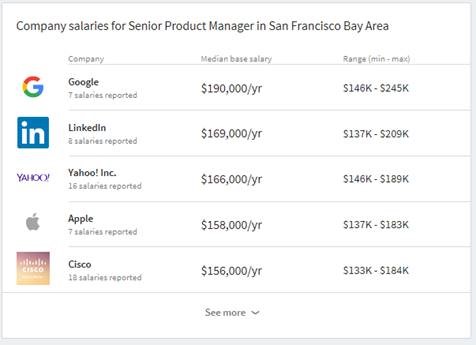
The service provides a set of salary analytics related to job, experience, industry, and location.  The user begins by specifying the position and location.  They can then quickly filter by industry and experience.  Both median salary and median compensation are immediately displayed along with a compensation histogram.  Other details include annual bonus, commission, restricted stock units, and stock options.  Other salary analytics include base salaries by company size, industry, education level, field of study, and top locations.

Another valuable tool is compensation data by position for key employers in a metro area.

LinkedIn Salary data at top companies by title and location.

The service is currently available in the US, UK, and Canada with plans to expand globally in 2017.  To obtain full salary details, users must provide their salary details or have a LinkedIn Premium subscription.

Other vendors providing similar data include Glassdoor and Salary.com.

Other recent LinkedIn developments in the news:

  • LinkedIn anticipates that the Microsoft acquisition will close by the end of 2016.  They are awaiting approval from the European authorities and then should be ready to complete the $26.2 billion transaction.
  • LinkedIn was blocked in Russia last week after they failed to comply with Russian rules concerning the housing of data related to Russian citizens.  The service has six million Russian members.  The block goes back to a 2014 law which was enacted after social media-fueled protests against the Putin regime.

Note: The link to the Glassdoor salary site was added on December 1st.


Digital Transformation and Sales Intelligence

Data Source: “The 2016 Guide To Digital Predators, Transformers, and Dinosaurs," Forrester Research, May 2016.
Data Source: “The 2016 Guide To Digital Predators, Transformers, and Dinosaurs,” Forrester Research, May 2016.

Forrester released a study titled “The 2016 Guide To Digital Predators, Transformers, and Dinosaurs” which argued that companies need to quickly transform themselves into digital businesses.  The study broke businesses into three digital categories: Predator, Transformer, and Dinosaur and evaluated the percent of business that are either digital services or sold online.

Predators are already generating over 80% of their business digitally and will grow their business to 90% by 2020.  For them, digital is a foundational element of their operations.

Likewise, transformers are quickly evolving into digital businesses while dinosaurs are plodding along.  In 2014, only one in six dollars was generated digitally at transformers, but by 2020, two of every three dollars will be digitally mediated at transformed businesses.

At the dinosaurs, only one in three dollars will be digitally generated in 2020.

Forrester found that transformers are customer-centric in their business strategy and processes.  Customer obsession is part of their corporate DNA:

While all companies profess to put customers first, it’s clear from the data that executives at digital Predators care more passionately about the customer across multiple dimensions: In every customer metric we measured, these executives rated the importance of the customer higher than peers in transformers and dinosaurs – in short, they are not just customer obsessed, they are really, really customer obsessed.

  • Nigel Fenwick, Forrester VP and Principal Analyst

Overall, Forrester found that 29% of current total sales are influenced by digital, but that 47% would be digitally influenced by 2020.  Thus, any business that wishes to remain competitive must have a digital strategy which encompasses sales, marketing, credit decisioning, contracting, and all of the elements across your sales funnel.

My blog focuses on sales intelligence (with some discussion of marketing intelligence and DaaS), so I’m covering a subset of this transformation.  But sales intelligence is a key element of the digital transformation of sales and marketing.  Its goal is to make sales reps more efficient and effective at generating revenue through

  • Improved understanding of customers and prospects.  Whether the company is employing ABM, ABSD, social selling, trigger selling, or other techniques, customer-centricity begins with an understanding of the customer at the contact, company, and industry level.  Sales intelligence vendors go beyond firmographics and contact data to deliver business descriptions, SWOTs, biographies, social posts, industry research, financials, analyst reports, technology platforms, etc.
  • Current Awareness. Improved awareness of changes at customers and prospects helps to improve account planning, messaging, and forecasting.  Where once this intelligence was delivered as generic company news, the sales intelligence vendors have refined their tagging and now provide high precision sales triggers which are accurate at both the company and business topic level.  Some have even begun to integrate sales triggers into their prospecting engines.
  • Reduced busywork + improved data quality.  Sales intelligence vendors cut the time wasted on busywork through the implementation of DaaS enrichment of accounts, contacts, and leads.  Enrichment provides more accurate firmographics, corporate linkage, and contact information which is then propagated to downstream systems.  It also reduces the keying done by prospects on web forms and sales reps in CRMs.  Furthermore, targeting, segmentation, and messaging are much more accurate when the ongoing maintenance of account intelligence is managed by a third party.

Over the past decade, sales intelligence firms have grown from standalone web information portals to integrated workflow services that deliver a broad set of account intelligence to CRMs, marketing automation platforms, sales acceleration (ABSD) services, Google Chrome, web forms, and mobile devices.  Thus, sales intelligence is now becoming available to sales, marketing, and service departments across a broad set of platforms and devices.

If you would like to read more on my thoughts concerning the digital transformation of sales and marketing, I have also discussed the topic on Sparklane and Avention’s blogs.

With AI, It is Garbage In, Garbage Out

scrapyard-70908_960_720

A few weeks ago, Salesforce announced its new Artificial Intelligence (AI) functionality called Einstein.  The new features promise to provide improved decision making based upon predictive scores and recommendations to sales, marketing, service, and other functions.  Likewise, Microsoft announced yesterday that they have formed a dedicated AI group working on infusing Microsoft products with intelligent capabilities.

However, as AI and Predictive Analytics become key technologies for companies, it is important to remember the old GIGO maxim:

Garbage In, Garbage Out

These tools simply won’t work well if your information is inaccurate, out of date, or incomplete.  Best case, bad data results in weak predictions that aren’t trusted.  Worst case, they provide a false confidence that wastes resources and misdirects corporate activities.

John Bruno, an analyst at Forrester, described this problem well in a recent blog:

The future analytics-driven sales processes is bright, but the path ahead is not without its challenges. Current and potential Salesforce customers should be mindful that intelligent recommendations require a large volume of quality data. If poor data goes in, poor recommendations will come out. Cleansing data and iterating the fine-tuning of recommendations will be vital to long-term success.  Another major hurdle is adoption. Many sellers still lack trust in “intelligent” recommendations. You will need to handhold these sellers until they form trust. This means starting with small recommendations and scaling from there.

The good news is that many of the sales intelligence companies are now offering data hygiene services for lead, contact, and account records.  The processing can be performed via CRM or MAP connectors or by uploading files to their cloud services.  The vendors match sales and marketing files against their reference datasets and then augment the files with firmographics, biographics, technographics, etc.  Matching can be done both in real-time to support both list uploads and web forms and via batch processing to support on going maintenance of corporate data.

While no company and contact database is 100% accurate, they are far more accurate than most marketing automation platforms and CRMs.  Furthermore, they have better field fill rates, standardized values (important for segmentation and analytics), and more rapid update cycles.

The predictive analytics companies are also beginning to provide enrichment services.


Quip: Rethinking Productivity Tools at SFDC

A few months ago, Salesforce.com purchased team productivity tool Quip.  This month’s  Dreamforce show was SFDC’s first opportunity to broadly promote Quip and their vision of productivity tools.  Quip’s mission is to “change the way people work together,” according to Quip CEO Bret Taylor.  Unfortunately, “the way that all of our teams work has completely shifted over the past decade, but the tools we use at work just haven’t kept up.”

The “path forward” is away from email attachments, meetings, and continuous monitoring of email inboxes.  Taylor was the CTO at Facebook when it transformed from a browser platform to a mobile first platform.  As this transformation took place, he realized that Facebook users were enjoying cutting edge apps running on a mobile phone while the state of the art inside the company was working with 8 ½ x 11 virtual documents and attaching them to email.  When founding Quip, he threw out the “preconceived notions” around productivity software and asked “what would productivity software look like in a decade if you were to start from scratch” if you designed it around mobility and communication?

One of the problems with building such a tool was that productivity has been defined by Microsoft and its Office Suite and has been framed by this unitary vision for decades.  They concluded that the goal of productivity tools was to “enhance communications.”  Thus, typewriters let anyone set copy and photocopiers let anyone run a printing press.  Likewise, the Office Suite digitized communication tools that already existed (e.g. typed documents to Word, overhead slides to PowerPoint, calculators to Excel).  Email then made it easier to attach virtual documents and transmit them globally in milliseconds.

But with the smartphone, productivity has failed to keep up.  Users have shifted to thumb typing emails on their phone instead of using productivity tools.  “All of us have willingly given up thirty years of R&D in the word processor to thumb type emails for one simple reason: it’s more important that the recipient of what you’re writing can click reply than that you have footnotes or fonts.  Communication is the most important feature of productivity and that’s why communication is the foundation of Quip.”

The goal of Quip was to avoid email entirely, otherwise they would simply be creating another attachment file type.  “Quip combines communication and writing in a single integrated product experience so you can work and communicate with your team without going back to our email inbox.”

Quip allows multiple simultaneous editors on any device with a chat thread attached to each document,” said Taylor.  “In Quip, that forty-email chain in making a decision is a shared document with a state of the decision right there for everyone to see.  And all the conversation that went into that decision is attached to it.”

Quip is based on four key values:

  1. Quip is built for teams with every feature “designed to move teamwork forward faster.”
  2. Quip was designed mobile-first.  While not all documents will be created on phones, they all will work on phones.  “With Quip, you can truly run your company from your phone.”
  3. Quip is deeply integrated with the Salesforce productivity cloud.  A Lightning module allows Quip documents to be embedded within SFDC records so that “all of the spreadsheets, documents, and discussions about an opportunity are attached to the opportunity itself.”  Salesforce fields can be pulled directly into documents and spreadsheets with automatic updating.
  4. Quip is collaborative.

A customer survey found that Quip reduced daily meetings by 28%, cut time to project completion by 28%, lowered email communications by 32%, and raised team communication by 43%.  The net was a 38% increase in team productivity.

A Quip document with text, spreadsheet, chart, and checklist.

Quip does not offer multiple tools, but instead provides a single app for mixing and matching checklists, spreadsheets, text, and images within a single canvas.  An integrated checklist provides a meeting notes canvas with assigned tasks via @mentions.  By tracking actions within the meeting notes, follow-up meetings are reduced.

Spreadsheets are embedded within documents such that “documents don’t need to be a separate file attachment that can live right in the context of the project you are working on.  And the data in spreadsheets isn’t trapped within a spreadsheet.  You can reference the data from spreadsheets inside of your document,” said Taylor.  “And it means that you can have an executive summary that automatically updates when the finance folks update the spreadsheet.  It’s a really connected platform.”

Quip embedded spreadsheet data updates automatically.

And because each document includes an integrated conversation, teams can work entirely within the document without returning to their email.

Quip is priced at $30 per month for a team of 5 and $10 per month for each additional person.  The Enterprise edition is priced at $25 per user per month.

Quip customers include Facebook, Electronic Arts, Ultimate Software, Instagram, CNN, Snapchat, Airbnb, and Pinterest.

SalesLoft: Excellence in Product Release Announcements

sl-product-releaseAs part of the update to my Field Guide to Sales Intelligence Vendors, I’m working my way through the product updates of nearly two dozen vendors.  In most cases, this information is only available to non-users as press releases and blogs.  But one of my profiled companies, SalesLoft, has a better way to communicate to its customers and prospects.  Their VP of Product Strategy Sean Kester records a ninety second video for each release which includes a mini-demo and user benefits discussion.

These videos are short and professional with optional closed captioning and a full transcript.  Furthermore, the videos are in plain English so that they can be easily understood by end users.  You won’t hear the typical tech speak.

And videos that start, “Hey, Guys, Sean here with SalesLoft” help to reinforce the brand and convey a sense of friendliness and ease of use.

Here is a sample transcript:

Hey Guys, Sean here with SalesLoft. We are excited to announce the new SalesLoft platform UI.

Today we’re introducing a new look. You’ll see an updated platform design for SalesLoft. Inspired by the desire to deliver consistency, the new UI represents a simpler interface, standardizing all the pages within the platform.

We made changes to how users interact with the interface:

The simpler design puts more focus on the information that matters without changing how you navigate throughout the platform…

The SalesLoft community has evolved over the past few years, becoming the application of record for the specialized inside sales organization.

The updated UI reflects your feedback, making it easier to quickly execute your tasks in addition to laying a foundation for faster innovation and increased value delivery to you, our users.

Thank you for enabling SalesLoft to continue to serve you. As always, we are excited to hear your feedback!

What’s more, it is clear that they understand that meeting the needs of their customers drives their success.

Bravo!

Data Enrichment Assists Digital Transformation

Blog on the Sparklane UK website discussing how sales and marketing can prepare for Digital Transformation.
Sparklane Blog

In a blog on Sparklane’s website, I had the opportunity to discuss how sales and marketing can digitally transform their departments by focusing on data enrichment and sales intelligence.

Firms have traditionally taken a haphazard approach to data quality, failing to recognize that data quality is a function of both initial data (keyed data, web forms, trade show scans, purchased lists, etc.) and time.  Data is dynamic.  It can be accurate today and inaccurate tomorrow.  That’s why data quality is often broken down into three dimensions: Accuracy, Completeness, and Timeliness.

So not only are firms failing to enrich data in real-time as data is acquired (or batch if purchased), they are ignoring the simple fact that

  • Companies relocate
  • Offices are shuttered
  • Execs change companies or positions within companies
  • Corporate URLs and email domains are changed when companies are acquired or renamed
  • Companies grow and shrink

The result has been saw-tooth data quality charts with quality spiking at data refresh and then quickly declining.  Both company and contact data are subject to data decay with contact data declining at a rate of 25% per annum (A recent Radius study has it at 27%).

To address this problem, firms should evaluate third-party solutions which provide a reference database matched against their sales and marketing datasets.  By standardizing on a reference dataset, sales and marketing operations can deploy a single source of truth across data acquisition (e.g. list loads, prospecting, web forms) and maintenance (ongoing updates to their CRM and Marketing Automation platforms).

There are many benefits to this approach:

  • Web Form and other keyed data is immediately verified and graded.
  • Lead Scoring is based upon richer and more accurate data.
  • Duplicates are detected before being created, allowing leads to be matched to current customers and prospects.
  • Leads from subsidiaries and branches are tied to ABM accounts, ensuring they are properly scored and routed.
  • Addresses, Phones, and other key firmographic and biographic fields are standardized ensuring they are properly segmented, targeted, and routed.
  • Sales and Marketing no longer waste resources targeting individuals who have left an organization.
  • Sales has more complete data for lead qualification, prioritization, and messaging.
  • Higher quality data is propagated to downstream systems, reducing the long-term cost of maintaining those platforms and helping prevent downstream errors and duplicates created by low quality upstream data.

And those benefits are simply those from cleaner data.  That is before we begin to consider the value of sales intelligence platforms in account planning, messaging, current awareness, identifying additional contacts at current accounts and prospects, and opportunity prioritization.

So if you want to begin to improve enterprise decision making and efficiency, an excellent place to start is in improving the data which is the lifeblood of your digital platforms.

Social Selling Benefits

Sales Research company CSO Insights and Seismic, a sales enablement vendor, asked 400 global B2B professionals about the benefits of social selling tools.  These tools include sales enablement, social listening, and social marketing solutions.  A full 38% weren’t sure of the benefits of these tools speaking to a need for vendors to better explain their value and provide user metrics.

The problem of value attribution has long been an issue with sales intelligence services as well, but as sales intelligence has become more tightly tied into the overall sales and marketing process, clear benefits such as reduced time spent keying and maintaining account information and the direct display of account intelligence within CRM I-frames have helped validate sales intelligence tools.

Likewise, B2B professionals found the biggest benefits of social selling tools to be reduced account / contact research time (39%), an increase in the number of leads (33%) and deeper client relationships (31%).  Broader process improvements were noted at lower rates with improved lead conversion (24%), shorter sales cycles (14%), and increased win rates on forecasted deals (13%) rounding out the benefits.

However, when the sub-group of professionals at firms which have aligned their social marketing and selling strategies was assessed, CSO Insights found a sixteen percent improvement in win rates.  Furthermore, the benefits were better understood with 57% enjoying more leads and 56% found deeper client relationships.  Amongst this group, only 18% were unsure about the benefits of social selling tools.  Thus, CSO Insights concluded that the high percentage of B2B professionals doubting the value of social selling tools was due to “a lack of maturity.”

CSO Insights defined social engagement as “equipping salespeople with skills, tools, and content to successfully navigate the change, decision, and value dynamics along the entire customer’s journey by leveraging social media.”  I find this definition a bit limiting operationally for vendors as it focuses exclusively on social media.  Both social selling and sales intelligence vendors have made the mistake of ignoring each other.  There are a few exceptions such as LinkedIn Sales Navigator adding a news feed and InsideView’s integrated social media Buzz tab, but most vendors either focus on profiles and news alerts/triggers or social monitoring and messaging.  The lack of fully integrated social monitoring and messaging tools within sales intelligence platforms remains a missed opportunity to improve sales intelligence products.

LinkedIn Sales Navigator offers Lead (executive) and company news alongside LinkedIn updates. Sales reps can filter for news or shares.
LinkedIn Sales Navigator offers Lead (executive) and Company News alongside LinkedIn updates. Sales reps can filter for news or shares.

A 2015 CSO Insights study of sales reps found that 33% felt social selling training was in need of a major redesign and 31% felt the training needs improvement.  CSO Insights warns against reducing social selling training to LinkedIn or Twitter training.  Research Director Tamara Schenk cautions that lessons from CRM training were not transferred to social selling training. “Salespeople are again asked to take tool training when at the same time the tool and the required skills have not yet been integrated into the current sales system, methodologies and processes. The result is the same. The new tool, social selling, is then considered as a time-consuming add-on rather than an effective enabler to create more and better business.”

Schenk noted that social strategy needs to be defined with marketing.  “An organization’s social strategy has to be aligned along the customer’s journey. [Sales] Enablement leaders are in an ideal position to orchestrate this process. After that, social selling skills have to be integrated in the current methodologies, engagement principles, and processes. Only then, not earlier, can social selling training services be designed and provided. And using the technology effectively is just one element. Another key element is the content challenge. Relevant and valuable content to attract prospects has to be made available for salespeople, ideally on the sales enablement platform with no further internal obstacles to access this content.”

The CSO Insights research was conducted in July by Schenk and Strategic Advisor Jim Dickie.  The study was based upon responses from B2B sales managers (61%), sales ops (21%), marketing (8%) and other roles located in North America (59%) and rest of world (41%).

Microsoft: Nadella Interviewed by Bloomberg

Microsoft CEO Satya NadellaMicrosoft CEO Satya Nadella was interviewed by Bloomberg on the topics of cloud computing, Azure, the LinkedIn acquisition, culture change at Microsoft, and the globalization of technology.

Here is a subset of what he said about tech changes:

Is the cloud the big technological change that we’re going to see over the next five years?

I think the big move that is happening today for sure is the cloud move and the mobile move. They sort of go together. And when I say mobility, it’s not the mobility of one device, it’s the mobility of the applications and the data across all your devices, because it’s about the ability of the human experience, not the device.

But I see three other broad platform shifts. One is what I’ve called conversations as a platform. If we can teach all our computers human language, can we democratize computers even more so than we have done today? Think about it. The model today of, “Well, I’ve got to learn the shell, learn to download 20 apps, and navigate between these apps to get stuff done”—what if none of that was a cognitive load on me, but I was able to simply talk, text, or voice and get my things done?

That’s a much more natural way for computing to surface. It’ll work for an 85-year-old person in China, and it’ll work for a 5-year-old in Bellevue [Wash.]. That, to me, is the next frontier and what we’re doing with [voice-enabled personal assistant] Cortana, what we are doing with our bots.

I’m also very, very bullish about making AI capability or machine learning capability available to every developer, every application, and letting any company use these core cognitive capabilities to add intelligence into their core operations. So that’s something that we’re doing with Azure and our Azure cognitive services.

The third one that I’m also very excited about is what’s happening with mixed reality.

Image Credit: Satya Nadella from LinkedIn

US-EU Privacy Shield

EU LogoThe US and EU finalized a new Privacy Shield agreement to replace the recently invalidated Safe Harbour agreement concerning data privacy.  The new program allows firms to begin self-certifying their compliance as of August 1st.  As part of the agreement, the US Department of Commerce will begin conducting regular compliance reviews.

“We have worked hard with all our partners in Europe and in the US to get this deal right and to have it done as soon as possible,” Andrus Ansip, said vice president for the European Commission’s Digital Single Market initiative. “Data flows between our two continents are essential to our society and economy – we now have a robust framework ensuring these transfers take place in the best and safest conditions.”

The US government will also implement “clear limitations, safeguards and oversight mechanisms” concerning the handling of European data.  Furthermore, The European Commission has assurances that bulk data collection would only be conducted “under specific preconditions and needs to be as targeted and focused as possible.”

A complaint mechanism is in place for Europeans which would be handled by the US Department of Commerce or the US Federal Trade Commission.  Mechanisms also exist for an independent ombudsman where national security questions come into play.

While tech companies applauded the new agreement, European privacy advocates contend the deal still fails to protect European citizens.