First Research: Plain English Industry Primers

FR

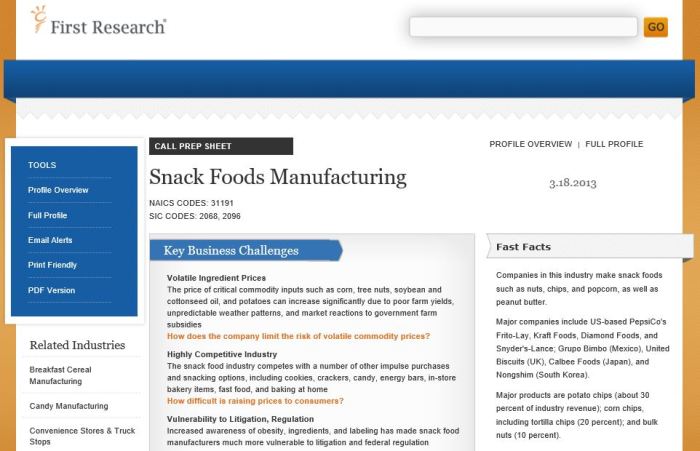
I’ve long respected the First Research industry overviews assembled by Dun & Bradstreet.  While most industry research runs from complex to arcane, First Research reports serve as industry primers providing plain English overviews of an industry.  If you were to read the report for your own industry, you would probably find it useful only for new hire training.

And that is the beauty of the reports.  They are for novices lacking an understanding of an industry which makes them perfect for territory sales reps or relationship managers.  In fact, they were originally designed for relationship managers at banks before First Research realized that sales reps were equally in need of their research.  If your job requires you to interact with individuals across many industries, then First Research may be the perfect resource for “getting up to speed” on an industry.  They can also be valuable for job hunters looking for a basic set of questions to ask about an industry.

Content includes an Industry Overview containing the following sub-sections:

  • Competitive Landscape
  • Products & Operations
  • Technology
  • Sales & Marketing
  • Finance & Working Capital
  • Regulation
  • International Insights
  • Regional Highlights
  • Human Resources

along with these additional sections:

  • News and Social (FirstRain)
  • Quarterly Industry Update
  • Industry Forecast
  • Industry Growth Rating (High, medium or low)
  • Industry Indicators
  • Company Information
  • Critical Issues
  • Business Challenges
  • Business Trends
  • Industry Opportunities
  • Executive Insights and Questions
  • Financial Information
  • Call Prep Questions ƒ Websites & Acronyms

First Research contains several sections of Q&A content including Call Prep Questions and Executive Insights which are questions specific to C-level executives.  Sometimes in life, you need to “fake it until you make it” (i.e. develop expertise) and First Research is designed for this purpose.

Through an OEM deal with FirstRain, high-precision industry news is included in the service along with FirstRain topic tagging and visual tools.  FirstRain content includes Latest News, Top Business Tweets, Management Changes, Event Timeline, Industry Health Indicators, Analyst Commentary, and Recent Transactions.  FirstRain does not archive this content but provides six months of open web news links.

FR News
FirstRain industry news is OEM’d within First Research reports providing six months of news, business tweets, an event timeline, analyst commentary, health indicators, transactions, and management changes.

First Research covers over 500 US and 35 Canadian industries spanning 1,000 NAICS codes.  While the reports are US-centric, they have recently begun adding international sections to the reports.  As a bonus, the product includes regional reports for US states, the District of Colombia, and Canadian provinces.  Country briefs are also available.

Other tools include a set of sales and marketing templates providing examples of how to use First Research content in various scenarios and an industry prospector tool for assisting with market development planning.

First Research reports are available as a standalone offering or integrated into the Hoover’s database, D&B360 CRM connectors, and the D&B Direct API.  A subset of the content is also being delivered via Data.com.  For library patrons, Dun & Bradstreet has partnered with Mergent to deliver the reports as a standalone offering or integrated into some of their products such as Mergent Intellect.

First Research should be viewed as industry insights for non-experts.  You won’t find depth on key trends or issues, but the service is easily accessible and walks the user through industry basics.  You generally don’t find industry news or Q&A sections in other industry services.

If you are looking for more advanced cross-industry research, you can step up to

  • MarketLine (global and regional research)
  • Euromonitor (global and regional research)
  • IBISWorld (US, Australian, Chinese, and global research)
  • Freedonia (US)
  • BMI (emerging markets)
  • EMD (emerging markets).

These services provide more complex reports while retaining readability.  While you won’t find as much handholding (e.g. Q&A sections), you will find broader industry trend and forecast content along with profiles of the top three or four competitors in the market.  As many are globally focused, they may be better sources for international market entry decisions.

You can find a full review of First Research at FreePint (Note: I am a contributor to FreePint, but the review was written by a different author)

Rube Goldberg Sales Processes

RubeGoldberg

Rube Goldberg understood that if there was a way to make a process more complicated, then so much the better.  But his machines of whimsy were designed for humor, not business processes.  Oftentimes, we are our own worst enemies in sales, creating obstacles instead of efficiencies and checks instead of common sense rules covering the most frequent scenarios.

In a recent blog post titled “Sales Acceleration is an Inside Job,” Barb Giamanco discussed the problem of sales acceleration and the inability of sales reps to respond quickly to requests.  While it should be intuitive that speed is a differentiator, it may well be that the opposite holds true; the lack of speed and the inability to quickly answer questions, respond to web forms, or provide a price quote all speak poorly to company knowledge sharing and customer support.  We are building leaks into our sales funnel by providing reasons for prospects to look elsewhere.

For sales reps, deals can be very much like the military — HURRY UP AND WAIT.  But unlike the military where there is a singular mission directed from above, sales reps are managing dozens of opportunities simultaneously.  Furthermore, information needs to be gathered from both electronic stores and co-workers.  Is it no wonder that response rates may lag?

Giamanco notes that the primary role of sales reps isn’t selling but facilitating the purchase decision:

Selling is about helping customers solve their business problems and make buying decisions. I want you to think about delivering value in a different way. Think of adding value as providing information quickly, in order to move buyers one step closer to a purchasing decision. If a core issue has been identified within an organization that needs to be addressed, there is executive support for the initiative, budget has been allocated and an implementation timeline has been put in place, then buyers typically do want to move quickly. Make it easy for them to get what they need.

This is one of the reasons that I have been expanding my Market Insights newsletter to cover Sales Acceleration tools such as QuotaFactory and SalesforceIQ.  These tools help prevent opportunities from falling between the cracks.  For example, SalesforceIQ provides actions based upon inbound email requests to ensure that sales reps don’t miss customer queries.

A study by InsideSales found that $12.8 billion was spent on sales acceleration products in 2013 with a forecast of $30 billion by 2017.  Giamanco argues, however, that the fundamental problem of purchase facilitation is not being addressed.

You never want to be the critical path step in closing a deal.  Prospects may take their time mulling over their decision, obtaining budget, reviewing contracts, and obtaining signatures, but there is no reason that a vendor should be adding to these lags.  A simple poll of your sales reps will indicate where the biggest process lags are on your side.  The question should also be posed during win/loss analysis research.

Which of the following leaks do you have in your sales funnel?

  • Are inbound leads (web form, telephonic, social) quickly passed to your sales reps?
  • Do you automatically match and enrich leads within your marketing automation or CRM platforms to assist with lead routing and qualification?
  • Are you providing sales intelligence around the lead so that sales reps have a baseline understanding of the prospect, potential pains, and which products or services are most likely to be of use?
  • Have you setup and maintained an easily discoverable sales enablement library with both internal (sales playbooks, competitor profiles) and external (e.g. case studies, collateral, recorded short demos) tools?  Are these tools properly tagged by industry, stage, job function, and content type to facilitate discovery?  Are these tools current from both a marketing (e.g. branding, positioning, terminology, use cases) and product (capabilities, benefits, requirements) perspective?
  • Is there a method for identifying subject matter experts in the organization and a way to quickly reach out to them (e.g. Chatter or Yammer)?
  • How quickly do you turn around trial requests (it should be within a few hours) or samples?
  • Are sales reps able to setup a demo on the fly?  Are they sufficiently confident to demo your service on their own?
  • Do sales reps know if a client has open issues in the customer service department?
  • Does the customer service department know that the sales rep has a pending meeting with a customer so that they can prioritize problem resolution?
  • Are there tools in place to
    • Ensure that customer checkpoint calls are held
    • Flag inbound information requests so that requests do not fall between the cracks
    • Identify customers with atypical usage patterns (e.g. high volume which could result in significant overages, volume drops from historic averages, low usage)?
  • Can you quickly turn around quotes, RFPs, RFIs, contracts?

Moving opportunities through the sales and marketing pipeline is a complex process with many potential points of failure.  Identify the problems posing the greatest threat to deal closure in 2016 and then move to remediate them.  Some solutions require simple process changes (e.g. can we offer greater discounting authority to sales reps?) while others may require additional training or new systems.


The public domain photo is from the 18th annual (2013) Rube Goldberg contest held at the Argonne National Laboratory (Department of Energy).  The challenge was to hammer a nail.