LinkedIn is now the number two social media platform by usage, advertising spend, ROI and analytics tools. Facebook remains number one. “While LinkedIn is often considered a hub for job hunters and corporate recruiters, the platform has also shifted to position itself as a marketing engine in recent years,” said Jerry Ascierto, executive editor of The Social Shake-Up Show. “The recent updates to its ad platform and UI seem to be encouraging brands to increase spend. As a result, more companies are experiencing better ROI from this network than others considered more popular and ‘fun,’ such as Instagram, Twitter and YouTube.”
Source: Social Shake-Up.
LinkedIn has benefited from a native video feature that was launched last year and was recently extended to company pages.
LinkedIn’s last official member count was 546 million global professional profiles.
Microsoft Chairman John Thompson said that the LinkedIn acquisition has been “wildly successful” and that Microsoft would be “all in” on a similar deal. Of particular interest are firms that would help connect users to the Microsoft cloud.
Thomson was critical of firms that share or sell user data. “Many of them make money off ads and they have used that as kind of a leverage point,” Thomson told Bloomberg. “At Microsoft, we don’t believe in that.”
While Facebook has taken a series of hits on its sharing of member data, LinkedIn has long protected member data (for example, Sales Navigator does not permit the uploading of member information to CRMs but makes it available for display). What’s more, Microsoft has built GDPR compliance into its product line and set it as a global standard.
LinkedIn celebrated its 15th anniversary last month. “15 years ago, we launched LinkedIn in Reid Hoffman’s living room with the tagline ‘relationships matter’,” said VP of Product Strategy Allen Blue. “I’m proud to say that this mantra still rings true today in both the halls of LinkedIn and on the platform. While the world of work has evolved immensely — be it the tools and products we use, the ways we communicate, and even the jobs themselves — our need to connect with one another to be productive in our careers remains at the core of all we do.”
A few weeks ago, I wrote about enterprise software vendors calling for an American version of GDPR with Microsoft announcing that it was building GDPR into its global product line as its standard privacy protocol.
On the Salesforce earnings call last week, CEO Marc Benioff observed that the software industry has been going through a “crisis of trust for the past six months” related to privacy and data ownership:
“From the European perspective the way they look at data is data belongs to you, it’s your data. Now for us at Salesforce, we understand that. We’ve had that position from the beginning. Our customers’ data belongs to them, it’s their data. I think in some cases, the companies that are start-ups and next generation technologies here in San Francisco, they think that data is theirs. I think the Europeans with GDPR have really flipped the coin, especially in advertising but in another areas saying hey, this data belongs to the consumer or to the customers, you guys have to pivot back to the consumer, you have to pivot back to the customer.”
Benioff once again called for a US privacy law similar to GDPR which provides “guardrails” around trust and safety. “This is going to help our industry,” said Benioff. ”It’s going to provide the ability for the customers to interact with great next generation technologies in a safe way.”
Benioff also warned that when AI technologies are indistinguishable from humans, trust will also be an issue.
It is less than 36 hours until GDPR becomes the law of the land in the EU Zone. As the regulation has extra-territorial privacy requirements, non EU companies, even those without a physical presence in the EU, are subject to its requirements with respect to communications with EU citizens and management of their data.
The US has a much weaker set of laws and there is concern that US firms are laggards with respect to compliance. However, a number of US technology firms have called for adoption of a US GDPR.
On Monday, Microsoft once again reiterated its belief that “privacy is a fundamental human right” and announced that GDPR will be their privacy standard globally.
“As people live more of their lives online and depend more on technology to operate their businesses, engage with friends and family, pursue opportunities, and manage their health and finances, the protection of this right is becoming more important than ever.”
Julie Brill, Microsoft Corporate VP & Deputy General Counsel
Companies, therefore, have a “huge responsibility” to protect and safeguard personal data.
Since GDPR was enacted in 2016, Microsoft has dedicated 1,600 engineers towards compliance. “GDPR compliance is deeply ingrained in the culture at Microsoft and embedded in the processes and practices that are at the heart of how we build and deliver products and services,” said Brill.
She noted, however, that GDPR is a “complex regulatory framework” subject to “ongoing interpretation” by regulators and feedback from customers. As such, the firm will “determine the steps that we all will need to take to maintain compliance.”
As a provider of corporate infrastructure, Microsoft views GDPR as an opportunity to differentiate itself and assist its customers with compliance on the Microsoft Cloud. “One of our most important goals is to help businesses become trusted stewards of their customers’ data,” said Brill. “This is why we offer a robust set of tools and services for GDPR compliance that are backed up by contractual commitments. For most companies, it will simply be more efficient and less expensive to host their data in the Microsoft Cloud where we can help them protect their customers’ data and maintain GDPR compliance.”
Salesforce and SugarCRM have also taken a strong position on GDPR calling for similar legislation in the US. “What we need is a national privacy law, and that will really not just protect the tech industry; it’s going to protect all the consumers,” said Salesforce CEO Marc Benioff.
This is not a new position for Salesforce. Back in 2014, Benioff said, “I’m all in favor of consumers having more power and more control over their data. As a consumer, you should have all of the rights. It’s like a cloud Bill of Rights. As a consumer or as an enterprise, you should have the right to be forgotten or to add or take away your data.”
As part of its compliance, the firm named their Senior VP of Global Privacy and Product Legal Lindsey Finch as their new Data Protection Officer. Finch has been with Salesforce for a decade with previous stints at GE (Privacy Counsel), the Federal Trade Commission, and Homeland Security.
“The official DPO designation is a natural outgrowth of our existing programme. My team and I will continue to partner across the company to foster a culture of privacy – designing, implementing, and ensuring compliance with our global privacy programme, including ensuring that privacy is considered throughout the product development lifecycle,” said Finch. “The top theme I’m hearing is that our customers are using the GDPR as an opportunity to focus on their privacy practices and putting their customers—oftentimes end-consumers—at the center of their businesses. The GDPR is a complex law, but putting the individuals to whom the personal data relates at the forefront, and focusing on their expectations and preferences, is a great starting point for compliance with the GDPR and other privacy laws.”
Finch described Salesforce’s approach to GDPR compliance:
“We started by kicking off a thorough review to ensure compliance across the company. The GDPR is an incredibly rich document—99 articles and 173 recitals across 88 pages! Our Privacy team broke this down into key principles and worked closely with our Technology & Products organization to review our compliance. We found that we were already in a really great place,
Since then, a lot of the work we’ve been doing has been to document how our customers can use our services to comply with some of the key GDPR principles, which we’ve published on our GDPR website. There is no finish line when it comes to GDPR compliance. While Salesforce currently offers the tools for our customers to comply with the GDPR, we will continue to release new innovations that help our customers achieve compliance success.”
Salesforce CMO Simon Mulcahy echoed Benioff and Finch at the Salesforce World Tour event in London last week. Mulcahy stated that many companies simply view GDPR as a compliance issue and nuisance, not an opportunity to align company interests with customer desires. “It is a compliance issue, but it’s also a phenomenal opportunity to give your customers what they want. What they want is to know that when they give you their data, you’re looking after it appropriately.”
“Benioff is right that we will need some regulation and I can’t see how we can set two standards–EU and US–so we’ll likely need to adopt what the EU has done or risk chaos. This also fits well into the narrative of the information utility. GDPR is another driver sending us toward utility formation for the information industry.”
Dennis Pombriant, Principal Beagle Research
Larry Augustin, CEO of SugarCRM noted that firms have been lax in their privacy and cyber security processes saying that self-regulation has proven to be insufficient with “too many incidents.”
“Data privacy issues are not going to go away. People are thinking a lot here now about GDPR, because Facebook, Twitter, and all of these issues keep coming. And Experian in the US, about managing personal information related to credit card data… there’s just a constant barrage of issues around data privacy and personal information,” continued Augustin. “Everyone has to address it, whether it’s in the context of GDPR or the next thing that’s going to come along. There is definitely a heightened awareness and interest.”
SugarCRM has built a data privacy manager into its CRM as a “command center” for the data privacy officer.
In my discussions with clients. they all admit to the regulations being a muddle that initially adds risk to their business models. The penalties are draconian, but the compliance requirements are ambiguous, particularly for B2B firms. As such, we are likely to be hearing about issues concerning GDPR compliance requirements over the next few years.
Microsoft CEO Satya Nadella digressed from standard earnings call topics two weeks ago to discuss the importance of ethics, privacy, and cybersecurity. While he did not provide a specific reason for the digression, the Facebook hearings and impending GDPR implementation were likely motivators.
Nadella noted that the intelligent cloud and intelligent edge are “tremendous opportunities” for Microsoft customers, but that it is critical that both Microsoft and its customers “ensure trust in technology” across three dimensions: privacy, cybersecurity, and ethics. Nadella argued that “privacy is a fundamental human right” and that the firm has implemented an “end-to-end privacy architecture” which is GDPR compliant.
“For customers, we will provide robust tools backed by our contractual commitments to help them comply with GDPR,” said Nadella. “In fact, for most customers it will be more effective and less costly to host their data in Microsoft’s GDPR-compliant cloud than to develop and maintain GDPR compliance tools themselves.”
With respect to cybersecurity, the company spearheaded a coalition of 34 global tech and security companies for the Cybersecurity Tech Accord, “an important first step by the industry to help create a safer and more secure online environment for everyone.”
Nadella also announced the establishment of an AI and Ethics in Engineering and Research Committee at Microsoft “to ensure we always advance AI in an ethical and responsible way to benefit our customers and the broader society. This includes new investments in technology to detect and address bias in AI systems. Microsoft stands for trust, and this will continue to be a differentiating focus for us moving forward.”
Up until recently, information technology and social media have been viewed as social goods with few drawbacks, but now that we are all tied into the social communications fabric, we are beginning to worry about the dark side of such connectivity whether it be job losses through automation, the stripping away of privacy, the vulnerability of our networks to hacks, or the undermining of objective truth and democratic systems.
One step towards addressing these problems is the GDPR Chief Privacy Officer requirement with its focus on privacy and cybersecurity. At most companies, this role is likely to be one of compliance, not ethics or broader social questions. At a few, however, this role may grow beyond mere compliance and begin to address the broader social and economic issues posed by information technology.
On December 9th, Microsoft announced closure of its $26.2 billion LinkedIn acquisition following EU approval. The full approval process took just about six months. Microsoft CEO Satya Nadella is “even more enthusiastic” about the transaction than he was in June.
Nadella listed the following “immediate term” integration scenarios:
LinkedIn identity and network in Microsoft Outlook and the Office suite
LinkedIn notifications within the Windows action center
Enabling members drafting résumés in Word to update their profiles, and discover and apply to jobs on LinkedIn
Extending the reach of Sponsored Content across Microsoft properties
Enterprise LinkedIn Lookup powered by Active Directory and Office 365
LinkedIn Learning available across the Office 365 and Windows ecosystem
Developing a business news desk across our content ecosystem and MSN.com
Redefining social selling through the combination of Sales Navigator and Dynamics 365
The emphasis on expanded opportunities for individuals to learn, compete, network, collaborate, and find jobs was a key justification of the merger. “While technology tools are not a panacea for current economic challenges, we believe they can make an important contribution,” said Microsoft’s Chief Legal Officer Brad Smith. “Microsoft and LinkedIn together have a bigger opportunity to help people online to develop and earn credentials for new skills, identify and pursue new jobs, and become more creative and productive as they work with their colleagues. Working together we can do more to serve not only those with college degrees, but the many people pursuing new experiences, skills and credentials related to vocational training and so-called middle skills. Our ambition is to do our part to create more opportunity for people who haven’t shared in recent economic growth.”
The LinkedIn and Microsoft Graphs complement each other and will help build LinkedIn’s vision of an Economic Graph.
LinkedIn CEO Jeff Weiner views the transaction as an opportunity to expand LinkedIn’s Economic Graph “and ultimately help create economic opportunity for every member of the global workforce.” LinkedIn will operate as an independent division with “the same mission and vision, the same culture and values, the same brand, and the same leadership team.”
Weiner reiterated LinkedIn’s commitment to its members, their privacy, and information security. The firm “remains focused on growing LinkedIn and creating value for our members and customers with a focus on integrating LinkedIn products with Microsoft.
The EU placed a few requirements on the deal, but did not view the transaction as anti-competitive, a position held by Salesforce.com. The EU evaluated the impact on professional social networks, CRM solutions, and API access. As an accommodation, Microsoft committed to a five year period in which it will
Ensure that PC manufacturers and distributors would be free not to install LinkedIn on Windows and allowing users to remove LinkedIn from Windows should PC manufacturers and distributors decide to preinstall it.
Allow competing professional social network service providers to maintain current levels of interoperability with Microsoft’s Office suite of products through the so-called Office add-in program and Office application programming interfaces.
Grant competing professional social network service providers access to “Microsoft Graph”, a gateway for software developers. It is used to build applications and services that can, subject to user consent, access data stored in the Microsoft cloud, such as contact information, calendar information, emails, etc. Software developers can potentially use this data to drive subscribers and usage to their professional social networks.
Margrethe Vestager, EU Commissioner in charge of competition policy, said: “A growing number of Europeans subscribe to professional social networks. These networks are important for professionals to connect and interact and to find new career opportunities. Today’s decision ensures that Europeans will continue to enjoy a freedom of choice between professional social networks.”
Data on LinkedIn employees by function from beta company profile page.
LinkedIn has 467 million global members and supports two dozen languages. The firm continues to add members at the rate of two per second. Last quarter, LinkedIn earned $960 million across three divisions: Talent Solutions ($623 million), Marketing Solutions ($175 million), and Premium Subscriptions ($162 million).
Conversation Starters
LinkedIn rolled out a new Conversation Starter feature to promote system messaging via a lightbulb icon. The feature analyzes the target individual’s profile to provide a series of conversational options. After selecting a potential opener, the user can modify the text to their voice. Starters include recent profile updates, work anniversaries, recent posts, mutual connections, and shared backgrounds (e.g. alma mater, former employers, groups).
“We know that reaching out to reconnect, ask for advice or network for potential job opportunities can be intimidating, so we’ve added personalized conversation starters in LinkedIn messaging to give members authentic ways to break the ice,” the company said in a blog post.
Unfortunately, the Conversation Starters on their marketing video are mostly focused on connections. This could result in a spate of similar sounding openers that could quickly become SPAM. This focus could be simply a marketing oversight, but variations on “Hi Suzi, I noticed you have X connections at Google. Have you heard…” seem like a weak set of Conversation Starters. While better than cold messages such as “Hi Suzi, I’m reaching out to you because my company…”, their sample seems uninspired. Furthermore, the Conversation Starters do not contain any stored messages from the sales rep to expedite the message creation process.
Meeting Scheduling
LinkedIn will soon be rolling out a bot to assist with multi-party meeting scheduling.
Decommissioning Professional Edition Features
According to Intero Advisory, a LinkedIn coaching service, LinkedIn is looking to migrate sales clients from their Professional edition to Sales Navigator. As part of this effort, LinkedIn is dropping two features from the Pro service: 1) Premium Search Filters and 2) Notes and Tags for connections. LinkedIn said these features will be available through the end of March. Users have until then to download any Notes and Tags. To help accommodate users, LinkedIn is offering a free three-month trial of Sales Navigator which includes the transfer of Notes and Tags.
LinkedIn continues the build out of its Economic Graph with the launch of LinkedIn Salary. The new tool provides salary data alongside other elements of the Economic Graph including jobs, employees, organizations, skills, and educational institutions.
“This includes salary, bonus, and equity data for specific job titles, and the different factors that impact pay such as years of experience, industry, company size, location, and education level — all of which becomes critical knowledge as you navigate your career,” LinkedIn wrote. “Also, rest assured that when you enter your salary, it’s immediately encrypted and remains private.”
LinkedIn Salary
The service provides a set of salary analytics related to job, experience, industry, and location. The user begins by specifying the position and location. They can then quickly filter by industry and experience. Both median salary and median compensation are immediately displayed along with a compensation histogram. Other details include annual bonus, commission, restricted stock units, and stock options. Other salary analytics include base salaries by company size, industry, education level, field of study, and top locations.
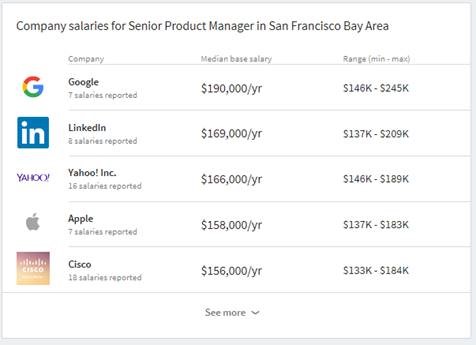
Another valuable tool is compensation data by position for key employers in a metro area.
LinkedIn Salary data at top companies by title and location.
The service is currently available in the US, UK, and Canada with plans to expand globally in 2017. To obtain full salary details, users must provide their salary details or have a LinkedIn Premium subscription.
Other vendors providing similar data include Glassdoor and Salary.com.
Other recent LinkedIn developments in the news:
LinkedIn anticipates that the Microsoft acquisition will close by the end of 2016. They are awaiting approval from the European authorities and then should be ready to complete the $26.2 billion transaction.
LinkedIn was blocked in Russia last week after they failed to comply with Russian rules concerning the housing of data related to Russian citizens. The service has six million Russian members. The block goes back to a 2014 law which was enacted after social media-fueled protests against the Putin regime.
Note: The link to the Glassdoor salary site was added on December 1st.
Microsoft CEO Satya Nadella was interviewed by Bloomberg on the topics of cloud computing, Azure, the LinkedIn acquisition, culture change at Microsoft, and the globalization of technology.
Here is a subset of what he said about tech changes:
Is the cloud the big technological change that we’re going to see over the next five years?
I think the big move that is happening today for sure is the cloud move and the mobile move. They sort of go together. And when I say mobility, it’s not the mobility of one device, it’s the mobility of the applications and the data across all your devices, because it’s about the ability of the human experience, not the device.
But I see three other broad platform shifts. One is what I’ve called conversations as a platform. If we can teach all our computers human language, can we democratize computers even more so than we have done today? Think about it. The model today of, “Well, I’ve got to learn the shell, learn to download 20 apps, and navigate between these apps to get stuff done”—what if none of that was a cognitive load on me, but I was able to simply talk, text, or voice and get my things done?
That’s a much more natural way for computing to surface. It’ll work for an 85-year-old person in China, and it’ll work for a 5-year-old in Bellevue [Wash.]. That, to me, is the next frontier and what we’re doing with [voice-enabled personal assistant] Cortana, what we are doing with our bots.
I’m also very, very bullish about making AI capability or machine learning capability available to every developer, every application, and letting any company use these core cognitive capabilities to add intelligence into their core operations. So that’s something that we’re doing with Azure and our Azure cognitive services.
The third one that I’m also very excited about is what’s happening with mixed reality.
Microsoft co-founder Bill Gates supports the LinkedIn acquisition and views it as an opportunity to build a Facebook for business professionals. This perspective is in line with LinkedIn CEO Jeffrey Weiner’s vision of an economic graph that captures the broad scope of business activity.
“This professional feed in LinkedIn, that is how I want to learn about my career, my company, my industry, and I’m going back there,” Gates told Bloomberg last month. “If we can make that as valuable as the Facebook feed in the social world, that’s huge value creation and that’ll happen over a period of years.”
Gates contends that Microsoft and LinkedIn are more valuable together than as separate entities even though Microsoft stock slipped two percent on the announcement. “I certainly think that the value of the two companies combined is greater than the two by themselves, but I love the idea that the market wants us to show that,” he said.
Gates remains a member of Microsoft’s Board and is formally listed as a Technical Advisor to CEO Satya Nadella.
Dynamics 365 and AppSource
In other news, the firm continues to enhance the Dynamics platform (CRM and ERP) with the introduction of Dynamics 365 and Microsoft AppSource. “Dynamics 365 provides business users with purpose-built SaaS applications. These applications have intelligence built in. They integrate deeply with communications and collaboration capabilities of Office 365,” said Nadella. “Dynamics 365 along with AppSource and our rich application platform introduces a disruptive and customer-centric business model so customers can build what they want and use just the capabilities they need.”
The new Dynamics 365 platform will be available this fall.
Merging the Microsoft and LinkedIn graphs to advance the Economic Graph (Slide from Fair Disclosure call on June 13, 2016).
Nadella views Office 365, Dynamics 365, AppSource (a newly launched SaaS app ecosystem for businesses), and LinkedIn as all working together to provide “services in the cloud where you can reason about the activity and the data underneath these services to benefit the customers who are using these services. So that’s what this notion of a graph represents.”
Nadella continued, “The professional cloud or the professional network helps usage across all of that professional usage. Whether it’s in Office 365 or whether you’re a salesperson using any application related to sales, you want your professional network there. Of course, it’s relevant in recruiting, it’s relevant in training, it’s relevant in marketing. So that’s really our strategy with LinkedIn as the professional network meeting the professional cloud. And so you were right to point out that these are all part of one overarching strategy, and ultimately it’s about adding value to customers.”
On Microsoft’s Q4 2016 earnings call this week, the firm reiterated their belief that the LinkedIn acquisition will close before the end of the calendar year.
LinkedIn announced immediate availability of a set of company insight analytics to its premium products including Sales Navigator, Business Plus, and Talent Solutions. The new reports provide company employment intelligence from the LinkedIn database which competing sales intelligence vendors would be hard pressed to replicate.
Product leader and strategist Megan Kamil blogged, “The use cases for these insights are limitless. From the market research associate gathering relevant information on key market and competitive landscapes to the investment professional trying to uncover the next ‘hot’ company, this information will be valuable to any business professional.”
The new Total Employee count provides a two-year graph of LinkedIn employment trends. The trend data can be quite useful for evaluating a company’s recent trajectory. LinkedIn also provides the average tenure. Low tenure needs to be interpreted carefully as it could be a sign of either rapid growth or an unhappy workforce. Had they also included an employee churn rate this issue would be clarified.
LinkedIn Total Employee Count provides two years of data, growth rate, and average tenure.
While employee counts are available in other services, the LinkedIn data is likely to be more accurate for companies with a high percentage of professionals. Firms with a high percentage of blue collar, seasonal, or part-time workers are more likely to be undercounted. Be aware, though, that larger companies often appear as multiple companies (e.g. overseas subs, major divisions, or acquired companies) in LinkedIn, so they could also be subject to an undercount.
Also quite useful is employment by job function as it allows sales reps and analysts to evaluate where the bulk of employment is within an organization and how it is shifting. This information is particularly valuable at startups as it provides an indicator of product maturity. For example, a firm that is engineering focused with few sales and marketing positions may be pre-revenue.
LinkedIn Employee Distribution by Function provides insights into the relative size of departments over two years.
However, if sales and marketing functions spiked last quarter, the firm may be readying a product launch. Such a shift can be detected in the New Hires report.
New Hires shows overall hiring trends with a focus on senior management.
The other two new reports are Notable Alumni and Total Job Openings. Alumni may be useful for tracking former execs at a long-standing client to their new place of employment. Such tracking may find new startups not on a sales reps’ radar along with potential connections or talking points.
Total Job openings are displayed by month and broken out by function and seniority.
Total Job Openings details monthly open positions for two years and current openings by function and level.
LinkedIn is beginning to leverage its 433 million profiles to provide unique insights for its premium services. A logical next step for them to take would be predictive modeling based upon their executive data. For example, an analysis of the hiring ramp at retail and logistics companies in November provides insights into how optimistic the industry is about the upcoming holiday season. Similarly, unannounced layoffs at companies just before the quarter ends might be picked up well before public companies announce their earnings. As LinkedIn also has a large dataset of hiring data, the firm could also begin providing insights on the open positions at companies. Unfortunately, the Job Openings report does not link to position details or allow for prior period analysis.
“This is just the beginning of the deeper, more advanced company insights we aim to deliver as part of our Premium experience on LinkedIn,” said Kamil.
If Microsoft is to obtain a strong ROI on its pending LinkedIn acquisition, it needs LinkedIn to more broadly develop analytics and tools which leverage the unique LinkedIn crowdsourced dataset. Imagine the value to sales and risk departments (e.g. credit, purchasing) of providing hiring trends over time and by position within Microsoft Dynamics.
One firm that is already providing hiring data analytics in their sales service is CB Insights for Sales which uses the Indeed hiring database for its reports. Users see a report similar to the LinkedIn Total Job Openings report, can view the open positions by function and level for current and prior periods, and drill down to both open and closed positions. Thus, a sales rep could view the required skillset for the new VP of Product or CMO to better understand her mandate.
Microsoft ($MSFT) put in a $26.2 billion cash bid for professional social networking company LinkedIn ($LNKD) yesterday. The deal is the largest transaction of the Satya Nadella era and represents a fifty percent premium over LinkedIn’s Friday closing price. The deal provides Microsoft an entrée into professional social networking, enterprise recruiting, and learning and development (Lynda.com). The deal also brings LinkedIn Sales Navigator into Microsoft’s enterprise product line.
Microsoft benefited from a dip in LinkedIn’s stock price earlier this year when the firm provided soft guidance for fiscal year 2016. Although the stock has rebounded some following a recent strong earnings report, the bid is below LinkedIn’s stock price at the beginning of the year.
The deal is expected to close later this year. Both boards have already approved the offer. Regulatory approval is required in the US, EU, Canada, and Brazil with the firm “confident” in approval.
LinkedIn Chairman Reid Hoffman called the transaction a “re-founding moment” for LinkedIn, which went public in May 2011.
Merger Plans
Jeff Wiener will continue as the CEO of LinkedIn with no changes in the firm’s organizational structure. He will report directly to Nadella. LinkedIn will continue as an independent brand and product line but will move to integrate the social network and its products with Microsoft Office and Dynamics. Nadella is looking to accelerate LinkedIn’s growth rate while “partnering on product integration plans with the Office 365 and Dynamics teams.”
LinkedIn will be rolled into Microsoft’s productivity and business processes segment, which includes Office and Office 365.
One of the merger’s goals is to provide “a professional’s profile everywhere.” Microsoft noted that professional data is scattered in disparate silos which are often outdated and incomplete, but that “in the future, a professional’s profile will be unified and the right data at the right time will surface in an app, whether Outlook, Skype, Office, or elsewhere.”
“Now you have the ability whenever you’re looking up a contact not only to see that contact with the information that’s contained in active directory, but you can get at the full richness of their information in the professional network and who are all the others in their professional network, so that is sort of what we mean by the social fabric of your digital work and Office 365,” said Nadella.
Microsoft is also looking to leverage LinkedIn’s newsfeed service which they built upon the Newsle and Pulse acquisitions. Microsoft told investors that “since information lives in silos, professionals miss relevant news and waste time. In the future, the newsfeed will be the place to go for every professional to stay connected with the happenings in their network, industry, and profession. Beyond all this, the feed will be constantly informed and tailored to the happenings at work like the meeting coming up and projects underway.”
The intelligent newsfeed will increase membership, monthly active users, and ad revenue.
Likewise, Microsoft anticipates an improved digital assistant as Cortana leverages LinkedIn professional and news intelligence. “Just imagine you’re walking into a meeting and Cortana now wakes up and tells you about the people you’re meeting for the first time, but tells you all the things that you want to know before walking in and meeting someone, because you have the access to the professional network. Cortana is about knowing everything about you, your organization, the work and now the professional network,” said Nadella. “So really being able to reason about all of that and be your personal digital assistant, that’s truly the best professional digital assistance is a fantastic opportunity.”
Microsoft Dynamics sales reps will benefit from a direct connection with LinkedIn Sales Navigator allowing them to engage in social selling. The firm told investors, “this will transform the sales cycle with actionable insights and the ability for each seller to build deeper relationships with prospects and customers – all to accelerate results.”
Other end user benefits include improved “organizational insights and transformation” via LinkedIn Recruiter and “just in time social learning” via Lynda.
Nadella told Microsoft employees that the merger expands market opportunities for Microsoft:
We are in pursuit of a common mission centered on empowering people and organizations. Along with the new growth in our Office 365 commercial and Dynamics businesses this deal is key to our bold ambition to reinvent productivity and business processes. Think about it: How people find jobs, build skills, sell, market and get work done and ultimately find success requires a connected professional world. It requires a vibrant network that brings together a professional’s information in LinkedIn’s public network with the information in Office 365 and Dynamics…As these experiences get more intelligent and delightful, the LinkedIn and Office 365 engagement will grow. And in turn, new opportunities will be created for monetization through individual and organization subscriptions and targeted advertising.
The merger will make business professionals more productive while “reinventing selling, marketing and talent management business processes.”
The Economic Graph
Microsoft published the following summary of “The Professional World” covered by Microsoft and LinkedIn:
Product counts from the Microsoft – LinkedIn Acquisition Fair Disclosure presentation on June 13, 2016.
Microsoft sees the acquisition as an opportunity to merge the Microsoft and LinkedIn Graphs. In a presentation to the market, Microsoft stated that “today, all the information a professional needs to be successful lives in silos. By connecting the world’s leading professional cloud and the professional network, we can create more connected, intelligent and productive experiences. We also have the opportunity to accelerate the realization of the Economic Graph.”
The Economic Graph is LinkedIn’s BHAG (Big, Hairy, Audacious Goal). A good BHAG should be viewed as internally achievable even if others view it as simply fanciful. Furthermore, a good BHAG provides a long-term vision and mission for framing business decisions and motivating employees.
In March 2015, Weiner said that the Economic Graph’s goal is to “create economic opportunity for every member of the global workforce” of over 3 billion people and 780 million “professionals, knowledge workers and students” by capturing broad economic information including employees, companies, universities, jobs, skills, etc.
Merging the Microsoft and LinkedIn graphs to advance the Economic Graph. (Slide from Fair Disclosure call on June 13, 2016).
Other elements of the graph include a “profile for every company in the world”. Weiner sized this at 60 million to 70 million companies “if you include small and medium-size businesses.”
Beyond people and companies, the economic graph would “be a digital representation of every job available in the world — that would be full-time, temporary, for profit and volunteer” along with “a digital representation for every skill required to obtain one of those jobs offered by one of those companies.”
“When you combine Microsoft’s corporate graph with LinkedIn’s professional graph we think we’re going to be able to take a very substantial leap forward in terms of the realization of our vision, which is creating economic opportunity for every member of the global workforce, and we’re going to do that through the development of the world’s first economic graph,” said Weiner. “Just as we have changed the way the world connects to opportunity, this relationship with Microsoft, and the combination of their cloud and LinkedIn’s network, now gives us a chance to also change the way the world works,” Weiner said. “For the last 13 years, we’ve been uniquely positioned to connect professionals to make them more productive and successful, and I’m looking forward to leading our team through the next chapter of our story.”
Analyst Perspective
“Based on the income statement and balance sheet, the numbers look high for an acquisition,” Patrick Moorhead of Moor Insight and Strategy said. “I see the potential for a beefed up business social media service which is more than a resume posting service as it is today. I can envision a service where businesses more freely collaborate, leveraging online versions of Office 365, Skype for business and OneDrive.”
Mark Vickery of D.M. Martins Research views the transaction as one that wraps sales and recruiting professionals within the Microsoft-LinkedIn product universe:
At an individual level, it starts with pre-professional networking and the job search, areas in which LinkedIn has been dominant as the leading professional network platform for a while now. But then it continues with professional development, through LinkedIn’s Lynda and, most importantly, with the integration of productivity tools, including Microsoft’s Office, SharePoint and Skype. A sales representative at Company XYZ, for example, who originally found his or her job through LinkedIn, could not only generate sales leads through the same platform, but also manage calendar (MS Office), meetings (Skype), and share documents (SharePoint) more seamlessly, provided that the many tools are properly integrated, without ever having to leave the Microsoft umbrella of products and services – all with a single sign on. In the end, the hypothetical salesperson could very well have an all-Microsoft experience in the office, from 9 a.m. to 5 p.m., and never have to seek (or encourage his or her employer to seek) workplace productivity solutions elsewhere.
Forbes contributor Grant Feller said that calling LinkedIn a social network would be akin to calling Google a search engine. Both descriptions are accurate but miss the true value of the firms. “LinkedIn is a content company. In effect, Microsoft has just bought one of the world’s most influential, specialised, highly read, constantly-updated (and, it must be said, occasionally annoying) digital media companies around,” said Feller. “The real value of the site is as a content-publishing platform in which key executives can expand their networks, their influence, their fame, their knowledge, their personas and their opportunities for a better-paid job by providing original content.”
Feller continued that while LinkedIn may at times be annoying or advertorial, LinkedIn produces much of its content. “It doesn’t just steal and redirect, though it does perform those acts admirably – it allows users to create material that intellectually nourishes.” However, Feller warned that Microsoft needs to protect LinkedIn from “a creep towards the banalities of Facebook” and improve the user experience.
Mitch Kapor, founder of Lotus Development Corp. and partner of venture firm Kapor Capital, noted that Microsoft has a mixed record with integrating acquisitions. “Sadly, history has shown [synergies] are very difficult to realize when two big companies combine, especially to the extent LinkedIn is remaining an independent fiefdom within the Microsoft empire.”
A general concern is that Microsoft is probably overpaying for LinkedIn. Some analysts also questioned the mixing of a non-profitable growth company with a slower growth cash flow company.
Moody’s has placed Microsoft’s ‘AAA’ credit rating under review as Microsoft will be issuing new debt.
Note: I hold no positions in Microsoft and LinkedIn and have no professional relationships with either firm.


 It is less than 36 hours until

 “We know that reaching out to reconnect, ask for advice or network for potential job opportunities can be intimidating, so we’ve added personalized conversation starters in LinkedIn messaging to give members authentic ways to break the ice,” the company said in a blog post.
 Microsoft CEO Satya Nadella was


