Leadspace is promising at least a fifty-percent cut in third-party data licensing expenses for human-verified contacts, firmographics, and technographics. “This frees companies to reinvest their savings into advanced AI-assisted technologies to fully optimize funnel conversion,” stated Leadspace.
Leadspace aggregates third-party data from over thirty vendors, with data spanning 70 million companies, 240 million buying centers, and 280 million business professionals.
Leadspace delivers “fully-enriched, 360-degree buyer profiles of current and high-performance lookalike customers” that align the company’s territories with its TAM and ICP. It then activates ABM-derived audiences across multiple channels, including Google Ads, Facebook, LinkedIn, Twitter, and LiveRamp.
Leadspace offers connectors for major platforms, including Salesforce, MSD, Marketo, Pardot, and HubSpot.
“Leadspace is redefining the performance of B2B sales and marketing teams. We have over a decade of experience in delivering the most extensible B2B profiles in the industry. And unlike other offerings, the Leadspace platform is data source agnostic, open, and extensible,” stated Alex Yoder, CEO of Leadspace. “Companies large and small need and deserve complete and active profiles, but today many companies struggle to keep their profiles up to date and complete. We’ve worked with SalesIntel for several years, and this expansion in our partnership to include human-verified B2B contacts and technographic data in the Leadspace B2B graph is a testament to their being the leading vendor for the most affordable direct dial and accurate contact data in the industry.”
SalesIntel employs a global research network of nearly 2,000 editors who double-verify its data each quarter, ensuring a 95% accuracy level of its contacts. It also provides firmographics and technographics.
“At SalesIntel, we are committed to providing the best sales intelligence available for revenue teams of all sizes. Leadspace requires the highest quality data to fuel its platform, so this partnership expansion comes naturally. We are honored to be a trusted provider,” said SalesIntel CEO Manoj Ramnani. “With customers having access to accurate contact data and over 200 million technographic data points, they will be equipped with the most accurate insights so they can expand reach, grow pipeline, and increase close rates.”
ABX PlatformDemandbase announced that it is the first sales intelligence and account engagement platform to integrate both services jointly into CRM. Demandbase offers a single view that combines first-party and behavioral data from the Demandbase ABX cloud and third-party datasets (firmographics, technographics, contact data, and news & social insights) from the Demandbase Sales Intelligence Cloud.
“Doing so gives B2B sellers access to all the information they need to spot and close larger deals faster,” stated the firm. “This first of its kind application guides sales teams to know where and when to engage with the right accounts and decision-makers, leading to higher win rates, shorter sales cycles, and bigger deals — boosting CRM adoption in the process.”
Demandbase brought firmographic, contact, and technographics databases in-house following the May 2021 acquisitions of InsideView and DemandMatrix. Intent data includes first and third-party intelligence, including Surging Intent, Demandbase Keyword Intent, Campaign Response, and Web Page Visits.
Revenue Operations can also select intent data from Bombora and G2, which are processed through the ABX platform’s predictive models.
The Demandbase Timeline provides current and historical intent data.
The Demandbase platform also supports activity timelines, product and competitor intent datasets, and persona-based engagement heatmaps, helping revenue teams assess account potential and determine where accounts stand in the buyer’s journey.
Heatmaps may be viewed by engagement, people, or journeys. Both preset and custom options are available. In addition, users can drill down to details by clicking on a row or column header.
The SFDC Heatmap is presented at the Account level with Engagement Minutes (Demandbase’s contact engagement model) displayed within the heatmap matrix.
Sales users can utilize this heatmap to find champions at an org via the highest engagement and understand with which roles they need to communicate.
The Demandbase Heatmap is available with both preset and customizable views.
The platform also supports long-running InsideView for Salesforce functionality, including
Company and contact profiles
Prospect list building for companies and contacts
Contact searching at accounts
A news viewer that combines company news, social posts, and blogs
Corporate family trees
Add to CRM with duplicate checking
CRM “stare and compare” updates
According to Demandbase, the unified UI lets customers “consolidate their tech stack, replacing ABM, sales intelligence, advertising, and other vendors with Demandbase One, the Smarter Go-To-Market solution.”
“The beauty of this unified sales UI is that all the data a salesperson needs is readily accessible, right in the CRM where they’re already working. It’s revolutionary for sales teams,” said Demandbase CRO Allison Metcalfe. “No more toggling between systems or wasting time in generic outreach that doesn’t drive sales. Instead, they’ll have deeper insights and greater visibility into prospective deals, gaining knowledge about what buyers are doing around the web, what they engage with, who to contact (and how), and what the most relevant messaging is. The actionability, productivity, and efficacy of such functionality is practically limitless.”
In other news, Demandbase was named to the Fast Company “100 Best Workplaces for Innovators.” The magazine noted that Demandbase reinvests 20% of its revenue in R&D.
The Opportunity Generator assembles targeted lists based on fitness and intent.
Market Intelligence vendor HG Insights released version 2.0 of its platform to deliver the “actionable insights” technology vendors need to better “understand their markets in-depth, make decisions, and Go-To-Market (GTM) with precision and confidence.” Platform 2.0 supports technographics, install data, spend data, twelve million company profiles, contract intelligence, and intent signals for nine million global companies.
“The HG Insights Platform goes beyond simple high-level market reports to provide business leaders with actionable insights to make successful Go-To-Market decisions,” said Robert Fox, CTO of HG Insights. “Customers are already using HG Insights to allocate resources more effectively, prioritize the right product initiatives, and give their sales and marketing teams the account details they need to pursue the best opportunities—and now we are building on these capabilities with Platform 2.0. I am excited at the speed of innovation the new platform launch unlocks as HG Insights maintains itself as the market leader of technology intelligence.”
HG Platform 2.0 supports modules for company profiling, marketing intelligence, contextual intent, and opportunity generation.
Platform 2.0 offers self-serviceable intent insights where marketers identify accounts with the highest current propensity to buy based on market signals. Intent Insights begins by matching each vendor’s Ideal Customer Profile and intent topics to define a set of target accounts. Account scoring then ranks the target accounts based on a combination of intent signals and market fit (firmographics and technographics).
Marketers can then employ IT spend intelligence to prioritize accounts by budgets, construct equitable sales territories, and analyze market spending trends.
The platform is supported by a “ground up” architectural refresh that improves HG Insights’ ability to scale up its data and insights delivery. In Q4, the firm plans to release a new API and native Salesforce integration served by the new platform.
Other platform features include improved account scoring, saved search lists, account match logic enhancements, self-serve customer reporting, and UX enhancements.
Install data enhancements include company hierarchy mapping and “new trending features that capture intensity trending over time.”
“These improvements give a more dynamic experience to our technology install data and can answer a broader variety of questions about product usage,” said Darcy Moss, Director of Product Marketing. “Data coverage and precision have improved—you are now able to profile installs at a global, country, and city/state level. Intensity Trending and Momentum deliver an improved understanding of technology usage.”
HG Insights, which began as a technographics vendor, now supports modules for opportunity generation, market intelligence, account profiling, and contextual intent. The Market Intelligence module, released in early 2021, helps marketing and strategy analysts size markets by IT spend, tech installs, firmographics, geography, company size, etc. It also lets them:
Analyze vendor penetration and identify threats, trends, and opportunities
Allocate resources and territories more efficiently
Identify untapped market potential with whitespace analysis
Contextual Intent, an add-on service, combines technology install data and buyer intent signals “to create a new scoring and filtering experience for laser-focused company targeting.” HG Insights processes two billion weekly intent signals spanning over 120 million verified tech installs. Its technology taxonomy support over 14,000 products, solutions, and services.
Contextual intent helps identify prospects researching or evaluating a product that is
Not detected in a current install
In a category where HG Insights has detected the installation of another product from the same vendor
A potential displacement of a competitor’s offering
HG Insights expanded its IT spend and intelligence insights when it acquired Intricately back in March. Intricately’s proprietary sensor network gathers cloud product adoption, usage, and spend data for seven million global businesses across 21,000 cloud offerings. Data are collected from over 150 global Internet points of presence, helping Intricately map digital infrastructure. Its insights are delivered via an API, integrations, data snapshots, and web applications.
Intent Activity identifies the signal strength, signal location, and buyer’s journey stage.
Microsoft announced Viva Sales, “a new seller experience application that brings together any customer relationship management technology (CRM), Microsoft 365, and Teams to provide a more streamlined and AI-powered selling experience.” The new solution is designed for the hybrid work environment where reps leverage video conferences, chats, emails, and documents to close deals. Viva Sales will also support Salesforce at launch.
Viva Sales “represents a new way of working by breaking down silos of data and breaking down silos of experience,” explained Microsoft Corporate VP for Business Applications Emily He. Sales reps “really want a more simplified experience. So, Viva Sales enables a seller to use the tools they already love and use every day, including your email system like Outlook, Word documents, PowerPoint presentations, as well as Teams,” she said.
Unfortunately, reps manage these disparate communications channels and their CRM to organize administrative tasks, collaborate on sales, and attend virtual sales meetings. “Yet, all sellers really want is to spend more time with their customers,” stated Microsoft Chief Commercial Officer Judson Althoff.
Continued Althoff, “What if everything a salesperson needed to do their job was brought together in one place – where they already spend most of their day – in calls, meetings, and chats? What if their customer records, data, and tasks were intelligently organized and accessible in the tools they use every day? What if the collaboration environment sellers use to talk to customers automatically provides the next best action and sentiment analysis?”
Viva Sales is a “new modern way of selling” that operates as a “smart CRM companion” that simplifies the seller’s workflows and enriches the CRM. Viva Sales captures AI-driven insights from Outlook, Teams, and Microsoft Office and feeds this information to the CRM.
“Viva Sales empowers sellers to be more connected with their customers, resulting in more personalized customer engagements and closed deals faster,” stated Althoff. “This happens through a simple customer tagging feature, which automates the data capture, saves the seller time, and provides their organization with a more complete picture of deal and customer status. With AI embedded throughout, Viva Sales is like a sales coach to move deals along with recommendations and reminders. This intelligence layer provides sellers the information they need to help them be more productive.”
Viva was launched last year as an employee portal, but Sales is the first functionally-specific edition of the service. Viva Sales will be in public preview in July and generally available this fall. Microsoft Dynamics Sales is inclusive of Viva Sales and “addresses both sellers’ and sales leaders’ needs by automatically enriching Dynamics 365 Sales with customer engagement data captured in Office 365 and Teams.”
Once an email is tagged to an account, Viva Sales presents a sidebar with CRM intelligence. Customer interactions are then logged to the CRM.
Sales reps tag customers or prospects in a Microsoft application. This “tag to capture” functionality alerts Viva to begin capturing account intelligence and offering insights to the sales rep. Viva Sales employs Microsoft’s recently announced Context IQ for capturing relevant content across Microsoft apps and services. This data can then be synced with any CRM.
“What we are focused on is removing the drudgery of manually entering the data into a CRM and then providing the AI capabilities for the sellers,” explained Product Marketing Senior Director Neha Bajwa. “There’s a virtual personal assistant that is sitting and helping them out doing all the busywork that we would normally have to do.”
The objective is to solve the problem of manual data entry without destroying the CRM. Viva runs alongside the CRM, capturing intelligence from other enterprise sales apps commonly deployed across sales teams. The data capture and CRM syncing improve rep productivity while the AI suggestions improve sales effectiveness through better recommendations, reminders, and Next Best actions.
“As you work with a customer, you can not only see your own interactions, [but] you can also see across your company and find all the people that are interacting with your client as well,” said Microsoft VP for Modern Work Jared Spataro. “We’re trying to apply AI not only to remove the boring stuff, but also to provide real value add so that you can cope with the volume and the expectations associated with you doing your job.”
The service recommends next steps, displays complete interaction histories, and pushes reminders to reps. It is also connected to LinkedIn, providing the names of colleagues with strong connections to a contact or account, allowing sales reps to conduct research before a Teams chat.
Viva Sales recommends colleagues with pre-existing relationships for pre-meeting briefings via Teams Chat.
During a Teams call, reps can view the relevant customer information in a sidebar and access meeting prep notes. After the call is recorded and transcribed, Viva Sales summarizes the call and captures action items. Conversation KPIs and talk tracks are also generated.
Another feature is the generation of customer lists with recent activity, sentiment graphs, and engagement within Excel.
Customer lists within Excel are enriched by Viva Sales. A sidebar provides contact-specific insights, including colleague connections and meeting summaries.
“The future of selling isn’t a new system. It’s bringing the information sellers need at the right time, the right context, into the tools they know, so their work experience can be streamlined,” said Althoff. “Empowering sellers to spend more time with their customers has been our goal — and we’ve done that by reimagining the selling experience with Viva Sales.”
One of the core issues at the heart of CRM implementations is the reliance on manual data entry, argued Paul Greenberg, Managing Principal at The 56 Group. What is necessary is ongoing automation to remove this busy work.
“Sellers rely on digital collaboration and productivity tools to connect with customers and close deals, but a lot of the insights they uncover with these tools don’t make it into the CRM,” Greenberg. “Microsoft is taking on this challenge by offering a solution that complements the CRM. Viva Sales automates the busy work, captures critical information about the customer, and helps sellers get the job done.”
RelPro has limited the topical scope of its intent data to banking use cases.
Sales Intelligence vendor RelPro, which focuses on the financial services sector, added banking services intent data and Commercial Real Estate (CRE) title and mortgage intelligence to its platform. Both datasets are available as premium offerings.
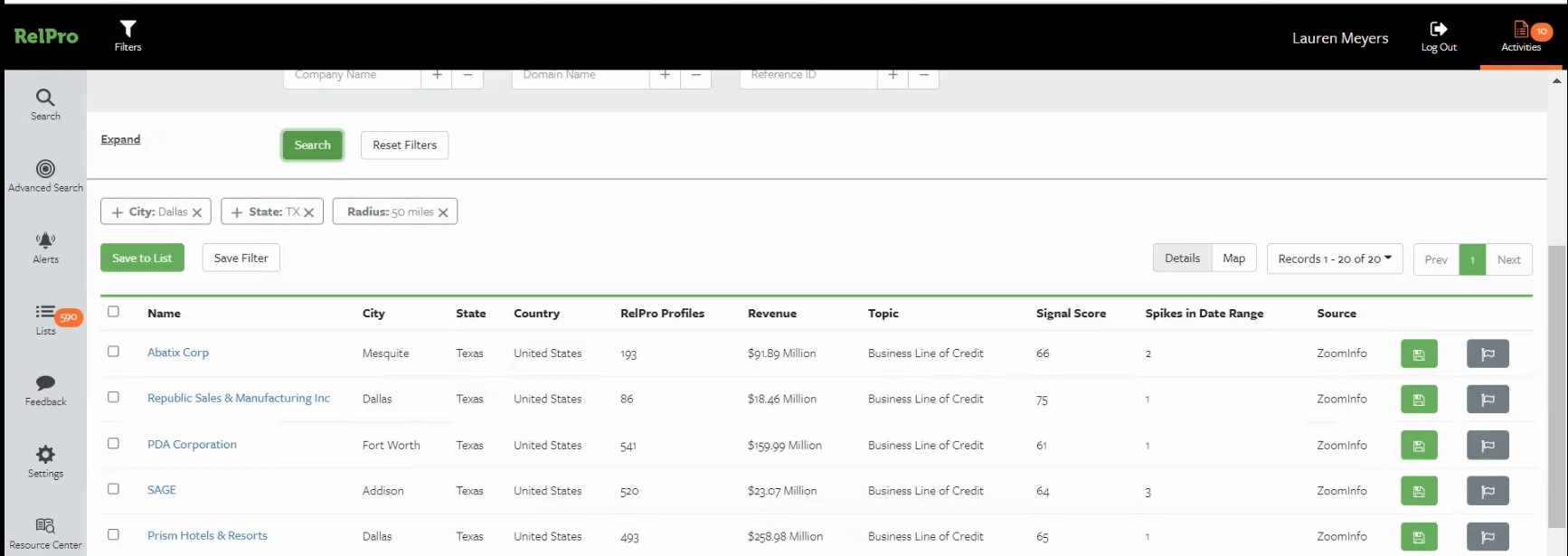
The intent data, sourced from Zoominfo, contains 66 signals related to financial research and products. RelPro has removed the noise from thousands of non-relevant topics by limiting the topics to standard commercial banking services.
Intent Data search results include signal score and spikes across a date range.
Users may screen against the intent topics, spike period (last week to past three months), audience strength, signal score, minimum spikes in the date range, and standard firmographics. Audience strength and minimum spikes ensure that the research is broadly based and sustained, avoiding spurious spikes created by a single employee doing heavy research on a topic for a day or two.
Audience strength is an intent distribution score containing the volume of searches on a topic across a company’s IP addresses. Other variables include the number of IPs at a company, the number of days investigating a topic of interest, how many times they viewed the page, and company size.
The minimum score lets banking professionals dial up or down the precision. Intent data falls along a bell curve, with sixty being a twenty percent increase in topical activity. Sixty, the lowest signal score for screening and presentation, is a relatively low threshold, particularly if the search is being performed across multiple weeks or months.
An intent tab lets Relationship Managers view an account’s spiking topics and each topic’s signal score, audience strength, and spikes in date range, helping them determine which financial products may be of interest to the account. If there are multiple signal spikes over a date range, the signal score is the average of the spike scores.
The RelPro company Intent Tab details spiking topics, audience strength, frequency of spikes, and the last signal date.
A last signal date indicates the last time the topic spiked, while the spikes in date range indicate the frequency of spikes over the date range. These fields help determine the recency and frequency of interest, particularly if low signal thresholds or a long search period have been selected.
RelPro added eight million CRE loans to its platform, helping financial services companies target companies and assess risk. Mortgage fields include property type, lender, loan amount, assessed value, execution, and maturity dates.
CRE Title Records in a RelPro company profile.
Users can view mortgage data and screen against it in Build-a-List. Along with CRE data, RelPro provides UCC (US liens), PPP and PPS loans (pandemic), and 7A and 504 (Small Business Administration) loans.
RelPro did not disclose the source of its CRE mortgage data.
RelPro claims that 50% of the top US banks license its service.
Bombora is one of the leading sources of third-party intent data gathered from B2B Media sources, with over 5,000 media websites contributing to its Company Surge intelligence. It has chosen to remain independent and broadly partner with RevTech Companies, including six of the seven vendors that were listed in Gartner’s 2022 Magic Quadrant for ABM Platforms: 6sense, Demandbase, Terminus, Madison Logic, RollWorks, and Triblio (Foundry).
“Gartner weighs Intent data as its single-most critical capability for new account acquisition and a driving force in both customer retention and expansion,” blogged Bombora Senior Product Marketing Manager Ryan Moline. “This full-funnel visibility into what’s important to your prospects and customers empowers your go-to-market teams with the data needed to create hyper-personalized, omnichannel buying experiences that result in more meetings booked, accelerated deal cycles, and opportunities for long-term growth. This is just one reason why many of the companies recognized in this year’s Gartner Magic Quadrant partner with Bombora for their Intent data needs.”
Both ABX platforms and direct customers rely on Bombora to identify in-market demand, allowing them to reach out to accounts in their ICP when they are actively researching solutions. Company Surge data can also be deployed for identifying churn risk accounts and upsell and cross-sell opportunities.
“Bombora’s content consumption model has become the de facto standard in B2B marketing for third-party behavioral data to indicate intent,” stated Forrester.
This month, Bombora announced an integration with HubSpot and an enhanced integration with Salesforce.
“Bombora has prioritized direct integrations and partnerships in order to make it easier for sales and marketing teams to access our insights without changing their workflows,” said Bombora CEO Erik Matlick. “HubSpot is one of the most well-known marketing, sales, and service software companies in the world, and we’re thrilled for our app to be in the spotlight as they look to help B2B brands with their business challenges.”
On its earnings call last week, ZoomInfo announced a pair of acquisitions that closed on April 1: Comparably (discussed yesterday) and Dogpatch Advisors.
Dogpatch Advisors is a “modern sales advisory consultancy that helps enterprises scale revenue operations, build sales playbooks, use data and insights to create and refine sales, and build outbound operations functions.” In addition, Dogpatch will “enable ZoomInfo to further drive Enterprise and Strategic revenue through expanded customer playbooks that utilize more data and product categories.”
Dogpatch was immediately rebranded as ZoomInfo Labs, providing a “new go-to-market thought leadership team” that “drives go-to-market data analysis, product enhancements, and strategy for our enterprise customers.”
Dogpatch CEO Ben Salzman will be heading up ZoomInfo Labs.
“This will immediately expand our capabilities for enterprises and drive enhancements across our suite of products,” stated Schuck. “Over time, we expect ZoomInfo Labs to put the modern go-to-market playbook within reach of every company.”
“Dogpatch Advisors is professional services and consultancy firm that helps enterprises build out their go-to-market efforts using data and insights and software to make those go-to-market efforts incredibly effective and efficient. And when we talk with our customers and our prospects…they want a world where their go-to-market motions are driven by data, where our software is interconnected seamlessly, where they have the ability to run innovative sales playbooks, but they don’t have a pathway to get there.
What we’re hoping to do with ZoomInfo Labs is to provide a mechanism to help our customers see a future that’s innovative, that’s data-driven, where systems are integrated and talk to each other, where our data cloud sits at the foundation of that, and our application layer drives the interconnectivity of that motion… [ZoomInfo Labs] is designed to help our customers not only see that vision but then also achieve that.”
ZoomInfo CFO Cameron Hyzer
Both acquisitions closed on April 1 but were announced on May 2. Individual deal terms were not disclosed, but the two firms were acquired for “approximately $145 million, inclusive of the purchase of a convertible promissory note and cash, net of cash acquired, subject to adjustments for working capital, transaction-related equity awards, and other customary adjustments.”
ZoomInfo also agreed to pay up to $28 million in equity awards “subject to continued employment and/or attainment of certain financial metrics.”
“We expect these acquisitions to contribute revenue in the low teens millions of dollars in 2022 and create a modest drag on margins of one to two points for the remaining quarters this year,” said Hyzer.
CEO Cameron Hyzer said that Dogpatch was more than an acquihire deal. While it has a small employee base, Dogpatch has “relationships and a history of really delivering great go-to-market consulting engagements for large clients.”
“It’s a handful of people, but I think that they very much box outside of [its weight] class in terms of the value they’re able to deliver,” continued Hyzer. “And we think that by bringing that on and being able to deliver those engagements that we’ll be able to further accelerate the solutions that we’re offering as well.”
Chorus, which was acquired by ZoomInfo last summer, rolled out a mobile app for its conversational sales service. The app supports core Chorus features on Android and iOS phones. Users can listen to calls, speed them up, and pause them. They can also share key moments with colleagues via Slack, email, and text. Hashtags and @ mentions assist with tagging and sharing.
Managers and trainers can assign listening and provide feedback, which can be reviewed during walks, commutes, or downtime. Users also have access to a library of best practices spanning various topics, including objection handling, pitching to specific verticals, or value discussions.
“With Chorus, reps can review top performers’ recordings on their own schedule,” said Alyson Baber, commercial sales leader at Zoom. “They can also focus on keywords, such as a competitor’s name or pricing information, and go directly to those parts of the discussion instead of having to sit through the entire call.”
Customer Success and Account Teams can review preceding conversations, review conversations before quarterly business reviews, and share the voice of the customer or product feedback with other teams.
B2B data vendor RevenueBase closed a $6 million seed round led by Bessemer Venture Partners. Additional investors include 2 Lanterns, Argon Ventures, Converge, Feldsmith Capital, Good Friends, Graph Ventures, Gutbrain Ventures, KOA Labs, PBJ Capital, and Service Provider Capital. The round was oversubscribed as RevenueBase enjoyed significant investor interest.
As part of the round, RevenueBase named three Directors to its Board:
Kent Bennett, Partner at Bessemer Venture Partners
Bob Davoli, Founder and Managing Director of GutBrain
Jude McColgan, former CEO of Localytics
RevenueBase launched last spring looking to solve issues in the B2B data market, including difficulty in identifying and engaging with Ideal Customer Profile (ICP) prospects and marketing’s reliance upon spammy demand generation instead of well-targeted messages. RevenueBase trebled its revenue over the past year and expects to do the same this year. It has already onboarded twenty customers, with a focus on selling data as a strategic asset to the CMO or CRO.
RevenueBase was founded by industry veterans Mark Feldman, the VP of Marketing at NetProspex before its acquisition by Dun & Bradstreet, and Milenko Beslic, who built Cheapflights, the travel industry’s first metasearch engine. As a marketing head at Backupify, Motion Recruitment, and Localytics, Feldman became frustrated with B2B data issues, including misalignment with the sales and marketing team’s go-to-market strategy, data decay, difficulty acquiring data, and managing disparate vendors and formats. His stint as a B2B data customer led him to return to the B2B data space and create a product that broadly aggregates company, contact, and custom customer-specific insight data that aligns 1:1 with each customers’ go-to-market strategies.
Custom insights can be any variable that enables targeting of the right businesses. For example,
Does the company offer a mobile app?
Are they a managed service provider?
Do they have a call center?
Do they sell perishable food products?
RevenueBase then builds a custom database for clients that it calls a Revenue Database, which is updated on an ongoing basis.
“We saw a whitespace for a company like RevenueBase, especially given that we’ve seen little real innovation or change in this market over the past decade leading businesspeople to be bombarded with impersonal and poorly targeted messages multiple times a day. This situation has been made worse by ‘The Great Resignation,’ during which so many people have left their positions, and the data hasn’t kept up with those changes. Milenko and I knew that we could build a better solution to make it easier for companies to access more buyers in order to increase revenue. We’re excited to have the support of great investors who are on board with our vision.”
CEO Mark Feldman
RevenueBase will deploy its funds towards building a customer UX and a set of enterprise software integrations for CRMs and MAPs. It is also looking to grow its headcount from twelve to twenty before the end of the year.
“We think the opportunity to be the B2B data refinement layer powering growth-oriented companies is massive,” said Bennett. “We are impressed with RevenueBase’s early traction and Mark’s and Milenko’s appetite to transform the B2B data industry.”
Feldman argues that RevenueBase is distinguished across three dimensions: “completeness of data, data accuracy at scale, and ease.” RevenueBase offers a high-touch, white-glove offering customized to each of its clients. It begins with customer alignment, holding a set of discovery workshops that identify each customer’s “revenue archetype.” RevenueBase then queries its 700 million global contacts database to build tailored databases for its clients.
RevenueBase maintains a database of 700 million global contacts.
Revenue Archetypes consist of an ICP, market segmentation, pains addressed, buyer personas, sales showstoppers, and custom insights that enable buyers to be engaged more personally.
“A revenue archetype is a model of what your ideal customer looks like, i.e., one you can derive revenue from,” Feldman explained to GZ Consulting. “It’s where there is a mutual benefit. They need your product/service and will pay a fair price for it. They also will favor you over the competition because your solution will result in the best cost-benefit tradeoff for the customer.“
Conversely, the Revenue Archetype also defines companies that are not good fits such as industries or geographies that require a standard not met by a firm’s offerings (e.g., HIPAA or GDPR requirements). It also identifies roles not involved in purchasing a company’s products or services. These individuals may be too junior in the organization or may not work in functions that use a company’s products or services.
RevenueBase argues that its knowledge graph technology improves the set of discoverable relationships, including the “longtail of customer-specific insights,” stated Feldman. For example, RevenueBase can identify partners, investors, technologies in use, revenue streams, business models, key resources, and modern industries (such as Fintech and SaaS) that do not fall into standard industry classifications.
Conventional firmographics vendors must have a product manager pre-define the company attributes to be collected and then build these definitions into its data collection methodology and structure. Because RevenueBase employs a graph database, it is not subject to these structural limitations and can identify uncommon or industry-specific elements that define the ICP. The data structure also supports multi-point verification and data attribution. In addition, data fields with high probabilities of changing, such as email addresses, job titles, and current employers, are re-verified at least four times per year.
RevenueBase promises to “replace all of your data vendors with one solution” that “reaches every company and decision-maker across the globe that will benefit from your unique offering.” By delivering high-quality, targeted data directly to sales and marketing systems, revenue teams avoid time-consuming sales rep data research and managing databases. Data quality steps include custom research, quarterly email re-verification, and annual phone checks. Data is delivered via a quarterly secure CSV file transfer with a 90% accuracy SLA.
Last month, Drift rolled out its Conversation Cloud, which combines the capabilities of its Conversational Marketing, Conversational Sales, and newly launched Conversational Service offerings. Drift’s Conversational AI guides visitors along any stage of the customer journey, helping them “voice their intent with open text questions, find answers to their own questions, get personalized recommendations, or book a sales meeting.”
“Everything starts with a conversation, and in-person communication and experiences are taking a back seat to the conversations we have online, especially in our business relationships. Businesses are relying more and more on digital experience platforms – or in our case, conversational experience platforms – to bridge these connections and manage key customer interactions, touchpoints, and engagement. Our guiding philosophy at Drift is to put the buyer at the center of everything we do, and we are excited to bring the Drift Conversation Cloud to market to help our customers deliver a better experience to buyers at each stage of their journey, all while improving their sales teams’ efficiencies and accelerating revenue.”
Drift CPO Leo Tenenblat
Drift Conversational Marketing supports real-time conversations with web visitors, helping to answer questions, deliver desired content, or “qualify and convert best-fit buyers.” Conversational Marketing functionality includes visitor intelligence, chatbots, meeting scheduling, and Fastlane lead form booking.
Drift Conversational Sales manages customer conversations across chat, video, email, and phone. Drift routes high value leads to sales reps, notifying them when qualified leads are engaging with the chatbot or the website. Sales reps can “craft personalized outreach based on what web pages buyers visited, which sales touchpoints they engaged with, and how often they interacted with your brand.” Prospect activity is automatically logged to Salesforce.
Drift Video asynchronous video sharing on LinkedIn messenger
Reps can also deliver personalized video messages based on site activity intelligence. Videos may be shared via LinkedIn, Drift, Outreach, or Salesloft. Drift claims a more than 3X improvement in response rates for asynchronous video.
Drift not only schedules meetings but also offers a new Deal Room module for capturing interactions between buyers and sellers, including meeting transcriptions and document sharing. Deal Room also provides real-time alerts when prospects engage with the Deal Room and manages Mutual Action Plans.
“Drift Deal Room enables seamless collaboration between your internal team and entire buyer committees in one central location,” blogged Drift Senior Product Marketing Manager Holly Xiao. “Everyone involved will be able to have conversations, share files, manage action items, schedule meetings, and more — directly in Deal Room.”
Continued Xiao, “Drift Deal Room lets you see who, what, and how buyers interact with your business throughout their entire journey. So, when it’s time for your next deal review, you’ll come to the table with a clear picture of deal activities and trajectory. And if you notice opportunities with lower engagement, you can rely on Drift Video, Drift Chat, Drift Email, and more to help you nurture deals in the right channel at the right time and keep them moving in the right direction.”
Conversational Service answers simple support questions, allowing the service team to focus on difficult support problems and high-priority customers. The Drift Chatbot supports Salesforce and Zendesk knowledge base articles. Conversational Service lets customers create their own support tickets or hand high-priority requests over to live service reps.
“Translating click-based engagement into buyer-led enablement across interactions requires conversation design that senses and responds to spoken and unspoken buyer needs across complex and connected buying journeys, wrote Forrester Principal Analyst Jessie Johnson last November. “Conversational interactions help B2B organizations meet buyers where they are in their journey, enable their buyers and customers in the moment, and inform the next interaction. The impact of poor execution, however, can have a lasting negative impact on the buying journey, customer experience, and even the brand itself.”