Flash: Groove Series B and Product Enhancements

Sales Engagement Platform Groove closed on a $45 million Series B led by Viking Global Investors.  Previous investors Capital One Ventures, Level Equity, Quest Venture Partners, and Uncork Capital also participated.  The funds will be deployed for international expansion and continued growth in the enterprise segment.

The round brings total funding to $61 million.  Groove did not disclose its market valuation following Round B.

“We’re experiencing explosive growth in the enterprise segment of the market,” Groove VP of Marketing Kristin Hersant told GZ Consulting.  “This latest round of funding will enable us to invest more heavily in R&D while expanding our operations in EMEA and doubling down on the sales and marketing engine that’s fueling this growth.”

Enterprise ARR is up 114% over the past years.  New enterprise clients include Activision, iHeartMedia, LexisNexis, New Relic, TIBCO, Veeva, and Wintrust.

Although Salesforce’s first cloud was the Sales Cloud, digital selling remains an issue for many Salesforce customers.  An August 2021 Forrester report on the “State of CRM” found that 57% of respondents struggled to offer solid customer experiences due to poor integration and accessibility.

Groove, a native Salesforce Sales Engagement application, “solves this accessibility problem by meeting sellers where they already work, increasing rep productivity while ensuring over 90% Salesforce adoption,” wrote Groove.

“This notion of the sales engagement platform as a cockpit for sellers is likely to continue to drive further integrations between other sales tech categories and these platforms as the advantages of bringing everything to the seller where they sell (the original vision for CRM technology) become more widely recognized,” said Anthony McPartlin, Principal Analyst for Forrester Research in a recent blog post.

“Our enterprise customers want to enable the modern seller while ensuring the highest levels of enterprise security and compliance.  We’re capturing a significant amount of enterprise market share from our competition because our platform was built for the needs of large, complex organizations that rely on Salesforce as their system of record.  We bring automation to the seller instead of requiring that they work out of a separate system. This flexibility ensures extremely high user adoption rates, even with technology averse sellers in non-tech industries.”

Groove CEO Chris Rothstein

Groove also announced a pair of product enhancements that meet “the unique needs of complex organizations.”  The first new feature is automatic logging to custom objects.  The second new capability, OmniActions, “enables reps to complete any sales action without leaving their workflows.”

Groove Custom Objects for Salesforce.

“By seamlessly integrating valuable CRM data into specialized workflows for different roles, teams, and industries, Groove drives CRM adoption and enables revenue teams to get a more complete picture of all sales activities.  The addition of automatic logging to custom objects and OmniActions provides customers even more flexibility for executing, capturing, and properly associating activities with both standard and custom Salesforce objects.  With these new features, Groove strengthens its position as the only sales engagement platform that can easily fit into an organization’s complex and dynamic sales workflows.”

“One of the great things about Groove is its ability to flex to any organization’s sales process, regardless of how much they have customized Salesforce.  Today, we’ve made it even easier for reps to complete, assign, and track their activities without having to leave their workflows.  That means more time for reps to sell, more complete data for managers to manage their teams, and more flexibility for admins to maintain established and successful processes.”

Groove VP of Product Sonia Sarao

Groove’s Advanced Activity Capture now automatically logs activity to custom objects, “minimizing the manual work required by sellers while ensuring complete visibility into account health and opportunities.”

Activity Capture may be configured by profile, allowing for customization at the functional or team level.

OmniActions lets reps manage or execute any activity outside of their regular Flows with automated real-time activity logging.  OmniActions is fully integrated with the Groove Omnibar, supporting actions in Google Workspace, Microsoft Outlook, Salesforce, or the Groove app.

Groove OmniActions

“This combination gives sellers a 360-degree view of their prospects’ and customers’ lifecycle from details and activity to actions – all in their workflow,” wrote the firm.  “OmniActions enables revenue organizations to associate all activities with open opportunities, whether they are part of a single action or multi-step Flow.  By accurately associating all types of activities, revenue teams can take advantage of more accurate reporting and insights into the sales process.”

Groove continues its rapid growth, making the Inc. 5000 for the past three years.  It has over 70,000 users.

Market Flash: Outreach Acquires Canopy and Launches Outreach Commit (Part II)

Continuing from yesterday’s post that discussed revenue innovation and the Sales Execution Gap. Today I am discussing their new Outreach Commit and Outreach Success Plans.


Outreach Commit, based on their Canopy acquisition, offers sales analytics and forecasting capabilities that augment Outreach’s AI-based buyer sentiment and Success Plans, providing Outreach customers with “true visibility across the entire revenue cycle.”

“The use of deep learning and big data has the potential to transform B2B forecasting in the same way it has transformed B2C forecasting. Such changes are shifting the emphasis on forecasting from predicting the number to beating the number…Reliable activity data allows sales leaders, for example, to drive more rigorous pipeline reviews and estimate forecasts with greater confidence.  It allows companies to discover and capture data about prospects and customers that previously lived in the realm of the ‘shadow pipeline’ — that murky world of secret selling that organizations have traditionally been blind to.”

Forrester Research Principal Analyst Anthony McPartlin, “Enabling B2B Interaction Visibility In A Converging Sales Tech Landscape” (June 2021)

Commit provides a flexible forecasting model with multi-level views, allowing managers to view a probabilistic model of outcomes for multiple periods and teams based upon prior win-loss histories, current pipeline, and adjustable assumptions.  Revenue forecasts are broken into Booked, Weighted Pipeline, and Intra-period high-velocity deals (i.e., projected new opportunities that are not in the pipeline but will close before the end of the period).  In addition, models can be adjusted to account for events external to the model (e.g., new product launches, tradeshow held earlier or late in the quarter, economic shocks).  The underlying KPIs that drive the models are selectable when setting them up, with the model updating every fifteen minutes.

Outreach Commit supports dynamic forecasting with bear, bull, and most likely outcomes.

Commit provides individualized rep scorecards based on company KPIs.  Managers can set targets, coach to outcomes, and level up their team.  Managerial note-taking helps them track 1:1’s, assign tasks, and track completion.

Commit supports active deal monitoring that flags deal risks and delivers insights.  “Signals notify leaders of the things they need to know today.  From opportunity risk identification to shifts in top of funnel metrics, Signals act as your eyes and ears–ensuring your frontline leaders are focused on what matters most to your business.”  Deal risk is significantly reduced when issues are flagged early to reps, and managers can provide on-demand coaching to address nascent problems.

Commit also supports Custom Signals.  Revenue Operations sets custom thresholds and unique parameters.

At a recent analyst briefing, Outreach management emphasized that they offer a tripartite value proposition: Engage (Sales Engagement), Guide (Kaia Conversation Intelligence), and Commit (Outreach Commit).

“To achieve predictable, efficient growth, every organization needs to engage with their buyers, guide their sellers through strong sales cycles, and then commit the number with confidence.”

Canopy deal terms were not disclosed.  All nine employees have joined Outreach. The startup, founded in 2019, had raised $2.1 million.

Outreach also provided updates on Outreach Kaia and Success Plans at its Unleash event.  Kaia, its Conversation Intelligence platform that was developed in-house, is adding real-time talk analytics, Comprehensive Search, Saved Search, and Outreach Voice Import.  The new capabilities will be available by the end of the month.

Call analytics provide real-time talk-time visibility, letting reps self-correct if they are speaking too much.

Comprehensive Search provides managers with access to notes, content cards, action items, and transcripts across the sales organization.  Additionally, both meeting platform intelligence and Outreach Voice cold calls are included.  Thus, “leaders can identify trends and risks across teams and at various stages of the sales cycle.”

Saved Search Alerts provide scheduled intelligence on key topics, allowing managers to track competitors, pricing, functional requests, etc.

Outreach Voice Import supports post-call analysis of Outreach Voice and Microsoft Teams.  Fully integrated support for Teams is scheduled for 2022.

Outreach warns RevOps not to trust the algorithm blindly. Instead, revenue teams should understand “the math behind every forecast to see what’s actually driving the number.”  Accordingly, Outreach maintains the fidelity of data signals such as engagement and sentiment through transparency that displays “every opportunity and signals where sellers should take action.”

“Canopy’s Augmented Revenue Analysis engine combines advanced statistical modeling with machine learning and artificial intelligence,” states the Canopy website.  “Simply put, we show our math.  Instead of black box predictions, we show you every trend and variable driving our predictions, ensuring you have access to every data point necessary to confidently call your business.”

Users can also review “where you started and where you finished,” providing a post-mortem period review that “pinpoints slippage, forecasting variance, and conversion rates across any data point from any time window.”  They can also generate “what if” scenarios with multiple assumptions.

Outreach Success Plans provide a shared portal for buyers and sellers to exchange timelines, success criteria, resources, and people.

Outreach Success Plans, which were announced back in May, will be generally available on October 27.  Success Plans align buyers and sellers to improve action and predictability in a shared deal room.  They act as a buying hub that allows buyers and sellers to agree on shared success criteria, objectives, and timelines.  Success Plans also support shared access to project resources, allowing new demand unit members to quickly access project documents.  Only invited individuals can participate in the Success Plans.

Success Plans provide an additional set of engagement intelligence for tracking deal risks and momentum.  The Opportunity View includes Success Plan views, comments, resource downloads, and shares, providing engagement insights specific to deal planning and document sharing.

Outreach Success Plans deliver “unparalleled visibility into pipeline opportunities and risks,” blogged VP of Product Marketing Victoria Grady.

Outreach claims that two-thirds of buyers have “stopped working with a company mid-deal, simply because the competitor provided a better buying experience.”  Thus, streamlining the document sharing process, framing the timeline, and agreeing on success criteria not only facilitates the process and improves deal visibility but improves the likelihood of winning each deal. Outreach supports 5,000 customers, including 19 of the 25 fastest-growing public companies and more than 60% of the Cloud 100.

Market Flash: Outreach Acquires Canopy and Launches Outreach Commit

Outreach Commit supports forecasting, scenario planning, and deal risk analysis.

Sales Engagement Platform Outreach expanded its value proposition with the acquisition of Revenue Intelligence service Canopy.  Outreach immediately began integrating the service into its platform, with GA expected in H1 2022.  The new Outreach Commit service “significantly expands” Outreach’s revenue intelligence capabilities, “giving revenue leaders the sales analytics and forecasting capabilities they need in today’s sales environment.”

“In the past 18 unpredictable and transformative months, we have seen the rise of a new cohort of leaders we are calling Revenue Innovators who have thrived by embracing the digital disruption of sales,” said Outreach CEO Manny Medina.  “These are leaders who had to adapt and evolve their mindset to embrace automation and machine learning as the keys to driving predictable, efficient growth – consistently and despite the uncertainty in the market.  They need tools that combine engagement with intelligence and marry together the art and the science of sales. The evolution of the Outreach platform does exactly that.” 

Outreach provides revenue innovators with “predictable, efficient growth” based upon AI guidance for more effective engagement, improved forecasting, and next best actions.  The objective is to reduce the “Sales Execution Gap” between revenue potential and actual performance based on instinct and limited data; instead, data and AI will narrow the gap.

“The Sales Execution Gap manifests itself in several ways across the business — decisions based on gut instincts, slow rep ramp times, competing priorities, random achievement, missed opportunities with little understanding as to why,” explained Medina.  “And yes, lost revenue, but also a growing disconnect between what high-performing reps want and what employers can deliver.”

“Once a seller has experienced the power of an Engagement and Intelligence platform, they won’t want to go back to inefficient, broken workflows — and they’re making career decisions because of it.”

Outreach CEO Manny Medina

Unfortunately, CRMs were “not designed for sellers.”  They are systems of record that store information but lack engagement and insights.  Firms that want reps to “live in the CRM” will drive away their best sales reps and candidates who “demand AI-driven insights and workflow automation to guide their actions in real-time.”  As more sellers become “digital natives,” this performance gap will widen.

Top-performing reps and managers that have enjoyed modern SalesTech tools will be reluctant to work without digital tools.  They expect their sales toolbox to include AI-generated intelligence, including email sentiment, live meeting guidance, real-time call analysis, and automated deal review and scoring.  They are also looking for sales engagement with templated sequences (cadences), multi-channel outreach, task prioritization, and recommended actions.  Finally, they are looking for improved forecasting, risk alerts, engagement data, and deal facilitation.

With Commit, Outreach has added forecasting and expanded risk analytics to its toolkit.

Outreach sees a bifurcation between traditional sales organizations and revenue innovators that have adopted digital communications and AI for outreach, prioritization, coaching, forecasting, and analytics.

“Revenue innovators are embracing automation and AI in real-time to provide guidance to reps mid-cycle, guide more effective engagement with customers, and entirely rethink how they forecast because they have the signals that can proactively identify risk in their pipeline and deals,” stated the firm.


Continue to Part II which discusses Outreach Commit and product enhancements announced at the Outreach Unleash virtual meeting.

Terminus Acquires Zylotech

Terminus acquired Boston-based B2B Customer Data Platform (CDP) Zylotech and immediately launched the rebranded Terminus CDP as part of its ABM Platform. 

Terminus CDP will be led by Matt Belkin, who has “25 years of experience in building and scaling data and technology companies.”  Belkin joined Terminus last year when it acquired Sales Intelligence vendor GrowFlare.

Zylotech CTO Abhi Yadav will be Terminus’ Head of Platform Development.  Yadav is also a Guest Lecturer at MIT Sloan School of Management.

The deal is Terminus’ fifth acquisition, backing up Gartner’s SalesTech Mayhem thesis that a handful of companies are quickly grabbing market share through strategic acquisitions and high levels of internal investment that fill missing capabilities.

Terminus’ acquisitions have focused on expanding the core capabilities of the company, not taking out competitors.  The other acquisitions were

Terminus Acquisition History

While CDPs are generally deployed to create a single view of the customer, David Raab, Founder of CDP Institute, commented that the Terminus CDP “will tie together the data silos that would otherwise result” from the acquisitions.

“CDP is becoming more widely adopted in B2B, as companies recognize their marketing automation and CRM systems are not enough to provide true data unification and sharing,” said Raab.  “By acquiring Zylotech, Terminus positions itself – and its clients – to take full advantage of the capabilities that a CDP provides.”

While data usage and spending are rapidly increasing, few marketers trust their data.  A 2017 Forrester survey found that only 12% of B2B marketers have high confidence in their data accuracy, and 84% identified data management as a top-five weakness.

“The key to a successful CDP is trust,” blogged Zylotech Director of Revenue Marketing Alex Bistran in August.  “Sales, marketing, and customer experience teams need to trust the data stored in their CDP to drive decisions, whether it’s deciding which accounts require immediate attention or which campaign messaging is most likely to resonate with a particular customer. By constantly refreshing data from your own customer interactions and combining it with validated, third-party B2B data to accurately reflect your contacts and accounts, a CDP provides a clean stream of actionable data that can be operationalized to flow through your marketing, sales, and customer service channels.  And, importantly, that can lead to a healthier revenue stream too.”

“B2B CRM data is painfully inaccurate and incomplete, and manual efforts to clean, deduplicate, and activate are slow and expensive.  This leads to poor conversion rates, an incomplete view of buying committees, and misleading ROI,” stated the firm.

“Bad data in equals bad data out. Period. We’re entering a marketing revolution – data really is the new oil, and Terminus is sitting on a gold mine. Under Matt’s leadership, Terminus CDP is poised to change the game for our customers. This level of data accuracy is critical for B2B GTM teams looking for a unified view into their customers. I’ve never been more excited about the future of marketing.”

Terminus CEO Tim Kopp

The Terminus CDP addresses the issues of bad data with auditing, cleansing, enrichment, and data management capabilities “backed by the industry’s largest global network of decision-makers and Buying Committees.”  Furthermore, Terminus CDP “dramatically” improves data accuracy, campaign effectiveness, and “wasted sales cycles.”

Buying Committee discovery is a novel UVP for a CDP but fits well within a broader ABM Platform umbrella. 

“We are in the golden age of marketing.  The breadth of technologies helping us create great experiences has never been so impressive.  But, what are all those customer experiences predicated on?  Data,” blogged Kopp.  “With Terminus CDP, our customers will have their most important account and contact data continuously cleansed and enriched. The result: our customers will be able to put their trust in their data, unleashing their go-to-market teams to accurately engage buying committees every time.”

Continued Kopp, “We’re entering a marketing revolution.  A time when sales and marketing teams don’t have to worry about data and can dedicate their energy to create phenomenal experiences that turn into pipeline.  I have never been more excited about the future of marketing.”

“Since our early days as an MIT spinout, Zylotech has been focused on delivering the data and intelligence go-to-market teams can trust and take action on,” said Yadav.  “Upon meeting Terminus, it was obvious that we shared a common vision. We are proud to join Terminus and this incredible team to jointly improve the accuracy of B2B data.”

Terms of the deal were not disclosed, but Kopp described it as a “big deal” that is a “really, really important acquisition.”  The Indianapolis Business Journal said that Zylotech was its largest deal to date.  The transaction was financed with funds from a $90 February venture round.

Enterprise clients include Google, Palo Alto Networks, Cisco, Dell, and Rimini Street.

Clari Acquires DealPoint

DealPoint Collaboration Flow

Revenue Intelligence platform Clari announced the acquisition of DealPoint.  DealPoint supports deal management and collaboration by enabling “new visibility for sales teams into the connections and agreements between buyers and sellers.” In addition, DealPoint supports deal rooms and Mutual Action Plans (MAPs), helping reduce friction between buyers and sellers and fostering deal alignment.

“With mutual action plans, sales teams can improve alignment with buyers, drive scalable process and rigor, and improve win rates,” said Clari CEO Andy Byrne. “Our acquisition of DealPoint gives Clari customers a new insight they have never had — a view into what buyers are thinking. Combined with our new execution insights, managers and reps will have comprehensive visibility and new inspection capabilities in one unified workspace.”

At the front end of the collaboration, workflow is deal qualification, including defining the pains, processes, and priorities. Next, the teams develop a joint interactive timeline, team maps, and shared team resources (e.g., case studies, requirements, proposals).  Finally, engagement metrics help reps quickly determine “which buyers are engaged, and who’s just kicking the tires.”

DealPoint monitors milestone completion and warns reps when milestones have been missed, helping keep deals on schedule.

“With a MAP, sellers get instant validation on value prop, buyer team, and timeline. Because both sides are operating from an actual plan, frontline managers can see not only what has been done on a deal, but also what hasn’t been done.

In other words, we know which buyers are serious, which deals are going to stall, and what needs to happen to keep everything running smoothly.

Incorporating those buyer signals gives Clari new insight into deal health that will revolutionize deal inspections, resource allocation, and forecast accuracy for frontline managers.”

Tom Williams, Head of DealPoint

Having a joint plan assists with buy-in, providing a psychological edge for the sales team.  “By providing a clear plan to value, you guide the customer journey and keep the conversation focused on fixing their problem with your product,” states DealPoint.  “Buyers adopt your plan as their own, edging out competitors and reducing surprises.”

Sales Managers also benefit from instituting a repeatable process.  According to DealPoint, 50% of reps quickly abandon new methodologies.  Thus, streamlining the methodology helps ensure buy-in and compliance.

Once integrated with Clari, managers will have even more confidence in forecasts based upon milestone tracking.  Additionally, managers can ask reps what needs to be done to bring the deal back on plan, and sales reps can ask similar questions to buyers, helping foster shared accountability.

Customer Success teams benefit from smooth handoffs and pre-defined expectations.

DealPoint argues that taking a set of small steps helps foster trust that reduces perceived buyer risk as milestones are met.  Likewise, collaborating on a joint plan helps build relationships between the revenue team and the buying committee.

DealPoint comes with the MEDDIC methodology out of the box, but users can implement others.

DealPoint is priced at $59 per rep per month on an annual contract.  Seats include an unlimited number of customers and Mutual Action Plans. In addition, DealPoint is integrated with Salesforce and HubSpot.

Deal Rooms are a logical extension of Revenue Intelligence as they facilitate communications between sales reps, customer success, and buyers.  Collaboration also aligns buyers and sellers, fosters collaboration, reduces the probability of surprises, improves forecast confidence, and gooses close rates.

The integrated Deal Room GA is scheduled for Q4.  Acquisition terms were not announced.

Alyce for Salesloft

Keeping on the gifting theme, Boston-based Alyce announced a partnership with Salesloft to support “smart gifting” on the Salesloft Sales Engagement Platform.  The partnership lets sales and marketing teams natively send gifts through Salesloft. 

Alyce appears within the Salesloft People page side panel, where reps can select a gift and personalize the message.  Gifting options include physical gifts, gift cards, subscriptions, branded swag, on-demand services (e.g., in-home massage, portrait session), experiences (e.g., walking tours, helicopter rides), and donations.  Alyce’s AI suggests three gift choices, but reps can select other choices from the marketplace.

“Actionable insights, seamlessly integrated together can help your sales team say the right thing, to the right person, at the right time with the right gift to drive action that’ll ensure your team hits your targets month after month,” wrote Alyce.

A gifting history provides details on which gifts have been received and how the prospect engaged with the gift, helping revenue teams “optimize follow-up to drive greater impact.”

Alyce employs AI to assist with gift selection from its curated global marketplace.  Alyce recipients are sent a physical or digital notification of a gift, which they can choose to accept, exchange, donate, or decline.

“Our partnership with Salesloft is such a natural match. We are both committed to enabling revenue teams to build strong relationships and improve business results with the help of smart technology.  At Alyce, we are thrilled that our integration with Salesloft is giving marketing and sales teams new gifting superpowers right in their workflow that will allow them to deliver meaningful moments, increase revenue, and create greater impact.”

Alyce CEO Greg Segall

In a case study, Salesloft enjoyed a 50% increase in alignment between BDRs and strategic marketing with Alyce and drove a 9% increase in meeting attendance.  Furthermore, twenty percent of gifts sent resulted in new opportunities.

“Through the platform, we have uncovered an increase in the sales team’s ability to sell to our target personas,” stated Nabiha Balala, Senior Manager of Enterprise Marketing at Salesloft. “Alyce has been such a game-changer. It’s organically become part of our everyday sales process.”

Alyce’s physical gifting is currently limited to the US and Canada. However, gift cards may be sent to the US, Canada, Britain, and Ireland.

Alyce raised a $30 million Series B in April.


I’ve been running a series on Offline Marketing Automation (E-Gifting and Event Marketing) this week: My other posts:

Postal.io $22M Series B (Part II)

Continuing my coverage of Postal.io following their $22 million Series B


The Postal market supports 600 vendors, providing them with a corporate sales channel without spending on corporate channel marketing.  Their vendor network is growing organically through word of mouth.  Last month they added 149 vendors.

“Vendors can add their products to the Postal Marketplace and get direct access to B2B buyers as their preferred corporate sending partner,“ Product Marketing Director Allyssa Eclarin explained to GZ Consulting.  Items can be purchased off-the-shelf or customized.  For example, companies can send cookies with corporate logos or baby gifts with the child’s name or curated boxes for special occasions.

“People don’t necessarily want another Starbucks gift card.  They want to hear that you heard them, that you value them, and that you understand their interests.  Maybe you send them a mug of their favorite sports team or where they went to college, or a new baby bundle.  Personalization matters.  And that’s what we’re finding is people are getting more personalized than ever. People are automating this channel, and it’s working.”

Postal Director Product Marketing Director Allyssa Eclarin

Furthermore, now that we are entering people’s homes via Zoom, there is a greater level of intimacy for personalizing gifts.

Postal also supports automated direct mail, incentive marketing, brand advocacy, internal and external events, and branded company swag. CRM and MAP partner platforms include Salesforce, Marketo, HubSpot, and Eloqua.

For Salesloft and Outreach, Postal may be added as a sequence/cadence step, streamlining the gifting process.  Gifts may be sent via email, social, direct message, or direct mail, with  Postal tracking gifts and supporting analytics such as the cost per touch.  Postal also offers a “Magic Link,” a unique URL that can be inserted into an email or social channel. For example, reps can send gifts through a DM and avoid the “what’s your email?” discussion with a magic link.  The link is then tracked for shipping, attribution, budgeting, and analytics.  Magic links can also be used for “send on behalf of” situations (e.g., an SDR building a relationship for the AE).

Postal.io is positioning itself alongside market leaders in managing customer and prospect touchpoints.

With face-to-face meetings stopped during the pandemic, e-gifting and personalized gifts are among the few methods for building goodwill and generating positive memories.  Offline marketing platforms such as Postal, Sendoso, PFL, and Alyce have seen robust growth over the past eighteen months as sales reps struggle to build relationships.

Traditional gifting has been cumbersome and difficult to track, but offline marketing platforms streamline gift selection, logistics, and tracking, letting reps know when a gift has been received.  Gifting serves multiple purposes: establishing a relationship, rewarding webinar attendance, keeping in touch with a champion during an absence (e.g., health, maternity / paternity leave), or maintaining goodwill (e.g., holiday gifts, birthday gifts).

“As marketing becomes increasingly technical and formulaic, businesses are struggling to create moments that break through the noise.  The adoption of digital marketing has ironically made it harder than ever to truly connect with consumers.  Postal is among the first to personalize marketing automation by creating a bridge between a boutique front-end marketplace and the established systems already embedded in most marketing technology stacks.  The friction between offline and online marketing disappears, making it simple for brands to build more meaningful connections with consumers in any industry.”

Eugene Lee, OMERS Ventures (Postal.io investor)

Along with the funding round, Postal announced a set of product enhancements:

  • Domestic and international warehousing for branded products.
  • International gifting across seventy countries with wallets and pricing in local currencies.
  • Postal Events, launched in February, supports hybrid teams.  Postal Event enhancements include custom event images on event pages, customized event email templates and messaging, custom form fields on registration pages, and integration of Postal Events with Salesforce Campaigns.
  • Calendar booking on gift landing pages

Postal.io posted 10X ARR growth year-over-year and added over 250 new customers and 4,000 users.  The firm is based in San Luis Obispo.

Postal and its competitors disagree on their category name, with terms such as Tactile Marketing, Sending Platform, and Personal Experience Platform.  Postal uses the category name Offline Marketing Automation. The G2 review site has the firms categorized as Account-Based Direct Mail Software.

Postal customers “get it.”  They say, “you’re going to automate this channel that I know works. I’m already spending the money, but I have no way to attribute it, track it, push it back, check the ROI, or anything like that without a platform.  Now, with Postal, they can, and customers are resonating with the term ‘offline marketing automation’,” explained Eclarin.  “We’re seeing the same thing happening to our category as we saw with email marketing automation boom, with the rise of MailChimp and the like. We have given teams an automated, scalable, and repeatable way to manage their offline channels. “

A Postal license runs across the company with no per-seat pricing.  Instead, admins set up individual and departmental budgets.  Thus, the HR department can leverage Postal to build camaraderie (e.g., events), welcome new employees with swag packages, and express congratulations (e.g., baby, company anniversary).  Likewise, managers can send gifts to reward performance.

Building camaraderie during WFH has become increasingly important for Postal.  When events launched, roughly 70% were for marketing and 30% for team building. However, as Zoom fatigue settled in and the pandemic slowed the return to offices, companies began looking for fun team-building exercises that avoid Zoom burnout.  Thus, corporate event volume has moved closer to parity with marketing events.

Postal promoted a Second City roast to demonstrate the value of digital event marketing hosted on their platform.

This is the third in a series of articles on Offline Marketing Automation (i.e. e-gifting and digital event marketing).

Postal.io $22M Series B

A Second City Improv show is one of the most popular Events on Postal.

Offline Marketing Automation Platform Postal.io closed on a $22 million Series B led by OMERS Ventures, with current investor Mayfield Fund also joining the round.  The series raised total funding to $31 million.

The funds will be directed toward growing the Postal.io team, ongoing product development, and international expansion.  The firm is looking to address the lack of tracking, attribution, automation, and scale in the $120 billion market for direct mail, personalized incentives, branded swag, and corporate gifting.

Postal offers an “expansive marketplace featuring high-end, locally curated items from specialized vendors” that foster “meaningful experiences to drive better engagement with prospects, increase conversion rates, and boost employee engagement.”

“Teams that were once manually sending offline touchpoints are now able to efficiently automate and track direct mail, branded company swag, personalized gifts, and virtual events at scale.  We help companies leverage this proven channel with a frictionless, team-agnostic platform.  Companies are using Postal.io across their organization to deliver more meaningful, impactful, and delightful experiences.”

Postal.io CEO Erik Kostelnik

Events began as mostly marketing activities, but with so many employees working from home, roughly half of their events are employee team-building activities or celebrations.  Postal claims an average attendance rate of 90% for its events.

Postal offers a concierge team that operates as an “extension of your marketing team.”  Postal Concierge assists with managing “curated, branded, specialty items, and experiences that are guaranteed to surprise and delight your prospects and clients.”  The Concierge team also assists with event customization and talent booking.

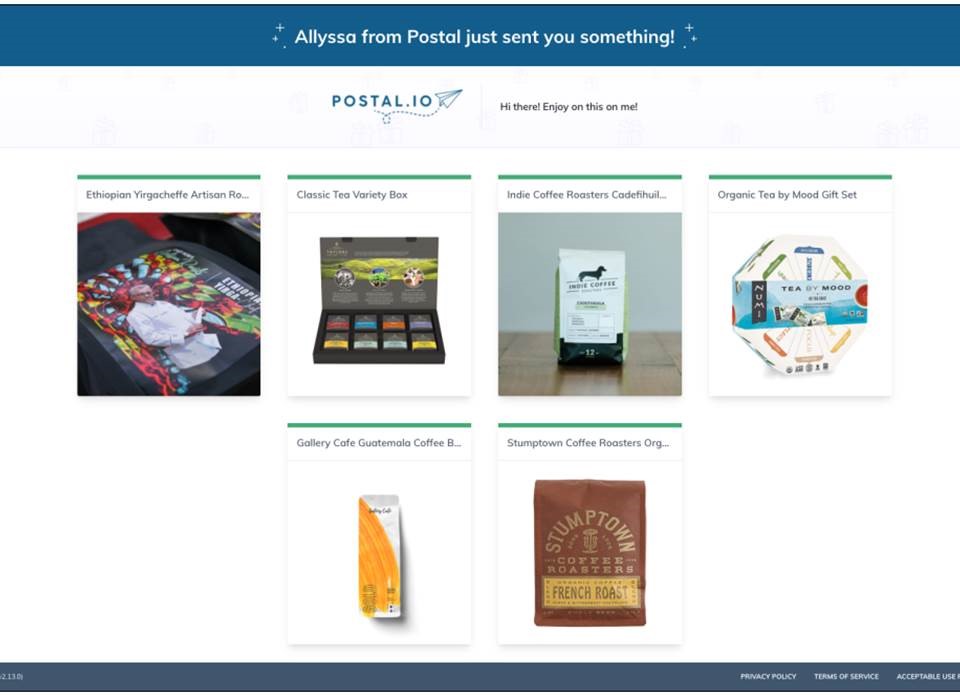
A Postal collection that provides a set of coffee or tea options.  The collection is being displayed with the rep’s name via a Magic Link.

Another feature is collections.  Instead of picking a single item, the rep sends a link to an array of themed items, allowing the user to choose from the collection.  Thus, a drink collection would include coffee, tea, and cocoa options.  Likewise, a cocktail-making event would offer a mocktail option.


Part II continues with a discussion of the Postal Marketplace and integrations.

Sendoso $100M Series C

With travel restricted and many executives continuing to work from home part-time or full time, face-to-face meetings and tradeshows will remain difficult for the foreseeable future. One of the successful workarounds has been offline marketing and e-gifting. Firms such as Sendoso, Alyce, PFL, and Postal have had significant success in rising above the din of digital marketing. I will be posting a set of articles on these firms over the coming days, beginning with Sendoso’s recent funding round.

San Francisco-based e-gifting platform Sendoso closed on a $100 million Series C round and announced plans to open a European headquarters in Dublin.  The Irish office will include a dedicated logistics and supply center to support the firm’s 20,000 global customers.  The new facility supports its multinational customers and expands its opportunities within the EU.  Beyond logistics and warehousing, the Dublin office will host an engineering team, marketers, customer success, and an inside sales team focused on European sales.

The funding round was led by SoftBank Vision Fund 2 and raised Sendoso’s total funding to $152.7 million.  Existing investors Oak HC/FT, Struck Capital, Stage 2 Capital, Craft Ventures, Signia Venture Partners, and Felicis Ventures also participated.

“We believe Sendoso offers the most comprehensive end-to-end gifting platform in the market,” said Priya Saiprasad, partner at SoftBank Investment Advisers.  “Their platform includes a global marketplace of curated vendors, seamless integration with existing tools, global logistics, and deep analytics.  As a result, Sendoso serves as the backbone to enterprises’ engagement programs with prospective customers, existing customers, employees, and other key stakeholders.”

Sendoso Funding Rounds (Source: Crunchbase)

CEO Kris Rudeegraap termed the round a “major milestone” for the firm.  The funds will be deployed to expand its products, services, and global footprint, including the Dublin facilities.

Sendoso sends corporate swag, regular physical gifts, and gift cards on behalf of its sales and marketing clients. In addition, the platform supports gift ordering, logistics, packing, custom packaging, and shipping.  Sendoso is integrated with CRMs, MAPs, and SEPs, including Salesforce, MS Dynamics, HubSpot, Marketo, Outreach, Salesloft, and Groove.  The firm has also partnered with ABM Platforms Terminus, Demandbase, and RollWorks.

Sales reps can order gifts and send follow-on emails to customers and prospects via the Outreach / Sendoso integration.

According to Sendoso, customers enjoy a 55% net increase in new opportunities by “creating authentic connections that show prospects you care.”  The firm suggests that marketers “send a coffee eGift before an event to encourage prospects to stop by your booth.”  Reps can then “show them you’re listening by sending personalized gifts based on their interests and hobbies. If they’re a sports fan, send them a blanket with their favorite team or give them tickets to a game.”

In the absence of face-to-face meetings, e-gifting has helped build relationships and break through the digital noise.  According to HubSpot platform data, virtual selling became significantly more difficult due to a flood of messages during the pandemic.  For example, sales emails spiked 59% in Q2 2020 compared to pre-Covid levels, causing a thirty percent drop in buyer response rates compared to before the pandemic.

“Everyone was stuck at home by themselves, saturated with emails,” said Rudeegraap. “Having a personal connection to sales prospects, employees, and others just meant more.” Sendoso claims that it has the “marketplace selection and logistics precision of Amazon.com,” but with greater personalization.  For example, Sendoso supports handwritten notes, special boxing, and an Amazon partnership that routes Amazon orders to Sendoso for repackaging.

“There are a lot of things we do uniquely in terms of what we have built throughout our software, gifting options, and logistics centre. We really personalize our gifts at scale with handwritten notes, special boxing, and more,” something that Amazon cannot do.  We have built a lot of unique technology and logistics software that would make it hard for Amazon to compete.” He said that one of Sendoso’s integrations is actually with Amazon, so Sendoso users can order through there, but then the gift is first routed to Sendoso to be repackaged in a nicer way before being sent out.”

Sendoso CEO Kris Rudeegraap

Rudeegraap is a former sales executive who found gift-sending valuable but cumbersome.  This experience led him to found Sendoso in 2016 with Chief Alliances Officer Braydan Young.  The firm has fulfilled three million gifts over the past half-decade.

“I was manually packing boxes, grabbing swag, coming up with handwritten notes,” he recalled. “It was inefficient, but it worked so well. So I dreamed up an idea: why not be able to click a button in Salesforce to do this automatically? Sometimes the best company is one that solves a pain point of your own.”

Sendoso has 500 global employees with plans to grow its headcount by thirty percent by the end of the year. Sendoso did not disclose its valuation, but TechCrunch estimated it at $640 million.


Continue to part I of my coverage of Postal.io which closed on a $22 million Series B last week.

ZoomInfo Chorus Integration

Go-to-Market Platform ZoomInfo announced that it completed the first stage of its Chorus Integration after acquiring the Conversational Sales firm in mid-July.

“Since announcing ZoomInfo’s acquisition of Chorus…our team has made great strides in seamlessly making key features of the Chorus platform available to our customers. These integrations will allow sales, marketing, and operations teams to instantly use both ZoomInfo and Chorus to expand their pipelines via a data-first approach that they can’t get with any other platform on the market.”

ZoomInfo CEO Henry Schuck

Conversational Sales functionality has also been added to ZoomInfo’s Engage SEP.  Chorus transcribes and analyzes calls, helping them build strong customer and prospect relationships and be more present during calls. For example, ZoomInfo dialer calls are recorded and stored in Salesforce while Chorus transcribes and analyzes the conversation.

Chorus’ Momentum Insights are displayed in the ZoomInfo platform under the Chorus tab.

Momentum Insights are available in ZoomInfo, Chorus, and Salesforce, delivering call insights wherever the rep is working.  “Combined Chorus and ZoomInfo users can now view conversation and relationship insights within the ZoomInfo platform for better visibility and management of their prospect and customer pipeline,” stated the firm.

The new Chorus tab in ZoomInfo lets revenue teams see with whom they’ve engaged across the account; whether the interactions were via inbound email, outbound email, or meeting; and the most recent interaction.  The Momentum Insights chart shows touchpoints over time with the ability to search by participants and activity type.  Users can drill down on any of the interactions for email or call details.  Audio can be reviewed from within ZoomInfo’s account and contact views.

Users can also drill down on Quick Signals or search by keyword from the Chorus tab, allowing reps to research deal risks, wow moments, negative sentiment, next steps/to-dos, timeline discovery, etc.  Chorus supports hundreds of topics that can be customized.  For example, companies can filter by specific competitors or product feature capabilities.

While the primary use case for Signals is rep account review, managers can use the tool for deal discussions, skill review, and coaching.  Likewise, product managers can broadly investigate customer calls to research specific topics (e.g., product complaints, competitors). 

When the user clicks on a signal, a textual synopsis of the discussion is provided, along with the ability to review that part of the discussion.  These tools are essential for reviewing negative sentiment, pricing discussions, competitors, etc.  Also, call snippets can be extracted for training (e.g., objection handling, competitive parrying, value messaging) or forwarding questions in the voice of the customer to subject matter experts or service departments.

Chorus users also benefit from the integration, with ZoomInfo serving as the reference data set for customer contact intelligence.  ZoomInfo claims that switching to ZoomInfo’s database and matching logic (from Clearbit) resulted in a 33% lift in match rates and a 10X faster load time for contact records in Chorus (150 MS).  Enriched company and contact intelligence include department, job function, seniority level, business email, phones, industry, location, and company.

According to Chorus, ten percent of calls have attendees that were not announced, leaving the rep blind to the role and importance of the additional attendees.  In other cases, a third party is mentioned, but that individual is not in attendance.  In either case, ZoomInfo will surface contact information for these individuals, helping fill out the Buying Committee.  ZoomInfo also recommends personas who are likely Buying Committee members, fostering multi-threaded discussions across the Demand Unit.

“In addition to helping you expand across your deals, you’ll gain a new understanding of which deals are more likely to close, helping improve your forecast accuracy and visibility across your pipeline,” blogged Senior Director of Customer & Product Marketing Sophie Cheng.  “ZoomInfo’s rich company insights like noteworthy scoops (news and events), intent data, and reporting relationships, infused with Chorus’ new Momentum suite will help paint a clearer picture of the entire relationship context like who’s involved in each deal, what’s being discussed, and the likelihood to close.”

Chorus speaking track analysis