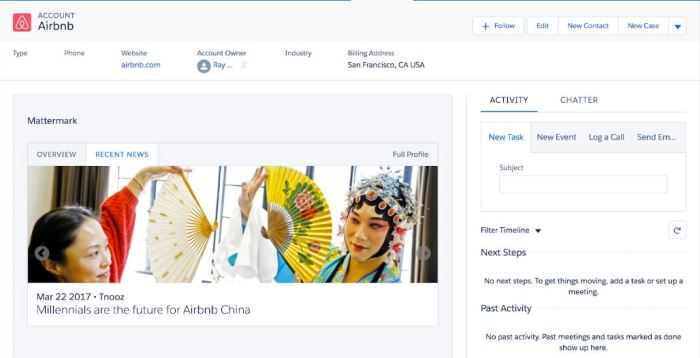
The Mattermark Account I-Frame in the Salesforce AppExchange supports both company news and an account overview with over 80 fields. The service is reasonably priced at $49 / user / month.
Mattermark is back as an independent company after being acquired by FullContact in late 2017. Unfortunately, the acquisition announcement was mishandled with FullContact first saying the product was going away and later saying that it was still available.
The relaunched
Mattermark attracted back much of its early staff including its founders
Danielle and Kevin Morrill and Product Lead Paul Denya. The firm has a
“renewed focus on private deal intelligence.”
“This transition has been in the works for the past few months without disruption to services. You have our assurance that will continue to be the case.”
Eric Milliken
To support
the relaunch, Mattermark is adding headcount to their customer service,
engineering, and data teams “to redouble our commitment to customer
satisfaction and data excellence.”
Mattermark data coverage spans 4 million companies, company news, and funding data. Users can leverage public lists or build shared lists. Mattermark also supports an API, Salesforce integration, Chrome extension, Google Sheets, and lead and account enrichment.
If a US public company, look at its 10-K (annual report). Firms generally discuss their competitors. You can locate the 10-K on a company’s investor site, through sales intelligence vendors, or free Edgar sites.
If a private company, look at Owler, a free site (See below). This is crowdsourced so may include firms that aren’t true competitors.
Owler competitor lists are gathered through social voting.
Look at sales intelligence services such as D&B Hoovers or InsideView. Hoover’s competitors are editorially generated and include top three flags (see below)
D&B Hoover’s competitor lists are gathered by a team of researchers.
Within IT, look at Forrester Wave reports. Another option is technology category searches in PE/VC databases such as DataFox, Crunchbase, Pitchbook, or CB Insights. Keep in mind that companies within the same segment may not be competitors, but partners, customers, etc.
Many industries have industry specific market research that includes competitors. A few general market research firms also provide competitors (e.g. MarketLine, Euromonitor, Global Data, and Freedonia). Top Competitors are also available in IBISWorld, Vertical IQ, and First Research.
Zoominfo and a few other vendors identify similar companies based upon proximity in articles. This finds competitors, but also customers and partners so should be carefully reviewed.
For new technologies or industries, D&B Hoovers offers Conceptual Search which identify companies associated with key phrases (e.g. Marcellus Shale, Obamacare). This is more of an associated companies list and will identify firms in a topical ecosystem. For example, “Harry Potter” identifies studios, publishers, toy makers, theme parks, and thematic tours. (See example below of conceptual search on Marcellus Shale). Conceptual Search lists may be refined by standard prospecting filters such as industry, geography, and size.
D&B Hoover’s Conceptual Search looks for companies associated with specific phrases.
If none of these work, use peer list searches (industry code lists) or keyword searches in sales intelligence vendors. If cost is a concern, go to your public library and see if they have ReferenceUSA, AtoZDatabases, or Mergent Online. Each of these allows you to build peer lists based on industry codes, company size, and geography. If you need help, ask for the business or reference librarian to assist.
EMIS, a research service for emerging markets, was sold by Euromonitor Institutional Investor to CITIC Capital and Chinese media company Caixin Global back in April. CITIC is an alternative investment management and advisory company. Also included in the sale was CEIC data, a provider of global time series data. The two businesses, jointly named ISI Emerging Markets, have been run in parallel and will continue to do so, but sales operations have been merged. Sales continues to be organized regionally, and some product specialization will be retained.
ISI
is headquartered in Hong Kong with offices in eighteen countries. The
firm has over 500 employees located in both emerging and developed
countries. The two firms reported an operating profit of £11.9 million
($15.1 million), as disclosed in the notes to Euromoney’s 2017 annual accounts.
The firms reported 2016 revenue of about $52.7 million and EBITDA of
$14.5 million. Based on 2016 turnover and the $180.5 million purchase
price, the deal had a 3.4 multiple.
EMIS
delivers news, research, analytical data, and peer comparisons for over 125
emerging markets. The content is multi-lingual and serves researchers,
industry analysts, corporate strategists, credit analysts, and business
development professionals. Customers are found in corporate and
investment banking, consultancies, private equity, government, and academia.
EMIS displays news and research from 7,000 publications and 3.6 million emerging market company profiles, two million of which include financials. Industry sources include BMI Research, Technavio, MarketLine, Mintel, and Euromonitor. Sixteen languages are supported for content and UI along with cross-translations between the languages.
The
products have regional strengths. CEIC began with a Chinese focus twenty-five
years ago and is strongest in Asia. EMIS began in Eastern Europe, but now
generates half of its revenue in the Americas. Asia now represents 25% of
its revenue with India its fastest growing market.
Chief
Product Officer Diego Obere said that “the majority of our employees are
based in emerging markets, allowing us to establish an unrivalled level of
expertise on these often opaque countries.” The firm’s “focus [is] on
providing our clients with information on countries that are classed as
emerging markets. Over 90% of our 5,000+ content sources are from emerging
markets”.
The
product roadmap includes an improved EMIS UX, upgraded industry pages, and
investments in improved mobile and API access.
Channel-wise, EMIS partnered with EBSCO and ProQuest for university distribution. The firm supports both subscription access and on-demand research purchases.
Dun & Bradstreet is looking to modernize its D-U-N-S Numbering system to support
digital businesses which may not have a phone number or physical
location. D-U-N-S Numbers, which are the de facto global company numbering
system, were developed by Dun & Bradstreet in 1963 and have long captured
business locations including headquarters, subsidiaries, and branches along
with firmographics and corporate linkage. Currently, there are over 300
million D-U-N-S numbered active and inactive global businesses. But this
model fails to capture the emerging nature of digital businesses and the gig
economy. The expanded definition will shift from location to “point of
commerce.”
“You can be a digital business. You can be a business that
is a two-person startup right out of a coffee shop and you’re accepting PayPal
as your form of payment. That doesn’t require a physical address
anymore. You could be part of the gig economy. You can be an Uber
driver. You can have an Airbnb property. Those don’t necessarily
fit under the mold of traditional businesses,” said Saleem Khan, Digital Leader
of Data Innovation at Dun & Bradstreet.
“That idea of point of commerce subsumes everything. It subsumes the digital location. It includes things like the Internet of Things and the gig economy as well.
Saleem Khan, Dun & Bradstreet, Leader of Data Innovation
The rise of the Internet of Things also calls for a broader
definition of businesses to assist with master data management and business linkage.
“There are 11.2 billion Internet connected devices out there, half
of which are doing B2B commerce,” said Khan. “It’s a ship coming into a
port and being scanned automatically. Wouldn’t it be nice to know which
businesses are tied to that particular Internet connected device? And so,
with respect to the D-U-N-S Number, what we’re doing is moving away from
business at a physical location in favor of business at a point of commerce.”
An expanded definition also benefits government agencies and financial
services companies which often require D-U-N-S Numbers for business
verification (e.g. anti-money laundering, know your customer), sub-contracting,
and credit and supplier risk analyses.
DiscoverOrg now offers two classes of segregated companies and contacts.
DiscoverOrg, which has historically focused on decisionmakers at top companies, greatly increased its company and contact coverage last week. The firm now collects data on 500,000 global companies, trebling its coverage. With respect to contacts, coverage grew five-fold to 20 million decision makers. All of the new companies are headquartered in the United States, but roughly 27% of the new contacts work outside of the United States.
The
expanded company and contact data has long been captured by DiscoverOrg but not
presented within their service. Thus, adding a lower tier of records
presented a problem which was solved by segregating the records into two
categories: Research Verified and Technology Generated. Research verified
profiles are collected and audited editorially. They are subject to
DiscoverOrg’s 95% data quality SLA with 96% direct dial fill rates and 98%
email fill rates. The research verified dataset spans 4.35 million
contacts across 163,000 global companies. This dataset remains their
primary universe.
The
technology generated dataset is collected, validated, deduped, and categorized
by DiscoverOrg’s platform. The dataset spans 15.5 million contacts across
319,000 additional US companies. As the dataset also includes technology
generated contacts at research-verified companies, sales and marketing can
utilize the technology-verified contacts when there are few eligible contacts
with the desired titles within the human-verified dataset. They can also
drill down into a universe of smaller companies not subject to human
verification.
“The dramatic growth of our database is due to rapid advancements in technology-enabled processes built on a decade of expertise with human-verified research. This human+technology approach has allowed us to develop unique assets for cleansing, verifying, and maintaining data that gives our customers the best advantage available: deep, accurate and complete data that fuels their growth.”
Derek Smith, DiscoverOrg Senior Vice President of Data
When
prospecting, human-verified and technology-verified contacts are displayed as
separate lists. When viewing contacts in a company profile, the
human-verified contacts are displayed by default, but the technology-verified
contacts are accessible if needed.
DiscoverOrg
built its reputation with a human-researched and verified database of top
companies which includes org charts, real-time buying signals, sales triggers,
and technographics. The firm is now deploying “proprietary technology and
human-in-the-loop automation” to deliver “a significantly broader universe with
levels of accuracy not typically seen at these volumes.”
DiscoverOrg
President Katie Bullard did not provide details on their technological
verification processes, but stated, “We have a variety of proprietary tools and
technologies that ensure the highest level of depth and quality available in
the market. Some of these include tools for retrieving and validating
direct dial phone numbers, email verification tools, and tools that parse job
descriptions to identify technologies used.”
The
expansion provides deeper coverage of SMBs. 94% of covered companies have
fewer than 1,000 employees and 75% have fewer than 100.
The
new contacts have a minimum of a corporate phone, email, title, department, and
company. Approximately 27% of the new contacts include direct dial
phones. DiscoverOrg is confident that email accuracy is above the
industry standard.
“With
this launch, no other company in the industry offers the data quality and depth
that smart go-to-market motions demand, AND the data quantity to reach entire
addressable markets,” claimed DiscoverOrg.
While DiscoverOrg covers international companies in its human-verified dataset, they do not have an international office, “but we’re always considering our international strategy,” said Bullard.
Industry research firm Vertical IQ launched a mobile app which delivers condensed profiles of 300 industries which can be quickly viewed before meetings or while commuting. The app is available on iPhone and Android devices at no additional charge for current customers.
“Vertical IQ users are busy professionals, and the reality is that they often don’t have the time to research and read an entire industry-related paper to prepare for a client or prospect meeting,” blogged the firm. “In order to best help our busy customers, we have to design the most efficient, practical way possible to prepare for meetings—writing and organizing industry-specific information that is digestible, quick, and to-the-point.”
Industries are listed alphabetically and searchable by Vertical IQ industry, NAICS / SIC, and Favorites. Searching is by keyword, so “Pest” returns Pest Control, Agricultural Chemical Manufacturers, Landscape Services, and Pest Control Services. The results list may be viewed alphabetically or by sector. The app has a short “Time to Pie,” a term coined by Intuit which means how quickly do users get to useful information.
Content is broken into eleven chapters which are navigated by a three-bar icon across fromthe chapter title:
Summary
Big Picture Video – an industry overview which helps reps “quickly visualize the business, gain insight, and be ready to talk about points of [my client’s] industry.”
Fast Facts – Average company size, geographic distribution, top firms, business structure, etc.
Call Prep Questions – Capital Financing, How Firms Operate, Industry Trends, Risks to Watch Out for, Working Capital
Working Capital – Sell and Invoice, Collect, Manage Cash, Pay, Report, Cash Management Challenges
Trends
Risks – Industry Risks, Company Risks
Numbers – BizMiner industry ratios
News
Quarterly Insights
Bank Product Usage – Industry adoption of standard bank products from Barlow Research
Vertical IQ was co-founded by Bobby Martin, who also started First Research. Both services provide an extensive set of industry snapshots for relationship managers looking to quickly learn about key industries.
“Vertical IQ helps you save time, increase the likelihood and effectiveness of pre-call planning, deepen relationships with clients, improve banker confidence during calls, and bridge the gap between a banker’s financial knowledge and business knowledge.”
Vertical IQ
Vertical IQ supports nearly 35,000 bankers, accountants and advisors who serve small to medium-sized businesses and professionals. Along with subscription services, users may purchase individual reports for $99.
DiscoverOrg now displays 22,000 global family trees to the subsidiary level.
DiscoverOrg, which has long emphasized technographics and contacts, expanded its company intelligence with the addition of global corporate hierarchies and private equity / venture capital funding intelligence. DiscoverOrg also expanded its contact / biographic coverage with detailed work histories, educational profiles, and North American mobile phones and personal emails.
“The traditional playbooks for B2B prospecting and corporate recruiting don’t work anymore. Today’s buyers and hires expect highly personalized outreach at the right time that cuts through the mass-produced noise we’re all inundated with. The additional data we are now delivering make it even easier for our customers to craft the right message and engage where and when they are most likely to get a response.”
DiscoverOrg CEO Henry Schuck
Family trees
are color coded and available for 22,000 global companies along with their
divisions and subsidiaries. Tree nodes may be expanded and collapsed,
allowing sales reps to customize their view. Users may link to major
subsidiaries that are also contained within the DiscoverOrg company universe
while non-covered subsidiaries are grayed out. Tree nodes include logo,
location, and ownership type.
DiscoverOrg
has long offered org charts highlighting contact reporting structures, but
family trees have been a gap in their service until now.
Funding data
includes total funding and round details such as amounts, dates, and investors.
DiscoverOrg did not disclose the sources of their new data sets beyond saying they were licensed from “leading third-party data providers.” The new content was verified by their 250 editors and DiscoverOrg’s automated verification processes prior to being presented to clients.
DiscoverOrg continues its rapid content build out with 4.3 million human-verified contacts across 160,000 top global companies. Additional functionality around the family trees is planned for the next three months. The firm also expects to add funding data screening to their build-a-list functionality.
“Our biggest differentiator is our ability to bring together proprietary technology,automated tools, and integrations that gather data – plus a layer of human verification to ensure its accuracy.”
Katie Bullard, DiscoverOrg President.
DiscoverOrg confirmed that they are on target for their $160M end of year ARR.
Back before the development of ICP / TAM tools and predictive analytics platforms, B2B marketers would simply describe their target market as the Global 2000 or Global 5000. The description was overly broad, but it generally meant global enterprises with revenue in excess of $1 billion.
Of course, you could easily refine the list with broad segmentation. For the sales intelligence vendors of 2005, it was the intersection of G5000 and (Professional Services, Financial Services, Tech firms).
So while there are now tools to refine your target universe, there remain companies that continue to focus on the G5000 concept. This includes startups and companies with expensive B2B solutions. It also includes Enterprise Sales groups.
Harry Henry has built a business around the G5000 concept. For a long time, the Global5000 database consisted of a hand-researched list of billion dollar revenue companies; but, a few weeks ago he released a companion dataset of top US execs for G5000 with plans to sell international contacts in the future. Henry has partnered with Salutary Data to build his new offering.
Marketers can license the G5000 company set for $2,300. The accompanying US dataset of 25,000 executives spanning 2,100 firms is available for $3900. Fields include
First & Last name
Job Title
Address (street, city, state & zip)
Email address — 100% fill rates
Phone number – Two possible phone numbers with a 35-50% direct dial fill rate.
The contact dataset focuses on Executive Management, Finance, HR/Personnel, Technology/IT, and Marketing.
“To provide you a sense of our vetting process, the contact records are aggregated from some 8 supplier sources and then tested using separate vendors who verify and score the accuracy of emails, phones, and name/title/company. The results of these tests are used to identify the most accurate data, which enables us to create a data stack. In addition, external and internal corroboration sources and techniques are also applied to further help identify the most current and accurate records.”
Global5000 Website
The contacts file is available with quarterly refreshes. Segmented versions by industry or job function are not available.
The G5000 database consists of over 5,000 active companies generating $60 trillion in annual revenue and employing 130 million employees. Revenue per employee of the G5000 firms is $397,000. The file includes five-year employee and revenue data along with recent events, business descriptions, year founded, industry, segment, market and ticker, and business contact details (e.g. address, phone, URL).
CreditSafe USA added payment and trade line intelligence to its US credit reports. Expanded intelligence includes trade line information from business leases, commercial credit cards and term loans that will enable businesses to make better, more informed decisions. Other information includes total credit utilization, past due amounts, at risk balances, and closed accounts.
“While business credit reports and scores are traditionally put together using a variety of public and private information covering business demographics and company-to-company trade payment data, the addition of payment data showing not just how a business pays its bills, but how it pays its term loans, commercial cards and other debts takes our reports to another level,” said Matthew Debbage, CEO of Creditsafe’s Americas and Asia-Pacific division. “Creditsafe has built its reputation and success on doing things differently. We are committed to changing the way business information is used and by adding in this payment data to our U.S. offering we are continuing to do just that and to provide American businesses with a compelling option. Our Analysis shows that a typical user will now have the added benefit of seeing financial payment data on over 40% of previously ‘thin credit file’ companies. We believe this increase in data availability is a complete game-changer.”
CreditSafe USA Closed Account Details
The new financial details span $220 billion in commercial transactions from 400 financial institutions.
A 2016 Manta survey of small businesses identified a “major knowledge gap” concerning business credit scores. The survey of 3,000 businesses found that almost three in four did not now their own credit score and sixty percent did not know where to obtain such intelligence.
OrgChartCity provides family trees by function and division.
Five years ago, there were several options for editorially researched org charts. These included DiscoverOrg, RainKing, SalesQuest Crush reports, and iProfile. But DiscoverOrg acquired both RainKing and iProfile and SalesQuest was acquired by OneSource which was later acquired by Dun & Bradstreet and bundled into the D&B Hoovers technology premium. Thus, the options for org chart intelligence narrowed significantly. However, Bowman Marketing Services (BMS), a company profile research firm based in Austin, TX, now offers OrgChartCity as both single profiles and a subscription service.
OrgChartCity intelligence includes both organizational structures and notes concerning budget data and responsibilities. Licensees receive both a PDF org chart and an Excel CSV containing first and last name, department, email, phone, and title.
CEO David Bowman, describes the OrgChartCity value proposition as “contacts in context” which provides org charts “handcrafted by business experts, not some nested database of contacts that a computer nerd put together.”
Information is collected through both primary and secondary research along with automated checks. Each data source is assessed by recency, context, and source type with records included only if they meet a 90% confidence threshold. If a company has not been updated in the prior 90 days, the licensee is provided with the current profile and a refreshed profile within a couple of days.
The firm focuses on the Fortune 500 and Global 2000. Coverage currently spans 500 companies with the firm adding dozens of org charts each quarter. Overall, the firm has around 35,000 active, profiled executives.
Individual profiles may be purchased by credit card on the OrgChartCity website for $125. An annual subscription to the full database is priced at $10,000 and includes alerts and full access to updates.
While Bowman Marketing Services is initially focusing on org charts, the firm performs detailed custom research for its clients and plans to market additional datasets in the future.
Custom research topics include company overviews, competition, segments, budgets and departments, social media presence, sustainability, news (specific to the client), technology platforms (specific to the clients), awards and recognition, financial outlook (summarized for sales reps), and 2018 initiatives. Custom report pricing runs between $1,000 and $5,000 per company based upon the number of topics covered and the size of the company.
BMS has been providing custom research since 2005. The custom business is profitable and OrgChartCity is nearing breakeven. The firm maintains a staff of 20 to 25 researchers.