Contacts database Social123 rolled out a set of enhancements to their contact enrichment service including more accurate matching, expanded reporting, saved searches, improved security, and additional enrichment fields.
Match rates were improved due to the normalization of company and contact names on input files. Name standardization reduces the number of nicknames, typos, and corporate identifiers (e.g. LLC) prior to match processing. D-U-N-S Number matching is also being offered which allows marketers to upload a list of D-U-N-S numbers and receive a set of targeted contacts at the companies. (D-U-N-S numbers are a proprietary global company numbering system developed and maintained by Dun & Bradstreet. They are the closest schema to a de facto global numbering system for companies and corporate linkages).
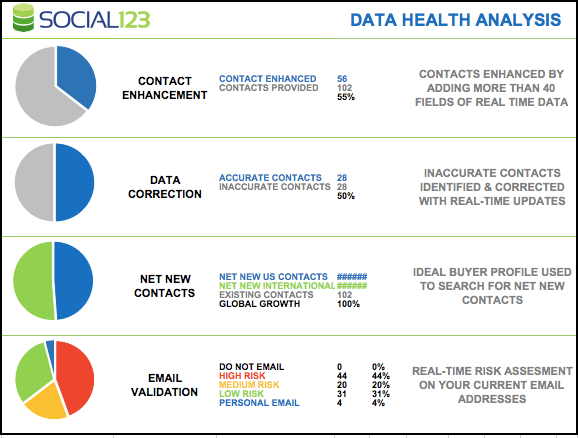
Social123 automated their Data Health report with data quality metrics, net-new contact counts, and contact analytics. Amongst the new contact analytics are the top ten titles and the top ten reported skills.
Social123 added twenty-five site location fields including address, phone, SICs, NAICS, revenue, employee count, and geocodes.
To improve security, users are no longer emailed direct file links. Instead, notification emails direct users to a secure application.
Finally, Social123 now offers a firmographic only append. Other services include contact prospecting, data cleansing, and email validation
The Social123 contacts dataset now exceeds 300 million detailed global contacts sourced from the open web and social media.
D&B NetProspex Workbench Data HealthScan report provides a free PDF detailing pre and post enrichment field population rates, data error rates, and segmentation reports.
Oftentimes when a small company is acquired, it is treated as a cash cow (if it is producing cash) or plugged into a larger business to address a capabilities gap or generate cross-selling opportunities. Less frequently is the new asset treated as a vital, strategic asset to help enter new markets.
Audience Solutions
In the case of Dun & Bradstreet’s acquisition of NetProspex, the acquired division has been a keystone for Dun & Bradstreet’s entry into Audience Solutions (Visitor ID, Audience Targeting). Dun & Bradstreet is beginning to gain traction in the programmatic advertising space. On their most recent earnings call, CEO Bob Carrigan noted that their customers have long relied on Dun & Bradstreet for company data, but that this data was difficult to map to online activities because people surf the net, not companies. When the firm acquired NetProspex early last year, they immediately set out to combine the NetProspex contact data with Dun & Bradstreet firmographics and D-U-N-S Numbers.
“Our contact data, coupled with our company data, on boarded for the digital world and matched to online cookies, helps our customers get their advertising in front of the right target, and the right decision maker at that target, at the right time,” said Carrigan. “And, by organizing around the D-U-N-S Number, our customers can finally connect their offline customer management data with their online advertising campaigns, creating that vital bridge between ad tech and marketing tech.”
Dun & Bradstreet data is then mapped to three hundred online segments. These segments utilize anonymous data including size variables, industry, job function, propensity to purchase specific products, and likelihood of qualifying for loans or company credit cards. Segments are then delivered to partners including Oracle, Adobe, Google, Xaxis and Nielsen. Furthermore, the firm’s global direct sales team offers bespoke segments for custom targeting.
“[The] whole programmatic wave, it’s all moving to B2B right now. And we’re starting to see some really nice uptake because we’re available for all the major buying platforms,” said Carrigan. “We’re also selling direct licenses to marketers as well and obviously we’ve got a portfolio already of sales and marketing solutions. This is a really nice complement to that and we’re trying to catch this wave and really deliver scale in a market that’s highly fragmented. So we’re pretty excited about this. It’s a great example of leveraging our core data in a new use case and it’s a great place for us to be.”
Adding Value to Hoover’s
Dun & Bradstreet also moved to quickly integrate NetProspex contacts into its Hoover’s sales intelligence service and used the NetProspex CleneStep contact verification process to validate Hoover’s contacts. The result was a deeper set of accurate contacts within Hoover’s and other Dun & Bradstreet contact-based offerings. The swap also saved Dun & Bradstreet several million dollars in contact acquisition costs.
NetProspex is also one of Hoover’s new Concierge Services for SMBs. Concierge services are turnkey marketing services for SMBs that have limited marketing resources.
Investing in NetProspex
A further sign of the strategic importance of NetProspex is the continuing investment in the NetProspex Workbench service. Workbench is a cloud-based data hygiene hub which verifies contacts (phone, email, and address), enriches the records with firmographics and technographics, provides segment and data hygiene analytics, and delivers net-new contacts. Their data health report is a slick PDF analysis of contact file health and segmentation. It is given away free as it also promotes Workbench enrichment (pre and post enrichment rates) and prospecting services.
The first thing that D&B did after acquiring NetProspex was swap out the weak firmographics attached to NetProspex contacts and replace them with D&B firmographics from their WorldBase file. This provides NetProspex with both more accurate firmographics and a much deeper set of company linkages.
Why linkage is important: Each new lead should be scored to determine whether to nurture the lead or send it immediately to a sales rep. Linkage data ensures that contacts associated with subsidiaries or branches of current customers and prospects are immediately forwarded to the appropriate sales rep. Furthermore, qualification is based upon the parent company, not simply the size information of the subsidiary or branch. Finally, channel conflict is reduced if leads are properly routed to the appropriate sales rep. Reliable firmographic and linkage enrichment provides a neutral third-party source for lead routing.
In January, NetProspex released a new dashboard set to its Workbench cloud-based data hygiene products. According to Dun & Bradstreet, “The dashboards keep track of consumption levels and alert you when you are in need of Targeted Data or a Data HealthScan. Now you can also gain insight into your Eloqua connectors in terms of performance and data enrichment.”
Data Management subscribers now see a Data HealthScore meter which indicates the overall quality of their most recent data HealthScan. They are also shown data management scores over time.
NetProspex Data Health Optimizer Report (Workbench)
Target Data subscribers can view the total number of contacts acquired over time and a Current Consumption meter which shows “the exact percentage of contact data you have consumed.” NetProspex also added calendars to the service indicating the last time data was managed by the platform and the recommended next action date.
Finally, NetProspex increased the number of US contacts to 42 million. Each of these contacts includes an email and a significant percentage contain direct dial numbers.
Data Analytics
While the Workbench service has long offered analytics, NetProspex recently added two analytical models to their Targeted Data subscriptions fulfilled by its Workbench platform. The two scores assist with segmentation, lead scoring, and messaging. Spend Capacity is based upon “non-traditional predictive segments such as UCC filings, inquiries and SIC revenue %.” The predictive score ranks the spend capacity of a firm between one and one hundred.
The second modeled score is Growth Trajectory which “anticipates the future growth or decay of a business based on a mix of criteria including revenue, borrow levels, credit inquiries, order frequency and spend levels.”
Targeted Subscriptions help marketers scrub their marketing database of poor or outdated leads. Records are standardized, verified (phone, email, and address), and enriched with Dun & Bradstreet company and contact data (42 million US B2B contacts with emails and direct dials). The subscription then maintains the marketing dataset and replaces bad records with good ones. The service includes Workbench Analytics concerning segmentation, technographics, and data quality.
“Data analytics (based on facts not probabilities) have not been readily available to the average marketer. That’s no longer the case. D&B is leveraging our deep expertise in understanding and analyzing company data and providing analytical insights as a value-added dimension to our Targeted Data Subscribers — no data scientist or fancy software needed,” says the firm.
Optimizer
According to Carrigan, Dun & Bradstreet generated more than ten million dollars in cross-sales revenue in its first year. This would include both cross-selling contact hygiene and enrichment services from NetProspex into the Dun and Bradstreet customer base and selling Dun & Bradstreet services to NetProspex clients. A key cross-sale is NetProspex contact enrichment and D&B Optimizer company enrichment sales. Optimizer lacked contact enrichments so NetProspex closes that gap.
What’s more, Dun & Bradstreet recognizes that the Optimizer platform needs to be modernized and announced plans to build company Optimizer services on the Workbench platform. Once completed, Workbench will provide a broader utility to marketers that need both lead (contact based) and account (company based) enrichment of their marketing automation platforms and CRMs.
While other sales and marketing intelligence vendors provide integrated prospecting within marketing automation platforms, Salesforce has not implemented Data.com prospecting for the Pardot B2B marketing automation platform. Pardot is strictly a permission-based marketing platform so sales reps need to work the prospects to obtain marketing permission before the record can be sent from Salesforce to Pardot.
“It’s a bad idea to purchase email lists and immediately send email to those purchased prospects, and no reputable email service provider will allow you to immediately send email to a purchased list. However, that doesn’t mean you can’t benefit from this treasure trove of information, as long as permission is explicitly obtained first,” said Skyler Holobach, Pardot’s Email Compliance Manager.
Instead, Holobach recommends using Data.com Clean to enrich basic contact information obtained from web forms or tradeshows. If the user is synching with Data.com Clean, then company and contact data is enriched. Otherwise, users can synch against Data.com Connect for contact enrichment. Updating takes the user through a “stare and compare” process.
When users have Data.com Prospector lists, they are required to call into accounts to obtain opt-in permission.
“The incorrect way would be to use Data.com as a cold lead generator for email purposes. Given the terms stated in the Permission-Based Marketing Policy, customers can not pull in prospects through Data.com and immediately add them to Pardot lists for emails and/or nurturing without first obtaining their permission. By not following best practices, you’re also running a significant risk for getting your IP address blacklisted, which can lead to significant email reputation damage,” said Holobach. “Instead, you should follow the best practices outlined above, to first obtain permission prior to sending email. By obtaining explicit permission prior to sending email, you can reap the benefits of the Data.com database while staying in compliance with Pardot’s Permission-Based Marketing Policy and keeping your email reputation high.”
I recently had the opportunity to interview Avention’s SVP of Product Lauren Bakewell concerning their new OneSource DataVision service. The full interview can be found in trade publication Jinfo (FKA FreePint). The new service provides a centralized data enrichment hub with visualization and segmentation tools to assist with business planning, territory planning, and account based marketing (ABM). DataVision also assists with TAM analysis and offers similar companies and contacts.
Like many other sales intelligence and Martech vendors, Avention is messaging around ABM programs which identify best customers and prospects for focused sales and marketing attention. DataVision “helps companies understand their current customer base in detail and identify the most relevant target companies and segments for growth,” said Bakewell. “OneSource DataVision benefits the marketing department by enabling customer segmentation and target identification, which in turn helps create targeted lists for campaigns, upsells and nurturing. Any marketer knows that a more targeted approach generates better leads for sales, meaning higher campaign ROI.”
According to Bakewell, Avention supports ABM and Account Based Sales Development (ABSD) processes in three ways:
Identifying target accounts
Delivering insights concerning accounts and contacts
Building lists of contacts at target accounts
Avention continues to build out its Global Content Live reference file built from over 100 data providers. Vendor content is fused to create a “golden record” which selects the most reliable vendor at the field level. International coverage has recently been tripled with a goal of covering 80% of GDP in their served markets by the end of 2016.
DataVision will soon be announcing connectors with the major marketing automation platforms. They are also “looking towards a more guided approach to help you get to the most meaningful segmentation, as well as areas to explore for growth. We want to move forward by providing more market analytics as part of the offering, helping you understand your data in an even more actionable way,” said Bakewell.
This morning, sales and marketing intelligence vendor Avention unveiled a survey and set of recommendations on implementing Account Based Marketing strategies. ABM is quickly moving from a buzzword to an actionable strategy for strategically targeting your best customers and prospects. If you are considering an ABM strategy or researching how to move forward with ABM, Avention’s “Account-Based Marketing: The Art of the Start – Leveraging a Strong Data Foundation to Fuel ABM Success” guide is now available.
The Avention Survey of over 100 top level B2B executives (e.g. CEO, CMO, VP of Sales) found that ABM strategies require “careful data-driven planning, execution and monitoring.” Furthermore, the lack of data access and quality are “fundamental impediments” that need to be resolved for ABM strategies to succeed.
ABM is based upon strategic targeting of your best accounts and similar companies. If your underlying data is poor you will have problems with best customer cloning, account messaging, and drilling deeper into organizations for cross-sell and upsell. Furthermore, “once a program is started, it is essential that account and market news and events be monitored to ensure programs remain relevant.”
Todd Berkowitz, research vice president for Gartner1 wrote in a January report, “By getting a better view of customer data, creating predictive models, employing account-based marketing, and creating internal and external-facing content specifically for existing customers, even marketing leaders from smaller providers can increase the likelihood of success.”
90% of the surveyed B2B execs believe that ABM is relevant to their organization and 86% are confident that ABM will drive growth; however, 75% are having trouble finding the appropriate contacts for selling deeper into target organizations, and more than fifty percent of B2B marketers lack an ability to monitor and adjust programs directed towards ABM accounts due to a lack of real-time intelligence.
ABM Survey of B2B Executives republished with permission from Avention.
Avention noted that ABM is a long-term strategy that requires continuously updated account and contact intelligence if campaigns are to remain relevant. For example, messages and offers may need to be adjusted due to key events such as executive changes.
Avention CEO Steve Pogorzelski summarized the ABM implementation problems found in the survey:
Almost two-thirds of the marketers responding to our survey report not having access to a single source of truth for customer data. This obviously impedes starting an ABM program and running it to successful conclusion, as such programs demand access to accurate and continually updated market and account data. ABM offers enterprises the opportunity to quickly fuel their customer acquisition, growth and retention strategies.
Pogorzelski noted that Avention provides three capabilities which support sales, marketing, and sales operations ABM responsibilities:
Marketing: “Consolidation and visualization of in-house customer data for sophisticated segmentation.” (For more on these capabilities, see my February blog on the launch of their DataVision platform).
Sales: Strategic intelligence concerning companies and contacts along with predictive indicators.
Sales Operations: CRM and Marketing Automation ecosystem connectivity.
Finally, I would note that traditional approaches to marketing data quality which involve annual data cleanses are insufficient to meet ABM and predictive marketing needs. Marketing data, particularly contacts, ages quickly. The lack of a continuous data quality strategy will result in a drop-off in sales and marketing productivity as contact and company data decays.
1 Gartner, Tech-Go-to-Market: Four Ways Marketers can Generate Demand with Existing Accounts, January 29, 2016
Full Disclosure: I broadly advise companies across the sales intelligence space including Avention. While I periodically write commissioned blogs for Avention, none of my commentary on my own blog or social media accounts is commissioned.
The Data.com Corporate Hierarchy Viewer displays the Dun & Bradstreet family tree. Users can add any location as an account. The tree also shows sizing variables and SFDC account owners.
Data.com has simplified its pricing from two tiers to a single tier for both its sales intelligence Prospector service and its data hygiene Clean offering. All Prospector users now receive the full Dun & Bradstreet WorldBase record for $150 per seat per month. The full Dun & Bradstreet file was previously priced at $165 per seat per month as part of the Premium offering. Corporate users will see the price rise from $125 to $150 but will receive the following additional content and capabilities due to the product unification:
Corporate family linkages with domestic and global ultimate parents
Corporate family hierarchy viewer
Up to six total SIC/NAICS industry classification codes
Account tradestyle (Doing Business As)
Account delinquency risk (High/Medium/Low)
Account latitude and longitude
Hoover’s First Research call prep content for imported and matched company records
Additional Hoover’s data/content, including Net Income, Industry Opportunities and Competitive Landscape
Users are still limited to 300 uploaded or downloaded records per user per month. Additional records are priced at $0.65 per record, unchanged from the previous premium offering. Data.com counts both company and contact records towards the monthly limit. Additional download record credits are not subject to monthly usage limits and may be allocated to Prospector accounts at the Salesforce Administrator’s discretion.
The Clean service price is now $25 per user per month for all users in the instance. All Clean users now receive the full WorldBase file. By standardizing clean to a single edition, Data.com has reduced the price of Clean Premium from $35 to $25.
Simplifying the product bundles makes sense. For premium users, there is a small price cut while there is a price rise for corporate users of Prospector but not Clean. As a premium to Salesforce, having two Data.com editions probably complicated sales discussions unnecessarily.
Lowering the price of Clean also makes sense as higher data quality raises the overall value of the CRM for sales, marketing, and support. Marketing enjoys better segmentation and targeting while sales benefits from improved company intelligence for qualification and fewer misrouted leads. Sales and support also benefit from the better population of contact information (e.g. direct dials, phones) and flags when an individual is no longer affiliated with the account.
While the price reduction makes Prospector more competitive with other Sales Intelligence solutions, Prospector remains at the upper end of the market. For example, InsideView for CRM is priced at $995 per annum, 44% below the price of Data.com Prospector.
Refresh, InsideView’s Salesforce enrichment service, exited beta and is now generally available to customers. Their AppExchange service provides automatic, continuous updates to CRM records “so that marketers and sellers can improve their response rates, get more qualified leads, and win more deals.”
The service updates incorrect information, appends missing fields, and provides duplicate management. To ensure administrative control, Refresh supports a “rule-based system with overrides.” Up to 40 fields are refreshed. Admins may also setup custom fields for enrichment. Salesforce Admins set the frequency to daily, weekly, or monthly.
One of the initial features is the ability to segment your database with different enrichment rules and update frequencies. Accounts can only be assigned to a single segment with a maximum of five segments. Outside of segmenting by international region or corporate divisions, I’m not sure why sales operations would set different rules for different accounts. It seems like a way to overly complicate data hygiene management.
The system provides admins two sets of alerts: the first notifies that matching has completed, and the second provides enrichment counts by fields.
InsideView Refresh email alerts notify the SFDC Admin that updates are pending approval.
Match scores are employed with a score of 100 assigned to any manually matched records (either by the admin or sales rep). Scores at or above 70 are viewed as auto-matched and enriched. Scores of 31 to 69 are available for review but not automatically enriched.
Subscription hygiene services provide broad-based benefits across multiple functions and workflows. In their product video, InsideView states that if companies don’t clean their marketing databases “it can severely choke your revenue operations. Poor data quality leads to lost productivity and lower revenue. For sales, it means wasted time and lost opportunities; for marketing, it means lower response rates and a shrinking pipeline; and for business operations, it means you’re on the hook to clean up the mess. You can’t afford to ignore the problem, yet most businesses aren’t prepared to address the complexity of their data and systems.”
The InsideView database currently spans 12 million prospectable companies and 30 million contacts. Company data is licensed from Equifax, Business Week (Capital IQ), Cortera, and Reuters. Additional contact data appears to be mined from the web though they are unclear about the sourcing now that NetProspex no longer provides contacts. They also offer a set of Community records which were “added or last updated using data that has been shared by InsideView users.” These contacts are verified by content editors.
The new service puts InsideView directly in competition with Salesforce’s Data.com Clean native offering for ongoing match and append. Data.com has an advantage in company coverage as it offers the Dun & Bradstreet global WorldBase file. With respect to contacts, InsideView offers fewer US contacts and emails but a broader set of international contacts. Neither service supports hygiene features such as email verification, address standardization, phone validation, or duplicate merge / purge (both have duplicate detection during record entry). Each claims standardization, but that is for records that are being enriched.
Both services also offer sales products (Data.com Prospector and InsideView for CRM), with InsideView having a clear advantage in several key sales intelligence categories (e.g. sales triggers, bios, social media “buzz”, a who knows who tool). The exception for sales intelligence is with respect to family trees (Dun & Bradstreet linkage is much deeper than Capital IQ linkage in InsideView) and industry content where InsideView offers thin overviews while Data.com now displays First Research industry overviews spanning 1,000 industries.
“When your CRM data is out of date, marketing targets the wrong contacts, accounts are assigned to the wrong territory, and salespeople waste valuable time,” said Jenny Cheng, chief product officer at InsideView. “We’re thrilled to announce the general availability of InsideView Refresh, the best way to update your CRM data to keep your lead-to-revenue operations working effectively.”
The Sales Intelligence (SI) space has been undergoing some rapid change over the past year. This evolution in functional scope and content sets has resulted in an expansion in the number of companies I cover as well as the categories (ABSD services, PE/VC funding databases). There is also a movement of sales intelligence vendors into marketing intelligence as the traditional SIs look for additional revenue opportunities and a broader value proposition.
A year ago, Account Based Marketing (ABM) was discussed mostly by DemandBase, a top of the funnel programmatic marketing vendor, but the predictive analytics vendors and Zoominfo began discussing the methodology. Thus, a year ago, ABM meant anti-ballistic missile or activity based management to all but the most well-versed marketers. Now the term is commonly found in corporate blogs and collateral and has spawned ABSD (Account Based Software Development) which follows ABM down to the middle of the funnel in the sales development function. There are now several ABSD vendors which I have begun to include in my newsletter including SalesLoft and QuotaFactory. ABSD shifts the sales development focus away from “smile and dial” calling towards targeted messaging into a set of top prospects. Since the prospecting activities are targeting higher value opportunities, there is a benefit to personalizing calls and emails. SalesLoft refers to this activity as “sincerity at scale.”
What is even more impressive about SalesLoft and QuotaFactory is that they are both less than two years old and yet they have already grown in commercial stature to the point where they are building out partner ecosystems with traditional SIs and other vendors. SalesLoft rolled out their Sales Development Cloud at their customer conference last month with nine partners including DiscoverOrg, InsideView, Datanyze, and Owler. At the same time, QuotaFactory announced partnerships with Bedrock Data, Ambition, HG Data, and InsideView.
A second area of rapid growth is the technology sales intelligence vendors. DiscoverOrg and RainKing have grown revenue and capabilities, transforming what was historically a sleepy niche into a significant sub-category. Both vendors have posted high multi-year growth rates, internationalized their datasets, expanded their technology trigger events, and developed CRM and marketing automation connectors. While they continue to gather rich profiles of IT execs, they are broadening their functional coverage to include non-IT functions that are significantly investing in IT cloud solutions such as marketing and finance. DiscoverOrg is continuing this functional expansion with product management (the recently released TEDD dataset), HR, and Sales. Furthermore, their databases, which once focused on the Fortune 1000, now cover nearly 50,000 top global companies and 700,000 executives. Both firms announced significant funding events in the past six months.
Aberdeen Group, which was spun off of Harte-Hanks last year, has begun to invest in the AccessCI database. Once the leading source of technology profiles and leads, the AccessCI (aka CiTDB and CITDS) dataset had received little investment from Harte-Hanks over the prior decade. Under new ownership, the product is once again receiving management attention.
The SIs have also increased their coverage of technographics. Avention acquired SalesQuest two years ago and integrated their Crush profiles into their products while other vendors have licensed vendor/product data from HG Data or mined technographic intelligence. HG Data has become so adept at collecting vendor/product data that DiscoverOrg and Aberdeen Group have begun licensing content from them.
Several firms that began as fundings databases found that Business Development was a logical extension of their value proposition and have since repositioned themselves as sales intelligence solutions. Firms such as DataFox and Mattermark are focusing more on sales intelligence functionality while CB Insights has launched a sales intelligence solution (with technographics) while retaining its focus on the PE/VC space.
For the most part, the SIs have avoided the predictive analytics space. The exceptions are Avention, which supports business signals and ideal profiles, and Radius which morphed from an SMB SI into a predictive analytics company. Meanwhile, the predictive analytics companies are beginning to offer a subset of SI features such as net-new leads.
Instead, the SIs have focused more on marketing analytics, data enrichment, and data hygiene which allows them to leverage their databases without investing in data scientists. Dun & Bradstreet acquired NetProspex last year for its contact database and the Workbench cloud data hygiene platform. They have also begun to offer Hoover’s concierge services including enrichment, segmentation reporting, and email delivery. Avention launched its DataVision customer data platform earlier this year while Zoominfo, Data.com, and InsideView have placed equal weight upon marketing services and sales intelligence services.
Social Selling continues to be a core element of positioning for InsideView and LinkedIn Sales Navigator. Artesian Solutions, a UK vendor that is launching a US product later this year, also focuses on social selling. A significant product gap across the SIs is the lack of social tools built into their offering. I can understand why SIs have shied away from Who Knows Who tools (the exceptions are InsideView and DueDil), but it is perplexing why most SI vendors have only limited sets of social media links and little social media content displayed in their services. Only InsideView, Artesian, and Owler have put much emphasis upon social media content.
Europe is also becoming a home of new services. DueDil has evolved into a UK challenger to Avention and BvD Mint while IKO System and Sparklane (formerly Zebaz) have an established presence in France.
When I started my newsletter four years ago, many of the companies and products either had not been launched or weren’t on my radar. I mostly focused on Avention, Hoover’s, InsideView, DiscoverOrg, BvD, Sales Genie, Data.com, and RainKing. While these companies continue to innovate, much of the energy is coming from new entrants. The rapid growth and diversity of sales intelligence functionality has been exciting to observe.
Credit: Darwin’s Finches are in the public domain. Charles Darwin, 1845.
Integrate evaluated over 750,000 records from B2B companies and found consistent data problems whether the firm was an SMB, Enterprise, or Media Company. In each case, roughly four in ten records contained inaccurate or bad information.
While the primary theme of my blog is sales intelligence, you cannot have sales intelligence if your databases are rife with duplicate records, invalid emails, missing or incorrect firmographics, and non-standardized values. These errors wreak havoc on marketing and sales. I came across a 2016 Integrate report that had a series of quotes on the subject which addressed the impact of bad data quality across multiple marketing activities:
The issue of data quality continues to be one of the biggest roadblocks to effectively analyzing the prospect and customer journey. It also dramatically increases the costs of analytics projects and negatively impacts performance. – Sameer Khan, Sr. Product Marketing Manager, IBM Customer Analytics
Dirty data is the silent killer of marketing campaigns. It makes you look bad, depresses the impact of great content and offers, and can put your brand, reputation and domain at risk (or worse). – Matt Heinz, President, Heinz Marketing
Data is the oil of any marketing engine, and in order to create perpetual demand generation, data accuracy needs to be a top priority. Marketers must be ruthless and deliberate about data quality and standardization at point of entry.
– Jonathan Burg, Sr. Director, Marketing+Customer Acquisition, Apperian
And if you still aren’t convinced that data quality can choke your initiatives, their research found that 40% of B2B records have some form of data quality issue with duplicate data representing 15% of your marketing database. Invalid Values and Ranges (10%) and Missing Fields (8%) were also common problems.
So if forty percent of your marketing data is faulty, then a significant percentage of your Marketing Qualified Leads passed to sales will contain errors including contacts not at companies (not evaluated by Integrate but contacts decay at a 25% rate per annum), and bad firmographics resulting in wasted time, incorrect routing, inaccurate lead qualification, and poor messaging. Furthermore, initiatives such as account based marketing (ABM), account based sales development (ABSD), and predictive analytics will stall if they are fueled by bad data.
A Data Quality report is an excellent way to start a data quality program. It helps with sizing the problem and providing an initial remediation cost.
Unfortunately, data quality is a boring topic. No new CMO has ever joined a company and said, “First, let’s perform a merge/purge on our account and contact records, standardize the fields, and enrich the records.” (OK, I’m being hyperbolic, there may have been a few). No, they want a shiny new marketing automation platform, new branding, and an advertising campaign that gets the company noticed.
Sadly, there is little glory in improving your marketing database — unless, of course, you want to improve your lead nurturing, scoring, segmentation, routing, and sales ready lead quality.
Quality is generally seen as a cost center but it can just as easily be viewed as a cost saver. Bad quality erodes your marketing effectiveness, hurts your brand, kicks the knees out from under your nascent big data experiments, and demoralizes sales reps. A bad company or contact record is like a virus propagated from system to system raising the cost over time.
Furthermore, how can you think about predictive analytics when your databases are rife with bad, incomplete, and out of date records?
Bad data isn’t simply a mistyped address. It’s also:
Missing lead firmographics making it difficult to nurture, score, route, and qualify leads.
Invalid emails that hurt your deliverability scores and decrease the likelihood your messages will be delivered to inboxes instead of spam folders.
Junk fields on web forms because the individual didn’t want to fill out a dozen fields to read your whitepaper.
Large gaps in your segmentation analysis labeled UNKNOWN.
Hosting costs for storing out of date and duplicate data.
Leads with missing linkage that were held for nurture because the marketing automation system didn’t know the location was a subsidiary of a Fortune 500 company.
Poor marketing messaging and targeting that tell the recipient that you know nothing about their business, job function, industry, or company size.
Finally, bad lead quality incentivizes sales reps to ignore leads because marketing never seems to send the “Glengarry” leads. Instead, they become demoralized as they call invalid phone numbers or find that the contact “doesn’t work here anymore”.
Henry Schuck, CEO of DiscoverOrg, describes the situation well:
Sifting through crappy leads as a sales person is incredibly demoralizing. Their commission – which often translates into their ability to save for their family’s future, have disposable income or cover their mortgage and car payments – depends on them being able to close business. Their ability to close business, in turn, depends solely on their ability to find, set appointments with, and CLOSE new opportunities. If the leads provided by your company will not help them do that – how does that feel? They just moved companies to come work for you and their future is uncertain, at best.
So look at data quality holistically. Address it at the front end in your call centers and web forms and then enrich and maintain your database over time. As contact records decay at a 25% rate per annum you need to view data quality as an ongoing process, not simply an annual refresh (which is more than many companies even do).
So by flipping your perspective, it is easy to find myriad tangible benefits which justify the cost of data quality programs. It may not lead to glory, but by recognizing the distributed costs of bad data and then remediating them, you can generate significant ROI.
Photo Credit: Data Hygiene report from Dun & Bradstreet NetProspex Workbench



 While other sales and marketing intelligence vendors provide integrated prospecting within marketing automation platforms, Salesforce has not implemented


 The Sales Intelligence (SI) space has been undergoing some rapid change over the past year. This evolution in functional scope and content sets has resulted in an expansion in the number of companies I cover as well as the categories (ABSD services, PE/VC funding databases). There is also a movement of sales intelligence vendors into marketing intelligence as the traditional SIs look for additional revenue opportunities and a broader value proposition.
