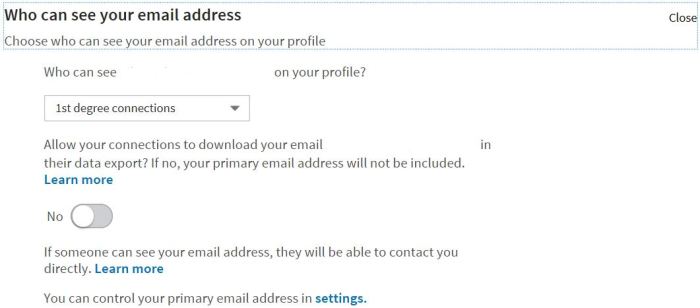
LinkedIn Email Downloading

LinkedIn users can block connections from downloading their emails.

LinkedIn added the option to restrict downloading of emails by their connections.  LinkedIn does not generally allow profile downloading or CRM synching except for permissioned connections.  Users now have the option to permit connections to view their emails but block them from downloading emails.  By default, emails are not downloadable unless users change their settings to permit downloads.

While the change is pro-privacy and consistent with GDPR, TechCrunch took a negative view of the new setting.

A win for privacy on LinkedIn could be a big loss for businesses, recruiters and anyone else expecting to be able to export the email addresses of their connections.…[The new option] could prevent some spam, and protect users who didn’t realize anyone who they’re connected to could download their email address into a giant spreadsheet. But the launch of this new setting without warning or even a formal announcement could piss off users who’d invested tons of time into the professional networking site in hopes of contacting their connections outside of it…

On a social network like Facebook, barring email exports makes more sense. But on LinkedIn’s professional network, where people are purposefully connecting with those they don’t know, and where exporting has always been allowed, making the change silently seems surreptitious. Perhaps LinkedIn didn’t want to bring attention to the fact it was allowing your email address to be slurped up by anyone you’re connected with, given the current media climate of intense scrutiny regarding privacy in social tech. But trying to hide a change that’s massively impactful to businesses that rely on LinkedIn could erode the trust of its core users.


Josh Constine, TechCrunch

TechCrunch overstates the loss.  Member control their data, not LinkedIn or LinkedIn connections.   Second, there are multiple ways to reach users from within LinkedIn including InMail, messaging, and PointDrive.  Unless the email is blocked on the profile, connections still have access to emails from within LinkedIn.  Finally, most emails in LinkedIn are personal emails, not business emails (an issue they should address by allowing both and setting privacy and messaging rules around multiple emails), so reaching out to individuals on their emails only makes sense for friends, family, and recruiters on LinkedIn, not businesspeople networking with colleagues and clients.

While LinkedIn wasn’t transparent about the privacy change, it enhanced the privacy of its members.  As such, looking for nefarious reasons for the enhancement is a reach.

Vertical IQ Launches Mobile App

Vertical IQ Summary (Mobile App)

Industry research firm Vertical IQ launched a mobile app which delivers condensed profiles of 300 industries which can be quickly viewed before meetings or while commuting.  The app is available on iPhone and Android devices at no additional charge for current customers.

“Vertical IQ users are busy professionals, and the reality is that they often don’t have the time to research and read an entire industry-related paper to prepare for a client or prospect meeting,” blogged the firm.  “In order to best help our busy customers, we have to design the most efficient, practical way possible to prepare for meetings—writing and organizing industry-specific information that is digestible, quick, and to-the-point.”

Industries are listed alphabetically and searchable by Vertical IQ industry, NAICS / SIC, and Favorites.  Searching is by keyword, so “Pest” returns Pest Control, Agricultural Chemical Manufacturers, Landscape Services, and Pest Control Services.  The results list may be viewed alphabetically or by sector.  The app has a short “Time to Pie,” a term coined by Intuit which means how quickly do users get to useful information.

Content is broken into eleven chapters which are navigated by a three-bar icon across fromthe chapter title:

  • Summary
  • Big Picture Video –  an industry overview which helps reps “quickly visualize the business, gain insight, and be ready to talk about points of [my client’s] industry.”
  • Fast Facts – Average company size, geographic distribution, top firms, business structure, etc.
  • Call Prep Questions – Capital Financing, How Firms Operate, Industry Trends, Risks to Watch Out for, Working Capital
  • Working Capital – Sell and Invoice, Collect, Manage Cash, Pay, Report, Cash Management Challenges
  • Trends
  • Risks – Industry Risks, Company Risks
  • Numbers – BizMiner industry ratios
  • News
  • Quarterly Insights
  • Bank Product Usage – Industry adoption of standard bank products from Barlow Research

Vertical IQ was co-founded by Bobby Martin, who also started First Research.  Both services provide an extensive set of industry snapshots for relationship managers looking to quickly learn about key industries.

“Vertical IQ helps you save time, increase the likelihood and effectiveness of pre-call planning, deepen relationships with clients, improve banker confidence during calls, and bridge the gap between a banker’s financial knowledge and business knowledge.”

Vertical IQ

Vertical IQ supports nearly 35,000 bankers, accountants and advisors who serve small to medium-sized businesses and professionals.  Along with subscription services, users may purchase individual reports for $99.

Salesforce: Trust is the Key Value for Tech Companies

Salesforce: Trust is the Key Value for Tech Companies

Speaking to Jim Cramer on Mad Money, Salesforce CEO Marc Benioff argued that for technology companies, the key value is no longer the great idea, but trust:

In technology over the last two decades, the most important thing has been the idea. That is, the best idea wins.   That has been what gets you funded, that’s how you grow your company, that’s been your highest value: the best idea wins. No longer true.

The current highest value is trust, and if trust is not your highest value, if the most important thing to you and your company is not trust, you need to look again, and that’s what’s happening with these companies today.

Salesforce CEO Marc Benioff

Benioff observed that a lack of trust is eroding Silicon Valley companies such as Facebook.  “Their executives are walking out, employees are walking out,and that happens with a lot of companies in tech right now. We’ve had a lot of walkouts this quarter.  And the reason why is because it’s kind of amessage to the executives: it’s time to transform.”

“Every company has to hold themselves to a new level of trust, and if your brand is not about trust, you’re going to have customer issues, and you can see that in that brand,” observed Benioff.

And trust has long been part of Salesforce’s value proposition.  The firm emphasizes it’s 1:1:1 philanthropy program (Donating 1% of technology, people, and resources) which has been adopted as a model by other companies.  Salesforce also promotes local nonprofits at Salesforce events, emphasizes Trailhead and meetups for skills advancement, embraced a San Francisco tech company tax to address homelessness, called for a US GDPR to protect privacy, raised womens’ wages to address a pay equity gap following a self-audit, and spoke out against anti-gay legislation.  Under a short-term profit-maximization model, these activities make little sense, but under a longer-term stakeholder’s approach, they make perfect sense.

Trust is based on a stakeholders approach to corporate governance.  It recognizes that Milton Friedman’s stance against social responsibility (“there is one and only one social responsibility of business to use its resources and engage in activities designed to increase its profits so long as it stays in the rules of the game, which is to say, engages in open and free competition, without deception or fraud.”) is wrong.  A stakeholders approach recognizes that employees, customers, partners, investors, and the general public all place value on companies that take a long-term view of their role in society.  Simple profit maximization is a short-term approach which fails to recognize that you can’t attract the best employees or close multi-million dollar deals if you are not trusted.

And you can see this in the stock price growth of Facebook and Salesforce over the past five years.  Facebook’s stock price outpaced Salesforce for the past five years, but once Facebook lost trust, its stock price declined.

Salesforce and Facebook both had strong stock price growth over the past five years, but Facebook retreated this year after it lost trust amongst stakeholders.

Dun & Bradstreet Privatization Update

Dun & Bradstreet Logo

Dun & Bradstreet continues to dribble out news about its privatization plan.  Last week the firm announced that Motive Partners has joined the acquisition group and that Stephen C. Daffron, Co-Founder and Industry Partner of Motive Partners, will assume the role of President upon transaction close.

Two weeks ago Black Knight announced that it is acquiring a $375 million stake in Dun & Bradstreet.  Once the transaction closes, Anthony Jabbour, Black Knight’s CEO, will assume the Dun & Bradstreet CEO position. Black Knight’s Executive Chairman William P. Foley II will serve in a similar position at Dun & Bradstreet.

Black Knight describes itself as “a leading provider of integrated software, data and analytics solutions that facilitate and automate many of the business processes across the homeownership life cycle.”

“With an impressive 177-year legacy and the support of a phenomenal group of investors, Dun & Bradstreet is entering an important next chapter in its evolution as a company.  I am excited by the opportunities in leading Dun & Bradstreet and look forward to working closely with management, Bill and the rest of the consortium and continuing the Company’s long history of excellence in helping customers and partners around the world.”

Anthony Jabbour, Incoming CEO of Dun & Bradstreet

Dun & Bradstreet shareholders have already approved the $6.5 billion transaction which is expected to close no later than Q1 2019.  Other investors include CC Capital, Cannae Holdings and Thomas H. Lee Partners, L.P. 

Last month, Dun & Bradstreet shareholders approved the deal.  Dun & Bradstreet still needs approval from the Russian Federal Antimonopoly Service and the UK Financial Conduct Authority.

Motive is a sector specialist investment firm focused on technology-enabled financial services companies.

Daffron served as the CEO of Interactive Data and held senior positions at Morgan Stanley, Renaissance Technologies, Goldman Sachs and Motive Partners.

“I am excited by this unique opportunity to work side-by-side with Anthony [Jabbour] in leading Dun & Bradstreet and look forward to working closely with management, Bill [Foley] and the rest of the investor consortium to help unlock the value within this renowned company,” said Daffron.  “Dun & Bradstreet is entering an important chapter in its evolution as a company and will be well positioned as a private company to increase operating efficiencies and effectively execute the company’s growth strategy.”

6Sense Sales Intelligence and Alerts

6Sense Account Spotlight

6Sense rolled out enhanced Sales Intelligence features to its ABM Orchestration platform.  New features help track account engagement over time, visualize anonymous intent at key accounts, and display engagement status by personas.  6Sense also added ABM Alerts and updates to its reference company dataset.  

According to 6Sense, “the Sales Intelligence enhancements change the way revenue generating teams create and drive pipeline with easy-to-consume insights designed to drive sales action in coordination with marketing.”

 “ABM is not a marketing-only initiative – it is crucial that account managers, sales development reps and other members of the sales team are collaborating and aligned.  Sharing critical target account insights such as recent topical interest and engagement history in a sales platform that the sales team is familiar with makes it easier for revenue teams to take action.”


Matt Senatore, Service Director of Account-Based Marketing, SiriusDecisions

6Sense Sales Intelligence is based upon CRM and marketing automation data, web engagement data, and 6sense’s anonymous intent data.  Intelligence is displayed across three tabs:

  1. Activities: Buying Stage, Top Branded and Generic Keywords, and Engagement Scores over time
  2. Persona Map: Engagement levels by job and function with associated engagement level
  3. Additional Insights: Firmographics, Technographics, Website Visitors by location, Top pages viewed by account

ABM Alerts deliver weekly activity profiles on key accounts to sales reps.  The email alerts include a spotlighted account “that has shown a significant volumeof relevant activity, making it especially interesting or urgent to act upon.”  6Sense spotlights firms that have not been recently contacted but are showing high-levels of engagement or intent.

The alert also provides up to five accounts which are newly engaged or reengaged, five accounts with multiple people engaging, and five accounts with declining engagement.  ABM alerts provide direct links to account profiles in 6Sense and Salesforce.

ABM Alert account details include a summary of the top activities associated with that account over the past week, including keyword research, and web visits.

“This update was designed as a response to sales teams’ requests to be empowered with insight to prioritize their time better, make their outreach more relevant, and shed light on what their prospects really care about at any given time,” said VP of Product Amar Doshi. “For those who subscribe to the BANT qualification approach, getting an early advantage on learning about need and timing can make all the difference in deal outcomes.”

InsideView Refresh Enhancements

InsideView Refresh Dashboard

InsideView rolled out a pair of enhancements to its CRM Refresh product.  Along with Accounts, Refresh now cleanses and enriches Contact records, matching both record types against its reference database of 13 million companies and 33 million contacts.  

Refresh also supports email validation, an important function for maintaining data quality. Both matched and unmatched records are processed on a semi-annual basis. Email validation is performed by StrikeIron, an Informatica company.

The Refresh dashboard (on right) provides match and field-level fill rates for both account and contact records.

“Valid email addresses lower bounce rates and increase deliverability of marketing campaigns, resulting in greater response rates and higher ABM program success,” wrote the Customer Success Team to its customers.  “Successful sales outreach also depends on accurate contact information, including whether anexisting contact has moved on to another job.”

“Employees just don’t stay in one job at one company any more, and keeping up with all that job shifting is a nightmare of CRM management.  Today we’re giving sales and marketing ops one more weapon in the battle against stale CRM data.  Other cleansing solutions only clean the contacts that exist in their systems, but email validation allows InsideView Refresh to add value to any contact with an email address.”

Adam Perry, InsideView director of product management

Pricing is available both on an à la carte volume basis and a seat-basedmodel similar to Data.com.  The idea is to provide an “easy switch” fromData.com Clean and Prospector to InsideView.  “We match allcapabilities and price to make it very easy for customers to switch,” said VPof Product and Solution Marketing Joe Andrews.  “We’ve seen a significant growth in demand for this since it’s become more generally known that Data.comis being sunset.”

Few firms have integrated email validation into their cloud or CRM hygiene offerings, leaving firms with bad contact records which cannot be matched against reference datasets.  Products such as D&B Optimizer, InsideView Refresh, and ReachForce SmartSuite are the exception, helping improve delivery rates and email sender scores by verifying emails, even for unmatched records.

Refresh is available for both Salesforce and Microsoft Dynamics.

DiscoverOrg Expanded Content

DiscoverOrg now displays 22,000 global family trees to the subsidiary level.

DiscoverOrg, which has long emphasized technographics and contacts, expanded its company intelligence with the addition of global corporate hierarchies and private equity / venture capital funding intelligence.  DiscoverOrg also expanded its contact / biographic coverage with detailed work histories, educational profiles, and North American mobile phones and personal emails.

“The traditional playbooks for B2B prospecting and corporate recruiting don’t work anymore.  Today’s buyers and hires expect highly personalized outreach at the right time that cuts through the mass-produced noise we’re all inundated with. The additional data we are now delivering make it even easier for our customers to craft the right message and engage where and when they are most likely to get a response.”


DiscoverOrg CEO Henry Schuck

Family trees are color coded and available for 22,000 global companies along with their divisions and subsidiaries.  Tree nodes may be expanded and collapsed, allowing sales reps to customize their view.  Users may link to major subsidiaries that are also contained within the DiscoverOrg company universe while non-covered subsidiaries are grayed out.  Tree nodes include logo, location, and ownership type.

DiscoverOrg has long offered org charts highlighting contact reporting structures, but family trees have been a gap in their service until now.

Funding data includes total funding and round details such as amounts, dates, and investors.

DiscoverOrg did not disclose the sources of their new data sets beyond saying they were licensed from “leading third-party data providers.”  The new content was verified by their 250 editors and DiscoverOrg’s automated verification processes prior to being presented to clients.

DiscoverOrg continues its rapid content build out with 4.3 million human-verified contacts across 160,000 top global companies.  Additional functionality around the family trees is planned for the next three months.  The firm also expects to add funding data screening to their build-a-list functionality.

“Our biggest differentiator is our ability to bring together proprietary technology,automated tools, and integrations that gather data – plus a layer of human verification to ensure its accuracy.”


Katie Bullard, DiscoverOrg President.

DiscoverOrg confirmed that they are on target for their $160M end of year ARR.

Oracle Acquires DataFox

Oracle recently acquired DataFox, providing them with access to 2.8 million company profiles, including funding and M&A data.  DataFox “gives customers real-time insight to know when a business exhibits noteworthy behaviors.”

“The combination of Oracle and DataFox will enhance Oracle Cloud Applications with an extensive set of trusted company-level data and signals, enabling customers to reach even better decisions and business outcomes,” wrote Oracle’s EVP of Applications Development Steve Miranda to customers and partners.

Oracle provides the following deal shorthand:

Oracle Cloud Applications + DataFox = Even Smarter Decisions

DataFox is growing its database at 1.2 million companies annually.  The database will deliver real-time insights into its cloud-based ERP, CX, HCM and SCM platforms.

DataFox Data Engine Overview (Oracle Presentation, October 23, 2018)

In a bit of extreme puffery, Oracle described DataFox as the “the most current, precise and expansive set of company-level information and insightful data.”  Bureau van Dijk and Dun & Bradstreet have 50X the active company coverage including detailed global linkage, risk models, and multi-year financial data.  Bureau van Dijk also offers the Zephyr database, an M&A and funding dataset with over twenty years of closed, pending, and rumored deals.  Where DataFox may have an advantage is in their focus on mid-size and emerging companies which have been recently funded, but this is a small subset of the company universe.

DataFox will continue to sell and support its products.  However, the DataFox roadmap and product line are fluid:

“Oracle is currently reviewing the existing DataFox product roadmap and will be providing guidance to customers in accordance with Oracle’s standard product communication policies. Any resulting features and timing of release of such features as determined by Oracle’s review of DataFox’s product roadmap are at the sole discretion of Oracle. All product roadmap information, whether communicated by DataFox or by Oracle, does not represent a commitment to deliver any material, code, or functionality, and should not be relied upon in making purchasing decisions. It is intended for information purposes only, and may not be incorporated into any contract.”

Along with AI insights, Oracle called out the needs for quality data to back data maintenance, artificial intelligence, and business signals.

Customer Data Challenges (Oracle Presentation, October 23, 2018)

DataFox has over 275 customers including Goldman Sachs, Bain & Company, Outreach, Live Ramp, and Twilio.

DataFox raised $19 million in funding.  Terms of the deal were not disclosed.  In January 2017, DataFox was valued at $33 million by Pitchbook.

Oracle should study Salesforce’s acquisition of Jigsaw (later renamed Data.com) as a cautionary tale.  Software companies struggle in selling data files as company and contact data decays rapidly and it is difficult to push data quality above 90% absent large editorial investments.  Furthermore, Jigsaw never represented more than 1% of Salesforce revenue so quickly fell off of the company’s internal radar.  The firm is now looking to decommission Data.com and asking its AppExchange partners to fill the sales intelligence and data hygiene gap left in its absence.  Coincidentally, DataFox is one of Salesforce’s Lightning Data partners.

On the positive side, LinkedIn hit $1.3 billion last quarter and has thrived under Microsoft’s ownership.  However, LinkedIn was a much more mature company at acquisition than DataFox with multiple revenue streams and a unique user generated content model.  Microsoft has provided LinkedIn with development capital and allowed it to maintain its independence.  It has also looked to leverage LinkedIn and Microsoft strengths when building sales and marketing products, instead of simply copying other vendors.  For example, Sales Navigator continues to respect the privacy of its members while using aggregated data to provide hiring and employment insights that other companies cannot deliver.  Navigator has also added strong messaging tools (chat, InMail, and PointDrive) which work around its lack of company emails.  Other innovations include SNAP workflow connectors, its new Pipeline CRM updating tool, and Buyer’s Circle for identifying the buying committee at large firms.

Sales Lead Best Practices

In their recent Information Industry Outlook 2019, Outsell provided the following “last mile to the sale” recommendations for sales lead best practices:

  1. Be at the top of organic search results
  2. 1-2 sentence company description on Home page
  3. Home page links to Services page
  4. Zero dead links on Home, About, or services pages
  5. 2 clicks max to get to contact pages
  6. Person answers phone in 1-3 rings
  7. Zero routing to right person
  8. 5 seconds or less to reach the right person

“If you are doing all the marketing in the world and you’re not picking up your phone or there’s no phone number on your website, you’re not going to have the results that you want,” said Outsell CEO Anthea Stratigos.

While the above recommendations were made for the information industry, they are broadly applicable to businesses regardless of size or industry.

Stratigos did not discuss conversational marketing bots such as Drift, but rapid response times and appropriate routing should be goals when implementing those tools as well.

Bombora Intent Data Added to InsideView Apex

InsideView Apex now supports intent segmentation across 3000+ B2B Bombora topics.

InsideView added Bombora intent intelligence to its Apex “go-to-market” ICP/TAM service.  InsideView highlighted two use cases: Refining a list of ideal prospects to focus on those showing intent and expanding a list of buyers to find additional prospects with similar intent and other characteristics.

Refining an ICP list helps marketers target their best prospects based upon open web research currently being performed at their ICP accounts.  Thus, custom campaigns can be targeted to accounts likely in market for specific solutions.  Instead of blanketing ICP accounts with general messages, a more refined approach can be taken with a higher likelihood of the message resonating.

Conversely, Intent data can be used to expand an ABM list.

“InsideView’s Targeting Intelligence platform provides a single point of access for all B2B data and targeting signals, from firmographics, contact details, news events, personal connections, technographics, and now intent data. Adding Bombora intent data makes go-to-market planning in Apex that much more powerful. Now you can discover even more ideal prospects, and home in on the specific accounts in your target market that are not only an ideal fit for what you sell but are also currently in-market.”

  • InsideView VP of Products Marc Perramond

I find the first use case, refining a list for targeted messaging, to be more compelling.  Intent data is ephemeral.  A firm that is researching a topic this month will have moved onto other topics a month or two later.  Using intent data to message to these companies on intent-based topics today is powerful.  It allows vendors to reach out to prospects before they have begun talking to prospective vendors.  It is a powerful method to answer the questions whom to call (account-wise), when to call, and what to say.

InsideView Apex intent filtering allows marketers to target their ABM list with messages that are likely to resonate.

However, vendors should be careful about using intent to expand their targets.  Identifying the key intent topics is crucial, but building an ABM list based upon ephemeral intent signals risks adding firms that had surging interest over the past few weeks, but have already made purchasing decisions, chosen not to pursue a technology, or were simply performing due diligence.  Surge scores simply mean that there was a recent peak in topical interest above the mean.

Defining who are your best candidates amongst your pool of ABM accounts for specific messages is a clear winner.  Adding accounts to an ABM list based upon a short-term surge in interest is likely to result in wasted marketing dollars.

Until recently, Bombora has had more success selling their intent file to predictive analytics companies than sales intelligence firms.  However, sales intelligence companies are now figuring out how to present intent data to sales reps and marketing professionals without having to provide sales training sessions on the nuances of intent data.  For example, DiscoverOrg recently redesigned its OppAlerts to focus on the few key topics relevant to the client and then limited the intent signals to the top few percent of surging accounts.  This level of refinement gives sales reps confidence that when they see a surging topic at an account, it is truly surging and not simply an anomaly.  And because numeric surge scores have been removed, the rep merely needs to know that there is a high certainty that individuals at the account are actively researching the topic in question.

B2B tech media company TechTarget delivers intent data to sales reps from its Priority Engine service.  While other intent services are at the company level, TechTarget has opted-in readers performing current research on a topic.  Thus, TechTarget can identify company, executive, topic, and buying stage for its intent file.