G2 Aiming for $100M ARR by End of Year

Nathan Latka interviews Godard Abel

On Nathan Latka’s podcast, Godard Abel, CEO of G2, said that he expects to hit $100 million ARR before the end of the year.  G2, which raised $157M at a $1.1B valuation in June 2021 (Series D), grew at 40% over the past year.  At the time of its Series D, its Annual Recurring Revenue (ARR) was $55 million.

G2 maintains a product/vendor taxonomy for its review site, with vendors identifying their product categories.  “If you’re a software vendor, you want it to be right on G2,” said Abel.  That way, its seven million monthly visitors can properly discover a vendor’s offerings.

Along with categorizing vendors, G2 editors determine the key features for each product category and let customers rate these capabilities.

The number of G2 listings grew 48% over the last year.  Its fifty-person research team collaborates with its “community of vendors” to maintain vendor and product profiles.

G2 also licenses its taxonomy to partners and investors.  For example, ServiceNow licenses the G2 taxonomy for its ITS Management tool for categorizing apps.  Abel also noted that around fifty of the “World’s leading SaaS investors” have licensed G2 data to help understand the SaaS competitive landscape and adjacent markets.

G2 has additional revenue streams.  It offers second-party opted-in intent data and a G2 Track service for tracking SaaS expenses.


Nathan Latka interviews SaaS CEOs and posts them to his podcast. This data is then loaded into his database of SaaS metrics. As he regularly reinterviews executives, there is often historical ARR and employment data. The database is a freemium service with limited free data.

G2 Revenue (Source: GetLatka.com)

HG Insights Platform 2.0

The Opportunity Generator assembles targeted lists based on fitness and intent.

Market Intelligence vendor HG Insights released version 2.0 of its platform to deliver the “actionable insights” technology vendors need to better “understand their markets in-depth, make decisions, and Go-To-Market (GTM) with precision and confidence.”  Platform 2.0 supports technographics, install data, spend data, twelve million company profiles, contract intelligence, and intent signals for nine million global companies.

“The HG Insights Platform goes beyond simple high-level market reports to provide business leaders with actionable insights to make successful Go-To-Market decisions,” said Robert Fox, CTO of HG Insights.  “Customers are already using HG Insights to allocate resources more effectively, prioritize the right product initiatives, and give their sales and marketing teams the account details they need to pursue the best opportunities—and now we are building on these capabilities with Platform 2.0.  I am excited at the speed of innovation the new platform launch unlocks as HG Insights maintains itself as the market leader of technology intelligence.”

HG Platform 2.0 supports modules for company profiling, marketing intelligence, contextual intent, and opportunity generation.

Platform 2.0 offers self-serviceable intent insights where marketers identify accounts with the highest current propensity to buy based on market signals.  Intent Insights begins by matching each vendor’s Ideal Customer Profile and intent topics to define a set of target accounts.  Account scoring then ranks the target accounts based on a combination of intent signals and market fit (firmographics and technographics).

Marketers can then employ IT spend intelligence to prioritize accounts by budgets, construct equitable sales territories, and analyze market spending trends.

The platform is supported by a “ground up” architectural refresh that improves HG Insights’ ability to scale up its data and insights delivery.  In Q4, the firm plans to release a new API and native Salesforce integration served by the new platform.

Other platform features include improved account scoring, saved search lists, account match logic enhancements, self-serve customer reporting, and UX enhancements.

Install data enhancements include company hierarchy mapping and “new trending features that capture intensity trending over time.”

“These improvements give a more dynamic experience to our technology install data and can answer a broader variety of questions about product usage,” said Darcy Moss, Director of Product Marketing.  “Data coverage and precision have improved—you are now able to profile installs at a global, country, and city/state level.  Intensity Trending and Momentum deliver an improved understanding of technology usage.”

HG Insights, which began as a technographics vendor, now supports modules for opportunity generation, market intelligence, account profiling, and contextual intent.  The Market Intelligence module, released in early 2021, helps marketing and strategy analysts size markets by IT spend, tech installs, firmographics, geography, company size, etc.  It also lets them:

  • Analyze vendor penetration and identify threats, trends, and opportunities
  • Allocate resources and territories more efficiently
  • Identify untapped market potential with whitespace analysis

Contextual Intent, an add-on service, combines technology install data and buyer intent signals “to create a new scoring and filtering experience for laser-focused company targeting.”  HG Insights processes two billion weekly intent signals spanning over 120 million verified tech installs.  Its technology taxonomy support over 14,000 products, solutions, and services.

Contextual intent helps identify prospects researching or evaluating a product that is

  • Not detected in a current install
  • In a category where HG Insights has detected the installation of another product from the same vendor
  • A potential displacement of a competitor’s offering

HG Insights expanded its IT spend and intelligence insights when it acquired Intricately back in March.  Intricately’s proprietary sensor network gathers cloud product adoption, usage, and spend data for seven million global businesses across 21,000 cloud offerings.  Data are collected from over 150 global Internet points of presence, helping Intricately map digital infrastructure.  Its insights are delivered via an API, integrations, data snapshots, and web applications.

Intent Activity identifies the signal strength, signal location, and buyer’s journey stage.

RelPro Adds CRE and Intent Data

RelPro has limited the topical scope of its intent data to banking use cases.

Sales Intelligence vendor RelPro, which focuses on the financial services sector, added banking services intent data and Commercial Real Estate (CRE) title and mortgage intelligence to its platform.  Both datasets are available as premium offerings.

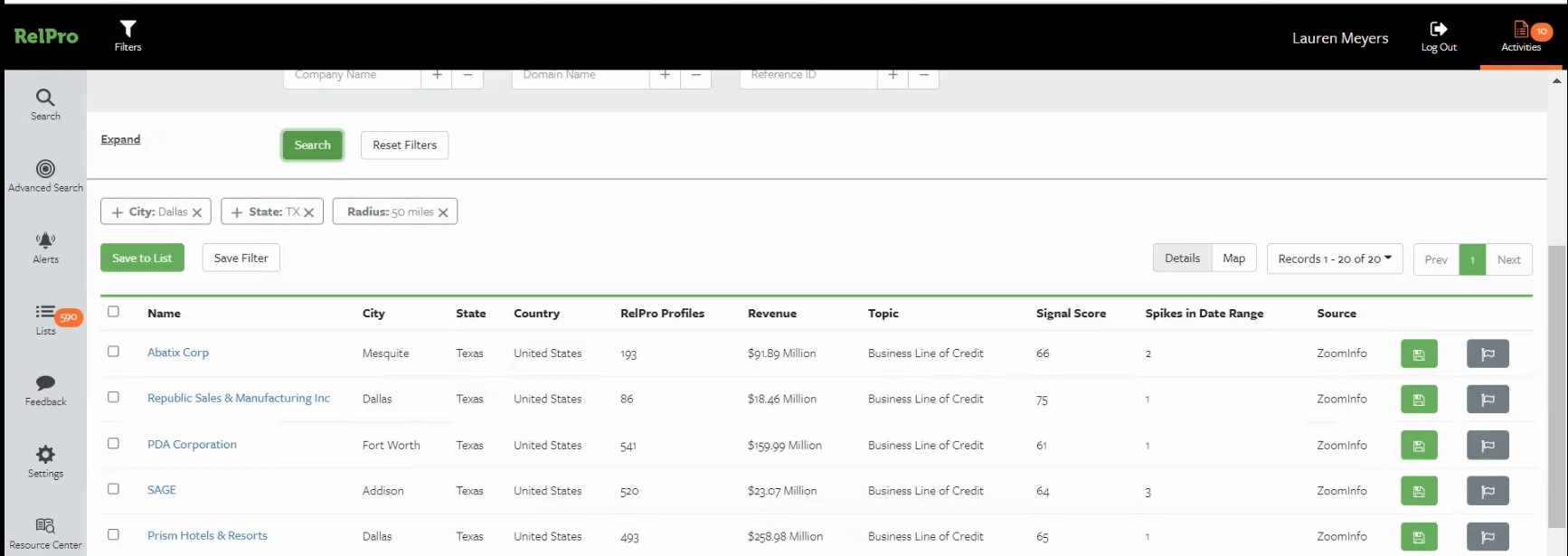
The intent data, sourced from Zoominfo, contains 66 signals related to financial research and products.  RelPro has removed the noise from thousands of non-relevant topics by limiting the topics to standard commercial banking services.

Intent Data search results include signal score and spikes across a date range.

Users may screen against the intent topics, spike period (last week to past three months), audience strength, signal score, minimum spikes in the date range, and standard firmographics.  Audience strength and minimum spikes ensure that the research is broadly based and sustained, avoiding spurious spikes created by a single employee doing heavy research on a topic for a day or two.

Audience strength is an intent distribution score containing the volume of searches on a topic across a company’s IP addresses.  Other variables include the number of IPs at a company, the number of days investigating a topic of interest, how many times they viewed the page, and company size.

The minimum score lets banking professionals dial up or down the precision.  Intent data falls along a bell curve, with sixty being a twenty percent increase in topical activity.  Sixty, the lowest signal score for screening and presentation, is a relatively low threshold, particularly if the search is being performed across multiple weeks or months.

An intent tab lets Relationship Managers view an account’s spiking topics and each topic’s signal score, audience strength, and spikes in date range, helping them determine which financial products may be of interest to the account.  If there are multiple signal spikes over a date range, the signal score is the average of the spike scores.

The RelPro company Intent Tab details spiking topics, audience strength, frequency of spikes, and the last signal date.

A last signal date indicates the last time the topic spiked, while the spikes in date range indicate the frequency of spikes over the date range.  These fields help determine the recency and frequency of interest, particularly if low signal thresholds or a long search period have been selected.

RelPro added eight million CRE loans to its platform, helping financial services companies target companies and assess risk.  Mortgage fields include property type, lender, loan amount, assessed value, execution, and maturity dates.

CRE Title Records in a RelPro company profile.

Users can view mortgage data and screen against it in Build-a-List.  Along with CRE data, RelPro provides UCC (US liens), PPP and PPS loans (pandemic), and 7A and 504 (Small Business Administration) loans.

RelPro did not disclose the source of its CRE mortgage data.

RelPro claims that 50% of the top US banks license its service.

RelPro Loan and Lien Screening variables.

Bombora RevTech Integrations

Bombora Insights in Terminus

Bombora is one of the leading sources of third-party intent data gathered from B2B Media sources, with over 5,000 media websites contributing to its Company Surge intelligence.  It has chosen to remain independent and broadly partner with RevTech Companies, including six of the seven vendors that were listed in Gartner’s 2022 Magic Quadrant for ABM Platforms: 6sense, Demandbase, Terminus, Madison Logic, RollWorks, and Triblio (Foundry).

“Gartner weighs Intent data as its single-most critical capability for new account acquisition and a driving force in both customer retention and expansion,” blogged Bombora Senior Product Marketing Manager Ryan Moline.  “This full-funnel visibility into what’s important to your prospects and customers empowers your go-to-market teams with the data needed to create hyper-personalized, omnichannel buying experiences that result in more meetings booked, accelerated deal cycles, and opportunities for long-term growth.  This is just one reason why many of the companies recognized in this year’s Gartner Magic Quadrant partner with Bombora for their Intent data needs.”

Both ABX platforms and direct customers rely on Bombora to identify in-market demand, allowing them to reach out to accounts in their ICP when they are actively researching solutions.  Company Surge data can also be deployed for identifying churn risk accounts and upsell and cross-sell opportunities.

“Bombora’s content consumption model has become the de facto standard in B2B marketing for third-party behavioral data to indicate intent,” stated Forrester.

This month, Bombora announced an integration with HubSpot and an enhanced integration with Salesforce.

“Bombora has prioritized direct integrations and partnerships in order to make it easier for sales and marketing teams to access our insights without changing their workflows,” said Bombora CEO Erik Matlick.  “HubSpot is one of the most well-known marketing, sales, and service software companies in the world, and we’re thrilled for our app to be in the spotlight as they look to help B2B brands with their business challenges.”

Company Surge for Salesforce

Terminus Connected Account Experiences

Account Based Engagement platform Terminus announced Connected Account Experiences, which helps customers identify in-market prospects, reach out to them, and engage them across the buyer’s journey.

Terminus claims that its cookie-free, first-party data provides a 16% lift in traffic from its targeted audience activation.

“Marketers can continuously optimize ABM strategies with Terminus Identify, the visitor identification system recently added to the Terminus Platform which features the company’s own first-party data sets,” stated the firm.  “Unlike other platforms, this owned data is never static and gets stronger with every interaction and with every channel.”

Terminus leverages both first-party visitor intelligence and partner intent data sets from Bombora and G2, helping marketers identify in-market accounts.  Other Terminus intent datasets include psychographics (the wants and interests of a company based upon public messaging), technographics, and hiring insights derived from job postings.

Other account intelligence includes firmographics, event data, relationships, and engagement data captured through interactions between prospects and company employees and automated platforms.

New engagement channels span CTV and audio, including Spotify, Hulu, DirectTV, and other streaming services.

“CTV is considered one of the fastest-growing channels in video advertising,” advised Terminus.  “Leveraging CTV from Terminus means customers can diversify their arsenals of creative assets and advertising channels, reach customers while they’re watching Hulu or other ad-supported streaming platforms, and boost brand awareness and revenue.”

Connected Account Experiences supports partner integrations through Salesloft, Outreach, and Slack.

Terminus supports many channels, including targeted display advertising, email signatures, account-based chat, personalized websites, LinkedIn Sponsored Content, direct mail (via Sendoso), asynchronous video (via Vidyard, Wistia, CloudApp, Hippo Video, or Loom), CTV, and audio.

“Today’s marketers need an ABM strategy that engages buyers with personalized touchpoints and connected account experiences across all channels and across the full funnel,” said Tim Kopp, CEO of Terminus.  “With Connected Account Experiences, Terminus enables marketers to identify their buyers wherever they are, reach them on any screen they use, and engage them with the marketing and sales automation tools their teams use every day.”

IDG Rebrands as Foundry

IDG Communications, which acquired four data and MarTech firms over the past 18 months, rebranded as Foundry (Foundryco.com).

‘’We set out to deliver on a strategy that reinvents our business for a new era in technology marketing where data and MarTech are engineered to work seamlessly together, powered by our global ecosystem of editorial brands,” said Kumaran Ramanathan, President of the newly named Foundry.  “However, to pivot, to reinvent you sometimes have to turn away from the very things that previously defined you and the long-standing equity in our name, synonymous as one of the world’s biggest media companies ultimately limits our ambition and ability to be identified as a marketing technology powerhouse.’’

Earlier this month, IDG acquired Marketing-as-a-Service (MaaS) platform Selling Simplified.   The Denver-based vendor provides lead generation products, data services, and analytics.  It also maintains a database of 160 million B2B records “specific to tech industry purchase intent.”  The acquisition added contact and account-level AI-powered lead generation capabilities to IDG’s expanding suite of intent-based marketing technologies.  IDG is moving quickly into the B2B MarTech space, having recently acquired ABM Platform Triblio, visitor intelligence vendor KickFire, and intent platform LeadSift.

“We meet with tech companies, marketers, sellers, and agencies every day and in every market around the world,” said Jason Tenenbown, Chief Strategy Officer of Foundry.  “What we’ve found is a growing disconnect between sales pipelines and marketing funnels.  Our strategy has been to leverage our proprietary data with proprietary marketing technologies to bridge that gap, creating an outcomes-based set of products and services that satisfy the needs of our clients.”

IDG Communications was founded in 1964.  It remains a wholly-owned subsidiary of IDG which is best known for its 200+ technology publications, including CIO, ChannelWorld, Computerworld, CSO, Network World, PCWorld, and TechHive.  Its digital publications provide a stream of second-party intent data “with access to more than 200 million individuals and global behavioral insights that are authenticated, timely and, contextually relevant.”

“No one else has first-party media relationships integrated with marketing technologies to help create an ecosystem that resolves customer pain points,” added Ramanathan.  “With the rebrand of IDG as Foundry, we are establishing ourselves as a company that generates and innovates with data.  While the new brand marks the completion of a major milestone in our corporate transformation, we will not stop innovating and building upon our recent success.” In a corporate branding video, Foundry emphasized that “those operating at the intersection of media and technology will have the edge.”  Furthermore, “MarTech without data simply does not work” and “campaigns without technology are limited in their ability to provide measurable return on investment” and are “hard to scale with real-world impact.”

Clearbit Data Activation Platform

Clearbit Audience Manager

Clearbit announced the general availability of its Data Activation Platform.  The new service helps B2B marketing teams “focus on creating demand, capturing intent, and optimizing their pipeline.”

The Data Activation Platform addresses the “business imperative for companies to have real-time intelligence about their target market, ideal customers, and engaged prospects.”  It then applies this intelligence across all stages of the customer’s journey.

The Data Activation Platform offers Clearbit customers a user interface for many of the features that were previously only supported as APIs.

“Data activation is specifically around the next step of how we’re helping companies put data to work,” explained CRO Kevin Tate to GZ Consulting.  “We started with the data.  How do you collect data and make it available so that companies can be smart as they engage your customers in the market?  And then, over the last three years, four years, what we’ve gotten to see is how these very fast-growing companies and their growth engineering teams and go-to-market teams have put our data to work in all these different customer touchpoints.  Until this Data Activation Platform, the way they put that data to work was through APIs and integrations that they stitch together.”

Clearbit observed how its data was used for website personalization, advertising campaigns (Google, Facebook, Instagram, and YouTube), webforms, lead scoring, routing, etc.  Clearbit then identified several customer needs: a user interface for “putting the data to work,” audience segmentation and activation, audience expansion (similar accounts or contacts by persona), data enrichment, and Reveal visitor intelligence.

“We’ve been fortunate to work with many of the most innovative B2B growth teams in the world, and they’ve taught us that it’s not just about having good data.  It’s about activating that data to improve your funnel from top to bottom,” said Ross Moser, CEO of Clearbit.  “The ability to apply real-time intelligence to each step of the customer journey – and optimize experiences in real-time – is what’s driving success for Clearbit’s customers.”

Clearbit company and visitor intelligence

The Data Activation Platform leverages Clearbit’s heritage as a data company.  Its database spans 44 million companies with over 100 firmographic and demographic attributes.  Clearbit also maintains data on 350 million contacts.  Marketers can target audiences, enrich their CRMs and MAPs, and personalize their website and customer experience apps.  Capabilities include

  • Clearbit Reveal visitor intelligence for tying anonymous users to firms and detecting website visitor intent
  • Ideal Customer Profiling and best-fit prospect recommendations
  • Audience management and segmentation based on data ingested from a company’s CRM, MAP, or CDP.  Alerts may be triggered to activate audiences across systems.
  • Real-time enrichment for short webforms.
  • Real-time integrations and APIs

Audiences can be targeted in multiple ways.  For example, marketers can deploy audiences on Facebook and Google:

  • Prospect Audiences target employees across the complete ICP, including account expansion to new prospects outside the CRM.  Targeting may be filtered by role and seniority, providing persona-level targeting across the ICP.
  • Contact Audiences that sync all matches to a contacts audience for retargeting on Facebook and Google
  • Site Visitor Audiences that retarget web visitors when they match on Facebook and Google.

Data syncing includes “Audience inclusion attributes” or “smart attributes” that are calculated, such as a Boolean ICP or current customer flags that can be pushed downstream to Salesforce and other platforms.  The refreshed value is automatically pushed to downstream systems if the calculation is modified.  Smart attributes are updated every fifteen minutes.

Clearbit partners include Salesforce, HubSpot, Marketo, Pardot, Segment, Drift, Intercom, Chili Piper, Slack, Zapier, Qualified, and Clari.  Personalization partners that leverage Clearbit Reveal include Uberflip, Optimizely, and Mutiny.

Clearbit is coming off a “big, big growth year” but does not disclose any sizing or growth details.  LinkedIn lists it with 177 employees, up 90% over the past year.  Business Development and Sales grew at a 150% pace. While Clearbit originally targeted B2B Internet service companies, it is gaining traction in financial services, retail services, and investments, businesses that are “looking for data, to power their intelligence, their go-to-market motions,” said Tate.

Intentsify Equity Round

Intent data vendor Intentsify announced that it received a strategic investment from BV Investment Partners, a middle-market private equity firm that focuses on the tech sector.  The new funds will help the firm accelerate growth and product development.

Intentsify, founded in 2018, continued its pace of strong growth in 2021.  The firm quadrupled revenue in 2019 and 2020 and expected to treble income in 2021 (as of mid-December). In addition, it has grown its customer base to over 150 customers.

Venn-diagram-intent-data-sources
Intentsify layers multiple, complementary intent feeds into its proprietary intent dataset.

“B2B organizations are increasingly leveraging multiple sources of intent data to focus time, efforts, and resources where and how they’ll have the most impact,” said Intentsify CEO Marc Laplante.  “The problem is most B2B companies struggle to quickly gather, analyze, and act on buyer intent signals, which change on a weekly basis. Intentsify is streamlining all of this so our customers can more effectively scale account-based demand and revenue. We are excited to partner with BV who understands our business and has the expertise to help us take Intentsify to the next level.”

Intentsify’s Intent Activation software ingests multiple categories of intent data from several proprietary data sources “to deliver a broader, more accurate view into which targeted accounts are in-market to purchase and the issues they care about.”

Intent data is gathered from over 50 billion intent signals per month from over 5,000 B2B media sites. Intentsify also includes Visitor tracking as part of its offering.

Intentsify offers a pair of Intent Activation Solutions for Demand Generation and Programmatic Marketing. Intent-Activated Demand Generation helps marketers engage target personas at accounts displaying relevant research activity while Intent-Activated Programmatic targets key personas “at the right locations among in-market target accounts.”

“Intentsify uses its proprietary technology backed by a global data science team to power numerous marketing, sales, and customer success use cases,” stated Justin Harrison, Managing Partner of BV Investment Partners.  “Intentsify’s co-founders have long experience in this field and are acknowledged thought leaders in the intent data space who have built a strong company with an impressive leadership team, and we look forward to working with them to scale their business.”

Intentsify did not disclose the size of the investment.

IDG Acquires LeadSift

Technology media company IDG Communications acquired Halifax-based intent data vendor LeadSift.  LeadSift identifies a daily digest of in-market leads, “allowing B2B marketers to craft the appropriate messaging for outreach and sales follow-up resulting in robust new business opportunities.”

Over the past eighteen months, IDG has been assembling elements of a MarTech solution, having acquired

  • Triblio – Acquired in 2020, The Triblio ABM platform supports account-based advertising, website personalization, sales activation, orchestration, and intent-based audiences.  Triblio is integrated with Marketo, Eloqua, HubSpot, LinkedIn, Salesforce, MS Dynamics, and Salesloft.  In addition, Triblio recently added a Smart Score that employs AI for account prioritization.  The Smart Score uses first and third-party intent, website activity, and CRM data “to identify what accounts should be prioritized for sales outreach.”
  • KickFire – Acquired in September, KickFire provides a cookieless, privacy-compliant visitor id service (first-party intent) that de-anonymizes website traffic at the account level and enriches it with firmographics.
  • LeadSift – LeadSift captures third-party, cookieless intent data at the account and contact level.  Each week it captures 80 million intent signals.  The LeadSift database spans 20 million companies and 30 million contacts.  Customers can create custom triggers based on keywords, job postings, and competitor names.

KickFire and LeadSift are complementary intent services. KickFire identifies in-market buyers on a company website, and LeadSift determines which companies are in-market based on B2B media search activities.

IDG also recently launched a second-party intent data service called IDG Neon that leverages B2B Media interactions with “verified data from personal interactions with technology audiences across events, conversations, and surveys.”  Intent data is gathered from the nearly 45 million global B2B technology purchasers and influencers registered across its proprietary network of digital tech publications.

Neon captures branded conversations, event attendance, roundtable participation, conversations with event sponsors, and individuals posing questions at event sessions.  This level of “deeper engagement” indicates “stronger intent.”

IDG brands include CIO, Computerworld, CSO, InfoWorld, Macworld, Network World, PCWorld, and Tech Hive.

“Expectations of tech marketers have never been higher as the technology landscape continues to become more competitive.  By positioning IDG at the intersection of media and MarTech, we help B2B marketers navigate the customer journey across a dynamic ecosystem by leveraging unmatched data sets.  LeadSift’s technology is further enhancing our unique intent data that drives ROI for our customers.”

IDG Communications President Kumaran Ramanathan

“The buying journey for B2B technology purchases are extremely complex and involve multiple decision-makers,” said LeadSift co-founder Sreejata Chatterjee.  “Having a view into those intent signals at the contact level provides a massive competitive advantage and directs your sales team to engage with the right buyers at the right time.”

LeadSift was founded in Halifax, Nova Scotia in 2012, focusing on “mining information from public web sources to help businesses identify and engage their customers in the buying journey.”   They were an early proponent of intent data, recognizing its value before it became a core element of ABM programs.

“It is obvious the company that has the most depth and breadth of data wins the B2B demand generation space,” wrote Das and Chatterjee to their customers.  “IDG.com being the #1 Tech Media company with troves of proprietary first-party intent-data across event attendance, engagement with editorial articles, branded conversations, and human-verified insights has a massive head start.  Imagine how scalable and actionable our intent signals will be once we integrate our 3rd-party real-time web-based intent signals with this proprietary first-party intent data stream.”

IDG, based in Boston, provides LeadSift with global reach and access to enterprise customers.  It also offers complementary intent data sets and the Triblio marketing platform for activating the intent datasets.

“3rd-party intent data is one piece (albeit a very important one) of the overall B2B marketing and demand generation puzzle,” continued Das and Chatterjee.  “But what if you could know all the information about your first-party web visitors (IDG | KickFire), cross-reference and prioritize them with 3rd-party intent signals (LeadSift + IDG proprietary first-party data), activate them seamlessly across digital channels (IDG | Triblio), and run highly targeted lead generation programs, all from one single dashboard!”

IDG sees itself at the intersection of media and MarTech.  However, it is not the only tech media vendor playing this angle. For example, TechTarget and Ziff Davis also combine B2B media assets, events (TechTarget’s are digital), multiple categories of intent data, and activation platforms.

“IDG’s goal of moving to the intersection of media and MarTech is to help B2B marketers navigate the customer journey across a dynamic ecosystem by leveraging unmatched data sets,” stated Ramanathan.  “LeadSift’s technology is further enhancing our unique intent data that drives ROI for our customers.”

Account-level intent starts at $12,000 per year. 

Last week, they launched LeadSift 360, a contact-level intent service that supports both keyword and research-based intent signals gathered from over five data sources.  LeadSift360 starts at $30,000 per year. IDG did not disclose deal terms.  LeadSift’s management and staff of fifteen will continue to operate in Halifax.

TechTarget: Priority Engine Enhancements

TechTarget announced a set of enhancements to its Priority Engine Sales Intelligence platform, including second-party intent data from its BrightTALK digital event platform and a refreshed user experience. As a result, TechTarget now provides intent data for 32 million opted-in technology researchers and purchasers across twice as many accounts.

Millions of BrightTALK contacts are fully integrated into Priority Engine, providing intelligence around individuals actively researching technology purchases at BrightTALK webinars, virtual events, and videos.  The expanded content provides richer intent data with additional messaging hooks for sales reps.

Prospect-level insights include content preferences, recently viewed content, and each buying committee member’s top interests.

Prospect Insights provide rich details for messaging.

BrightTALK was acquired twelve months ago.  BrightTALK hosts 30,000 new webinars and videos each year, providing multi-media content that complements TechTarget’s text-based research content.  Prospect-level BrightTALK intent data and buyer contact intelligence are now being combined with second-party intent data from TechTarget’s 140+ enterprise technology media sites, bringing the combined pool of buyers and influencers to 32 million.  As these individuals are opted-in, intent data can be tied to the individual instead of the account, allowing for improved messaging and targeting.  Not only is the enterprise software topic collected, but TechTarget gathers competitors under consideration and buying journey stage.  Furthermore, opted-in contact data ensures that the shared contact intelligence is GDPR and CCPA compliant.

BrightTALK Prospect Insights include webinar registrations, views, view times, webinar types, and titles.

BrightTALK Intent data indicates which content was viewed and the duration the demand unit member spent viewing the content.

TechTarget noted that buyers and influencers have distinct digital research styles, with some preferring multi-media content and others opting for white papers and related text-based reports and articles.  Thus, bringing in BrightTALK significantly expanded TechTarget’s ability to identify buyer intent based on different learning preferences.

“Despite strong similarities in overall audience makeup (company size, industry, and job title/function are remarkably consistent), there’s only a 10%-20% overlap in members between the databases, depending on geo,” wrote TechTarget SVP of Products Andrew Briney in April.

“Learning preference and behavior is quite different for members of BrightTALK,” continued Briney.  “While the content topics, focus, and quality is [SIC] very similar to what’s offered on the TechTarget network, BrightTALK members prefer the immersive, interactive learning experiences delivered by webinars (85%) and videos (61%) over downloadable PDF content like whitepapers (47%) and e-Books (42%). Given this preference, it’s not surprising BrightTALK members average more than 30 minutes in view-time per webinar/video.”

Priority Engine Personalized Rankings view

The enhancements also provide insights into “overall buyer content preferences (content type and topic), and interactions with customer content across multiple channels help inform more personalized sales outreach and marketing engagement strategies.”

“Priority Engine delivers the actionable purchase intent data our customers need to drive superior performance.  This new release gets exponentially more data into their hands and gives them the ability to deliver customized experiences their marketers and sellers need to thrive.”

TechTarget CEO Michael Cotoia

UI enhancements include a new view that calls out “untapped, high potential accounts” for initial engagement in a rep’s territory.  There is also a new timeline for viewing account journeys and recent engagement.  The new timeline helps reps “easily monitor buying changes to better optimize pipeline, identify cross-sell/upsell opportunities and grow revenue.”

Other UI changes include a set of shortcuts located in the left-side navigation bar.  The shortcuts display the following user views:

  • Top Accounts – The 500 most active accounts and prospects (default view)
  • Untapped Potential – Accounts or prospects with whom the rep has not yet interacted in Priority Engine
  • Viewed your Content – Accounts or prospects that have viewed or downloaded company content syndicated through TechTarget’s content syndication program
  • Visited your Website – Accounts that have visited the company’s website (Inbound Converter)
  • Confirmed Projects – Any projects that TechTarget has confirmed are active in the rep’s territory based on direct outreach
  • Favorites – Accounts or prospects that you have selected to favorite in Priority Engine

Finally, the platform now contains separate modules that support sales and marketing use cases.

The Highlights view provides buying journey interactions and new contacts at top accounts.