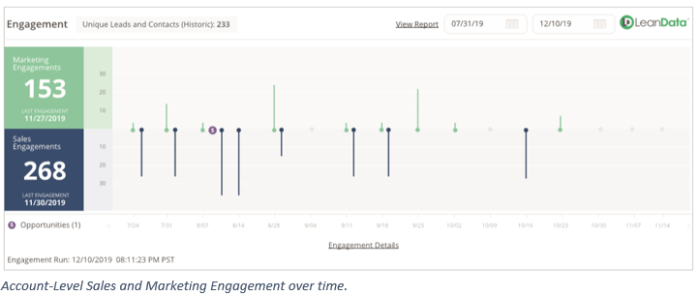
Operations vendor LeanData released LeanData Engagement, an analytics solution that works alongside its lead-to-account matching and automation tools. LeanData Engagement is available on the Salesforce AppExchange and associates sales and marketing engagement activity with relevant accounts. Engagement is tracked along the full account journey and identifies which individuals are engaged in each account along with the sales and marketing activities that drove engagement.
Lead engagement visualization tools identify which accounts have open opportunities and with which teams they are engaged. Sales Follow-Up Lists help reps understand which buying committee members are actively engaged.
A campaign engagement dashboard within the Salesforce Campaign object displays engagement activity, allowing marketers to evaluate campaign performance and decide if any adjustments are required.
LeanData Engagement “allows marketers to forge greater alignment with their sales organizations to improve campaign-conversion rates, accelerate pipeline growth, and maximize return from sales and marketing investments,” said the firm.
“Especially during times of economic uncertainly, it’s critically important to understand how your customers and prospects are engaging with your company,” said LeanData SVP of Product Hendrick Lee. “With LeanData Engagement, the interactions of every buyer are automatically connected to the right accounts in CRM, thus unlocking truly holistic account-based marketing analytics. Engagement is an important addition to LeanData’s revenue operations product family which exists to help companies unlock greater revenue growth, increase performance, and improve customer experience across the buyer journey.”
Kerry Washington, the Principal Analyst at SiriusDecisions, observed that one of the best opportunities for ABM improvement is identifying when multiple individuals at an account are demonstrating interest in a product or service. SiriusDecisions emphasizes the importance of understanding and penetrating buying committees, not merely individual decision-makers.
“Because more than 75 percent of B2B purchases are made by groups of people working together – not individuals – the best indicator of a true buying cycle is the engagement of multiple buying committee members,” said Cunningham. “In the past, identifying that engagement was difficult. However, modern solutions have emerged that allow B2B organizations selling to committees to more effectively take action on this vital intelligence and thus gain a strong competitive advantage.”
Terminus announced a set of additional “full-funnel marketing” features to its ABM platform. New B2B account-based marketing capabilities include dynamic web personalization, lead-to-account matching, account engagement scores, expanded ABM reporting, and streamlined workflows.
Dynamic Web Personalization ensures a “consistent and relevant experience” to website visitors independent of their originating channel. With web personalization, markers can serve up “visually impactful content [that] appears depending on what segment a visitor is in, allowing every page on your website to dynamically deliver relevant information.” Marketers do not need to build multiple landing pages. Terminus supports personalization by industry, revenue range, intent, relationship, engagement, CRM stage, or Target Account List in the Account Hub.
The new Lead-to-Account matching ties leads to the appropriate Salesforce Account record. The Lead-to-Account capability is powered by the Terminus B2B Account Graph that helps marketing “maintain CRM accuracy, enable custom reports and workflows, and keep sales teams organized and thinking about the entire buying committee.”
Terminus, which already provides relationship scores, added engagement scoring to its analytical tool kit. As engagement varies by company and market, “users can now configure how valuable various digital touchpoints are to better report on what accounts are engaged in the ABM Scorecard.” The ABM Scorecard is a marketing dashboard that evaluates marketing’s impact on engagement, pipeline, and revenue. The ABM Scorecard assesses engagement impact across both time and segment.
“If you are struggling to understand how to measure the ROI of your account-based marketing program, the updated ABM scorecard with Trends is a great way to prove that you are driving desired business outcomes. You can do this by segmenting by your targeted accounts and layering in Terminus firmographics to quickly see pipeline and revenue by industry, revenue range, employee range, etc. to show your CMO how you are driving results over time. This enhanced scorecard allows you to quickly see how each one of your ABM programs is getting to engagement, pipeline, and revenue goals. By trending your key marketing KPIs you can see if you’re accelerating or decelerating toward your goals, so you can easily pivot if necessary.”
Terminus VP of Growth and Product Marketing Janet Polyakov
“These Relationship Scores are a unique, first-party data source that informs teams how their relationships with specific accounts and contacts are improving or degrading over time by providing buying intent signals, sales coaching opportunities, and more accurate pipeline forecasting,” said Terminus. “Additionally, Sigstr’s email marketing capabilities enable users to unify messaging across the web, owned websites, and the inbox. The new capability provides users the ability to centrally control the email signatures of their employees while promoting dynamic, personalized content to the most engaged audiences in the inbox.”
Other new features include a native integration with Google Analytics and enhanced ad campaign reporting with trended advertising metrics.
“With these new capabilities, we’ve doubled down on our effort to be the most complete account-based platform on the market,” said Bryan Brown, chief product officer at Terminus. “As marketers’ jobs become more demanding, it’s critical that they are able to execute with agility across multiple points of interaction, be it ads, web, or email, all from a single platform. Terminus enables users to easily measure business outcomes well beyond clicks and leads that facilitate better collaboration across teams and deliver higher quality engagements.”
Infogroup launched InfoUSA Results, an SMB solution for website building. The package includes a custom website and landing page tied to online campaigns and a dedicated toll-free or local phone number. InfoUSA Results also supports site analytics, SEO optimization, Google Ads, local listings, and display ad remarketing. Customers can manage the site once it is built or let InfoUSA manage it.
“We designed InfoUSA Results so businesses can easily reach more customers online. We developed this product with the time-strapped business owner in mind. Imagine, as a business owner, you have a team working on your behalf, and new customer leads come right to you. In fact, it can be as simple as InfoUSA Results sending a text to a business owner alerting them that they have a new customer prospect who is interested in doing business with them. That is pretty slick.”
Mark Cullinane, President of Local Marketing Solutions at Infogroup.
InfoUSA Results designs websites that are mobile-ready and search engine optimized with metadata and structured markup. They are optimized for fast load times. Sitemaps are submitted to Google for speedier indexation via the Google Search Console. InfoUSA also distributes company data to hundreds of online directory listing platforms.
The service includes multi-channel lead tracking for calls, web forms, texts, and emails with analytics delivered via a dashboard. Voice, SMS text, and email responses are reported and logged. Calls are displayed on a geo map with length and quality.
Call management features include call recording, call whispering, and voicemail.
InfoUSA did not publish pricing but is offering a 30% discount for the next three months.
InfoUSA Results provides website design, SEO, display ad remarketing, and site analytics.
At Demandbase’s virtual Keynote on St. Patrick’s Day, Demandbase discussed the evolution of ABM platforms and three new products: Site Analytics, Data Stream, and Self-Service Targeting.
The first product announcement was around Site Analytics and improved web engagement metrics. The functionality is not a replacement for Google or Adobe Analytics but enables an understanding of account-level interactions across the company website. It also provides page-level intelligence concerning which pages matter the most, allowing marketers to promote and optimize high performing pages.
Site Analytics also helps uncover new audiences for sales and marketing outreach, such as verticals outside your current ICP. It can also be used for understanding which accounts are demonstrating interest in a new product launch for SDR outreach, optimizing content based upon key account viewing activity, and monitoring trends to determine campaign performance and the impact of various marketing activities.
Marketers may filter by page, URL keyword, account filters (industry, revenue, and employment), page performance, and audience. Marketers may also save filters and create new audiences based upon site traffic.
The second launch was Data Stream, which lets analysts push data from Demandbase into BI platforms for expanded account-level reporting. Data Stream is designed for firms that have already invested in data modeling and reporting and that have a data team or data analyst working with a BI or reporting platform. Demandbase data includes audience and account intelligence, campaign metrics, site analytics, and intent.
Daily, data is pushed into a data warehouse (e.g. Google Big Query, Amazon Redshift, Azure Synapse Analytics) or Cloud Storage (e.g. Google Cloud, Amazon S3, Azure Blog Storage). From there, customers can load the data into reporting tools such as Tableau, Domo, or Google Data Studio and combine account-level data with other data sources. This process provides an account-based lens to digital marketing alongside intent data and other corporate datasets.
Data Stream “helps you form a complete picture across your prospects and customers,” said VP of Marketing Phil Hollrah. “Being able to deliver this data in an automated fashion with no manual intervention needed is a huge benefit to our customers. You can set up your reports, you can auto-refresh this data daily, and then those reports are going to be up-to-date with the latest information.
The third release was Self-Serve Targeting for account-based advertising. Previously, this was only available as a managed service, but now marketers can set up campaigns and creative, then modify and optimize the campaigns. Self-Serve Targeting is supported by a five-step wizard that allows marketers to upload and change creative. Marketers set up campaigns with budget, geolocation, duration, and audience. And because it is self-serve, marketers can quickly adjust campaign budgets, scheduling, frequency, or creative, allowing them to make real-time changes.
The wizard provides a campaign forecast that estimates the max spend versus projected budget, estimated impressions against qualified accounts, and the likely reach across the targeted accounts.
Self-Serve Targeting supports multiple campaigns for different segments, whether performing 1-to-1 or 1-to-many advertising.
Site Analytics and Data Stream are generally available. Self-Serve Targeting is available as part of an early adopter program.
I had four tradeshows canceled this month and next. They were opportunities for me to meet with customers and prospects (and conduct research for my industry newsletters). At this point, I’m assuming that at least two more will fall by the wayside in H1. I’m sure many of you are in a similar boat. Your marketing calendar is in a shambles, your field and inside sales reps are cloistered at home, and you are uncertain about how to manage remote workers.
Here are some ideas about how to retain momentum and deploy technology to mitigate pipeline and operational risks:
Video Meetings
If you haven’t deployed video widely across your workforce, due so ASAP. Vendors such as Zoom, WebEx, BlueJeans, Join.Me, and GoToMeeting provide reliable video conferencing solutions for multi-party meetings, demos, and document sharing. Video Meetings are a do not pass Go, donot collect $200 requirement. Every customer-facing, development, management, and planning employee should be able to join meetings from home or the office.
Setup scheduled video meetings for the next three months so they are blocked out on team calendars. This could be a 15-minute corporate call every few weeks, weekly team calls, and one-on-ones. Standing meetings should all be web-based. Office-based employees are going to feel disconnected socially, so build in some social fun at the team level (e.g. recognizing birthdays and work anniversaries, celebrating wins and releases, etc.)
I would also build training time into video meetings. It shouldn’t be all top-down. Give your staff the opportunity to cross-train peers. A sales rep could discuss her latest victory with lessons learned or provide insights into a target vertical. Marketing can review the latest product positioning and new collateral. Product Management can train on new products, review the product roadmap, and discuss the competitive landscape. The goal is to provide training, communications, coordination, and social interaction.
Record meetings and make them available to those who miss meetings with Slack or Team links. Expect that meetings will be missed due to illness, parenting requirements, and meeting conflicts.
Marketing Work-Arounds
As event marketing is off the table, marketers will need to be flexible in how they deploy their budgets. For those that planned on hosting events, they should at least proceed with their Keynote as a webinar. For H2, a roadshow in September or October can be planned, but mitigate risk in your contracting and through joint shows (shared cost and risk).
Marketers will need to deploy or expand their use of other channels including webinars, press releases, analyst outreach, blogging, social, and video. Direct mail is problematic as prospects are likely to be working from home, but e-gifting is a viable option. Look at e-gifting vendors that are supported by your Sales Engagement platform (e.g. Sendoso, PFL, Alyce)
Here is an opportunity to test additional channels and provide your event marketing team with some cross-channel development.
Canceled shows are also a reason for re-engagement campaigns. You can restart the marketing nurture process with a message around “not being able to talk to you this season.” Keep the message short and serious. You don’t know if your prospect is worried about his or her job, family members, or personal health. Also, don’t appear to be taking advantage of the situation. Be empathetic, not opportunistic.
Also, make sure to reschedule meetings from those cancelled conferences. These are likely to be phone or video calls, but reps and executives should reconfirm calls now.
Conversation Intelligence
Once you have standardized meetings, make sure they are recorded and transcribed. This is particularly true for sales meetings. Conversation Intelligence vendors such as Gong, ExecVision, and Chorus record calls, transcribe them, and perform NLP/AI processing on the conversations. Conversation Intelligence allows sales reps to be more present during calls as they no longer need to focus on note-taking.
Transcriptions and analytics have multiple benefits:
Sales Reps can quickly review calls and return to key topics and issues (e.g. pricing, next steps).
Sales Managers can review calls related to accounts and opportunities at risk to provide coaching tips to reps.
Analytics identify both the strengths and weaknesses of reps versus their peers. They also flag missed actions (e.g. discussing next steps), customer concerns, and competitors. To assist with training and opportunity scoring, Conversation Intelligence vendors identify filler word frequency, monologue length, and conversational engagement.
Reps can forward snippets to peers for questions and help. If there is a question about a bug or support issue, the snippet can be forwarded to support personnel for an update. If a sales rep feels that they handled a question or issue poorly, a snippet can be forwarded to sales management or training for advice on how to better handle the issue next time. Snippets allow peers to hear the voice of the customer.
Snippets can be stored in a library for training purposes. These would include exemplars for objection handling, competitor parrying, value discussions, etc.
Product Managers can perform bulk analysis of sales calls to identify requested features, competitor discussions, and product issues. Vendors allow for keyword customization and analytics.
Sales Cadences, also called sequences, are at the core of Sales Engagement. Cadences set up a structured set of multi-channel outbound communications supported by email templates, dialers, social, and SMS text. Cadences improve sales efficiency by eliminating follow up tasks, recording activities to CRMs, and deploying A/B tested content (emails, attachments, cadences, call scripts). While most commonly used for SDR outreach, cadences can also be used for meeting reminders, setting up quarterly account reviews, and training follow up.
SEP vendors understand that authenticity is the key to sales success. Simply blasting mindless emails at prospects is futile. Cadences can be customized by target role, industry, company size, technographics, and stage in the buyer journey. Furthermore, reps are expected to personalize emails before sending them out (SalesLoft says 20% is the optimal level). Most of the vendors now support 1-1 embedded videos from Vidyard, Hippo Video, or Videolicious.
SEP Vendors also provide a deep set of analytics. Initially, these focused on communication efficacy (e.g. open and click-through rates, best time of day to call), but now analytics assess conversations, call out deal risks, prioritize accounts, and suggest next best actions.
SEPs are now commonly deployed amongst SDRs and Inside Sales, but may still be foreign to field sales reps; however, field sales reps will be operating more like inside sales reps for the next quarter, so deploying SEPs to field sales makes sense.
Beyond outbound communications, SEP vendors are beginning to support meeting management (setting up calls), conversational intelligence, and opportunity management. SalesLoft and Outreach are the farthest along in supporting these emerging feature sets. SalesLoft acquired and integrated NoteNinja (meeting management) and Costello (opportunity management) into its platform.
SEP Vendors have taken two approaches to partnering. SalesLoft, Outreach, and Xant have partner App Directories while the other vendors integrate key vendors (e.g. Vidyard, LinkedIn Sales Navigator, Zoominfo) into their offerings without a formal partner ecosystem directory.
LinkedIn
For B2B sales, there is no social platform more trusted than LinkedIn. Sales reps can leverage their networks by sharing marketing content (they should include some comments of their own) as well as writing their own content.
LinkedIn also offers an excellent Sales Intelligence product called Sales Navigator. It is available as both a desktop and mobile solution and provides additional communications channels:
InMail: An outbound email alternative, InMail allows you to message prospects for whom you lack emails and direct dial numbers.
Chat: A quick short-message way to keep in contact with members of the buying committee. It is also useful for quick reach out after establishing a LinkedIn connection with a prospect or to send a quick, congratulatory note. Chat messages are retained archivally, providing a conversational log. I have had success providing my Calendly link with initial chats, providing a mechanism for new connections to easily schedule a call (my Calendly includes my video meeting details so there is little friction).
Smart Links: Forward one or multiple attachments to a prospect via social, InMail, or email. Viewing and forwarding are tracked by LinkedIn, helping reps know which content was viewed and when. Forward tracking helps expand their understanding of the buying committee. Smart Links maintain corporate branding.
Sales Navigator provides several other high-value features:
SNAP connectors display LinkedIn content and Navigator functionality (e.g. icebreakers, mini-profiles, InMail) within Sales Engagement Platforms, CRMs, and other enterprise software.
TeamLinks allow you to leverage co-worker relationships for reaching out to prospects.
Build a List lets reps assemble Lead (contact) and Account lists within Sales Navigator. Lead and Account lists may also be synced from the CRM, allowing reps to track news and updates about key companies and contacts. While LinkedIn does not permit upload of account and contact data, they make exceptions for notes, tags, and messages entered by the rep in Sales Navigator. They also just added a thin record upload of contacts to CRM and the ability to flag execs that have left a company.
List Sharing — After building a list, users may share them with co-workers who have Sales Navigator licenses.
Sales Navigator can be a bit pricey, so running a test amongst your inside sales and field sales reps makes sense, particularly if you are concerned about H1 pipeline delays. Given the difficulty of reaching anybody by phone (made worse by prospects working at home) or email, adding additional sales communications channels is well worth testing out.
There are other LinkedIn services worth investigating or trialing. LinkedIn Marketing supports highly targeted B2B campaigns. Unlike other platforms, LinkedIn can target by company, job function, level, industry, geography, and education. LinkedIn provides campaign metrics and allows marketers to set daily budgets. Both CPM and CPC pricing are available. Pricing is based upon second-best auctions (you pay 1 cent above the second best bid price).
For larger companies, LinkedIn Elevate should also be considered, particularly with remote workers. Elevate provides a curated feed of content to company employees for social media distribution (e.g. LinkedIn, Twitter, and Facebook). Elevate amplifies corporate messaging and reduces the level of effort for sales reps and other employees to share content through social networks.
LinkedIn Learning is offering sixteen courses at no charge covering topics related to working from home, remote management, tools, and mindset.
“In the coming days, we will make 16 LinkedIn Learning courses available for free including tips on how to: stay productive, build relationships when you’re not face-to-face, use virtual meeting tools (Microsoft Teams, Skype, BlueJeans, Cisco Webex and Zoom), and balance family and work dynamics in a healthy way.”
Ryan Roslansky, LinkedIn SVP of Product
Sales Intelligence
Sales Intelligence services help sales reps build prospecting lists, quality leads, refine account messaging, expand into new departments and locations, track accounts, and target additional buying committee members.
Many sales intelligence services also offer B2B DaaS services for updating CRMs and MAPs. Salesforce data hygiene is maintained through Lightning Data connectors, a sub-category on the AppExchange. Because data is synced with CRMs and MAPs, it is continuously updated, ensuring that firmographic data is accurate and that departed contacts are removed from sales and marketing activity (BTW — contacts decay at 30% per annum, so maintaining your enterprise software contact data is a valuable investment)
Sales Intelligence vendors also provide full workflow integrations into CRMs which allow reps to build lists; view and update accounts, contacts, and leads; and perform account qualification and account planning within CRM I-frames.
Sales Intelligence vendors include
Zoominfo: Deep contacts, emails, org charts, and technographic content. They are the leader in technology sales intelligence and recently added visitor intelligence, trigger-based workflows, and webforms. Zoominfo (FKA DiscoverOrg) also supports Ideal Customer Profiling (ICP), email verification, and B2B DaaS.
D&B Hoovers: The deepest set of global company intelligence for strategic sales reps. Includes full family trees, public company financials and filings, analyst reports, industry market research, SWOTs, European private company financials, and sales triggers. Dun & Bradstreet also supports ICP, B2B DaaS, Visitor Intelligence, Programmatic Marketing, and Customer Data Platforms.
InsideView: A global database with greater depth in North America and Europe, InsideView offers strong sales triggers and integrated social media viewing. InsideView also supports B2B DaaS and ICP.
Sales Genie: The best solution for reps that sell to both companies and individuals (e.g. insurance agencies, mobile, office supplies, landscaping). Features include light sales force automation for firms that have yet to implement a CRM, new businesses, new homeowners, email templates, integrated dialer, and marketing services (SEO, site design, direct mail).
RelPro: A specialist vendor targeting financial services companies.
Artesian Solutions: A UK-based social selling vendor with deep sales triggers and mobile-based meeting prep. They also offer a US solution.
Cognism: A UK-based sales intelligence vendor with sales engagement functionality, B2B DaaS services, and ICP tools.
Vainu: A Nordic-based sales intelligence vendor that also covers the Netherlands (France, US, and the UK are in beta). They also support B2B DaaS and trigger-based workflows.
Ongoing Investment
Research has shown that firms that continue to invest during recessions come out of the downturns much better prepared to grow market share and revenue than those that stop investing. Marketing is an investment in your pipeline and brand. B2B Data-as-a-Service is an investment in your data quality and ability to target prospects effectively. It also reduces sales and marketing waste in efforts directed at weak prospects and departed contacts. SalesTech and MarTech purchases are investments in your revenue generation capabilities.
This is also an opportunity for your sales and marketing teams to cross-train, develop new skills, and test out new tools and processes.
When we come out of the backside of what, hopefully, is a short-term recession, you want to be better prepared to meet latent demand for your products and services. While cutting back on investment and cash burn may be necessary for survival at some companies, don’t cut back on your ability to serve the market in 2021 unless you have to do so. Let others sacrifice the future of their revenue generation operations out of short-term concerns. Bank your savings in travel expenses and event marketing, but don’t cut back in other areas unless necessary.
Terra Incognita
We are entering a terra incognita for the next three to six months, so steady, empathetic leadership should be your objective. On 9/11, our CEO pulled us into the room and talked to us. I don’t remember his words, but I remember that he was calm and understood that we were all upset and anxious. Business was the least of his concerns that day. He wanted to show a steady hand at the tiller and sent us home to be with family.
Our raison d’être is not to work, and sometimes we are jolted back into that reality. Family, friends, and health are a higher priority. COVID 19 is not the new normal, but simply a bad storm that will pass.
Content intelligence vendor PathFactory announced a partnership with ABM Orchestration vendor 6Sense to “give marketers complete visibility into the quality of account engagement, as well as what content and topics are accelerating them through their customer journey.”
The new
partnership taps 6Sense’s account identification capabilities and combines it with
PathFactory’s content consumption data, providing richer account engagement
intelligence. “They can even watch a buying committee’s activities
populate and track their journey in near real-time,” said PathFactory.
Account intelligence is synced with the CRM and displayed to sales reps,
helping them understand which content and topics resonated at target accounts.
PathFactory
offers a set of content tracks, either defined by marketing or PathFactory’s
AI. Content tracks are a sequence of relevant content associated with
specific calls to action. Content tracks “keep people engaged longer and
helps them self-educate” while encouraging them to “binge on your content.”
By assessing which individuals and accounts are binging on account tracks,
PathFactory can determine when accounts are “getting serious.” Highly
engaged accounts are more likely to turn into deals.
Content
insights suggest the next best content and next best action, with PathFactory
personalizing content tracks in real-time. PathFactory tracks engagement
at both the individual and account level while assessing content attributes
such as type, topic, and reading length.
“While B2B marketing organizations have invested heavily in ABM over the past several years, many marketers still struggle to successfully execute campaigns, scale programs, and report on results. We are confident this integration will give marketers the unprecedented ability to optimize the customer journey and generate revenue from their ABM efforts.”
Dev Ganesan, CEO of PathFactory
PathFactory clients do not require a
separate 6Sense license.
“PathFactory and 6sense are marrying
two of the most critical data sets necessary for successful ABM execution,”
said Jason Zintak, CEO of 6sense. “With 6sense’s industry-leading account
identification capabilities and PathFactory’s content consumption data, sales
and marketing teams can get deep insight into anonymous buying behavior of
individuals and accounts, and deliver hyper-personalized content journeys.”
PathFactory placed 186th on Deloitte’s Fast 500 list, and Gartner named them a Cool Vendor in their 2019 Technology Marketing category.
SalesLoft Conversation Intelligence transcribes and indexes meetings and conference calls to share with stakeholders. Photo: Zoom Meeting Intelligence
Sales engagement vendor SalesLoft rebranded its Meeting Intelligence functionality as Conversation Intelligence. SalesLoft describes four sets of features which help reps schedule meetings and then listen to, understand, and engage with customers and prospects. SalesLoft supports a broad set of conversation tools including appointment setting; automated recording, transcription, and indexing of calls; time-stamped notes, and call analytics. This functionality is available for prospect, customer, and internal calls. Managers, mentors, and trainers can join calls or whisper into a sales rep’s ear.
“Through
the evolution of SalesLoft’s platform and user experience, one feature has
changed so much that its prior name no longer did it justice,” wrote SalesLoft
Head of Community Aly Merritt. “Meeting Intelligence is now Conversation
Intelligence, because sales isn’t just meetings – it’s every conversation and
interaction.”
Call
recordings can be stored in a training library or shared for coaching or
questions. For example, if a sales rep does not know the answer to a
question, it can be forwarded directly to customer support or engineering for a
response.
Conversation
Intelligence supports both SalesLoft’s native dialer and leading web meeting
applications: Zoom, GoToMeeting, join.me, UberConference, Cisco WebEx, and
Cisco WebEx Enterprise.
Sales calls come in many forms: prospecting, discovery, demos, stakeholder alignment, and so on. All of these interactions make up the foundation for the long-term customer relationship. High-value customer relationships are made possible when prospects feel that the relationship they are entering into is mutually beneficial.
How can you build such a relationship? By working to ensure your prospects feel heard and confident that you understand their needs. Work to engage them throughout their journey. After all, sales doesn’t stop when the deal closes, nor does engagement cease when a seller hangs up the phone.
▪ SalesLoft Product News
SalesLoft said that it is “designed to flex around the needs of the user based not only on their role but also on their preferred workflow. This empowers SalesLoft customers to offer consistent value at every stage.”
“Sales meetings are the moments in the sales cycle where you have the opportunity to provide the most value for your customers. As such, they are some of the single biggest opportunities for your team to influence revenue. It’s where your deals are won and lost,” wrote the firm. “Despite this, sellers often don’t get the opportunity to improve on this critical component of the sales process. Combine this with the challenges that face sales leaders around how much time it takes to digest sales meetings, gain visibility into what’s really happening, and be proactive in the deal cycle.”