LinkedIn: Now Part of Microsoft

On December 9th, Microsoft announced closure of its $26.2 billion LinkedIn acquisition following EU approval.  The full approval process took just about six months.  Microsoft CEO Satya Nadella is “even more enthusiastic” about the transaction than he was in June.

Nadella listed the following “immediate term” integration scenarios:

  • LinkedIn identity and network in Microsoft Outlook and the Office suite
  • LinkedIn notifications within the Windows action center
  • Enabling members drafting résumés in Word to update their profiles, and discover and apply to jobs on LinkedIn
  • Extending the reach of Sponsored Content across Microsoft properties
  • Enterprise LinkedIn Lookup powered by Active Directory and Office 365
  • LinkedIn Learning available across the Office 365 and Windows ecosystem
  • Developing a business news desk across our content ecosystem and MSN.com
  • Redefining social selling through the combination of Sales Navigator and Dynamics 365

The emphasis on expanded opportunities for individuals to learn, compete, network, collaborate, and find jobs was a key justification of the merger.  “While technology tools are not a panacea for current economic challenges, we believe they can make an important contribution,” said Microsoft’s Chief Legal Officer Brad Smith.  “Microsoft and LinkedIn together have a bigger opportunity to help people online to develop and earn credentials for new skills, identify and pursue new jobs, and become more creative and productive as they work with their colleagues. Working together we can do more to serve not only those with college degrees, but the many people pursuing new experiences, skills and credentials related to vocational training and so-called middle skills. Our ambition is to do our part to create more opportunity for people who haven’t shared in recent economic growth.”

The LinkedIn and Microsoft Graphs complement each other and will help build LinkedIn's vision of an Economic Graph.
The LinkedIn and Microsoft Graphs complement each other and will help build LinkedIn’s vision of an Economic Graph.

LinkedIn CEO Jeff Weiner views the transaction as an opportunity to expand LinkedIn’s Economic Graph “and ultimately help create economic opportunity for every member of the global workforce.”  LinkedIn will operate as an independent division with “the same mission and vision, the same culture and values, the same brand, and the same leadership team.”

Weiner reiterated LinkedIn’s commitment to its members, their privacy, and information security.  The firm “remains focused on growing LinkedIn and creating value for our members and customers with a focus on integrating LinkedIn products with Microsoft.

The EU placed a few requirements on the deal, but did not view the transaction as anti-competitive, a position held by Salesforce.com.  The EU evaluated the impact on professional social networks, CRM solutions, and API access.  As an accommodation, Microsoft committed to a five year period in which it will

  • Ensure that PC manufacturers and distributors would be free not to install LinkedIn on Windows and allowing users to remove LinkedIn from Windows should PC manufacturers and distributors decide to preinstall it.
  • Allow competing professional social network service providers to maintain current levels of interoperability with Microsoft’s Office suite of products through the so-called Office add-in program and Office application programming interfaces.
  • Grant competing professional social network service providers access to “Microsoft Graph”, a gateway for software developers. It is used to build applications and services that can, subject to user consent, access data stored in the Microsoft cloud, such as contact information, calendar information, emails, etc. Software developers can potentially use this data to drive subscribers and usage to their professional social networks.

Margrethe Vestager, EU Commissioner in charge of competition policy, said: “A growing number of Europeans subscribe to professional social networks. These networks are important for professionals to connect and interact and to find new career opportunities. Today’s decision ensures that Europeans will continue to enjoy a freedom of choice between professional social networks.”

Data on employees by function from beta company profile page.
Data on LinkedIn employees by function from beta company profile page.

LinkedIn has 467 million global members and supports two dozen languages.  The firm continues to add members at the rate of two per second.  Last quarter, LinkedIn earned $960 million across three divisions: Talent Solutions ($623 million), Marketing Solutions ($175 million), and Premium Subscriptions ($162 million).

Conversation Starters

LinkedIn rolled out a new Conversation Starter feature to promote system messaging via a lightbulb icon.  The feature analyzes the target individual’s profile to provide a series of conversational options.  After selecting a potential opener, the user can modify the text to their voice.  Starters include recent profile updates, work anniversaries, recent posts, mutual connections, and shared backgrounds (e.g. alma mater, former employers, groups).

li-conversation-starter“We know that reaching out to reconnect, ask for advice or network for potential job opportunities can be intimidating, so we’ve added personalized conversation starters in LinkedIn messaging to give members authentic ways to break the ice,” the company said in a blog post.

Unfortunately, the Conversation Starters on their marketing video are mostly focused on connections.  This could result in a spate of similar sounding openers that could quickly become SPAM.  This focus could be simply a marketing oversight, but variations on “Hi Suzi, I noticed you have X connections at Google.  Have you heard…” seem like a weak set of Conversation Starters.  While better than cold messages such as “Hi Suzi, I’m reaching out to you because my company…”, their sample seems uninspired.  Furthermore, the Conversation Starters do not contain any stored messages from the sales rep to expedite the message creation process.

Meeting Scheduling

LinkedIn will soon be rolling out a bot to assist with multi-party meeting scheduling.

Decommissioning Professional Edition Features

According to Intero Advisory, a LinkedIn coaching service, LinkedIn is looking to migrate sales clients from their Professional edition to Sales Navigator.  As part of this effort, LinkedIn is dropping two features from the Pro service: 1) Premium Search Filters and 2) Notes and Tags for connections.  LinkedIn said these features will be available through the end of March.  Users have until then to download any Notes and Tags.  To help accommodate users, LinkedIn is offering a free three-month trial of Sales Navigator which includes the transfer of Notes and Tags.

LinkedIn InMail 2.0

I’ve never been fond of LinkedIn’s InMail service which is limited in its utility.  However,  InMail claims to have a 15% response rate which is 5x that of email.  What’s more the top ten percent of InMail senders net a 30% response rate.  According to Doug Camplejohn, Head of Products at LinkedIn, this disparity demonstrates that there are a set of best practices which improve rep response rates.  LinkedIn is rolling out a 2.0 version of InMail which assists with sales rep personalization.

“The best InMailers don’t treat InMail as a SPAM cannon, they really think about it as a handwritten note,” said Camplejohn.  “They take a little time to personalize things and we want to make it easy for all of you to be that good at InMail.”

li-inmail
InMail 2.0 provides full profile access, a signature block, attachment support, shared connections, icebreakers, and synch to CRM.

The first step was making the InMail box smaller so that it doesn’t cover up the recipient’s profile.  Thus, it is easier for reps to identify a personal hook to the recipient.  InMail is also providing a set of icebreakers (e.g. recent posts and updates) and shared connections to assist with messaging.  A critical new feature is the option to synch the email to CRM, providing an audit trail for InMail communications within SFDC.

InMail 2.0 also supports a signature block, attachments, and a new Inbox with threaded messages.  There is also a pending tab for tracking InMails that lack responses.

InMail 2.0 Inbox
InMail 2.0 Inbox

InMail is included as part of the Sales Navigator service.  Professional users receive twenty InMails per month while Team accounts are granted thirty InMails per sales rep per month.

Improving rep messaging is a key aspect of their Navigator product strategy.  LinkedIn is also working on integrating the PointDrive sales messaging service into Sales Navigator in Q1.

LinkedIn has begun rolling out InMail 2.0 to users.

RelSci Goes Freemium

Relationship Science (RelSci) from within the Salesforce AppExchange.

Relationship Science (RelSci) rolled out a freemium offering for their social networking service this week.  A free edition provides ten profile views while the Professional edition is priced at $49.99 per month and supports contact synching, relationship finding, news alerts, power searching, and a mobile app.  The full feature set is shown on their pricing page.

While the professional edition does not yet support networking, the feature is in development for single users.

RelSci is designed for investors (e.g. PE, VC, Wealth Managers), fund raisers, and business development professionals.  It works best at companies where relationships are highly prized for reaching top executives, directors, and donors.  The firm marries your contact network with a database of 5 million “movers and shakers” across 1 1/2 million organizations.  The enterprise edition allows users to leverage the relationships across their firm, providing a powerful research and networking tool.

Along with standard company and executive profiles, you will find nonprofit board and association memberships, nonprofit and political donations, investments, and news alerts.  What you won’t find is emails and direct dial phone numbers.  The system is designed for introductions, not cold calling.

The product offers an elegant user interface combined with powerful prospecting tools.  Along with standard prospecting, there are screens which assist with trip planning, donor searching, and identifying potential investors.

So how does RelSci stack up vs. LinkedIn Sales Navigator?  A recent DiscoverOrg survey found that one quarter of top level executives are not LinkedIn members so RelSci has a distinct advantage there.  Furthermore, RelSci brings in intelligence not found within LinkedIn such as rich company profiles (LinkedIn’s are basically warmed over marketing materials from the website and Facebook), donations, and investments.

However, Sales Navigator offers InMail with recommended names to drop while RelSci forces users to request introductions through their network.  This could be a potential bottleneck at firms where the strongest networks go through top level execs and the firms’ rainmakers.

Also, if your focus is more directors and managers, you many not find sufficient depth within RelSci.  An ABM strategy could stall out due to lack of executive depth in RelSci.  For those companies, I’d recommend a full sales intelligence offering (e.g. Avention, Hoover’sDiscoverOrg, RainKing) in conjunction with free LinkedIn.

RelSci offers powerful screening and visualization tools tied to an elegant user interface.  For professional networkers aiming at the upper echelons of companies and boards, RelSci is a superior option to LinkedIn.

Contify: Social Intelligence within SFDC

Social Selling vendor Contify rolled out a Salesforce.com connector for their account based social intelligence service.  Contify intelligence is displayed within Lead and Opportunity record I-frames.  The display is split into two tabs: News & Mentions and Social Updates.  Both tabs may be filtered by topic.

The Social Updates feed combines account intelligence from Twitter, Facebook, LinkedIn, and YouTube.  The company “only shows social media updates which have relevant sales triggers associated with it.”  Thus users are not “bombarded with a stream of updates that aren’t relevant to you.

Contify Social Updates

News triggers are set to thirty days, but may be adjusted by users.

The Indian vendor provides fourteen sales triggers mined from the web and social platforms.  Triggers are delivered as alerts and within the subscription service.  Users may share triggers via Chatter, email, Twitter, and LinkedIn.  Users may also save triggers as bookmarks for later review.  A separate triggers list is included within the record.  Contify also offers Custom Triggers which may be created from within SFDC.  Custom Triggers consist of a set of search and stop keywords.  Contify begins delivering customer trigger results within fifteen minutes.

Trigger categories are similar to those found in other products.  This is not to fault Contify as there are a set of common events which have been deemed to be most valuable by B2B sales reps.  These include Funding Activity, M&A, Management Changes, Partnerships, and New Offerings.

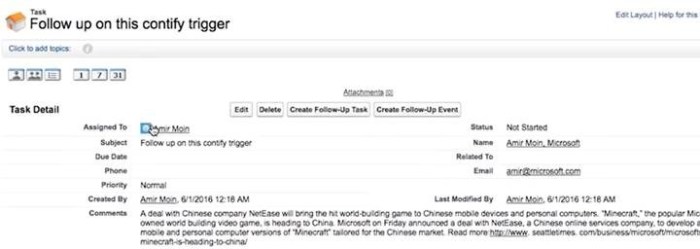
Triggers may also be setup as tasks which are saved as open activities.  Trigger information is stored within the Comments field of the task.

Contify triggers may be flagged as tasks for alter action.

If users are unable to find the correct company, they can submit the URL to Contify’s editors who will create a company profile within 24 hours.

The service is priced at $49.95 per user per month billed annually.

The firm has over 10,000 users.

Sales Intelligence Vendors Still Don’t Get Social

For some reason, sales intelligence vendors have never properly understood social selling and how to integrate social media into their products.  This has long amazed me.  Instead of building an integrated social media viewing tool with sharing and feedback, they all seem to nibble around the edges. You’ll find social hyperlinks directly from company or contact profiles, but these simply window out to the social media site.  Also fairly common is the inclusion of corporate blogs into their news and sales trigger feeds, but fully integrated social media tools have yet to be offered by vendors.

The closest any of them have come is InsideView which added a Buzz Tab about five years ago to its InsideView for Sales product.  The Buzz Tab provides a consolidated view of blogs, Facebook, and Twitter feeds.  However, the social content remains segregated from their other discovery tools and the population of Facebook and Twitter feeds is limited.  Other social tools include a Who Knows Who “Six Degrees” tool and the inclusion of Personal Tweets from business executives in their alerts.

The InsideView buzz tab supports keyword searching and filtering for company blogs, Facebook, and Twitter.

There are also a set of social selling tools that focus on social media, blogs, and news but which are light on company and contact information.  As these tools improve, one of the sales intelligence vendors is going to make a build vs. buy decision and either OEM the upcoming service or buy a social selling service outright.

What tools such as Artesian Software, Owler, Contify, and Trapit do isn’t revolutionary.  They basically provide a unified view of news and social content.  Users can filter the feeds and interact with the posts.  If a free service such as Owler can build such functionality, why can’t the sales intelligence vendors?  Core functionality could provide the following features:

  1. A deep set of direct links for companies and executives to LinkedIn, Twitter, Facebook, YouTube, G+, etc.
  2. A unified view of the corporate social media content across Twitter, Facebook, SlideShare, YouTube, Vimeo, corporate blogs, business blogs, etc.  This view would be easily filterable by source, date, keyword, etc.
  3. Social Media Metrics for a company charted over time.  If the company is also selling into the marketing department, then comparative metrics should be available.
  4. When filtering Twitter, allow the user to see both the Tweets from a company and mentions (these are separate options).
  5. Support basic widgets from the major social media vendors.  These are small applets that display key statistics along with a brief description and logo/headshot.
  6. Allow any news article, sales trigger, or social media post to be shared via social media, enterprise social (e.g. Chatter, Yammer), and email.
  7. Support expanded alerts that include targeted social media alongside sales triggers.  Thus, an alert could consist of the half dozen most important sales trigger topics, Twitter posts from the company, Blog headlines, and YouTube / Vimeo uploads.
  8. Executive alerts based upon social media posts and news mentions.

Who Know Who Six degree tools are also worth considering, but this functionality is so well locked up by LinkedIn that relationship discovery tools have remained a standalone category.  Amongst Sales Intelligence vendors, only InsideView and DueDil Connect have built relationship finder tools in competition with LinkedIn.

To be fair, the sales intelligence vendors all understood early on that they needed to work with LinkedIn.  Most of them adopted the LinkedIn widget or the LinkedIn API to provide relationship and executive intelligence into their service.  But then LinkedIn decided it was going to offer its own sales intelligence service called Sales Navigator and began blocking sales intelligence vendor access to LinkedIn.  Since then, with the exception of InsideView, the sales intelligence firms have done little to integrate social content into their services.  Hopefully, the vendors begin to see this gap in their offerings and begin to address it.

Artesian Solutions’ Social Selling Enhancements

Artesian Solutions combines company and market (industry) Watchlists with a broad set of social sharing, emailing, and bookmarking tools.
Artesian Solutions combines company and market (industry) Watchlists with a broad set of social sharing (Twitter, LinkedIn, Chatter), emailing, calendaring, and bookmarking tools.

UK Social Selling vendor Artesian Solutions announced a set of enhancements to its social selling platform.  Amongst the improvements are an improved CRM connector, “fully customisable” triggers, market sector alerts, employee display filters, and an update to their Ready mobile app.  They are also in the midst of soft launching a US edition with a comparable set of social selling features.

The enhanced CRM connectors for Salesforce.com and Microsoft Dynamics “drive a more dynamic connection between interaction information, business information and market insight for more intuitive and contextualised sales and marketing.”  Among the features are sales trigger filtering by topic and trigger sharing by email, social media, and Chatter.

A new employees page allows users to filter employees by job function and level and set priorities by executive role and level.  The firm has also expanded the depth of executive content including executive overviews and social media links.

Along with market alerts, Artesian has increased the granularity of its market views.  Market alerts may be filtered by industry and country and are delivered weekly.

AS TW R
Artesian Ready Twitter Feed

Artesian also rolled out version 2.3 of its Ready mobile app which provides company and executive insights synched with the mobile calendar.  The service also supports collaborative note taking and a “360° comprehensive profile of customers and prospects.”

New Ready features include Twitter timelines and Twitter sharing (see image on left), social links (LinkedIn, Twitter, Facebook, AngelList, Crunchbase, Klout), job information, and a data quality form for reporting incorrect information.

Rachel Oldroyd, Artesian Product Manager for Mobile commented that Ready “delivers the latest social profile insight straight to users’ fingertips, right up to the very second they go through the meeting room door, for the ultimate in readiness and customer engagement. Its summer launch is very timely, offering a real opportunity to brush off the dust, re-invigorate meetings with new ideas and fresh thinking, and get back into gear ahead of September.”

Ready is available for both Android and iOS devices.

Artesian is priced at $99 per user per month in the US and £89 per user per month in the UK with volume discounting available at higher seat counts.  This pricing is in line with other social selling products such as InsideView and LinkedIn Sales Navigator.  Ready and CRM integrations are included as part of the core service offering along with onboarding, training, and social selling scores.  The firm strongly believes that sales training is key to user adoption so does not charge for custom training sessions.

Social Selling Scores are similar to LinkedIn’s Social Selling Index.  These scores introduce a gamification element to the service helping encourage best practices and ongoing use by sales reps.  Artesian bases its scores on targeting, connecting, and sharing.

Artesian Solutions provides a Social Selling Score Dashboard on the home page to encourage broad usage of their service.

Artesian opened a Boston office at the beginning of this year and recently soft launched their US edition.  The firm has not disclosed their primary US vendor but it is a credible source of company and contact information.  The US version supports 4.2 million companies and 400,000 Canadian firms.  Social Selling functionality is similar to the UK product with the exception of filed data not available in the US (e.g. registered company financials; directors and shareholders; mortgages and charges; and Companies House images).  Key features in both services include social selling alerts and sharing, company prospecting, watchlists, and social selling scores.

Social Selling Benefits

Sales Research company CSO Insights and Seismic, a sales enablement vendor, asked 400 global B2B professionals about the benefits of social selling tools.  These tools include sales enablement, social listening, and social marketing solutions.  A full 38% weren’t sure of the benefits of these tools speaking to a need for vendors to better explain their value and provide user metrics.

The problem of value attribution has long been an issue with sales intelligence services as well, but as sales intelligence has become more tightly tied into the overall sales and marketing process, clear benefits such as reduced time spent keying and maintaining account information and the direct display of account intelligence within CRM I-frames have helped validate sales intelligence tools.

Likewise, B2B professionals found the biggest benefits of social selling tools to be reduced account / contact research time (39%), an increase in the number of leads (33%) and deeper client relationships (31%).  Broader process improvements were noted at lower rates with improved lead conversion (24%), shorter sales cycles (14%), and increased win rates on forecasted deals (13%) rounding out the benefits.

However, when the sub-group of professionals at firms which have aligned their social marketing and selling strategies was assessed, CSO Insights found a sixteen percent improvement in win rates.  Furthermore, the benefits were better understood with 57% enjoying more leads and 56% found deeper client relationships.  Amongst this group, only 18% were unsure about the benefits of social selling tools.  Thus, CSO Insights concluded that the high percentage of B2B professionals doubting the value of social selling tools was due to “a lack of maturity.”

CSO Insights defined social engagement as “equipping salespeople with skills, tools, and content to successfully navigate the change, decision, and value dynamics along the entire customer’s journey by leveraging social media.”  I find this definition a bit limiting operationally for vendors as it focuses exclusively on social media.  Both social selling and sales intelligence vendors have made the mistake of ignoring each other.  There are a few exceptions such as LinkedIn Sales Navigator adding a news feed and InsideView’s integrated social media Buzz tab, but most vendors either focus on profiles and news alerts/triggers or social monitoring and messaging.  The lack of fully integrated social monitoring and messaging tools within sales intelligence platforms remains a missed opportunity to improve sales intelligence products.

LinkedIn Sales Navigator offers Lead (executive) and company news alongside LinkedIn updates. Sales reps can filter for news or shares.
LinkedIn Sales Navigator offers Lead (executive) and Company News alongside LinkedIn updates. Sales reps can filter for news or shares.

A 2015 CSO Insights study of sales reps found that 33% felt social selling training was in need of a major redesign and 31% felt the training needs improvement.  CSO Insights warns against reducing social selling training to LinkedIn or Twitter training.  Research Director Tamara Schenk cautions that lessons from CRM training were not transferred to social selling training. “Salespeople are again asked to take tool training when at the same time the tool and the required skills have not yet been integrated into the current sales system, methodologies and processes. The result is the same. The new tool, social selling, is then considered as a time-consuming add-on rather than an effective enabler to create more and better business.”

Schenk noted that social strategy needs to be defined with marketing.  “An organization’s social strategy has to be aligned along the customer’s journey. [Sales] Enablement leaders are in an ideal position to orchestrate this process. After that, social selling skills have to be integrated in the current methodologies, engagement principles, and processes. Only then, not earlier, can social selling training services be designed and provided. And using the technology effectively is just one element. Another key element is the content challenge. Relevant and valuable content to attract prospects has to be made available for salespeople, ideally on the sales enablement platform with no further internal obstacles to access this content.”

The CSO Insights research was conducted in July by Schenk and Strategic Advisor Jim Dickie.  The study was based upon responses from B2B sales managers (61%), sales ops (21%), marketing (8%) and other roles located in North America (59%) and rest of world (41%).

Trapit: Social Selling for Account Based Sales

Trapit Social and News Intelligence

Social intelligence vendor Trapit launched a social selling service for account based sales.  The monitoring service tracks over 100,000 curated web sources.  Content categories include blogs, professional journals, social media, and news services.  For Twitter, the service supports Retweets, Replies, and Favorites.  Trapit also supports “robust filtering” by media-type, source quality, tags, and geographic location.

“With this package we are empowering salespeople to close more business by providing them with capabilities that help them take control of and excel at every stage of the customer journey,” said CEO Hank Nothhaft Jr.  “This new package, coupled with our core curation and analytics capabilities, makes Trapit the only comprehensive sales enablement platform that actually puts the seller in the driver’s seat.”

TrapIt displays pre-defined messages to assist with social media engagement.  A publishing module helps the marketing department schedule posts to social media or blogs and feeds suggested copy to sales reps.  An analytics module assists with tracking social media metrics.

“We think this is really important because buyers have more power than ever,” Nothaft said. “The seller has become almost obsolete, and many are doing little more than taking an order from a customer who has already made a decision. Trapit allows the seller to get involved much earlier in the customer journey, which had previously been controlled mostly by the marketing team. We’re putting these empowering tools in the hands of the sellers directly,” said Nofthaft.  “The top salespeople already understand how to navigate social and digital relationships and how to use them to drive engagement and sales.   Trapit not only makes it easier for those sellers to do what they are already doing, but it also gives others an easy to use platform specifically designed for making social sales.”

Customers include Everbank, HD Vest, New York Life, and Microsoft.  Trapit is based in San Francisco and has received $20 million in funding to date.

RelPro: Adding Tech Search to Relationship Intelligence

RelPro's new Technology Search combines firmographic searching with Product and Vendor fields from HG Data.
RelPro’s new technology search combines firmographic searching with product and vendor fields from HG Data.

RelPro has licensed the HG Data company technology dataset for inclusion in their relationship intelligence database.  The new content will assist sales and marketing teams in prospecting for companies and executives based upon the corporate technology stack.  The dataset covers 100 million contacts across ten million companies.

“RelPro’s mission has always been to leverage data and analytics to help companies generate higher revenue through smarter prospecting and lead generation” said Martin Wise, RelPro CEO, “We are frequently asked by our customers if we can help them shorten their sales cycle. One key contributor to an accelerated sales process is accurate firmographic data which enables the right prospects to be targeted. By partnering with HG Data, we enable our technology customers to access valuable intelligence on installed technologies which connects with RelPro’s sales and marketing intelligence analytics for efficient lead generation and increased conversion rates.”

RelPro provides access to Zoominfo executives, Dun & Bradstreet companies, BoardEx linkage, and the HG technology stack.  Contact profiles include work histories, education, awards, industry associations, memberships, and “relationship intelligence” from news, social media, and the open web.

RelPro supports exporting to CSV and Salesforce, but does not discuss an AppExchange service.

RelPro is at the upper end of the sales intelligence product pricing range.  RelPro begins at $1,200 per user but is limited to 800 profile views and 10 weekly alerts.  The Team edition is priced at $6,000 for five users and provides 30 alerts per user but only 4,500 profile views.   If companies are looking for additional email alerts, they are available in packages of 50 profiles for $125 per month.  Tech searching is extra.

RelPro also offers data enrichment services.

MSFT – LNKD: Expanding the Economic Graph

Microsoft ($MSFT) put in a $26.2 billion cash bid for professional social networking company LinkedIn ($LNKD) yesterday.  The deal is the largest transaction of the Satya Nadella era and represents a fifty percent premium over LinkedIn’s Friday closing price. The deal provides Microsoft an entrée into professional social networking, enterprise recruiting, and learning and development (Lynda.com).  The deal also brings LinkedIn Sales Navigator into Microsoft’s enterprise product line.

Microsoft benefited from a dip in LinkedIn’s stock price earlier this year when the firm provided soft guidance for fiscal year 2016.  Although the stock has rebounded some following a recent strong earnings report, the bid is below LinkedIn’s stock price at the beginning of the year.

The deal is expected to close later this year.  Both boards have already approved the offer.  Regulatory approval is required in the US, EU, Canada, and Brazil with the firm “confident” in approval.

LinkedIn Chairman Reid Hoffman called the transaction a “re-founding moment” for LinkedIn, which went public in May 2011.

Merger Plans

Jeff Wiener will continue as the CEO of LinkedIn with no changes in the firm’s organizational structure.  He will report directly to Nadella.  LinkedIn will continue as an independent brand and product line but will move to integrate the social network and its products with Microsoft Office and Dynamics.  Nadella is looking to accelerate LinkedIn’s growth rate while “partnering on product integration plans with the Office 365 and Dynamics teams.”

LinkedIn will be rolled into Microsoft’s productivity and business processes segment, which includes Office and Office 365.

One of the merger’s goals is to provide “a professional’s profile everywhere.”  Microsoft noted that professional data is scattered in disparate silos which are often outdated and incomplete, but that “in the future, a professional’s profile will be unified and the right data at the right time will surface in an app, whether Outlook, Skype, Office, or elsewhere.”

“Now you have the ability whenever you’re looking up a contact not only to see that contact with the information that’s contained in active directory, but you can get at the full richness of their information in the professional network and who are all the others in their professional network, so that is sort of what we mean by the social fabric of your digital work and Office 365,” said Nadella.

Microsoft is also looking to leverage LinkedIn’s newsfeed service which they built upon the Newsle and Pulse acquisitions.  Microsoft told investors that “since information lives in silos, professionals miss relevant news and waste time.  In the future, the newsfeed will be the place to go for every professional to stay connected with the happenings in their network, industry, and profession.  Beyond all this, the feed will be constantly informed and tailored to the happenings at work like the meeting coming up and projects underway.”

The intelligent newsfeed will increase membership, monthly active users, and ad revenue.

Likewise, Microsoft anticipates an improved digital assistant as Cortana leverages LinkedIn professional and news intelligence.  “Just imagine you’re walking into a meeting and Cortana now wakes up and tells you about the people you’re meeting for the first time, but tells you all the things that you want to know before walking in and meeting someone, because you have the access to the professional network. Cortana is about knowing everything about you, your organization, the work and now the professional network,” said Nadella.  “So really being able to reason about all of that and be your personal digital assistant, that’s truly the best professional digital assistance is a fantastic opportunity.”

Microsoft Dynamics sales reps will benefit from a direct connection with LinkedIn Sales Navigator allowing them to engage in social selling.  The firm told investors, “this will transform the sales cycle with actionable insights and the ability for each seller to build deeper relationships with prospects and customers – all to accelerate results.”

Other end user benefits include improved “organizational insights and transformation” via LinkedIn Recruiter and “just in time social learning” via Lynda.

Nadella told Microsoft employees that the merger expands market opportunities for Microsoft:

We are in pursuit of a common mission centered on empowering people and organizations. Along with the new growth in our Office 365 commercial and Dynamics businesses this deal is key to our bold ambition to reinvent productivity and business processes. Think about it: How people find jobs, build skills, sell, market and get work done and ultimately find success requires a connected professional world. It requires a vibrant network that brings together a professional’s information in LinkedIn’s public network with the information in Office 365 and Dynamics…As these experiences get more intelligent and delightful, the LinkedIn and Office 365 engagement will grow. And in turn, new opportunities will be created for monetization through individual and organization subscriptions and targeted advertising.

The merger will make business professionals more productive while “reinventing selling, marketing and talent management business processes.”

The Economic Graph

Microsoft published the following summary of “The Professional World” covered by Microsoft and LinkedIn:

Product counts from the Microsoft - LinkedIn Acquisition Fair Disclosure presentation on June 13, 2016.
Product counts from the Microsoft – LinkedIn Acquisition Fair Disclosure presentation on June 13, 2016.

Microsoft sees the acquisition as an opportunity to merge the Microsoft and LinkedIn Graphs.  In a presentation to the market, Microsoft stated that “today, all the information a professional needs to be successful lives in silos.  By connecting the world’s leading professional cloud and the professional network, we can create more connected, intelligent and productive experiences.  We also have the opportunity to accelerate the realization of the Economic Graph.”

The Economic Graph is LinkedIn’s BHAG (Big, Hairy, Audacious Goal). A good BHAG should be viewed as internally achievable even if others view it as simply fanciful. Furthermore, a good BHAG provides a long-term vision and mission for framing business decisions and motivating employees.

In March 2015, Weiner said that the Economic Graph’s goal is to “create economic opportunity for every member of the global workforce” of over 3 billion people and 780 million “professionals, knowledge workers and students” by capturing broad economic information including employees, companies, universities, jobs, skills, etc.

Merging the Microsoft and LinkedIn graphs to advance the Economic Graph (Slide from Fair Disclosure call on June 13, 2016).
Merging the Microsoft and LinkedIn graphs to advance the Economic Graph. (Slide from Fair Disclosure call on June 13, 2016).

Other elements of the graph include a “profile for every company in the world”. Weiner sized this at 60 million to 70 million companies “if you include small and medium-size businesses.”

Beyond people and companies, the economic graph would “be a digital representation of every job available in the world — that would be full-time, temporary, for profit and volunteer” along with “a digital representation for every skill required to obtain one of those jobs offered by one of those companies.”

“When you combine Microsoft’s corporate graph with LinkedIn’s professional graph we think we’re going to be able to take a very substantial leap forward in terms of the realization of our vision, which is creating economic opportunity for every member of the global workforce, and we’re going to do that through the development of the world’s first economic graph,” said Weiner.  “Just as we have changed the way the world connects to opportunity, this relationship with Microsoft, and the combination of their cloud and LinkedIn’s network, now gives us a chance to also change the way the world works,” Weiner said. “For the last 13 years, we’ve been uniquely positioned to connect professionals to make them more productive and successful, and I’m looking forward to leading our team through the next chapter of our story.”

Analyst Perspective

“Based on the income statement and balance sheet, the numbers look high for an acquisition,” Patrick Moorhead of Moor Insight and Strategy said. “I see the potential for a beefed up business social media service which is more than a resume posting service as it is today. I can envision a service where businesses more freely collaborate, leveraging online versions of Office 365, Skype for business and OneDrive.”

Mark Vickery of D.M. Martins Research views the transaction as one that wraps sales and recruiting professionals within the Microsoft-LinkedIn product universe:

At an individual level, it starts with pre-professional networking and the job search, areas in which LinkedIn has been dominant as the leading professional network platform for a while now. But then it continues with professional development, through LinkedIn’s Lynda and, most importantly, with the integration of productivity tools, including Microsoft’s Office, SharePoint and Skype. A sales representative at Company XYZ, for example, who originally found his or her job through LinkedIn, could not only generate sales leads through the same platform, but also manage calendar (MS Office), meetings (Skype), and share documents (SharePoint) more seamlessly, provided that the many tools are properly integrated, without ever having to leave the Microsoft umbrella of products and services – all with a single sign on. In the end, the hypothetical salesperson could very well have an all-Microsoft experience in the office, from 9 a.m. to 5 p.m., and never have to seek (or encourage his or her employer to seek) workplace productivity solutions elsewhere.

Forbes contributor Grant Feller said that calling LinkedIn a social network would be akin to calling Google a search engine.  Both descriptions are accurate but miss the true value of the firms.  “LinkedIn is a content company.  In effect, Microsoft has just bought one of the world’s most influential, specialised, highly read, constantly-updated (and, it must be said, occasionally annoying) digital media companies around,” said Feller.  “The real value of the site is as a content-publishing platform in which key executives can expand their networks, their influence, their fame, their knowledge, their personas and their opportunities for a better-paid job by providing original content.”

Feller continued that while LinkedIn may at times be annoying or advertorial, LinkedIn produces much of its content.  “It doesn’t just steal and redirect, though it does perform those acts admirably – it allows users to create material that intellectually nourishes.”  However, Feller warned that Microsoft needs to protect LinkedIn from “a creep towards the banalities of Facebook” and improve the user experience.

Mitch Kapor, founder of Lotus Development Corp. and partner of venture firm Kapor Capital, noted that Microsoft has a mixed record with integrating acquisitions.  “Sadly, history has shown [synergies] are very difficult to realize when two big companies combine, especially to the extent LinkedIn is remaining an independent fiefdom within the Microsoft empire.”

A general concern is that Microsoft is probably overpaying for LinkedIn.  Some analysts also questioned the mixing of a non-profitable growth company with a slower growth cash flow company.

Moody’s has placed Microsoft’s  ‘AAA’ credit rating under review as Microsoft will be issuing new debt.

Note: I hold no positions in Microsoft and LinkedIn and have no professional relationships with either firm.