DiscoverOrg Data Quality Put to the Test

DiscoverOrg contact and firmographic intelligence displayed within SFDC.
DiscoverOrg contact and firmographic intelligence displayed within Salesforce.com.

Sales Trainer Steve W. Martin recently ran an independent study of DiscoverOrg contact data quality which found that the vendor lives up to its high quality data claims and SLA.  According to Martin, “DiscoverOrg had no foreknowledge that I was measuring their data accuracy and no influence over the sample data set I used.”

Martin randomly selected 100 contacts from a file of 10,000 and conducted the study himself.  He evaluated seven fields and found very high data quality levels:

  • Full Name Accuracy was 99%, including spelling.
  • Contact Company name was 98%
  • Title Accuracy was 96%
  • LinkedIn URL accuracy was 97%.  The three contacts that lacked LinkedIn URLs confirmed that they did not have LinkedIn profiles.
  • Seniority Level accuracy was 100%
  • 97% of the emails were deliverable with only a 3% bounce rate.  As contacts decay at a 2% rate per month, 97% is at the upper end of expectations.
  • Twitter Handles were correct 100% of the time, but only 10% of the contacts had the field populated.

With the exception of Twitter handles where there is likely a significant underpopulation of the field, the dataset lived up to its 95% SLA and data quality claims.  It should be noted that Martin did not evaluate DiscoverOrg’s technographics, org chart relationships, responsibility data, or event alerts.  These are other areas where their editorial data distinguishes the firm.

“This study confirms what I have personally heard from a wide cross-section of the technology companies I work with,” said Martin.  “DiscoverOrg provides highly accurate contact data. In addition, this study was based on a small subset of the data that DiscoverOrg provides. Of primary importance to my clients are the detailed IT organization charts, the identification of the different technologies installed, recent trigger events such as personnel changes, and the direct phone numbers of contacts.”

These types of studies are often expensive to conduct and difficult to construct when comparing vendors.  I performed similar studies as internal benchmarks when I worked at OneSource (now D&B Hoovers) and for clients since becoming a consultant and no vendors approach this level of data quality (Note: I have never evaluated RainKing which utilizes similar data collection methods).  What is clear is that the smaller universe, editorially-crafted DiscoverOrg file of 60,000 companies and 1 1/2 million contacts clearly has higher contact data quality than other vendors (again, excluding RainKing).  When discussing DiscoverOrg and RainKing with clients, I describe them as using traditional artisanal research methods which entail focusing on a smaller universe of companies and contacts at these companies.  This approach makes for a strong fit for firms employing an ABM approach to target large accounts, but may be insufficient for more transactional marketing approaches which are more sales development and demand generation focused.  Both cost and lack of coverage of SMBs would be issues at those firms.

“Bad data is costly and can be the single point of failure in an otherwise successful campaign,” says the firm on their website.  “We don’t just pay lip-service to the quality of our data. We contractually guarantee it. We know that success in every sales and marketing effort begins with highly accurate, verified data that your team can trust.”

What is clear is that this quality-centric approach to gathering data has proven successful.  Both RainKing and DiscoverOrg have high growth rates and regular Inc. 5000 membership.  DiscoverOrg closed last year with $71 million in annualized recurring revenue so is almost assured of making the Inc. list for the seventh year in a row.

Martin published his results online as a PDF.

Market Insights News

Market Insights Newsletter (January 22, 2017)

One of the services I provide to vendors is a weekly newsletter called Market Insights which covers the Sales Intelligence, Data as a Service (DaaS), Data Hygiene, and Predictive Analytics markets.  I’ve been writing it since mid-2012 and continue to expand my coverage of Sales and Marketing Intelligence.

Year one, I had four clients, all located in the United States.  Three were in the Sales Intelligence space and one was in Data Hygiene so my focus was on those segments plus DaaS, a key delivery channel.  But predictive analytics was beginning to compete with the SI firms so I folded it into my coverage in 2013.

By 2015, Account Based Marketing and Account Based Sales Development were hot topics so they joined my topic list.  I was also covering many more sales intelligence companies outside of the United States.  On the DaaS side, Marketing Automation Platform and Chrome Connectors have become much more prominent in my coverage.  I’ve also added coverage of intent vendors and sales engagement platforms.

And interest in my little newsletter has grown to over two dozen paid clients including firms in the UK, France, Israel, Germany, and India.  This list now includes content vendors that market their databases to the sales intelligence, hygiene, and predictive analytics vendors.

What I’m most proud of is that eight of the top nine sales intelligence vendors in North America are now newsletter clients along with three of the top four UK vendors.

Please contact me If you are interested in a free trial subscription to Market Insights.

Trillium Software Sold to SyncSort

"Why Good Data Matters" Statistics from Trillium Software
“Why Good Data Matters” Statistics from Trillium Software

Harte-Hanks, which has been looking to sell off its Trillium Software data quality division for several quarters, found an acquirer in SyncSort.  The $112 million transaction will combine the data quality and integration capabilities of the two firms with a focus on extending Trillium services into the Hadoop big data platform.  The transaction is subject to regulatory approval.

“With most large enterprises making significant investments in Big Data for business and operational analytics, core data integration and data quality workloads are moving into Hadoop at a rapid pace,” said SyncSort CEO Josh Rogers. “As a pioneer in bringing high-performance data integration software to the Hadoop ecosystem, Syncsort sees an opportunity to extend our unique value with Trillium’s proven, best-of-breed data quality products. Together, we are a clear leader in the data integration and data quality market, and the logical choice for large enterprises seeking to chart a path to Hadoop. We look forward to working closely with Trillium’s customers and investing in the great products they have come to rely on.”’

Harte-Hanks has been slimming itself down the past few years.  They sold off both their publishing group and Trillium Software and spun off Aberdeen Services (Aberdeen market research and Access CI technology database).

“Our announcement today is the result of a comprehensive process to maximize the value of the Trillium Software business in the growing Data Quality and Data Governance segment,” said Harte-Hanks CEO Karen Puckett. “Now Harte Hanks can wholly focus resources on our core strengths and capitalize on our unique combination of marketing strategy, analytics, and execution capabilities. The sale of Trillium Software, along with the cost reduction program we implemented in 2016, provides Harte Hanks with a stronger balance sheet as we move the Company on its path toward revenue stability and historically strong cash flows and improved profitability.”

In a recent Magic Quadrant on Data Quality Tools, Gartner placed Trillium in the Leaders quadrant and gave them high marks for the “strength and stability” of their core profiling, parsing, standardization, and matching functionality.  Trillium also was noted for its “strong mind share and a very long and solid track record of delivering data quality solutions” and its growth in the cloud-based deployments.

On the negative side, Gartner noted concerns about pricing, “ease of installation, upgrade, and migration,” and the uncertainty that surrounds the Harte-Hanks divestment (the analysis was prior to the announcement).

Social123 Rebrands as Synthio

Synthio Logo

Social123 has rebranded as Synthio to emphasize the “synthesis and maintenance of data sources.”  The rename denotes a shift from data provision to “empowering users with a Data as a Service platform that automates synthesizing non-standard and free-form data into clean, standardized, and impactful solutions.”

The firm also discussed its SynthCenter platform which supports  the following legacy functionality:

  • SynthSearch: Company and contact searching
  • SynthEnrich: Database enrichment spanning 45 fields

And new capabilities:

  •  SynthClean: Merge datasets; remove duplicates; normalize titles, company names, and phone numbers; and validate email addresses and URLs.
  • SynchConnect: Connect freemail email addresses to B2B email addresses and personas
  • SynchTech: Enriches company records with installed technology including back-end platforms.
  • SynthForce: A Salesforce connector for I-frame display of contact information and news.
  • SynthCard: A digital business card following SynthSearch
  • SynthBridge: Integrations with Oracle Marketing Cloud (Eloqua), Marketo, and HubSpot.  The Eloqua and Marketo connectors support SynthSearch and SynthAppend.  The HubSpot connector enriches leads with contact and firmographic intelligence.

The firm did not discuss whether they license their technology data or gather it directly.

“Our goal is to put the new SynthCenter platform squarely in the middle of a modern marketer’s stack,” said Synthio CEO Aaron Biddar. “As marketing and technology management converge, marketers find themselves with the new responsibility of managing increasingly large and complex datasets. Unfortunately, they are still using tools designed for a simpler, email centric, world. The new SynthCenter platform is designed to address and ease many of these pain points, and comprehensively make contact data more accurate, more standardized, and more ingestible directly into major Marketing Automation Platforms and CRM systems. With SynthCenter, users now have actionable intelligence, not just spreadsheets of contact data.”

Synthio’s database spans 320 million contacts gathered from social and other sources.  Emails are validated in real-time.  The firm claims a 40% append rate, but that is dependent upon the quality of the customer’s match file.

Services are available on both a subscription and pay as you go model.

Synthio has been growing rapidly.  Last year, Social123 ranked #377 on the “Inc. 5000” list with a 123% three-year Compound Average Growth Rate (CAGR) on $2.8 million in 2015 revenue.

Synthio (FKA Social123) Use Cases

With AI, It is Garbage In, Garbage Out

scrapyard-70908_960_720

A few weeks ago, Salesforce announced its new Artificial Intelligence (AI) functionality called Einstein.  The new features promise to provide improved decision making based upon predictive scores and recommendations to sales, marketing, service, and other functions.  Likewise, Microsoft announced yesterday that they have formed a dedicated AI group working on infusing Microsoft products with intelligent capabilities.

However, as AI and Predictive Analytics become key technologies for companies, it is important to remember the old GIGO maxim:

Garbage In, Garbage Out

These tools simply won’t work well if your information is inaccurate, out of date, or incomplete.  Best case, bad data results in weak predictions that aren’t trusted.  Worst case, they provide a false confidence that wastes resources and misdirects corporate activities.

John Bruno, an analyst at Forrester, described this problem well in a recent blog:

The future analytics-driven sales processes is bright, but the path ahead is not without its challenges. Current and potential Salesforce customers should be mindful that intelligent recommendations require a large volume of quality data. If poor data goes in, poor recommendations will come out. Cleansing data and iterating the fine-tuning of recommendations will be vital to long-term success.  Another major hurdle is adoption. Many sellers still lack trust in “intelligent” recommendations. You will need to handhold these sellers until they form trust. This means starting with small recommendations and scaling from there.

The good news is that many of the sales intelligence companies are now offering data hygiene services for lead, contact, and account records.  The processing can be performed via CRM or MAP connectors or by uploading files to their cloud services.  The vendors match sales and marketing files against their reference datasets and then augment the files with firmographics, biographics, technographics, etc.  Matching can be done both in real-time to support both list uploads and web forms and via batch processing to support on going maintenance of corporate data.

While no company and contact database is 100% accurate, they are far more accurate than most marketing automation platforms and CRMs.  Furthermore, they have better field fill rates, standardized values (important for segmentation and analytics), and more rapid update cycles.

The predictive analytics companies are also beginning to provide enrichment services.


Data Enrichment Assists Digital Transformation

Blog on the Sparklane UK website discussing how sales and marketing can prepare for Digital Transformation.
Sparklane Blog

In a blog on Sparklane’s website, I had the opportunity to discuss how sales and marketing can digitally transform their departments by focusing on data enrichment and sales intelligence.

Firms have traditionally taken a haphazard approach to data quality, failing to recognize that data quality is a function of both initial data (keyed data, web forms, trade show scans, purchased lists, etc.) and time.  Data is dynamic.  It can be accurate today and inaccurate tomorrow.  That’s why data quality is often broken down into three dimensions: Accuracy, Completeness, and Timeliness.

So not only are firms failing to enrich data in real-time as data is acquired (or batch if purchased), they are ignoring the simple fact that

  • Companies relocate
  • Offices are shuttered
  • Execs change companies or positions within companies
  • Corporate URLs and email domains are changed when companies are acquired or renamed
  • Companies grow and shrink

The result has been saw-tooth data quality charts with quality spiking at data refresh and then quickly declining.  Both company and contact data are subject to data decay with contact data declining at a rate of 25% per annum (A recent Radius study has it at 27%).

To address this problem, firms should evaluate third-party solutions which provide a reference database matched against their sales and marketing datasets.  By standardizing on a reference dataset, sales and marketing operations can deploy a single source of truth across data acquisition (e.g. list loads, prospecting, web forms) and maintenance (ongoing updates to their CRM and Marketing Automation platforms).

There are many benefits to this approach:

  • Web Form and other keyed data is immediately verified and graded.
  • Lead Scoring is based upon richer and more accurate data.
  • Duplicates are detected before being created, allowing leads to be matched to current customers and prospects.
  • Leads from subsidiaries and branches are tied to ABM accounts, ensuring they are properly scored and routed.
  • Addresses, Phones, and other key firmographic and biographic fields are standardized ensuring they are properly segmented, targeted, and routed.
  • Sales and Marketing no longer waste resources targeting individuals who have left an organization.
  • Sales has more complete data for lead qualification, prioritization, and messaging.
  • Higher quality data is propagated to downstream systems, reducing the long-term cost of maintaining those platforms and helping prevent downstream errors and duplicates created by low quality upstream data.

And those benefits are simply those from cleaner data.  That is before we begin to consider the value of sales intelligence platforms in account planning, messaging, current awareness, identifying additional contacts at current accounts and prospects, and opportunity prioritization.

So if you want to begin to improve enterprise decision making and efficiency, an excellent place to start is in improving the data which is the lifeblood of your digital platforms.

Radius: Data Decay Rates

While there is a commonly cited statistic about contact data decaying at a 2.1% rate per month, the nature of this decay has been less reported.  Predictive Analytics company Radius conducted a study of 10,000 businesses and assessed the rate of decay over three months.  Data quality was assessed by external vendors in May and August 2016.  The Move or Unreachable value of 27% is similar to the often cited annual decay rate of 25% for contacts.

Radius published only three month decay rates, but I annualized the data using a four-period compounding formula.

Radius three-month data decay rates with imputed annual rates calculated by GZ Consulting.

One statistic that I did not annualize is the “Emails become Invalid” rate.  If 7.6% of contacts are not reachable after three months, then why are only 2.5% of emails becoming invalid?  There are several reasons:  First, approximately 8% of companies set their mail servers to not send bounce messages (or 0.6% of the three-month spread).  Secondly, most companies do not immediately turn off email messages when a person leaves the firm.  They generally forward the emails for a period of time to an administrative assistant or the individual who has assumed the departed person’s role.  This tends to be a temporary situation, but it explains the 5% gap between the two rates.  As one would expect companies to eventually decommission old emails, the annual rate of emails becoming valid should be closer to 25% than the non-displayed CAGR rate of 9.7%.

Radius is looking to address the decay problem in its database via leveraging their clients’ second-party data to obtain network effects for augmenting and updating their file.  Customers opt into the network with their data immediately anonymized and aggregated, “providing additional points of validation and verification.”  Customer contributions now cover 70% of the businesses in Radius’ Business Graph spanning one billion interactions.

Zoominfo has employed a similar model over the past few years for building out their contact file.  Their Community network has lifted their coverage of active US B2B contacts to 80 million.

Radius claims that the network improves the accuracy, comprehensiveness, and freshness of their data.  For example, phone connect rates improve from 84% to 93% when there are at least five data validation points.  Likewise, physical address accuracy improves from 85% to 96% when there are at least five validation points.

The comprehensiveness of firmographic data also improves with additional members.  Without the customer network, only 64% of records had full firmographic or contact attributes.  The population of comprehensive records rises to 81% with fifty network members.

Finally, Radius claims it’s network is “up to 20 times faster” at updating the Business Graph “than with traditional, manual methods of data collection and validation.”

“Network effects have long been a driver of business value and innovation across many industries, particularly for B2C companies,” said Radius CEO Darian Shirazi. “At Radius we are pushing the envelope on what B2B companies can come to expect from data. Now, leveraging customer network effects opens the door to further transform B2B data and develop new marketing innovations. By tapping into our predictive expertise and already robust data set, customer network effects can help marketers make smarter, faster decisions that drive revenue and growth.”

Quora: What features do you look for in lead generation software?

I woke up this morning to the following Quora query in my inbox:

What features do you look for in lead genration software?

so I attacked it immediately…

First off, I would call these companies sales intelligence solutions, not lead generation.  While they are used for lead gen, their primary value is for sales reps in prospecting, lead qualification, account planning, and selling deeper into the organization.

As you provided no details on your organization beyond B2B, I will put aside sales methodologies, sales structures, industry, and whether you are looking to align your sales and marketing departments.  Instead I assembled a checklist of features and coverage questions to ask.

Here are the key features I would consider.  Not all questions may be applicable to your situation.

  1. Content
    1. Is your coverage US, North American, or Global?
    2. Do you cover the smallest companies and branch locations?
    3. Do you offer consumer data (important for sales reps that sell to both B2B and B2C)?
    4. Are you company centric or contact centric in your data collection? Company centric will have better location data and works well for ABM, contact centric works for less strategically oriented firms looking to make many calls)
    5. How do you collect your data (e.g. Direct research, aggregation from other vendors, semantic mining) and how do you ensure the quality of your data)?  Direct research delivers the highest quality but limits coverage to a top companies universe at a higher price point.  Aggregation can deliver a full company universe but has a higher incidence of defunct companies and duplicates.  Semantic mining is the lowest cost way to build a dataset but is weak on data not easily mined (e.g. revenue, industry codes, linkage) and misses smaller companies without a web presence.
    6. How do you validate contacts?  How do you know when somebody has left an organization? How do you validate emails (and how often)?
    7. How many job functions and job levels do you support?
    8. How many sales triggers do you support?
  2. Current Awareness
    1. News alerts for companies
    2. Do you support one-click following of companies?
    3. Sales triggers.  How many triggers do you offer?
    4. Custom triggers
    5. Searchable news archive
    6. Do you include an integrated social media feed?  Can it be filtered and searched? Which social media sites are included?  How about blogs?
    7. Do you filter out duplicate stories and non-business news stories?
  3. Account Planning
    1. Family Trees.  US or global?  Do they include branches or only subsidiaries?  Are they downloadable to assist with analysis?  What details are shown in the trees?
    2. Long Business Descriptions?  How many companies have long business descriptions?  How are these gathered?
    3. SWOT Reports
    4. Biographies
    5. Social Media Links for companies and contacts
    6. Competitors Reports
    7. Industry specific datasets (e.g. technology platform data)
    8. Industry Snapshots (Plain English primers which provide a high-level industry overview for sales reps selling broadly across many industries)
    9. Market Research (Formal reports on an industry including key trends, issues
    10. Can I quickly create a PDF download of company information?  Does it include all of the reports or a subset?  Does it include an option to include recent news stories?
  4. Public Company Account Planning
    1. Full public company financials and ratios.  How many quarters and years?  US or Global?
    2. Are key financials graphed?
    3. Significant Developments (multi-year synopses of key events at the company)
    4. Business & Geographic Segment reports
    5. SEC Filings
    6. Earnings Transcripts
    7. Brokerage House Analyst Reports
    8. Stock Charts
  5. Prospecting
    1. Radius search (e.g. 20 miles from a ZIP code)
    2. Metro Areas and Counties
    3. Industry Codes (at both a sector level and more granular SIC and NAICS level)
    4. Sales Triggers
    5. Industry Specific Variables (e.g. Technology Platform, Bank Affiliations)
    6. High-Level Credit Score (for filtering out low yield prospects unlikely to obtain credit department approval)
    7. Ultimate Parent (for expanding a contract)
    8. Job Function and Job Level
    9. Support for both company and contact prospecting
    10. Can we build Peer Lists (similar companies)?  Can we modify the peer variables?
    11. Neighbor Lists.  Useful for understanding the neighborhood in which the business is located as well as identifying additional companies worthy of a visit if planning on on-site.
    12. Can we build prospecting lists from competitor reports, family trees, or other list sources from within the service?
    13. How many companies or contacts may be downloaded in a list?
    14. Can I create custom report views and download formats?
    15. Are there any contractual limits on the total number of records which can be downloaded by a single person or over the full contract?
    16. Can prospect lists be uploaded to my CRM directly or do you only support CSV downloads?
    17. Can I save search criteria?  Lists?
  6. Collaboration
    1. Can we share news and triggers to email? Social Media? Chatter/Yammer?
    2. Can we create shared Watchlists and company lists?
    3. Is there a Who Knows Who Tool for discovering relationships across the organization?  How are these relationships gathered?  How much control do participants have in maintaining control over their contacts?
  7. CRM Integration (specify your CRM)
    1. Do you support Send to CRM from your browser service?
    2. Do you display integrated I-frames within my CRM?  Which record types?
    3. Do you support “stare and compare” updates for updating CRM records on a just-in-time basis?
    4. Do you provide a warning flag if a record is out of date so the rep knows to run a “stare and compare” update?
    5. Do you offer batch updates to Account records managed by our Sales Ops team?  How about Contacts and Leads?
    6. Is most of your functionality and content available from within the CRM or does the system window out to the browser application?
    7. Does the system check for duplicates before creating a record?
    8. Can I send a list of companies/contacts or am I restricted to a single record at a time?
    9. Do you support Send to CRM with a choice between creating a Lead record or an Account and Contact record?
    10. Do you support Custom variables?  If so, which ones?
    11. Does account record creation maintain family tree linkages?
    12. Do you offer an Opportunity View which rolls up all current and closed opportunities at an account into a single view?
  8. Lead Scoring
    1. Do you offer any lead scoring tools?
    2. Are lead scores based upon predictive models using a broad set of business signals or tied to a few firmographic variables?  How about sales triggers?  Availability of key contacts?
    3. Are lead scores easily visible on company records across all platforms?
    4. Can I view the key variables involved in determining lead scores?
  9. Mobile
    1. Is your browser application tested on mobile devices?  Does it have a responsive design?
    2. Do you offer mobile apps?  If so, which features above are included?  Does it support mobile specific features such as current location for prospecting and mapping, click to connect, etc.?
  10. API
    1. Is an API available?  What protocols does it support?
    2. Which report types does it support?
    3. Can I perform company and contact prospecting via the CRM?
    4. Can I pass company or contact parameters for match and enrich?
  11. Customer Support
    1. What are your hours?
    2. Do you support online chat or a phone helpline?
    3. Do you include training with your service?  Onsite? Custom? Webinars? Recorded?
    4. What SLAs do you provide for customer support? data quality?
  12. Pricing
    1. What do you charge for # seats of your service?
    2. Are there charges for additional company and contact downloads?
    3. Are there charges for additional datasets or features?
    4. Are there charges for downloads beyond a fixed number of records?
    5. Do you include CRM and mobile apps as part of your pricing?
    6. Are there additional charges for batch updating of records in my CRM or Marketing Automation Platform?


Social123: Contact Enrichment

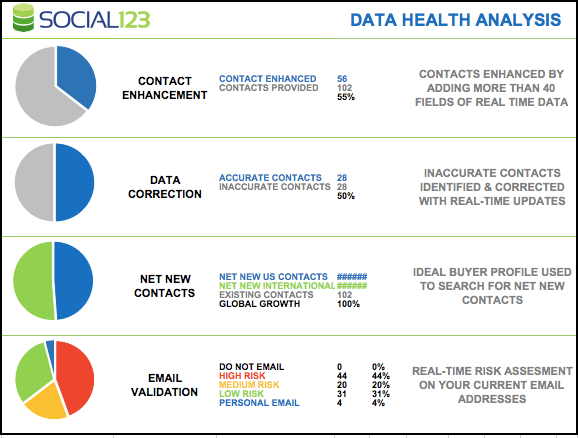
The Social123 Data Health Analysis Report

Contacts database Social123 rolled out a set of enhancements to their contact enrichment service including more accurate matching, expanded reporting, saved searches, improved security, and additional enrichment fields.

Match rates were improved due to the normalization of company and contact names on input files.  Name standardization reduces the number of nicknames, typos, and corporate identifiers (e.g. LLC) prior to match processing.  D-U-N-S Number matching is also being offered which allows marketers to upload a list of D-U-N-S numbers and receive a set of targeted contacts at the companies.  (D-U-N-S numbers are a proprietary global company numbering system developed and maintained by Dun & Bradstreet.  They are the closest schema to a de facto global numbering system for companies and corporate linkages).

Social123 automated their Data Health report with data quality metrics, net-new contact counts, and contact analytics.  Amongst the new contact analytics are the top ten titles and the top ten reported skills.

Social123 added twenty-five site location fields including address, phone, SICs, NAICS, revenue, employee count, and geocodes.

To improve security, users are no longer emailed direct file links.  Instead, notification emails direct users to a secure application.

Finally, Social123 now offers a firmographic only append.  Other services include contact prospecting, data cleansing, and email validation

The Social123 contacts dataset now exceeds 300 million detailed global contacts sourced from the open web and social media.

The Corporate Data Show Podcast

"Effective sales is not just about how many people to contact at the company, but who are the right people and what should I say to them."
The Corporate Data Show Podcast

I was privileged to be recently interviewed by Rick Holmes for the Corporate Data Show podcast.  The two of us discussed the benefits of sales intelligence, how sales intelligence differs from business intelligence, data collection methods, CRM and MAP integrations, ABSD, and sales triggers.

Rick is the CEO of Every Market Media so also very knowledgeable about the content industry.  EMM is a compiler of US and global B2B Emails.