Cognism Intelligence within Salesforce. Hybrid Engagement Platforms Continuously update CRMs and MAPs.
The market
is beginning to evolve a set of hybrid engagement vendors that deliver a broad
set of sales and marketing services. The boundary between sales and
marketing is quickly crumbling. Hybrid engagement services manage both
data and workflows. Features include
Data Services: Prospecting, Webforms & Batch Data Enrichment, CRM/MAP Data Maintenance, De-duping, Data Health Reports
Lead Management: Lead Scoring, Lead-to-Account Mapping and Routing, Dynamic Lead Prioritization, First and Third-Party Intent
Future functionality will include Next Best Actions, Embedded 1:1 Video, SNAP (Sales Navigator) Integrations, and Programmatic Advertising.
No vendor provides all of these services and some provide them as separate offerings, but firms such as Dun & Bradstreet, Zoominfo, Infogroup (Salesgenie), Lead411, LinkedIn Sales Navigator, and Cognism have all taken steps over the past two years to meet the emerging requirements of the CRO.
For the
moment, I’m calling these emerging offerings Hybrid Engage Platforms, but that
is a placeholder name as the market evolves.
SalesTech adoption rates and spend continue to increase according to a recent SalesTech study of 268 B2B sales and marketing managers conducted by Smart Selling Tools. Only 3% of respondents are planning on reducing their SalesTech spend in 2020 while 6% plan to spend significantly more in 2020 and 41% slightly more. Expanded spending will be focused on the top and middle of the funnel followed by management and reporting. Skills Development, Onboarding, and Bottom of the Funnel expenditures have a lower priority.
Over the past year, SalesTech spend per user has increased significantly. In 2017, only one-third of respondents spent in excess of $150 per user, but two years later, 65% spend more than $150 per user. As the average number of sales tools in use rose only modestly from 4.5 to 4.9 over the past two years, the spend per product has likely increased. The number of applications that are used by a majority of respondents trebled to six (CRM, Online Meetings, Lead List/Database, Social Selling, Account Targeting, and Skills Training & Reinforcement) with an additional four at 47% or higher. CRMs are used by 75% of respondents, lead/list databases by 65%, and social selling by 60%. The one category that dropped in usage was online meetings.
Adoption rates of technologies were fairly even by company size with large firm (500+) employees more likely to have adopted Sales Enablement, Skills Training & Reinforcement, and Sales Performance & Compensation. Conversely, firms with fewer than 500 employees were more likely to have adopted Prospect Engagement (Sales Engagement) solutions.
Account targeting tools for ideal customer prospecting grew from 4% to 51% over the past year, a clear indication that ABM strategies have been adopted. Lead Engagement (communicating at scale with early-stage, unqualified leads) grew from 11% to 49%, while social selling grew from 10% to 60%.
“The significant increase in usage of sales tools across the board indicates a trend (likely irreversible). If your organization is slow to take up the use of sales tools, you could get left behind. Even so, we don’t recommend adding new sales tools without considering what’s required to keep them up to date and who will be responsible, having a plan for measuring success (what does “Good” look like?), and deciding what’s required to establish and grow user adoption.”
Smart Selling Tools founder Nancy Nardin.
The top
three industries represented in the study were technology (42%), Financial
Services (9.3%), and Manufacturing (8.7%).
Drift Video allows customers and prospects to immediately engage in a chat.
Drift, which has quickly established itself as a leader in the chatbot space, is upping the ante by integrating video and chat. Users will be able to share and record videos via a Chrome extension or mobile app. Recorded videos can then be dropped into emails and sent to customers or prospects.
Videos
are “private and secure” with single sign-on functionality from Okta, OneLogin,
and Microsoft Azure. Users can restrict viewing to a specific email or
email list and “everyone else will have to request permission, just like you
would with a Google Doc.”
Drift
suggests three sales use cases for video: as a conversation starter, as a
second chance to refine a message after a call, and as a group selling tool
(team share).
Drift
Video provides real-time desktop and mobile notifications when viewed. Users
can immediately start a conversation while somebody is viewing their video “so
you can reach out and say hello or follow-up at the perfect time.”
It
is the immediate notification element which Drift claims to be its product
differentiation.
“There are a few good software products out there that make it easy to capture and share videos. But we took a look around the market and noticed one big thing missing: none of those products create a better buying experience because they don’t actually help you start conversations with potential customers. You still have to make a video, send an email, and hope to get a response. But with Drift Video, you can get a notification in real-time while someone is watching your video and then hop right in and say hello.”
Drift Website
“Since
starting Drift, we’ve said there are two mega-trends that would shape the
future of B2B sales and marketing: messaging and video,” said CEO David Cancel.
“Over the last few years we’ve built an industry-leading messaging
platform used by over 150,000 businesses, and now we’re expanding our
Conversational Marketing platform by adding video.”
Video
is driving global IP demand. According to Cisco, one million minutes of
video will be crossing the Internet every second by 2020 and 82% of all
Internet traffic will be video by 2021.
Drift
video is available today as part of the Drift offering. There is no
surcharge for video functionality for up to ten videos per month with a chat
option embedded into the video. For $12 per seat per month or $120 per
annum, reps are provided with a Pro license which includes unlimited HD quality
video sharing and storage. Only the Pro version restricts video sharing.
Future
features include Team Analytics, Book Meetings from Video, and integrations
with Salesforce, Pardot, and Marketo.
“We’ve
spent the last year working on Drift Video and it was one of the main reasons
for raising our Series C in April 2018,” stated Cancel. “In looking at
the market over that time, we saw that while there are many products that make
it easy to create and share videos, none of them were built to help to start
conversations and create a better buying experience. After a private beta
with some great early customers, that’s what we’re bringing to market today
with Drift Video.”
Drift
has integrated video in its own sales process with 50% of Drift revenue
“influenced by video in the selling process.”
“Video
is the greatest conversation starter in B2B buying,” said Alexa Nguyen in a
Drift video. “In a world of faceless phone calls and emails, video has
helped us build trust, and video has helped us close more deals.”
Video is another way for salespeople to engage with their prospects outside of the norm. Prospects are constantly bombarded with emails and phone calls asking for their attention. But it’s hard to cut through that noise because they don’t trust easily. In order to build that trust, you need to build a personal connection. And all personal connections start with a conversation. Video allows people to be personal, show that they’re human, and help build that connection that might be lost through text in an email.
Lacey Berrien, Drift’s PR Senior Manager
According
to research from Forrester and Boston Consulting Group, 75% of B2B transactions
have little or no sales interaction. Thus, video offers a valuable
channel through which sales reps can avoid being disintermediated. However,
sales reps could push this functionality too far. While chat
functionality sounds like the next step for video, reps should be careful not
to step over the line from personable to creepy.
When
prospects view an email, most understand that the act of opening an email
triggers a notification to the sender, but they don’t expect that the viewing
of a video will be treated as a real-time permission for a call or chat. Immediately
reaching out to customers and prospects may be viewed as a non-permissioned
extension of an asynchronous communication into synchronous. Drift does
not discuss GDPR in the announcement, but this seems to cross the boundary into
non-permissioned communications and the release of personally identifiable
information (“John@B2BProspect.com
is viewing your video. Call immediately”). The video privacy
permissions are focused on the seller (ensuring they aren’t shared with
others), but there does not seem to be any functionality to limit the “call me
back” immediacy of the service. If anything, the immediate messaging will
drive down the open rate of all embedded video and kill its efficacy.
When
I raised this concern to Drift, they offered a best practice to address this
issue. Lacey Berrien, Drift’s PR Senior Manager, suggested that sales
reps could either wait for the contact to initiate the chat or use a message
such as “Thanks for watching my video! I’m here if you have any
questions.” This approach makes sense. By utilizing a generic
message that sounds automated, it feels less invasive. This may be a
situation where a generic message may be welcome as it serves as an invitation
to chat while a personalized message may be off-putting.
The user can take one of two roads — proactively engage with the video viewer while they’re watching via the chat functionality OR not engage at all and allow the video viewer to chat with them at their own discretion…Other customers have gone the route of not messaging and just offering the viewer another channel to engage with them outside of email or a phone call. Buyers have all of the power. And the ultimate goal is to meet them where they are…and to always be available to help.
Lacey Berrien, Drift’s PR Senior Manager
There
appears to be a Gresham’s
Law of MarTech (“Bad money drives out good”); an effective channel or
marketing tool quickly becomes overused or misused, resulting in lowered
efficacy. Embedded video could quickly convert a golden channel into
chaff through overuse and perceived creepiness. What makes embedded video
so compelling today is its ability to personalize and deliver a relevant
message on a 1:1 basis. If embedded video overwhelms prospects or is seen
as inviting immediate, unwanted contact, it will kill the golden goose. A
softer touch is likely the best practice. If viewers maintain the control
and opt into contact, then it will enhance the value of a video by providing a
Call to Action that the prospect controls.
MarTech growth rate chart courtesy of Scott Brinker and Chief Martech
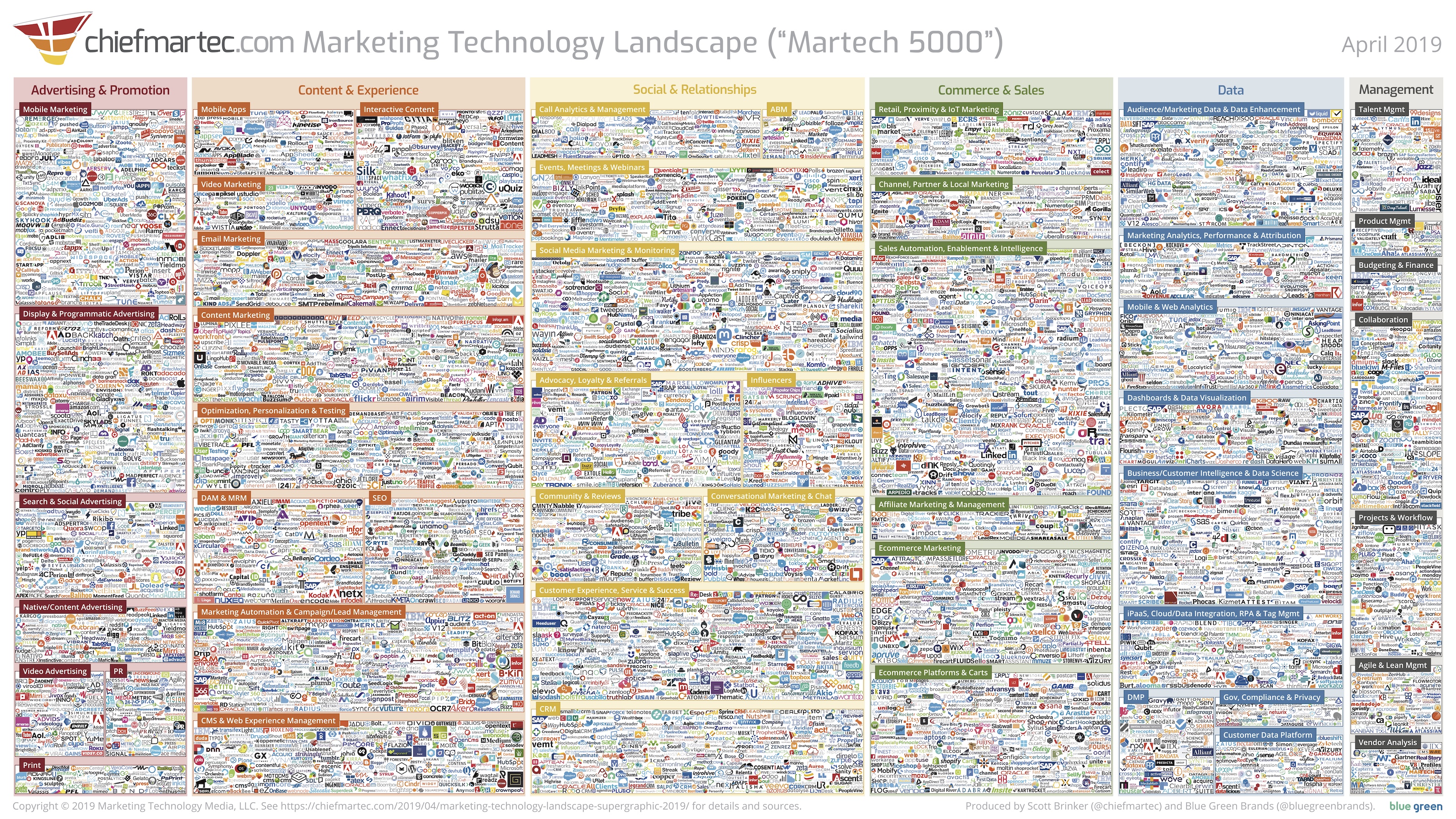
Scott Brinker published his 2019 Chief Martech eye chart and it now spans 7,040 companies, up 211 since last year. While the industry continues to grow, the rate of growth appears to have moderated. Between 2014 and 2018, the industry was adding over 1,000 companies each year with the biggest jump for the 2018 chart (1,800).
“That’s not
so much a slowing down as a flattening out, a plateau,” said Brinker. “At
face value, it would seem that, indeed, we have achieved ‘peak martech.’ (pause
for dramatic effect)”
While
industry growth may have plateaued, Brinker admitted that 7,040 significantly
underestimates the total number of Martech firms and joked that he may have hit
“peak martech landscape.” Brinker noted five areas where his chart is
underweighted:
Regionally – When comparing to national MarTech landscapes, Brinker spotted hundreds of companies on the UK, Canadian, Chinese, German, Swedish, and Finnish country charts that were absent on the 2019 Chief Martech chart.
Vertical – Likewise, verticalized solutions are also underrepresented.
Apps built for specific MarTech platform ecosystems
Apps built by services companies (but packaged as products)
Apps built with low-code/no-code citizen developer platforms
“Each of
these trends — the growth of platform ecosystems, the blending of software and
services businesses, and the rise of citizen developer platforms — are birthing
whole new galaxies of martech apps.
The major
marketing suites have all embraced becoming true marketing platforms, with ever
more open APIs and official marketplaces for third-party apps.”
Brinker
lists Salesforce, Oracle, Adobe, Microsoft, and G Suite amongst the platform
ecosystems, but one would also include browser extensions, mobile apps, and
sales engagement platforms (technically, SalesTech, but there is a fair amount
of overlap between MarTech and SalesTech these days) to the list. Brinker
noted that WordPress has 54,480 plugins.
Audience / Marketing Data & Data Enhancement (2018 MarTech Landscape)
Many of the
DaaS and Sales Intelligence vendors covered in this newsletter are amongst the
204 vendors listed in the Audience / Marketing Data & Data Enrichment
category and the 457 vendors listed in the Sales Automation Enablement & Intelligence
grouping.
SalesLoft CEO Kyle Porter Gave the Opening Keynote at the SalesLoft Rainmaker 2019 Sales Conference.
At their Rainmaker 2019 conference, SalesLoft announced a doubling of their ecosystem, mobile functionality, a rebuilt analytics engine, and a hot leads feature. The show attracted 1,300 attendees to hear 164 speakers.
“We’re in the middle of an evolution in the relationship between sellers and buyers,” said SalesLoft’s CEO, Kyle Porter. “Sales teams need to tear up their playbooks and start fresh with a blend of human, relevant sales tactics and the modern technology needed to create an authentic sales experience that is repeatable and scalable.”
SalesLoft’s
purpose is to “to activate the authentic seller in all of us” and elevate the
sales profession by offering “world-class experiences.” The firm operates
under a quintet of values that inform its hiring and operations:
SalesLoft Operating Principles.
These
principles led to SalesLoft being named the top-midsized employer in Atlanta
for the second year in a row. “We embrace the transformative power of
technology innovation for our customers, but we believe in people first,” said
Porter. “Our founding purpose is to create an environment where others
can come to learn more, do more, and become more. Team members are
encouraged to take their talents and skills and apply them to serve others and
find fulfillment. We show love to our people so they can share that
sentiment with our customers.”
SalesLoft’s
sales engagement platform is designed to support evolving buying behavior.
B2B buyers are swamped by messaging and “super busy,” yet need to solve
complex problems. Buyers are looking for an “engaging, authentic
experience” that understands buyer needs and solves their problems.
However, sellers are inefficient and operate with broken processes.
SalesLoft is looking to address process failures by centralizing sales
workflows and encouraging best practices. Objectives include elevating
the sales profession through community, encouraging diversity amongst its staff
and event speakers (54% of whom were women or minorities at Rainmaker), and
transparency in its policies and outcomes.
Porter
described his future vision of sales where “every single seller has a digital
assistant by their side” along with a “sales coaching network” which is a
“giant distributed network of sales activity.” Sales reps are supported
by a digital assistant which delivers broad data and context-specific insights
based on seller, stage, and customer to help reps “connect authentically with
the buyer.”
Porter
contends that “you can’t take the human out of the equation” but you can make
it “easier to distribute a world-class experience to your customer.”
“[It’s time to] elevate the profession of sales to focus on delivering customers world-class experiences. With that, you can maximize revenue. A sales experience must be authentic, engaging, relevant, human, one-to-one and, most importantly, it understands buyers’ needs and solves their problems.”
SalesLoft CEO Kyle Porter
Sales
reps have long suffered from a bad reputation, being forced to take ethical
shortcuts to meet managerial demands. SalesLoft is looking to lead by
example. According to Porter, when “we do right,” SalesLoft customers are
able to hire, innovate, and invent new things.
SalesLoft’s
other goal is to improve the efficiency and efficacy of sales teams. A
SalesLoft study found a 22% increase in opportunities created when comparing
the 90-day windows before and after implementing their platform. To back
up their research, they commissioned a Forrester study of their customers which
found a
2.5X improvement in response rates
20% lift in conversion and productivity
Doubling of the funnel
13% increase in renewals
329% ROI
“Many
people say we’re in a state of digital transformation,” said SalesLoft CMO
Sydney Sloan. “For sales, we’re entering a revolution of how we engage
customers.”
Buyers are looking for partners that work with them to identify and resolve issues. “Today’s successful seller has to be a problem solver and you do that by asking great questions and collectively solving the problem with and for your customer,” said Sloan. “It doesn’t matter if the product goes 10 miles an hour or 50 miles an hour, it’s the people I want to work with in partnership and, at the end of the day, it’s the people I want to work with. I’ll pick a company because of the relationship. The product still has to solve my problems but if two things are equal, I’ll go with the partnership.”