Factiva Reimagined

Factiva’s new UX for trending news

Factiva, a news and company intelligence service from Dow Jones, announced that it has reimagined its product experience with a “modern, intuitive, and easy-to-use design” that  “streamlines knowledge gathering and consumption.”

Factiva has long competed against LexisNexis in the news space for journalists and business professionals.  It delivers content from over 200 countries in 32 languages, along with company profiles.  At one point, it competed in the sales intelligence space against OneSource, LexisNexis, and Hoover’s but stepped away from that segment about a decade ago.

New features include personalized and trending news modules, enhanced natural language search capabilities, and tailored content recommendations to “support strategic, data-driven business decisions.”  The new UX is designed to simplify research and is mobile-first.

“News-derived data is a critical source of business intelligence for any professional, providing an unparalleled view of the past and present and windows into the future,” said Traci Mabrey, general manager of Factiva at Dow Jones.  “At a time when the threat of misinformation and disinformation is ever-present, every level of the organization needs easy access to high-quality, trustworthy news to guide their daily decisions.  This is what led us to the strategic redesign of Factiva.”

New features include:

  • A fresh and modern interface that’s accessible to users with all levels of experience.
  • Faster, free-text-based search optimized for ease, speed, and content discovery.
  • Responsive, mobile-first design that adapts to any device, ensuring the same powerful functionality anytime, anywhere.
  • Personalized results tailored to the topics, industries, and companies that are most relevant to each user.

As millennials and Generation Z move into management, they seek “instant access to a personalized view of fact-checked content from multiple sources and publications.”  Furthermore, their information tools must be convenient.

“The role of knowledge management has rapidly evolved—people expect an experience like that of their favorite app, while still requiring trusted, premium information,” said Mabrey.  “Our goal is to be the leading news and business search engine for the decision makers of today and tomorrow.  With Factiva, the next generation of leaders can leverage high-quality, trusted news to cut through the noise, and surface business-critical information.”

Owler Integrates with HubSpot & Teams

Owler maintains lists of companies that have been synced with HubSpot.

Company Intelligence vendor Owler unveiled a pair of integrations with HubSpot and Microsoft Teams.  Both offerings are available through its Owler Max subscription product for sales reps.

Owler supports competitive and sales intelligence, with data gathered from web mining and crowdsourcing.  Along with standard firmographics, it offers M&A intelligence, funding profiles, company news alerts, and twenty-three sales triggers.

Owler Max is their sales intelligence edition with CRM syncing, email alerts, and prospecting.  Reps control which of the twenty-three alert categories are relevant, including new triggers based on revenue and employee count changes.

Company prospecting selects include industry, location, company status, revenue, employee counts, funding history, and competitors.  Owler profiles 15 million global companies, with the option to push companies and lists to the CRM.  Company data is passed bi-directionally, while news can be used to create HubSpot Tasks or display alerts via email, HubSpot, or Slack.

News and company profile links are embedded within HubSpot Tasks.

“Owler Max provides sales teams with resources they need to do their jobs the best they possibly can,” said Owler CEO Tim Harsch.  “Our new integrations and data insights offer sales teams key improvements to organization, workflow, and research efficiency.  Sales professionals can leverage data better, drive desired results quicker, and grow the capacity of collaboration in the remote work era.”

Owler syncs data every six hours and can match and upload 1,000 records per minute.

The Teams integration was launched back in August.  Owler Max users will see their MS Teams instance in the Owler Max dashboard.  They then click connect, name the connection, and syncing commences for all followed companies.  Team members can then read, collaborate, or share company intelligence via Teams or email, with alerts automatically posted to Teams channels.  Alerts may be aggregated from all lists or customized.  Users can also control which of its nearly two dozen event categories should be shared so that only relevant topics are posted.

“Owler Max’s new offerings put sales teams on a straight path to winning.  To unlock their full potential, sales teams need efficient access to personalized data and tools for seamless workflow.  By providing this scaffolding, Owler Max gives sales professionals an immediate competitive edge.” 

Owler CEO Tim Harsch

Owler Max is priced at $600 per annum with a minimum of five seats.  Owler Max also supports a Salesforce connector.

Artesian Tweaks Platform Performance & News Storage

The Artesian Watchlist

Artesian Solutions implemented a set of technological upgrades to its sales intelligence service which provide speedier searches, more accurate sales triggers, and improved capacity. Artesian now employs Elasticsearch for its news and social media storage. According to the firm, “This has enabled it to dramatically scale up server capacity, boost the performance of its advanced architecture, and provided the ability to analyse, filter and deliver results from raw unstructured data. Search results that previously took 10 seconds now take just 10 milliseconds.”

Artesian Solutions enhanced their sales triggers with improved scoring and ranking algorithms while improved caching and load balancing allow the firm to expand concurrent users ten-fold without a degradation in performance.

The net result of these architectural enhancements is a 25X increase in historical content available for analysis and research and a five-fold increase in the speed of news query engines.

“We constantly feed back into our engineering team the learnings, preferences and needs of our customers, and in return they always deliver robust, superior performance enhancements that not only accelerate our R&D programme, but solidify our position as the market leader in sales intelligence software,” said Artesian CTO Steve Borthwick. “We’ve boosted the performance and accuracy of the Artesian platform across the board, improving raw speed and our ability to handle a significant number of simultaneous users, as well as optimising their ability to uncover those all-important golden nuggets of sales insight.”

InsideView UI Refresh

InsideView recently rolled out a beta user interface which follows a mobile first navigation structure and includes a redesigned News Feed view for followed companies.  InsideView describes the new UI as “fresh. Modern. And easier to navigate, with more engaging graphics and a common user experience across platforms – within CRM, mobile, and web.” 

The color scheme utilizes a monochrome palate with splashes of red, blue and green for accents (e.g. hyperlinks, highlighted tabs, buttons).  Unfortunately, much of the text is gray against a white background which may cause readability issues in brightly lit locations. 

Navigation is via a left-handed navigation bar.  For companies, the primary tabs are Overview, Company Information, People, and Insights.  Sub-headings under Company Information are Firmographics, Industry Profile, Financials, Family Tree, and Competitors.  Industry Profile has a third level of horizontal tabs, and really should be presented as a top-level navigation item. 

A Search bar provides a type-ahead feature to assist with company and contact searching.  The type-ahead feature begins as a Recently Viewed list of companies and contacts. 

The Insights Tab includes social integration, news filtering by agent, and keyword searching.

The Insights Tab is an updated version of the InsideView buzz tab.  Users can view company news, blogs, Twitter, and Facebook in a single feed.  News can be filtered to a subset of their 17 agents and be shared via email, social media, or Yammer.  All four sources are keyword searchable.  Twitter is fully integrated with a Twitter handle summary along with reply, retweet, and favorite.  Facebook supports an integrated stream of posts with commenting support. 

One of the nice features that was carried forward from the old Buzz tab is the ability to switch between company posts and posts from others for Twitter and Facebook. 

In place of a static Home Page, the user is taken to the News Page which presents the user with news stories for followed companies in a grid pattern.  Users may filter the topics by one or multiple Agents (sales triggers) and Watchlists.  Individual articles may be shared with social media, email, or Yammer. 

The News view may be filtered by Watchlist and Agent.

The Company view still lacks an export to PDF feature similar to that found in D&B Hoovers and Hoovers classic.

Users will be able to switch between the classic and beta versions through April 27th.

Ignite Technologies Acquires FirstRain

FR
FirstRain Coverage of Lattice Engines includes web volume, business influencers, market drivers, Twitter trends, recent stories, related topics, and subject filtering.

Ignite Technologies will be acquiring news analytics vendor FirstRain as part of a pre-negotiated, Chapter 11 corporate reorganization.  The acquisition is expected to close by the end of July subject to court approval.  The acquisition is being funded by Ignite’s parent company, ESW Capital.

FirstRain provides a set of company-specific insights and analytics derived from news, press releases, filings, Twitter, and other open web content sets.  FirstRain applies a high-precision taxonomy to the “business web” which spans companies, industries, geographies, and business topics.  For the past few years, FirstRain has been the source of company and industry news for Dun & Bradstreet (Hoovers Classic, First Research, D&B Direct, and D&B 360), Mergent, and other OEM partners.  FirstRain also provides integrated solutions on Salesforce, Microsoft Dynamics, and Microsoft SharePoint.

FirstRain Who to Call Panel.
The FirstRain Who to Call Panel provides insights on which accounts have Deal Threats and Accelerators, Reasons to Check In, or New Information.

“FirstRain’s leading-edge, analytics technology providing actionable insights for its clients’ sales and marketing teams strengthens Ignite’s portfolio of sales and marketing solutions,” said Ignite’s CEO Davin Cushman. “Additionally, with the close of the FirstRain acquisition, Ignite will be materially expanding our foundation of sales and marketing solutions that Chief Marketing and Chief Revenue Officers can depend on to drive their business.”

Once the acquisition closes, FirstRain will be part of the Ignite Prime product offering which provides access to enterprise software by simply paying a maintenance fee on at least one Ignite standard solution.

“Ignite has a proven track record of buying, strengthening and growing the companies it acquires, and FirstRain is excited about the potential for our world-class teams to carry the FirstRain solutions and customers forward,” said YY Lee, Chief Executive Officer of FirstRain. “Through this acquisition, Ignite’s foundation of success and innovative programs, including their unique Ignite Prime program, extends the value proposition even further for FirstRain customers, now and into the future.”

LinkedIn StoryLines Launched

StoryLines are trending topics shown on the right side of the LinkedIn Desktop

LinkedIn recently introduced their new Storylines feature parallel to the LinkedIn feed.  StoryLines are “curated interest-based feeds that surface developing stories to help you discover and discuss news, ideas, and diverse perspectives from the largest group of professionals, publishers and editorial voices ever assembled.”

Articles are based upon information LinkedIn has about each reader such as their industry.  StoryLines are intended to combine industry expertise with individual network commentary.  A unique hashtag makes “it easy for you to join the conversation and add your own take on the issue.”

LinkedIn emphasized that StoryLines promotes a diversity of opinions and sources.  “Each story includes multiple perspectives, ranging from news publishers and influencers, to people in your network, so that you can easily weigh up diverse opinions”

StoryLines are curated via a combination of editorial curation and algorithmic filters.  When stories break, an editor writes a summary and identifies diverse sources.  An algorithm then adds additional member commentary.  This approach ensures a multiplicity of views that pull members out of “filter bubbles” which would otherwise reinforce current views and biases.  Topics will be business related

“I don’t want just one point of view”

  • LinkedIn VP of Product Tomer Cohen

Unlike Facebook, LinkedIn believes it can avoid the problems of “fake news.”  Inaccurate content that is intentionally deceptive, including fake news, is not acceptable on our site,” said VP of Product Tomer Cohen.  “Our combination of algorithms and editors creates an experience where trending news is validated by editorial to ensure that it is professional and comes from trusted sources.”

Cohen added, “The content members write and share on LinkedIn becomes part of their professional identity — it can be seen by their boss, colleagues, and potential business partners. Promoting fake news can damage your reputation, and there is no hiding behind anonymity on LinkedIn.”

Other features include related stories and follow options for topical experts.

The new feature is being rolled out to US members and then will expand internationally.

LinkedIn mobile also added feed personalization tools which will soon be available via desktop.  Amongst the filters are options to follow companies, industry leaders, and publications.  Users can also hide posts, and unfollow people and companies.  Unfollowing people allows users to retain connections without seeing the connections posts.

LinkedIn has struggled to customize their feed for users, but StoryLines sounds like a smart innovation.  By creating a curated trending topic category and placing it to the right of the feed, they can provide relevant content and discussions without it overwhelming the user feed.  Furthermore, by curating a set of diverse viewpoints, members are provided with a broader set of perspectives.

Since the beginning of the year, I have noticed an improvement in LinkedIn’s feed.  Gone are the eye candy stories from Business Insider covering bots and bikes.  Also, there are fewer viral stories about enterprising individuals overcoming hardship.  Instead, they have done a better job of surfacing posts from my connections and articles in my field.

The launch of Sales Navigator Enterprise (covered last week) was another indicator that they are focusing more on the Professional side of Professional Social Networking.

ABM and High Growth Companies

Account Based Strategy Adoption Rates (DiscoverOrg and Smart Selling Tools)

A joint study by DiscoverOrg and Smart Selling Tools of 200 sales and marketing organizations found that high growth companies with at least 40% growth over the past three years are 2.5 times more likely to have adopted an Account Based Marketing (ABM) strategy.  Furthermore high growth companies are twice as likely to have successful cold calling programs and are more likely to have a dedicated outbound prospecting team.  High growth firms are also more likely to hire sales reps based upon their “tech-savvy” than experience and have adopted twice as many sales technologies than their slower growth brethren.  With respect to MarTech, high-growth companies have adopted 24% more marketing solutions.

The study also found that fast growth companies provide at least three hours of coaching or training per week to their sales teams.  At slower growth companies, training appeared to have less of an effect.  According to the report, “While an increase in training hours correlated with a rise in growth rates for the high growth group, it did not with low growth companies. This suggests that training may not in of itself cause growth, but it is critical in sustaining it. Fast growing organizations need to train constantly to maintain momentum and enable teams to perform at a high level. Companies that err on the side of less training and coaching do not appear to set their teams up for the same level of success.”

“The findings clearly demonstrate that achieving fast growth is not as simple as having a great product and hiring experienced sales reps.  Sales and marketing teams that are true revenue-generating engines take risks and do the hard things – like cold calling, focusing on data quality, and heavily aligning sales and marketing teams across account-based strategies.”

– DiscoverOrg CEO Henry Schuck

“Technology proliferation in the sales and marketing industry is both a challenge and an opportunity,” added  Nancy Nardin, CEO of Smart Selling Tools. “The fastest growing companies are investing in technologies that make their sales and marketing teams more productive and more insightful, while recognizing it is equally as important to have highly trained team members who know how to leverage that technology to its fullest power.”

The primary inhibitor of even faster growth at high growth companies was data quality issues concerning accounts and contacts.

The top technology available to sales reps were CRM (52%) and LinkedIn (free LinkedIn was deployed at 45% , premium LinkedIn at 33%, and Sales Navigator at 27% of sales teams).  Pipeline and Opportunity Management software was third at 42%.  Rounding out the top five were compensation/commission software and sales intelligence, both with a 38% deployment rate.  Surprisingly, 37% of sales teams still employ account and contact data providers / list providers.  As sales intelligence vendors support list building along with sales intelligence (and some also data hygiene), there are likely ongoing opportunities to move sales teams up the value chain from list purchases.

Predictive analytics / predictive intelligence placed 36th out of 37 technologies with only a 5% deployment rate.  As Gartner estimated the total global market for predictive analytics technology to be between $100 and $150 million, this low penetration rate should not be overly surprising.

The study, conducted in November, used 40% growth between 2013 and 2016 (estimated) as the high growth cutoff as it is represents the recent growth floor for Inc. 5000 membership.  Of the 200 firms studied, 17% fell into the high-growth category, 69% fell into the low-growth category (1-39%), 13% had flat revenue, and 1% had declining revenues.  The survey was over weighted to technology companies with software, IT Services and Telco as the top three industries surveyed.  82% of the firms were B2B and 85% were headquartered in the US.

Contify: Social Intelligence within SFDC

Social Selling vendor Contify rolled out a Salesforce.com connector for their account based social intelligence service.  Contify intelligence is displayed within Lead and Opportunity record I-frames.  The display is split into two tabs: News & Mentions and Social Updates.  Both tabs may be filtered by topic.

The Social Updates feed combines account intelligence from Twitter, Facebook, LinkedIn, and YouTube.  The company “only shows social media updates which have relevant sales triggers associated with it.”  Thus users are not “bombarded with a stream of updates that aren’t relevant to you.

Contify Social Updates

News triggers are set to thirty days, but may be adjusted by users.

The Indian vendor provides fourteen sales triggers mined from the web and social platforms.  Triggers are delivered as alerts and within the subscription service.  Users may share triggers via Chatter, email, Twitter, and LinkedIn.  Users may also save triggers as bookmarks for later review.  A separate triggers list is included within the record.  Contify also offers Custom Triggers which may be created from within SFDC.  Custom Triggers consist of a set of search and stop keywords.  Contify begins delivering customer trigger results within fifteen minutes.

Trigger categories are similar to those found in other products.  This is not to fault Contify as there are a set of common events which have been deemed to be most valuable by B2B sales reps.  These include Funding Activity, M&A, Management Changes, Partnerships, and New Offerings.

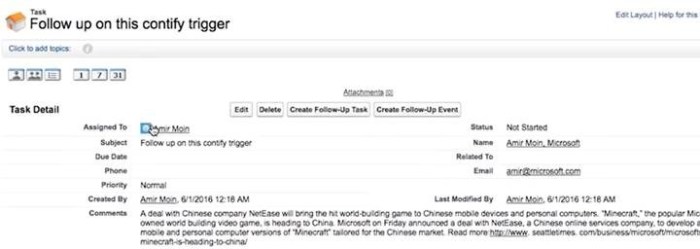
Triggers may also be setup as tasks which are saved as open activities.  Trigger information is stored within the Comments field of the task.

Contify triggers may be flagged as tasks for alter action.

If users are unable to find the correct company, they can submit the URL to Contify’s editors who will create a company profile within 24 hours.

The service is priced at $49.95 per user per month billed annually.

The firm has over 10,000 users.

Trapit: Social Selling for Account Based Sales

Trapit Social and News Intelligence

Social intelligence vendor Trapit launched a social selling service for account based sales.  The monitoring service tracks over 100,000 curated web sources.  Content categories include blogs, professional journals, social media, and news services.  For Twitter, the service supports Retweets, Replies, and Favorites.  Trapit also supports “robust filtering” by media-type, source quality, tags, and geographic location.

“With this package we are empowering salespeople to close more business by providing them with capabilities that help them take control of and excel at every stage of the customer journey,” said CEO Hank Nothhaft Jr.  “This new package, coupled with our core curation and analytics capabilities, makes Trapit the only comprehensive sales enablement platform that actually puts the seller in the driver’s seat.”

TrapIt displays pre-defined messages to assist with social media engagement.  A publishing module helps the marketing department schedule posts to social media or blogs and feeds suggested copy to sales reps.  An analytics module assists with tracking social media metrics.

“We think this is really important because buyers have more power than ever,” Nothaft said. “The seller has become almost obsolete, and many are doing little more than taking an order from a customer who has already made a decision. Trapit allows the seller to get involved much earlier in the customer journey, which had previously been controlled mostly by the marketing team. We’re putting these empowering tools in the hands of the sellers directly,” said Nofthaft.  “The top salespeople already understand how to navigate social and digital relationships and how to use them to drive engagement and sales.   Trapit not only makes it easier for those sellers to do what they are already doing, but it also gives others an easy to use platform specifically designed for making social sales.”

Customers include Everbank, HD Vest, New York Life, and Microsoft.  Trapit is based in San Francisco and has received $20 million in funding to date.

News Aggregators: Who Do I Use?

FR
FirstRain coverage of Lattice Engines includes web volume, business influencers, market drivers, Twitter trends, recent stories, related topics, and subject filtering.

The following is a Quora post I wrote concerning news aggregators…

As an industry analyst that publishes a weekly subscription newsletter on the information industry, I follow companies and industry topics related to my industry.  Coverage spans about fifty companies across North America and Europe with many of the firms having global footprints.  As such, press releases are likely to come from North America and Europe but news coverage needs to be global.

Alerts are basically a distraction so I employ daily push (email alerts) and pull (portals) approaches.  I only want alerts for major events (e.g. PE/VC fundings and M&A activity).

Also, I am not performing due diligence or media analysis, so duplicate filtering and high precision are critical.  I do not want five variants on the same AP story or passing mentions of companies in the twelfth paragraph of an article.  I also am not interested in stock market news as it is ephemeral.

I provided the above as I use information services to meet specific workflow needs.  Your needs may differ.  Here is how I achieve the above objectives (in order of importance):

  • FirstRain – I have used FirstRain for five years.  They have extremely high precision meaning that stories are almost always about the topic in question.  They include a FirstTweets feature which provides ten Tweets about my subject.  Instead of simply looking for Twitter keywords, they follow the Twitter links and analyze the linked content.  Thus, FirstTweets provides me with side door access to blogs, company website posts, and social media.  I am setup to receive daily news for companies and industries and can explore their news archive by company, industry, or business topic.  SUBSCRIPTION SERVICE
  • Owler – Owler combines semantic mining of open web news with social media crawling (Blogs, YouTube, and Vimeo), polling (e.g. CEO and transaction favorability), crowdsourcing (e.g. company size estimates and competitors), and editorial resources.  Editors review story tagging to improve precision and collect funding and M&A information.  I receive daily alerts of news and social media that complements FirstRain well.  I also receive editorially created M&A and funding alerts that provide transaction details and company overviews along with curated story hyperlinks.  FREE SERVICE
  • Feedly – I use Feedly as my RSS portal.  I have it setup for company blogs, industry analysts, trade publications, and a few individual bloggers.  I generally use Feedly as a backup system to make sure I haven’t missed a story or for when my newsletter is short and I’m looking for additional ideas. FREE SERVICE
  • Seeking Alpha – I have a short list of public companies that I cover with earnings news flashes.  Seeking Alpha provides me with alerts on transcripts, filings, and investor analysis (I generally ignore the investor analysis).  The key things for me are the earnings bullets and transcripts. FREE SERVICE
  • Trade Publications – I am setup for weekly feeds of a few trade publications.  FREE SERVICES
  • Factiva – Factiva is a subscription service, but I can access it through my alma mater’s library.  I generally access Factiva only a few times per quarter for archival research (they go back over thirty years) or Wall Street Journal articles (Factiva and the WSJ are both owned by News Corp).  SUBSCRIPTION SERVICE
  • YouTube – I have setup the corporate YouTube sites for many of the companies I follow.  YouTube provides corporate positioning videos, product demos, webinars, conference keynotes, and training tips.  I live in YouTube the week of Dreamforce (SFDC’s annual show) as I am not able to attend the show. FREE SERVICE

I also have licenses to various sales intelligence services but do not use them generally for my newsletter as it could bias my research.  If you have access to a subscription sales intelligence service (e.g. InsideView, Avention, Hoover’s) or news service (e.g. Factiva or LexisNexis), it can also be part of your aggregation mix.