RelSci Goes Freemium

Relationship Science (RelSci) from within the Salesforce AppExchange.

Relationship Science (RelSci) rolled out a freemium offering for their social networking service this week.  A free edition provides ten profile views while the Professional edition is priced at $49.99 per month and supports contact synching, relationship finding, news alerts, power searching, and a mobile app.  The full feature set is shown on their pricing page.

While the professional edition does not yet support networking, the feature is in development for single users.

RelSci is designed for investors (e.g. PE, VC, Wealth Managers), fund raisers, and business development professionals.  It works best at companies where relationships are highly prized for reaching top executives, directors, and donors.  The firm marries your contact network with a database of 5 million “movers and shakers” across 1 1/2 million organizations.  The enterprise edition allows users to leverage the relationships across their firm, providing a powerful research and networking tool.

Along with standard company and executive profiles, you will find nonprofit board and association memberships, nonprofit and political donations, investments, and news alerts.  What you won’t find is emails and direct dial phone numbers.  The system is designed for introductions, not cold calling.

The product offers an elegant user interface combined with powerful prospecting tools.  Along with standard prospecting, there are screens which assist with trip planning, donor searching, and identifying potential investors.

So how does RelSci stack up vs. LinkedIn Sales Navigator?  A recent DiscoverOrg survey found that one quarter of top level executives are not LinkedIn members so RelSci has a distinct advantage there.  Furthermore, RelSci brings in intelligence not found within LinkedIn such as rich company profiles (LinkedIn’s are basically warmed over marketing materials from the website and Facebook), donations, and investments.

However, Sales Navigator offers InMail with recommended names to drop while RelSci forces users to request introductions through their network.  This could be a potential bottleneck at firms where the strongest networks go through top level execs and the firms’ rainmakers.

Also, if your focus is more directors and managers, you many not find sufficient depth within RelSci.  An ABM strategy could stall out due to lack of executive depth in RelSci.  For those companies, I’d recommend a full sales intelligence offering (e.g. Avention, Hoover’sDiscoverOrg, RainKing) in conjunction with free LinkedIn.

RelSci offers powerful screening and visualization tools tied to an elegant user interface.  For professional networkers aiming at the upper echelons of companies and boards, RelSci is a superior option to LinkedIn.

Sales Intelligence: US vs. UK

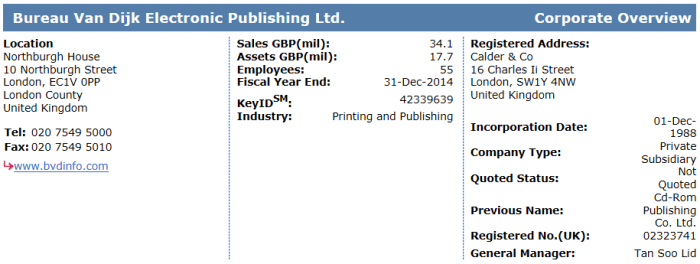
UK private company financials (source: Artesian Solutions)

The UK is the second largest market for sales intelligence services.  For US firms, the UK is usually either the second or third market (after Canada) which they support.  Thus, the UK market is served by both British (e.g. DueDil, Artesian Solutions, Bureau van Dijk) and American companies (e.g. Avention, Dun & Bradstreet, Factiva).

A key difference between the US and UK markets is the availability of UK private company data.  Approximately three million active UK firms are required to register with Companies House (the major exceptions are small businesses, partnerships, and public sector entities).  Large firms are required to provide full financials while mid-size firms may only be required to file a Balance Sheet or summary financials.  The smallest firms may simply be required to file a basic Annual Return with Director and Shareholder information and abbreviated accounts.

Along with annual financials, the UK filing regime requires statements concerning Directors and Shareholders (DASH); Mortgages, Charges, and County Court Judgments (MCCJ); and Gazette filings concerning receiverships and the winding down of businesses.  The net effect is a richer set of financial figures, superior intelligence concerning corporate families and ownership, a broad list directors, and intelligence concerning cross-company director linkages.

There are some drawbacks to this system.  First, the filings for private companies are not filed until three quarters after the end of the financial year so one is generally looking at data that is three to seven quarters in arrears.  A company’s financial position can shift significantly during this time.  Of course, few companies in the US are required to make any kind of financial filings.

Second, statements may be filed from the offices of corporate secretaries, accountants, or corporate owners.  Thus, the registered address often differs from the actual “trading address”.  When evaluating UK sales intelligence tools, look for vendors that provide both registered and trading addresses.  You should also ask about the population of URLs and phone numbers.

In the UK, sales reps should be calling into the Trading Address (physical) location, not the Registered Address (legal). Make sure your Sales Intelligence service provides both.
In the UK, sales reps should be calling into the Trading Address (physical) location, not the Registered Address (legal). Make sure your Sales Intelligence service provides both.  (Source: Avention)

Third, while there is very good data concerning corporate linkages, including minority shareholdings, the data only goes to the subsidiary level.  But companies may have hundreds of operating locations not listed.  In the US, vendors capture all of these branch locations, but this intelligence is more limited in the UK.

Another problem with this regime is there is little focus on who is managing the organization.  While a few directors are listed, they may not be the people the sales rep will be calling into.  Thus, the sales intelligence vendors have been working to tie in marketing datasets which provide additional color (British translation: colour) including mid-level managers with emails, URLs, and phone numbers.

Finally, one is more likely to have turnover figures (US translation: revenue) in the UK than in the US.  Conversely, US vendors are more likely to have employee figures and modeled revenue figures.  As a result, the employee count is a better sizing metric when prospecting in the US and turnover is the superior prospecting metric in the UK.

I am currently working on the next edition of my Field Guide for Sales Intelligence Vendors.  One of the key additions to this year’s edition is the inclusion of three UK vendors: Artesian Solutions, Bureau van Dijk, and DueDilAvention, which also offers a strong UK product, was previously included.  The new edition will be available before the end of this year.  I am now taking pre-orders for the expanded guide with purchasers receiving the 2015 edition at no charge.

InsideSales.com: Essentials for SMBs

InsideSales.com Notifications and Activity Tracking

InsideSales.com is now offering “InsideSales Essentials,” a cloud-based sales acceleration service for SMBs (I have generally classified companies like this as Account Based Sales Development [ABSD], but Sales Acceleration is also a descriptor used by vendors in this category).  The new offering supports email tracking and analytics, integrated dialer, email templates, call recording and monitoring, and automated voicemails.  The service also bundles in local call number display in the top twenty-five metro areas.  InsideSales claims that local number presentation improves contact rates by up to 38%.

“InsideSales has mastered sales across the enterprise, powering companies like Microsoft, ADP, and Groupon to increase revenue growth by up to 30 percent. With this new package, we’re taking what’s proven to work for some of the biggest brands and tailoring it for small business needs,” said Gabe Larsen, director of InsideSales.com Labs.  “Essentials gives small and medium-sized businesses the power to sell smarter and help expand their company through strategic sales plays.”

InsideSales Essentials begins at $5,000 for five seats.

“Our mission is to leverage big data and cloud capabilities to unlock human potential through predictive analytics and machine learning,” said InsideSales CEO Dave Elkington. “We are building an Amazon-style recommendation engine for business — a system capable of intelligently analyzing billions of data points in real-time and recommending the optimal next steps for almost any application or business process. This lays the groundwork for a future where predictive technology can be applied, not just to sales organizations but also to government, healthcare, retail and beyond.”

The firm was also just named to Forbes Cloud 100, placing it amongst the top private cloud companies in the world.

ABSD  / Sales Acceleration is a rapidly growing field as firms look to formalize ABM processes amongst their sales development teams.  I have seen such rapid growth amongst ABSD firms that I am including profiles of four ABSD vendors (QuotaFactory, KiteDesk, Outreach, and SalesLoft) in the next edition of my Field Guide to Sales Intelligence Vendors.  Inclusion is based upon the existence of a partner ecosystem which includes sales intelligence vendors.  Because InsideSales.com does not offer such an ecosystem, they did not make the cut.  However, the firm has seen rapid growth and would be considered amongst the leaders in this burgeoning field.

Outreach: Forbes 100 Cloud Rising Star

Account Based Sales Development vendor Outreach has been named a Forbes 100 Cloud Rising Star.  CEO Manuel Medina said that his firm offers a “platform that transforms how sales teams communicate and engage with prospects.  We believe there is a massive opportunity to bring a higher level of sophistication to the sales process so teams can focus on what they do best – close deals.”

Karan Mehandru, General Partner at Trinity Ventures, describes Outreach as a “system of action for sales people.”  Calling sales “the lifeblood of the organization,” Mehandru continued that “salespeople are creating the same level of sophistication as their marketing counterparts” which creates an opportunity for a “massive company” to deliver on the promise of CRM.

Mehandru joined the Outreach board after Trinity led a $17.5 million Series B round this summer.

Noting that almost sixty percent of sales rep time is dedicated to non-sales activity, Medina said, “Our main goal is to provide them with both more analytics about what he’s doing and more insight into what he could be doing to do it better.”

Seattle-based Outreach has grown to 92 employees and has sixteen open positions across Product, Sales, Engineering, Marketing, and Customer Success.  Back in June, they stated plans to double their company to 160 employees over the next year with a trebling of their engineering team to forty headcount.

The firm supports over one thousand sales teams at firms of all sizes.  Customers include AdRoll, Adobe, Glassdoor, Cloudera, Zillow, and Docusign.

Outlook provides email and phone cadence tools. Email features include Exchange and Gmail support, email templates, A/B testing, open and click tracking, and out of office detection. Actions are posted to Salesforce.

The firm provides a cadence tool for email and phone, analytics, mobile apps, and connectors with Salesforce, Gmail, Exchange, DiscoverOrg, and Datanyze.

Over the next year, the company is looking to add additional intelligence and insights into the sales workflow.  The firm lists many insight and workflow capabilities as coming soon:

  • Plays and Playbooks – “Create a master plan to engage your accounts with Plays and Playbooks designed to optimize your approach.”
  • Play-by-Play – “Engage multiple personas within an account simultaneously with Plays designed to accomplish a specific goal at every step.”
  • Insights Tiles – “Learn more about the person you’re communicating with for the most personalized conversation possible.”
  • Colleague Replies – “Determine how connecting with one prospect in an account affects the engagement of other colleagues in the playbook.”
  • Persona Optimized – “Outreach gives you analytics to determine when the best times are to call, all by persona.”
  • Voicemail Drop – “When reaching your recipient’s voicemail, let Outreach leave a pre-recorded message, so you can move on to the next activity.”
  • VM Drop A/B Testing – “Let Outreach test which voicemails produce higher call-back rates by A/B testing the drop of a selection of recordings.”
  • Calling within Playbooks – “Call each role persona in succession for an opportunity to communicate your value.”
  • Conversation Transcription – “Read transcripts of conversations, broken down by who said what, for coaching opportunities.”
  • Transcription Search – “Search conversation histories for specific mentions of objections, competitors, and more.”
  • Whisper – “Managers can speak to their reps on a call without the end recipient hearing them.”

An MS Dynamics connector is also in development.

Owler: CEO Jim Fowler on Marketing

Owler's Profile of General Electric.
Owler’s Profile of General Electric.

Jim Fowler, CEO of Owler and former CEO of Jigsaw, has an excellent interview with Brian Carroll on the B2B Lead Blog.  They discuss SEO, virality, why successful entrepreneurs itch to start additional companies, and the give and take between sales and marketing.

Here is Fowler on the subject of the future of B2B Sales and Marketing:

Sales people are going to continue to have to become better marketers.

With Jigsaw, we provided a set of contact data so that you could communicate with people directly with phone numbers and business email addresses. I said at the time, what this means is that the people on the receiving end of these communications are going to get more and more and more communications. It’s kind of a funny thing. Sales and marketing, their job is to communicate with people that don’t really want to be communicated with, but they need to be because they need to buy stuff.

I think that we’re going to continue to see the buyers or the receivers of these communications get more and more of it, and it’s become more and harder to rise above the noise. What it means is sales people are going to have to become better marketers. They’re going to have to work hand in hand with marketers to get them.

Marketers, frankly are going to have to become gods, because their job is just getting harder and harder. I mean, people have no attention. We’re in the age of a hundred and forty character limit is all people will read, and this makes the job tough. I just think that with that in mind all of our communication is crisp, simple, scannable data.

For instance, our descriptions of companies are one sentence long. We only allow a hundred and forty character description of a company, because we know people won’t read more than that. I just think understanding these trends is critical regarding future success. It’s going to continue to accelerate, is my prediction.

It is clear that reaching B2B professionals is becoming more difficult for sales and marketing which is why Marketing Automation, Account Based Sales Development, and Sales Intelligence services are so necessary.  It is about having a compelling message when you can get their attention.  It is also why Account Based Marketing is gaining traction — when it is difficult to garner attention, make sure you are focusing your sales and marketing efforts on your best prospects.

However, I disagree with Fowler’s contention that 140 character business descriptions are sufficient to describe a company.  While sales reps would rather be selling than reading long reports, 140 characters is simply too short.  It is really an editorial decision made by Owler.  They didn’t want to invest editorial resources in writing and maintaining business descriptions.  Instead, they are focusing their editors on fine tuning their triggers and collecting funding and M&A details.  Whether you are using Owler for competitive intelligence or sales intelligence, 140 characters will often be insufficient to provide an actionable description.

Here is Owler’s description of General Electric:

GE provides capital, expertise and infrastructure for a global economy.

Let’s compare that to what Reuters says about GE:

General Electric Company (GE) is a global digital industrial company. The Company’s products and services range from aircraft engines, power generation and oil and gas production equipment to medical imaging, financing and industrial products. Its segments include Power segment offers products and services related to energy production and water reuse; Renewable Energy segment offers renewable power sources; Oil & Gas offers drilling, completion, production and oil field operation; Energy Management offers technologies to electrical power; Aviation designs and produces commercial and military aircraft engines, integrated digital components and mechanical aircraft systems; Healthcare provides essential healthcare technologies; Transportation is a supplier to the railroad, mining, marine, stationary power and drilling industries; Appliances & Lighting offers appliances and a subset of lighting products, and Capital offers continuing financial services businesses and products.

And that is Reuter’s short description.  The long description from Reuters runs one to two paragraphs for each of their divisions.

To be fair, when you are looking to cover millions of companies, short descriptions are understandable for the vast majority of companies.  But top companies should have deeper profiles.  Owler, with half a million registered users, has sufficient usage data to identify the most heavily researched companies and write longer profiles.  The question is whether they wish to invest expensive editorial resources in expanding beyond Twitter-length descriptions.

Sparklane: Sales Triggers and Hidden Opportunities

The Sparklane Watchlist

I posted a blog yesterday on the Sparklane website discussing sales triggers as a tool for identifying new opportunities.  Triggers provide a mechanism for warming up cold calls with of-the-moment talking points.  Current triggers signal to prospects that you have conducted some research on the company and aren’t calling blindly into the firm.  They also help account reps stay abreast of what is happening at their key customers and prospects.  Sales Triggers are a key component of social selling and Account Based Marketing strategies.

Sparklane is a French Sales Intelligence solution which provides elements of predictive lead scoring around target companies.  They are readying to enter the UK market with an English language service in the coming weeks.  Their goal is to revisit the Battle of Hastings (1066) and “conquer the UK” (OK, I’m overstating their marketing claim, but there is nothing wrong with bold objectives).

Sparklane has had significant success in the French market with fifty percent annual growth since launching seven years ago.  Last year they posted five million euros  in revenue with a goal of eight million euros this year ($9 million).  Clients include Samsung, Oracle, Jaguar, Capgemini, and SAS.

We have entered into a new era. The era of smart data. Basic data has less and less value. Sparklane is the first player on this market to propose a true predictive lead scoring solution. Sparklane’s main benefit is to improve quickly the sales performance of its clients.

  • Sparklane CEO Frédéric PICHARD

Just last week, I blogged about Contify, an Indian social selling vendor, which is focusing on news + social awareness.  I have also recently written about Artesian Solutions which opened a Boston office and is rolling out a North American social selling offering.  Their Artesian Ready app is the most advanced sales intelligence mobile offering I’ve seen on the market.

It is wonderful to see the market continue to heat up with new competitors and approaches.  Competition catalyzes product development and helps goose innovation.  It focuses the mind of competitors and helps keep complacency at bay.  I look forward to seeing what ideas the French have around social selling when they launch their UK service in a few weeks.

Sparklane Lead Scoring

Fortune: The C-Suite Remains a Male Bastion

DiscoverOrg employs 150 editors to gather its multi-level executive database across 60,000 global organizations.

Fortune employed DiscoverOrg C-Level executive data to analyze the presence of women in the C-Suite. Of the 9,975 C-level executives evaluated, only 18% were female. At the corporate apex, only 6.9% of the CEOs and 6.7% of Board Chairs were women. That is fewer than one in fourteen execs.

Of the twelve titles assessed, only four have female population rates above twenty five percent:

  • 31.9% Chief Legal Officer
  • 36.4% Chief Compliance Officer
  • 48.0% Chief Marketing Officer
  • 62.2% Chief Human Resources Officer

Even more concerning is that the top two positions leading to the CEO position, COO (7.2%) and CFO (8.8%), remain male bastions.

“The biggest surprise to me was how little gender diversity there still is,” opined DiscoverOrg CEO Henry Schuck. “You might expect less than 50% of C-level executives to be women, but I was surprised at how much less it was.”


I also found it interesting that this research was employed using DiscoverOrg data and not a public company dataset from Reuters, FactSet, S&P, Mergent, etc.  Any of these public information vendors could have also provided the data as well, but DiscoverOrg had an advantage in that it researches the full C-suite (and several levels below it) and reverifies data every ninety days.  While the other vendors are also likely to have highly accurate data for the C-Suite, they are dependent upon SEC filings to recognize executive changes.  Thus, they would be as accurate as DiscoverOrg for CEO, Chairman, COO, CFO, and Chief Legal Officer, but are less likely to be accurate for positions which report into the CEO, CFO , and COO.  Here, DiscoverOrg’s curated data collection methods have a data quality advantage.

What would be fascinating is if DiscoverOrg analyzed their data by function, level, and sector across the Fortune 1000.  They already have data sets for Finance, Marketing, Product Management (TEDD), and IT with several others ready to launched by the end of the year.  Assuming DiscoverOrg can provide historical cuts of their database, the IT function can be evaluated going back a half decade or more with Finance and Marketing for a few years.  At a minimum, such an analysis would make for some fascinating blogs, but it could also be an invaluable dataset for academic research.

Contify: Social Intelligence within SFDC

Social Selling vendor Contify rolled out a Salesforce.com connector for their account based social intelligence service.  Contify intelligence is displayed within Lead and Opportunity record I-frames.  The display is split into two tabs: News & Mentions and Social Updates.  Both tabs may be filtered by topic.

The Social Updates feed combines account intelligence from Twitter, Facebook, LinkedIn, and YouTube.  The company “only shows social media updates which have relevant sales triggers associated with it.”  Thus users are not “bombarded with a stream of updates that aren’t relevant to you.

Contify Social Updates

News triggers are set to thirty days, but may be adjusted by users.

The Indian vendor provides fourteen sales triggers mined from the web and social platforms.  Triggers are delivered as alerts and within the subscription service.  Users may share triggers via Chatter, email, Twitter, and LinkedIn.  Users may also save triggers as bookmarks for later review.  A separate triggers list is included within the record.  Contify also offers Custom Triggers which may be created from within SFDC.  Custom Triggers consist of a set of search and stop keywords.  Contify begins delivering customer trigger results within fifteen minutes.

Trigger categories are similar to those found in other products.  This is not to fault Contify as there are a set of common events which have been deemed to be most valuable by B2B sales reps.  These include Funding Activity, M&A, Management Changes, Partnerships, and New Offerings.

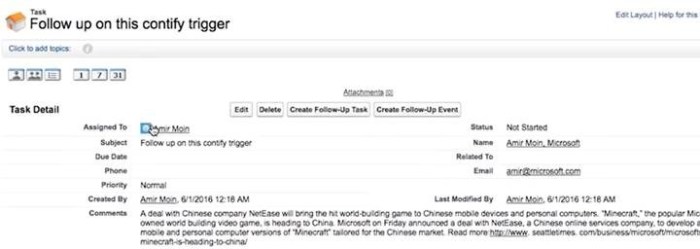
Triggers may also be setup as tasks which are saved as open activities.  Trigger information is stored within the Comments field of the task.

Contify triggers may be flagged as tasks for alter action.

If users are unable to find the correct company, they can submit the URL to Contify’s editors who will create a company profile within 24 hours.

The service is priced at $49.95 per user per month billed annually.

The firm has over 10,000 users.

Quora: What features do you look for in lead generation software?

I woke up this morning to the following Quora query in my inbox:

What features do you look for in lead genration software?

so I attacked it immediately…

First off, I would call these companies sales intelligence solutions, not lead generation.  While they are used for lead gen, their primary value is for sales reps in prospecting, lead qualification, account planning, and selling deeper into the organization.

As you provided no details on your organization beyond B2B, I will put aside sales methodologies, sales structures, industry, and whether you are looking to align your sales and marketing departments.  Instead I assembled a checklist of features and coverage questions to ask.

Here are the key features I would consider.  Not all questions may be applicable to your situation.

  1. Content
    1. Is your coverage US, North American, or Global?
    2. Do you cover the smallest companies and branch locations?
    3. Do you offer consumer data (important for sales reps that sell to both B2B and B2C)?
    4. Are you company centric or contact centric in your data collection? Company centric will have better location data and works well for ABM, contact centric works for less strategically oriented firms looking to make many calls)
    5. How do you collect your data (e.g. Direct research, aggregation from other vendors, semantic mining) and how do you ensure the quality of your data)?  Direct research delivers the highest quality but limits coverage to a top companies universe at a higher price point.  Aggregation can deliver a full company universe but has a higher incidence of defunct companies and duplicates.  Semantic mining is the lowest cost way to build a dataset but is weak on data not easily mined (e.g. revenue, industry codes, linkage) and misses smaller companies without a web presence.
    6. How do you validate contacts?  How do you know when somebody has left an organization? How do you validate emails (and how often)?
    7. How many job functions and job levels do you support?
    8. How many sales triggers do you support?
  2. Current Awareness
    1. News alerts for companies
    2. Do you support one-click following of companies?
    3. Sales triggers.  How many triggers do you offer?
    4. Custom triggers
    5. Searchable news archive
    6. Do you include an integrated social media feed?  Can it be filtered and searched? Which social media sites are included?  How about blogs?
    7. Do you filter out duplicate stories and non-business news stories?
  3. Account Planning
    1. Family Trees.  US or global?  Do they include branches or only subsidiaries?  Are they downloadable to assist with analysis?  What details are shown in the trees?
    2. Long Business Descriptions?  How many companies have long business descriptions?  How are these gathered?
    3. SWOT Reports
    4. Biographies
    5. Social Media Links for companies and contacts
    6. Competitors Reports
    7. Industry specific datasets (e.g. technology platform data)
    8. Industry Snapshots (Plain English primers which provide a high-level industry overview for sales reps selling broadly across many industries)
    9. Market Research (Formal reports on an industry including key trends, issues
    10. Can I quickly create a PDF download of company information?  Does it include all of the reports or a subset?  Does it include an option to include recent news stories?
  4. Public Company Account Planning
    1. Full public company financials and ratios.  How many quarters and years?  US or Global?
    2. Are key financials graphed?
    3. Significant Developments (multi-year synopses of key events at the company)
    4. Business & Geographic Segment reports
    5. SEC Filings
    6. Earnings Transcripts
    7. Brokerage House Analyst Reports
    8. Stock Charts
  5. Prospecting
    1. Radius search (e.g. 20 miles from a ZIP code)
    2. Metro Areas and Counties
    3. Industry Codes (at both a sector level and more granular SIC and NAICS level)
    4. Sales Triggers
    5. Industry Specific Variables (e.g. Technology Platform, Bank Affiliations)
    6. High-Level Credit Score (for filtering out low yield prospects unlikely to obtain credit department approval)
    7. Ultimate Parent (for expanding a contract)
    8. Job Function and Job Level
    9. Support for both company and contact prospecting
    10. Can we build Peer Lists (similar companies)?  Can we modify the peer variables?
    11. Neighbor Lists.  Useful for understanding the neighborhood in which the business is located as well as identifying additional companies worthy of a visit if planning on on-site.
    12. Can we build prospecting lists from competitor reports, family trees, or other list sources from within the service?
    13. How many companies or contacts may be downloaded in a list?
    14. Can I create custom report views and download formats?
    15. Are there any contractual limits on the total number of records which can be downloaded by a single person or over the full contract?
    16. Can prospect lists be uploaded to my CRM directly or do you only support CSV downloads?
    17. Can I save search criteria?  Lists?
  6. Collaboration
    1. Can we share news and triggers to email? Social Media? Chatter/Yammer?
    2. Can we create shared Watchlists and company lists?
    3. Is there a Who Knows Who Tool for discovering relationships across the organization?  How are these relationships gathered?  How much control do participants have in maintaining control over their contacts?
  7. CRM Integration (specify your CRM)
    1. Do you support Send to CRM from your browser service?
    2. Do you display integrated I-frames within my CRM?  Which record types?
    3. Do you support “stare and compare” updates for updating CRM records on a just-in-time basis?
    4. Do you provide a warning flag if a record is out of date so the rep knows to run a “stare and compare” update?
    5. Do you offer batch updates to Account records managed by our Sales Ops team?  How about Contacts and Leads?
    6. Is most of your functionality and content available from within the CRM or does the system window out to the browser application?
    7. Does the system check for duplicates before creating a record?
    8. Can I send a list of companies/contacts or am I restricted to a single record at a time?
    9. Do you support Send to CRM with a choice between creating a Lead record or an Account and Contact record?
    10. Do you support Custom variables?  If so, which ones?
    11. Does account record creation maintain family tree linkages?
    12. Do you offer an Opportunity View which rolls up all current and closed opportunities at an account into a single view?
  8. Lead Scoring
    1. Do you offer any lead scoring tools?
    2. Are lead scores based upon predictive models using a broad set of business signals or tied to a few firmographic variables?  How about sales triggers?  Availability of key contacts?
    3. Are lead scores easily visible on company records across all platforms?
    4. Can I view the key variables involved in determining lead scores?
  9. Mobile
    1. Is your browser application tested on mobile devices?  Does it have a responsive design?
    2. Do you offer mobile apps?  If so, which features above are included?  Does it support mobile specific features such as current location for prospecting and mapping, click to connect, etc.?
  10. API
    1. Is an API available?  What protocols does it support?
    2. Which report types does it support?
    3. Can I perform company and contact prospecting via the CRM?
    4. Can I pass company or contact parameters for match and enrich?
  11. Customer Support
    1. What are your hours?
    2. Do you support online chat or a phone helpline?
    3. Do you include training with your service?  Onsite? Custom? Webinars? Recorded?
    4. What SLAs do you provide for customer support? data quality?
  12. Pricing
    1. What do you charge for # seats of your service?
    2. Are there charges for additional company and contact downloads?
    3. Are there charges for additional datasets or features?
    4. Are there charges for downloads beyond a fixed number of records?
    5. Do you include CRM and mobile apps as part of your pricing?
    6. Are there additional charges for batch updating of records in my CRM or Marketing Automation Platform?


Sales Intelligence Vendors Still Don’t Get Social

For some reason, sales intelligence vendors have never properly understood social selling and how to integrate social media into their products.  This has long amazed me.  Instead of building an integrated social media viewing tool with sharing and feedback, they all seem to nibble around the edges. You’ll find social hyperlinks directly from company or contact profiles, but these simply window out to the social media site.  Also fairly common is the inclusion of corporate blogs into their news and sales trigger feeds, but fully integrated social media tools have yet to be offered by vendors.

The closest any of them have come is InsideView which added a Buzz Tab about five years ago to its InsideView for Sales product.  The Buzz Tab provides a consolidated view of blogs, Facebook, and Twitter feeds.  However, the social content remains segregated from their other discovery tools and the population of Facebook and Twitter feeds is limited.  Other social tools include a Who Knows Who “Six Degrees” tool and the inclusion of Personal Tweets from business executives in their alerts.

The InsideView buzz tab supports keyword searching and filtering for company blogs, Facebook, and Twitter.

There are also a set of social selling tools that focus on social media, blogs, and news but which are light on company and contact information.  As these tools improve, one of the sales intelligence vendors is going to make a build vs. buy decision and either OEM the upcoming service or buy a social selling service outright.

What tools such as Artesian Software, Owler, Contify, and Trapit do isn’t revolutionary.  They basically provide a unified view of news and social content.  Users can filter the feeds and interact with the posts.  If a free service such as Owler can build such functionality, why can’t the sales intelligence vendors?  Core functionality could provide the following features:

  1. A deep set of direct links for companies and executives to LinkedIn, Twitter, Facebook, YouTube, G+, etc.
  2. A unified view of the corporate social media content across Twitter, Facebook, SlideShare, YouTube, Vimeo, corporate blogs, business blogs, etc.  This view would be easily filterable by source, date, keyword, etc.
  3. Social Media Metrics for a company charted over time.  If the company is also selling into the marketing department, then comparative metrics should be available.
  4. When filtering Twitter, allow the user to see both the Tweets from a company and mentions (these are separate options).
  5. Support basic widgets from the major social media vendors.  These are small applets that display key statistics along with a brief description and logo/headshot.
  6. Allow any news article, sales trigger, or social media post to be shared via social media, enterprise social (e.g. Chatter, Yammer), and email.
  7. Support expanded alerts that include targeted social media alongside sales triggers.  Thus, an alert could consist of the half dozen most important sales trigger topics, Twitter posts from the company, Blog headlines, and YouTube / Vimeo uploads.
  8. Executive alerts based upon social media posts and news mentions.

Who Know Who Six degree tools are also worth considering, but this functionality is so well locked up by LinkedIn that relationship discovery tools have remained a standalone category.  Amongst Sales Intelligence vendors, only InsideView and DueDil Connect have built relationship finder tools in competition with LinkedIn.

To be fair, the sales intelligence vendors all understood early on that they needed to work with LinkedIn.  Most of them adopted the LinkedIn widget or the LinkedIn API to provide relationship and executive intelligence into their service.  But then LinkedIn decided it was going to offer its own sales intelligence service called Sales Navigator and began blocking sales intelligence vendor access to LinkedIn.  Since then, with the exception of InsideView, the sales intelligence firms have done little to integrate social content into their services.  Hopefully, the vendors begin to see this gap in their offerings and begin to address it.