This was one of the two weeks a year that I take off from writing my Market Insights Newsletter, but I wanted to let you know that I’m splitting the newsletter into two newsletters. When I started writing the Market Insights Newsletter back in 2012, it focused on Sales Intelligence, Social Selling, and B2B DaaS. Since then, B2B DaaS has increased greatly in importance, and I’ve added adjacent topics including Sales Engagement Platforms, data privacy / compliance, ABM, and Customer Data Platforms. The result was a doubling in the length of the newsletter and an increase in the frequency that articles were bumped. Some features are often bumped for a month or longer due to length.
In August, I
took my summer vacation, but there was no August news break. It took me a
few months to catch up on announcements from that week. This led me to
the realization that I needed to split my newsletter in half to improve both
topical focus and story currency. The split will also allow me to profile
more startups.
Most of my readers will continue to receive a Sales Intelligence (SI) newsletter which covers
Sales Intelligence
B2B DaaS
Data Hygiene
ABM
B2B Data (Companies, Contacts, Intent, Technographics, and Triggers)
Customer Data Platforms
Compliance (GDPR, CCPD, KYC, AML, PEP)
The SI
edition of Market Insights will continue to publish on Sundays.
Contact me if you’d like to be set up with a trial edition of either newsletter. I offer SMB pricing for startups, so don’t assume that I am unaffordable like other analyst services.
Sales engagement vendor SalesLoft acquired Costello earlier this week. Costello, which describes itself as an opportunity management software company, supports quick deal updates, guided selling playbooks, pipeline collaboration, and real-time CRM sync. Other features include deal management, dashboards, and dynamic note-taking.
SalesLoft
said that the acquisition “furthers SalesLoft’s mission to help account
executives not only prospect and build pipeline, but manage their day and their
deals, from creation through close.”
“Combining
Costello and SalesLoft gives all sellers, whether they’re pipeline builders,
closers, or responsible for upsells and renewals, a platform to deliver the
ultimate buyer experience and close more revenue. Sales engagement is now
the place all reps can start and end their days,” said SalesLoft CEO Kyle
Porter.
“Sales Engagement isn’t just about generating pipeline. It is about all the people who engage with customers and prospects throughout their journey. We are working with our customers to constantly evolve what sales engagement can do for them. It now represents the complete workflow application for sellers. It’s a giant leap towards solving the sales challenges I hear from revenue leaders all the time.”
SalesLoft CEO Kyle Porter
Costello has
been available as a SalesLoft application partner since last year. “The
companies will continue to support existing Costello customers, invest and
enhance product capabilities, and natively integrate Costello capabilities into
the SalesLoft platform,” stated the firm.
Solution matrix posted by SalesLoft CEO Kyle Porter
SalesLoft
listed four sales challenges that are addressed by the merged company: updating
opportunities, app switching, new hire account messaging, and simplified
pipeline review.
During
calls, Costello acts as a “real-time co-pilot” that ensures sales reps ask key
questions, handle objections, and tell relevant customer stories.
Costello
displays a Deal Dashboard and Deal View from within SalesLoft for pipeline
management. Deal Status elements include deal stage, days in stage, days
active, and deal amount. Costello also calls out Deal Gaps (missing deal
fields, days past due), Stakeholders (buyers’ circle with roles and concerns),
Call Summary with notes, and a deal timeline.
Costello is
SalesLoft’s second acquisition. They previously acquired NoteNinja which
served as the basis for their meeting scheduling and intelligence
functionality. SalesLoft plans to natively integrate Costello
functionality into the SalesLoft platform while investing and enhancing product
capabilities.
SalesLoft
supports over 2,300 companies and has grown revenue 1,000 percent over the past
three years. The firm has 450 employees.
“Sales Engagement platforms have started to make significant progress with sales organizations. When we look across our dataset of high-growth early-adopters, 69% are leveraging a Sales Engagement platform today. As the sales engagement platform market looks to expand to the more widespread market of sales reps, we expect the platform’s feature set will also expand beyond traditional prospecting channels to serve all the day-to-day needs of the sales rep including enablement, planning and forecasting and productivity.”
Craig Rosenberg, Co-founder and Chief Analyst of TOPO
Cognism Intelligence within Salesforce. Hybrid Engagement Platforms Continuously update CRMs and MAPs.
The market
is beginning to evolve a set of hybrid engagement vendors that deliver a broad
set of sales and marketing services. The boundary between sales and
marketing is quickly crumbling. Hybrid engagement services manage both
data and workflows. Features include
Data Services: Prospecting, Webforms & Batch Data Enrichment, CRM/MAP Data Maintenance, De-duping, Data Health Reports
Lead Management: Lead Scoring, Lead-to-Account Mapping and Routing, Dynamic Lead Prioritization, First and Third-Party Intent
Future functionality will include Next Best Actions, Embedded 1:1 Video, SNAP (Sales Navigator) Integrations, and Programmatic Advertising.
No vendor provides all of these services and some provide them as separate offerings, but firms such as Dun & Bradstreet, Zoominfo, Infogroup (Salesgenie), Lead411, LinkedIn Sales Navigator, and Cognism have all taken steps over the past two years to meet the emerging requirements of the CRO.
For the
moment, I’m calling these emerging offerings Hybrid Engage Platforms, but that
is a placeholder name as the market evolves.
SalesTech adoption rates and spend continue to increase according to a recent SalesTech study of 268 B2B sales and marketing managers conducted by Smart Selling Tools. Only 3% of respondents are planning on reducing their SalesTech spend in 2020 while 6% plan to spend significantly more in 2020 and 41% slightly more. Expanded spending will be focused on the top and middle of the funnel followed by management and reporting. Skills Development, Onboarding, and Bottom of the Funnel expenditures have a lower priority.
Over the past year, SalesTech spend per user has increased significantly. In 2017, only one-third of respondents spent in excess of $150 per user, but two years later, 65% spend more than $150 per user. As the average number of sales tools in use rose only modestly from 4.5 to 4.9 over the past two years, the spend per product has likely increased. The number of applications that are used by a majority of respondents trebled to six (CRM, Online Meetings, Lead List/Database, Social Selling, Account Targeting, and Skills Training & Reinforcement) with an additional four at 47% or higher. CRMs are used by 75% of respondents, lead/list databases by 65%, and social selling by 60%. The one category that dropped in usage was online meetings.
Adoption rates of technologies were fairly even by company size with large firm (500+) employees more likely to have adopted Sales Enablement, Skills Training & Reinforcement, and Sales Performance & Compensation. Conversely, firms with fewer than 500 employees were more likely to have adopted Prospect Engagement (Sales Engagement) solutions.
Account targeting tools for ideal customer prospecting grew from 4% to 51% over the past year, a clear indication that ABM strategies have been adopted. Lead Engagement (communicating at scale with early-stage, unqualified leads) grew from 11% to 49%, while social selling grew from 10% to 60%.
“The significant increase in usage of sales tools across the board indicates a trend (likely irreversible). If your organization is slow to take up the use of sales tools, you could get left behind. Even so, we don’t recommend adding new sales tools without considering what’s required to keep them up to date and who will be responsible, having a plan for measuring success (what does “Good” look like?), and deciding what’s required to establish and grow user adoption.”
Smart Selling Tools founder Nancy Nardin.
The top
three industries represented in the study were technology (42%), Financial
Services (9.3%), and Manufacturing (8.7%).
I am pleased to announce that my next enterprise software purchasing report is available through this website and my partners at Tenbound. “Evaluating Sales Engagement Platforms: A Guide for Purchasing SEPs” assists with the purchasing decision of this rapidly developing SalesTech category.
Evaluating Sales Engagement Platforms
Single User License (October Discounted Price)
$495.00
The report is available as both a single buyer license for smaller firms evaluating the sector and as a buyer-committee license for larger firms. The Buyer Committee license covers a team of seven and includes a Word document checklist to assist with the evaluation.
GZ Consulting / Tenbound reports are independently written and not sponsored by any of the profiled vendors. Michael R. Levy of GZ Consulting wrote this report.
SalesLoft Conversation Intelligence transcribes and indexes meetings and conference calls to share with stakeholders. Photo: Zoom Meeting Intelligence
Sales engagement vendor SalesLoft rebranded its Meeting Intelligence functionality as Conversation Intelligence. SalesLoft describes four sets of features which help reps schedule meetings and then listen to, understand, and engage with customers and prospects. SalesLoft supports a broad set of conversation tools including appointment setting; automated recording, transcription, and indexing of calls; time-stamped notes, and call analytics. This functionality is available for prospect, customer, and internal calls. Managers, mentors, and trainers can join calls or whisper into a sales rep’s ear.
“Through
the evolution of SalesLoft’s platform and user experience, one feature has
changed so much that its prior name no longer did it justice,” wrote SalesLoft
Head of Community Aly Merritt. “Meeting Intelligence is now Conversation
Intelligence, because sales isn’t just meetings – it’s every conversation and
interaction.”
Call
recordings can be stored in a training library or shared for coaching or
questions. For example, if a sales rep does not know the answer to a
question, it can be forwarded directly to customer support or engineering for a
response.
Conversation
Intelligence supports both SalesLoft’s native dialer and leading web meeting
applications: Zoom, GoToMeeting, join.me, UberConference, Cisco WebEx, and
Cisco WebEx Enterprise.
Sales calls come in many forms: prospecting, discovery, demos, stakeholder alignment, and so on. All of these interactions make up the foundation for the long-term customer relationship. High-value customer relationships are made possible when prospects feel that the relationship they are entering into is mutually beneficial.
How can you build such a relationship? By working to ensure your prospects feel heard and confident that you understand their needs. Work to engage them throughout their journey. After all, sales doesn’t stop when the deal closes, nor does engagement cease when a seller hangs up the phone.
▪ SalesLoft Product News
SalesLoft said that it is “designed to flex around the needs of the user based not only on their role but also on their preferred workflow. This empowers SalesLoft customers to offer consistent value at every stage.”
“Sales meetings are the moments in the sales cycle where you have the opportunity to provide the most value for your customers. As such, they are some of the single biggest opportunities for your team to influence revenue. It’s where your deals are won and lost,” wrote the firm. “Despite this, sellers often don’t get the opportunity to improve on this critical component of the sales process. Combine this with the challenges that face sales leaders around how much time it takes to digest sales meetings, gain visibility into what’s really happening, and be proactive in the deal cycle.”
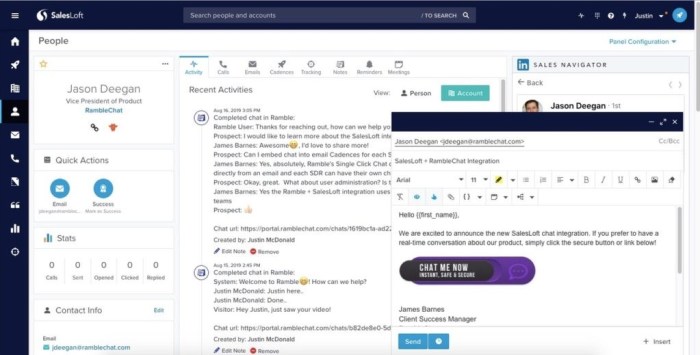
Real-time Ramble chats with account owners may be initiated from SalesLoft emails or any other outbound or marketing content which supports URLs.
Conversational marketing vendor RambleChat is the latest partner available through the SalesLoft app directory. Along with real-time website chat, joint customers can embed chat into SalesLoft email cadences. RambleChat then routes sales conversations to account owners “providing a more personalized interaction via chat.” Joint customers can also employ dynamic fields in SalesLoft to customize greetings with personal and company names.
“The SalesLoft/RambleChat integration gives a whole new capability for marketing and sales teams. RambleChat is the only chat platform that can instantly open chat from any online source. Ramble then routes sales conversations to the right account owner — enhancing both demand generation and ABM campaigns. And now, for the first time, chat can be an integral part of sales plays and interactions in the SalesLoft platform.”
Sean Kester, VP of Platform Strategy at SalesLoft.
Single Click
Chat (SCC), RambleChat’s patent-pending technology, extends chat capabilities
from the website to outbound communications. So long as a URL can be
embedded, chat conversations can be initiated via a click. Along with
corporate websites, SCC enables chat initiation from LinkedIn, Twitter,
Facebook, digital ads, landing pages, blogs, QR codes, and product
collateral. SCC allows sales reps to “meet buyers at the moment of
interest.”
Ramble
automatically logs chat conversation histories and details at the SalesLoft
Account level. When a user navigates to an account, chat history is
displayed under the “Notes” section. If a SalesLoft user desires more
in-depth information about the chat conversation, a URL is automatically
provided for the user to click.
RambleChat
has been in partnership discussions with SalesLoft since at least March when
Ramble CEO Justin McDonald attended SalesLoft’s Rainmaker conference. Instead
of simply building a website chat solution, the firms chose to “build better
pipelines by extending chat beyond corporate websites and into SalesLoft
Cadences and social channels via RambleChat’s Single Click Chat.”
“As we met with joint customers in mid 2018, a constant theme surfaced; the market was struggling to find practical and tangible means of Account-Based Selling and Marketing. There’s no shortage of ABM technology, but many lacked quick deployment and immediate results for sales organizations. This became the MO for the RambleChat + SalesLoft partnership, and we landed with a more powerful integration that fills the ABM gap for both sales and marketing.”
Ramble CEO Justin McDonald
“I’m
immensely excited about our joint efforts. This integration delivers new
opportunities for sales engagement and improves functionality for sales reps to
execute account-based selling. Account-based marketing (ABM) requires an
equal effort from Sales, and RambleChat delivers immediate functionality to
bridge the gap for SalesLoft customers,” said RambleChat CEO Justin
McDonald.
“Schoolmarm” Royal Daulton figurine (Source: WannabeEditor on Wikipedia)
I’m starting to feel like the schoolmarm* calling out grammar and spelling errors. I am not normally a stickler about such things, but sales reps and marketers need to do a better job on the basics. I called out marketers a few weeks ago (“How Not to Write a Press Release“) and this week it is sales reps. Here is my letter to Sales Reps:
As you adopt sales engagement tools, you will be sending more emails, but writing fewer words for each email. Your email templates should be perfectly grammatical, so the 20% that you write to personalize your messages should also be perfectly grammatical. I’m not seeing this. Saturday, I received emails from two different tactile marketing companies (the bizarre category name of companies that send direct mail gifts) with run-ons and missing punctuation.
You do yourself and your company no favors by failing basic grammar checks (I use Grammarly) before hitting send. Good grammar supports clarity, displays professionalism, and signals that the small things matter.
Here is an example from earlier today:
“Call a play to connect with me for a quick overview and I’ll send you an example NFL team swag item (your team) or a $25 Dinner eGift if you are more of an NHL fan, like myself.”
The Call to Action from a tactile marketing vendor
If you received this sentence in an email, would you be more or less inclined towards their call to action (CTA) due to the poor grammar and twisted syntax?
Yes, the $25 gift is a strong CTA, but the poor grammar undermines trust. If you can’t do the small things right (e.g. proofing your email), then why would I assume you would get the big things right (e.g. managing the logistics of thousands of individually packaged and personalized eGifts)?
We all make mistakes when writing, and some of us are better than others at the mechanics of the written word. I’m simply suggesting that you do a quick readthrough of what you write before you send it. Using a grammar checking tool is a good backstop.
Another trick: put on our headphones and use Microsoft Word’s read aloud function. Close your eyes and listen for clarity, word choice, and messaging. Yes, this is a timely step; you may want to reserve it for key decisionmakers at ABM accounts, but sometimes you want to slow down to ensure you get things right.
Word choice is also important. When you are unsure whether you are properly using a word, select a different word or type Define <word> into Google or Bing. For emails, simple words should be employed and jargon avoided.
Bing’s first response to Define Kvetching
And to sales engagement vendors, how about some tools to flag style and grammar issues? As you develop AI tools for email, flag both best practices (e.g. Subject line too long, CTA not in the top third of the body, bullet points lower click through rates) and grammar issues.
Let’s write well, not good.
* Readers of the future: In 2019 the term schoolmarm was a bit antiquated and slightly pejorative, but not on the politically incorrect list of phrases. If in 2022 the term enters the list of micro-aggressions, mea culpa.
So congratulations to CEO Manny Medina and the team at Outreach. The Sales engagement firm has been going head-to-head with SalesLoft to become the leading vendor in its category.
Outreach is based in Seattle and reached unicorn status earlier this year, a rather impressive feat for a five-year old company that doesn’t rent scooters. It is on track to hit 450 employees by the end of the year and has doubled its revenue growth each year since 2016.
Outreach has 3,500 customers including Adobe, DocuSign and eBay.
One area of rapid growth is in its Galaxy partner ecosystem. New partners include Seismic, BombBomb, and Sendoso. The Seismic integration allows reps to insert Seismic content into emails and multi-recipient sequences via a Seismic icon. Reps are notified when prospects view content, allowing them to “transition the prospect into a high-priority, more personalized Sequence.” Sales reps can also send follow-up content after a successful demo or meeting and modify messaging based upon which Seismic content is resonating.
BombBomb supports personalized videos which are inserted into
sequences. When a recipient watches the
video, reps can trigger an urgent call task or place the viewer into a
high-touch sequence. Recorded videos and
screen captures are also supported. BombBomb is priced at $29.99 per seat per
month with volume discounts.
Sendoso supports sequences which include e-gift or direct mail steps. Reps can also setup triggers when e-gift links are activated or direct mail items received. For example, I recently attended a trade show and received a box of mini-cupcakes afterwards with an accompanying note from the Sendoso sales rep.
I’ve been sitting on a Harvard Business Review article written by Doug Camplejohn since March due to a surfeit of news. I figured that if I couldn’t slip it into my blog in August, I would never get to it. August is when the press releases slow and there is an opportunity to speak about broader topics such as how to write a press release (or not write one).
Camplejohn’s
advice takes a long-run strategic approach to building and nurturing a social
network based upon ongoing engagement, asking for advice during transitions,
and assisting others. As such, his advice dovetails well with real-world
approaches to building relationship networks.
Camplejohn
begins by recommending that business professionals build their network with
peers instead of focusing on seniority. A peer-based network grows over
one’s career, creating a network which matures with the professional.
Furthermore, senior-executive response rates are lower than mid-level
managers. Less than one percent of VPs and CxOs respond to cold reach
out.
“People earlier in their careers respond most often to an initial message, while VPs and C-level professionals respond the least to people they don’t already know.”
Doug Camplejohn, VP of Product Management at LinkedIn
Initial messages should be short. Camplejohn recommends three sentences that can be easily read on a mobile device. InMail messages of under 100 words work best with response rates “decreasing significantly” beyond 500 words.
Camplejohn
also advises a hook such as an alma mater, joint interest, or a mutual friend.
“According to our research, referencing a mutual connection boosts the
acceptance rate of these messages by 51%, second only to attending the same
school at the same time (53%),” wrote Camplejohn.
Camplejohn
notes the value of asking for advice and leveraging transitions. In
fundraising, there is an adage, “If you go seeking advice, you get money; if
you seek money, you get advice.” Likewise, transition periods are an
excellent opportunity to build your network and seek advice.
“If you’re in a transitional period — starting at a new company, switching industries, or moving to a new city — recognize the opportunity to reach out to people, ask for their advice, and absorb their wisdom.”
Doug Camplejohn, VP of Product Management at LinkedIn
Another
recommendation is to pay it forward. Don’t be looking for immediate
benefits or strictly reciprocal opportunities. Social networkers
recognize that they are contributing to the commons, whether helping one person
or adding to the group. Sales reps and others should also continue to
nurture their network, maintaining conversations with colleagues, clients,
partners, and mentors.
“The best way to build a relationship is to help
someone with joy and with no expectation of anything in return. It feels
good, it trains your own sense of generosity, and it informs you of what the
other person values. It also sets the stage for you to ask them something
in the future. You don’t have to offer to help in every circumstance, but
make yourself available as a resource to people, particularly to people who are
just starting out in their careers.”
Camplejohn concludes that online networking should be viewed as an extension of real-world interactions: “Connect with people personally by finding common ground, then build trust and long-term relationships, rather than one-time transactions.”