Terminus Acquires Zylotech

Terminus acquired Boston-based B2B Customer Data Platform (CDP) Zylotech and immediately launched the rebranded Terminus CDP as part of its ABM Platform. 

Terminus CDP will be led by Matt Belkin, who has “25 years of experience in building and scaling data and technology companies.”  Belkin joined Terminus last year when it acquired Sales Intelligence vendor GrowFlare.

Zylotech CTO Abhi Yadav will be Terminus’ Head of Platform Development.  Yadav is also a Guest Lecturer at MIT Sloan School of Management.

The deal is Terminus’ fifth acquisition, backing up Gartner’s SalesTech Mayhem thesis that a handful of companies are quickly grabbing market share through strategic acquisitions and high levels of internal investment that fill missing capabilities.

Terminus’ acquisitions have focused on expanding the core capabilities of the company, not taking out competitors.  The other acquisitions were

Terminus Acquisition History

While CDPs are generally deployed to create a single view of the customer, David Raab, Founder of CDP Institute, commented that the Terminus CDP “will tie together the data silos that would otherwise result” from the acquisitions.

“CDP is becoming more widely adopted in B2B, as companies recognize their marketing automation and CRM systems are not enough to provide true data unification and sharing,” said Raab.  “By acquiring Zylotech, Terminus positions itself – and its clients – to take full advantage of the capabilities that a CDP provides.”

While data usage and spending are rapidly increasing, few marketers trust their data.  A 2017 Forrester survey found that only 12% of B2B marketers have high confidence in their data accuracy, and 84% identified data management as a top-five weakness.

“The key to a successful CDP is trust,” blogged Zylotech Director of Revenue Marketing Alex Bistran in August.  “Sales, marketing, and customer experience teams need to trust the data stored in their CDP to drive decisions, whether it’s deciding which accounts require immediate attention or which campaign messaging is most likely to resonate with a particular customer. By constantly refreshing data from your own customer interactions and combining it with validated, third-party B2B data to accurately reflect your contacts and accounts, a CDP provides a clean stream of actionable data that can be operationalized to flow through your marketing, sales, and customer service channels.  And, importantly, that can lead to a healthier revenue stream too.”

“B2B CRM data is painfully inaccurate and incomplete, and manual efforts to clean, deduplicate, and activate are slow and expensive.  This leads to poor conversion rates, an incomplete view of buying committees, and misleading ROI,” stated the firm.

“Bad data in equals bad data out. Period. We’re entering a marketing revolution – data really is the new oil, and Terminus is sitting on a gold mine. Under Matt’s leadership, Terminus CDP is poised to change the game for our customers. This level of data accuracy is critical for B2B GTM teams looking for a unified view into their customers. I’ve never been more excited about the future of marketing.”

Terminus CEO Tim Kopp

The Terminus CDP addresses the issues of bad data with auditing, cleansing, enrichment, and data management capabilities “backed by the industry’s largest global network of decision-makers and Buying Committees.”  Furthermore, Terminus CDP “dramatically” improves data accuracy, campaign effectiveness, and “wasted sales cycles.”

Buying Committee discovery is a novel UVP for a CDP but fits well within a broader ABM Platform umbrella. 

“We are in the golden age of marketing.  The breadth of technologies helping us create great experiences has never been so impressive.  But, what are all those customer experiences predicated on?  Data,” blogged Kopp.  “With Terminus CDP, our customers will have their most important account and contact data continuously cleansed and enriched. The result: our customers will be able to put their trust in their data, unleashing their go-to-market teams to accurately engage buying committees every time.”

Continued Kopp, “We’re entering a marketing revolution.  A time when sales and marketing teams don’t have to worry about data and can dedicate their energy to create phenomenal experiences that turn into pipeline.  I have never been more excited about the future of marketing.”

“Since our early days as an MIT spinout, Zylotech has been focused on delivering the data and intelligence go-to-market teams can trust and take action on,” said Yadav.  “Upon meeting Terminus, it was obvious that we shared a common vision. We are proud to join Terminus and this incredible team to jointly improve the accuracy of B2B data.”

Terms of the deal were not disclosed, but Kopp described it as a “big deal” that is a “really, really important acquisition.”  The Indianapolis Business Journal said that Zylotech was its largest deal to date.  The transaction was financed with funds from a $90 February venture round.

Enterprise clients include Google, Palo Alto Networks, Cisco, Dell, and Rimini Street.

Alyce for Salesloft

Keeping on the gifting theme, Boston-based Alyce announced a partnership with Salesloft to support “smart gifting” on the Salesloft Sales Engagement Platform.  The partnership lets sales and marketing teams natively send gifts through Salesloft. 

Alyce appears within the Salesloft People page side panel, where reps can select a gift and personalize the message.  Gifting options include physical gifts, gift cards, subscriptions, branded swag, on-demand services (e.g., in-home massage, portrait session), experiences (e.g., walking tours, helicopter rides), and donations.  Alyce’s AI suggests three gift choices, but reps can select other choices from the marketplace.

“Actionable insights, seamlessly integrated together can help your sales team say the right thing, to the right person, at the right time with the right gift to drive action that’ll ensure your team hits your targets month after month,” wrote Alyce.

A gifting history provides details on which gifts have been received and how the prospect engaged with the gift, helping revenue teams “optimize follow-up to drive greater impact.”

Alyce employs AI to assist with gift selection from its curated global marketplace.  Alyce recipients are sent a physical or digital notification of a gift, which they can choose to accept, exchange, donate, or decline.

“Our partnership with Salesloft is such a natural match. We are both committed to enabling revenue teams to build strong relationships and improve business results with the help of smart technology.  At Alyce, we are thrilled that our integration with Salesloft is giving marketing and sales teams new gifting superpowers right in their workflow that will allow them to deliver meaningful moments, increase revenue, and create greater impact.”

Alyce CEO Greg Segall

In a case study, Salesloft enjoyed a 50% increase in alignment between BDRs and strategic marketing with Alyce and drove a 9% increase in meeting attendance.  Furthermore, twenty percent of gifts sent resulted in new opportunities.

“Through the platform, we have uncovered an increase in the sales team’s ability to sell to our target personas,” stated Nabiha Balala, Senior Manager of Enterprise Marketing at Salesloft. “Alyce has been such a game-changer. It’s organically become part of our everyday sales process.”

Alyce’s physical gifting is currently limited to the US and Canada. However, gift cards may be sent to the US, Canada, Britain, and Ireland.

Alyce raised a $30 million Series B in April.


I’ve been running a series on Offline Marketing Automation (E-Gifting and Event Marketing) this week: My other posts:

Postal.io $22M Series B (Part II)

Continuing my coverage of Postal.io following their $22 million Series B


The Postal market supports 600 vendors, providing them with a corporate sales channel without spending on corporate channel marketing.  Their vendor network is growing organically through word of mouth.  Last month they added 149 vendors.

“Vendors can add their products to the Postal Marketplace and get direct access to B2B buyers as their preferred corporate sending partner,“ Product Marketing Director Allyssa Eclarin explained to GZ Consulting.  Items can be purchased off-the-shelf or customized.  For example, companies can send cookies with corporate logos or baby gifts with the child’s name or curated boxes for special occasions.

“People don’t necessarily want another Starbucks gift card.  They want to hear that you heard them, that you value them, and that you understand their interests.  Maybe you send them a mug of their favorite sports team or where they went to college, or a new baby bundle.  Personalization matters.  And that’s what we’re finding is people are getting more personalized than ever. People are automating this channel, and it’s working.”

Postal Director Product Marketing Director Allyssa Eclarin

Furthermore, now that we are entering people’s homes via Zoom, there is a greater level of intimacy for personalizing gifts.

Postal also supports automated direct mail, incentive marketing, brand advocacy, internal and external events, and branded company swag. CRM and MAP partner platforms include Salesforce, Marketo, HubSpot, and Eloqua.

For Salesloft and Outreach, Postal may be added as a sequence/cadence step, streamlining the gifting process.  Gifts may be sent via email, social, direct message, or direct mail, with  Postal tracking gifts and supporting analytics such as the cost per touch.  Postal also offers a “Magic Link,” a unique URL that can be inserted into an email or social channel. For example, reps can send gifts through a DM and avoid the “what’s your email?” discussion with a magic link.  The link is then tracked for shipping, attribution, budgeting, and analytics.  Magic links can also be used for “send on behalf of” situations (e.g., an SDR building a relationship for the AE).

Postal.io is positioning itself alongside market leaders in managing customer and prospect touchpoints.

With face-to-face meetings stopped during the pandemic, e-gifting and personalized gifts are among the few methods for building goodwill and generating positive memories.  Offline marketing platforms such as Postal, Sendoso, PFL, and Alyce have seen robust growth over the past eighteen months as sales reps struggle to build relationships.

Traditional gifting has been cumbersome and difficult to track, but offline marketing platforms streamline gift selection, logistics, and tracking, letting reps know when a gift has been received.  Gifting serves multiple purposes: establishing a relationship, rewarding webinar attendance, keeping in touch with a champion during an absence (e.g., health, maternity / paternity leave), or maintaining goodwill (e.g., holiday gifts, birthday gifts).

“As marketing becomes increasingly technical and formulaic, businesses are struggling to create moments that break through the noise.  The adoption of digital marketing has ironically made it harder than ever to truly connect with consumers.  Postal is among the first to personalize marketing automation by creating a bridge between a boutique front-end marketplace and the established systems already embedded in most marketing technology stacks.  The friction between offline and online marketing disappears, making it simple for brands to build more meaningful connections with consumers in any industry.”

Eugene Lee, OMERS Ventures (Postal.io investor)

Along with the funding round, Postal announced a set of product enhancements:

  • Domestic and international warehousing for branded products.
  • International gifting across seventy countries with wallets and pricing in local currencies.
  • Postal Events, launched in February, supports hybrid teams.  Postal Event enhancements include custom event images on event pages, customized event email templates and messaging, custom form fields on registration pages, and integration of Postal Events with Salesforce Campaigns.
  • Calendar booking on gift landing pages

Postal.io posted 10X ARR growth year-over-year and added over 250 new customers and 4,000 users.  The firm is based in San Luis Obispo.

Postal and its competitors disagree on their category name, with terms such as Tactile Marketing, Sending Platform, and Personal Experience Platform.  Postal uses the category name Offline Marketing Automation. The G2 review site has the firms categorized as Account-Based Direct Mail Software.

Postal customers “get it.”  They say, “you’re going to automate this channel that I know works. I’m already spending the money, but I have no way to attribute it, track it, push it back, check the ROI, or anything like that without a platform.  Now, with Postal, they can, and customers are resonating with the term ‘offline marketing automation’,” explained Eclarin.  “We’re seeing the same thing happening to our category as we saw with email marketing automation boom, with the rise of MailChimp and the like. We have given teams an automated, scalable, and repeatable way to manage their offline channels. “

A Postal license runs across the company with no per-seat pricing.  Instead, admins set up individual and departmental budgets.  Thus, the HR department can leverage Postal to build camaraderie (e.g., events), welcome new employees with swag packages, and express congratulations (e.g., baby, company anniversary).  Likewise, managers can send gifts to reward performance.

Building camaraderie during WFH has become increasingly important for Postal.  When events launched, roughly 70% were for marketing and 30% for team building. However, as Zoom fatigue settled in and the pandemic slowed the return to offices, companies began looking for fun team-building exercises that avoid Zoom burnout.  Thus, corporate event volume has moved closer to parity with marketing events.

Postal promoted a Second City roast to demonstrate the value of digital event marketing hosted on their platform.

This is the third in a series of articles on Offline Marketing Automation (i.e. e-gifting and digital event marketing).

Postal.io $22M Series B

A Second City Improv show is one of the most popular Events on Postal.

Offline Marketing Automation Platform Postal.io closed on a $22 million Series B led by OMERS Ventures, with current investor Mayfield Fund also joining the round.  The series raised total funding to $31 million.

The funds will be directed toward growing the Postal.io team, ongoing product development, and international expansion.  The firm is looking to address the lack of tracking, attribution, automation, and scale in the $120 billion market for direct mail, personalized incentives, branded swag, and corporate gifting.

Postal offers an “expansive marketplace featuring high-end, locally curated items from specialized vendors” that foster “meaningful experiences to drive better engagement with prospects, increase conversion rates, and boost employee engagement.”

“Teams that were once manually sending offline touchpoints are now able to efficiently automate and track direct mail, branded company swag, personalized gifts, and virtual events at scale.  We help companies leverage this proven channel with a frictionless, team-agnostic platform.  Companies are using Postal.io across their organization to deliver more meaningful, impactful, and delightful experiences.”

Postal.io CEO Erik Kostelnik

Events began as mostly marketing activities, but with so many employees working from home, roughly half of their events are employee team-building activities or celebrations.  Postal claims an average attendance rate of 90% for its events.

Postal offers a concierge team that operates as an “extension of your marketing team.”  Postal Concierge assists with managing “curated, branded, specialty items, and experiences that are guaranteed to surprise and delight your prospects and clients.”  The Concierge team also assists with event customization and talent booking.

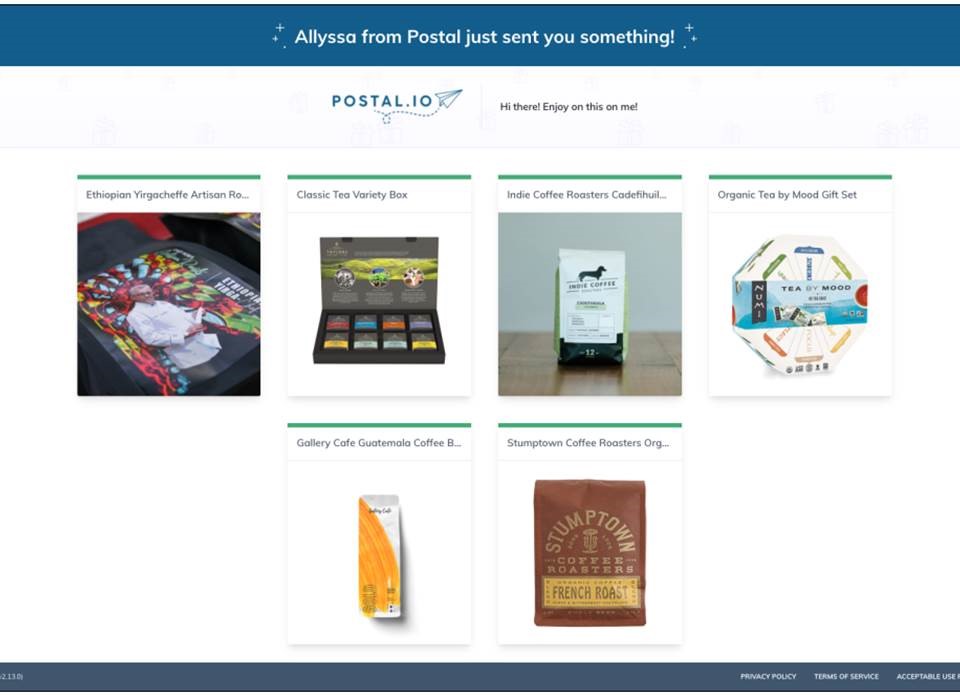
A Postal collection that provides a set of coffee or tea options.  The collection is being displayed with the rep’s name via a Magic Link.

Another feature is collections.  Instead of picking a single item, the rep sends a link to an array of themed items, allowing the user to choose from the collection.  Thus, a drink collection would include coffee, tea, and cocoa options.  Likewise, a cocktail-making event would offer a mocktail option.


Part II continues with a discussion of the Postal Marketplace and integrations.

Sendoso $100M Series C

With travel restricted and many executives continuing to work from home part-time or full time, face-to-face meetings and tradeshows will remain difficult for the foreseeable future. One of the successful workarounds has been offline marketing and e-gifting. Firms such as Sendoso, Alyce, PFL, and Postal have had significant success in rising above the din of digital marketing. I will be posting a set of articles on these firms over the coming days, beginning with Sendoso’s recent funding round.

San Francisco-based e-gifting platform Sendoso closed on a $100 million Series C round and announced plans to open a European headquarters in Dublin.  The Irish office will include a dedicated logistics and supply center to support the firm’s 20,000 global customers.  The new facility supports its multinational customers and expands its opportunities within the EU.  Beyond logistics and warehousing, the Dublin office will host an engineering team, marketers, customer success, and an inside sales team focused on European sales.

The funding round was led by SoftBank Vision Fund 2 and raised Sendoso’s total funding to $152.7 million.  Existing investors Oak HC/FT, Struck Capital, Stage 2 Capital, Craft Ventures, Signia Venture Partners, and Felicis Ventures also participated.

“We believe Sendoso offers the most comprehensive end-to-end gifting platform in the market,” said Priya Saiprasad, partner at SoftBank Investment Advisers.  “Their platform includes a global marketplace of curated vendors, seamless integration with existing tools, global logistics, and deep analytics.  As a result, Sendoso serves as the backbone to enterprises’ engagement programs with prospective customers, existing customers, employees, and other key stakeholders.”

Sendoso Funding Rounds (Source: Crunchbase)

CEO Kris Rudeegraap termed the round a “major milestone” for the firm.  The funds will be deployed to expand its products, services, and global footprint, including the Dublin facilities.

Sendoso sends corporate swag, regular physical gifts, and gift cards on behalf of its sales and marketing clients. In addition, the platform supports gift ordering, logistics, packing, custom packaging, and shipping.  Sendoso is integrated with CRMs, MAPs, and SEPs, including Salesforce, MS Dynamics, HubSpot, Marketo, Outreach, Salesloft, and Groove.  The firm has also partnered with ABM Platforms Terminus, Demandbase, and RollWorks.

Sales reps can order gifts and send follow-on emails to customers and prospects via the Outreach / Sendoso integration.

According to Sendoso, customers enjoy a 55% net increase in new opportunities by “creating authentic connections that show prospects you care.”  The firm suggests that marketers “send a coffee eGift before an event to encourage prospects to stop by your booth.”  Reps can then “show them you’re listening by sending personalized gifts based on their interests and hobbies. If they’re a sports fan, send them a blanket with their favorite team or give them tickets to a game.”

In the absence of face-to-face meetings, e-gifting has helped build relationships and break through the digital noise.  According to HubSpot platform data, virtual selling became significantly more difficult due to a flood of messages during the pandemic.  For example, sales emails spiked 59% in Q2 2020 compared to pre-Covid levels, causing a thirty percent drop in buyer response rates compared to before the pandemic.

“Everyone was stuck at home by themselves, saturated with emails,” said Rudeegraap. “Having a personal connection to sales prospects, employees, and others just meant more.” Sendoso claims that it has the “marketplace selection and logistics precision of Amazon.com,” but with greater personalization.  For example, Sendoso supports handwritten notes, special boxing, and an Amazon partnership that routes Amazon orders to Sendoso for repackaging.

“There are a lot of things we do uniquely in terms of what we have built throughout our software, gifting options, and logistics centre. We really personalize our gifts at scale with handwritten notes, special boxing, and more,” something that Amazon cannot do.  We have built a lot of unique technology and logistics software that would make it hard for Amazon to compete.” He said that one of Sendoso’s integrations is actually with Amazon, so Sendoso users can order through there, but then the gift is first routed to Sendoso to be repackaged in a nicer way before being sent out.”

Sendoso CEO Kris Rudeegraap

Rudeegraap is a former sales executive who found gift-sending valuable but cumbersome.  This experience led him to found Sendoso in 2016 with Chief Alliances Officer Braydan Young.  The firm has fulfilled three million gifts over the past half-decade.

“I was manually packing boxes, grabbing swag, coming up with handwritten notes,” he recalled. “It was inefficient, but it worked so well. So I dreamed up an idea: why not be able to click a button in Salesforce to do this automatically? Sometimes the best company is one that solves a pain point of your own.”

Sendoso has 500 global employees with plans to grow its headcount by thirty percent by the end of the year. Sendoso did not disclose its valuation, but TechCrunch estimated it at $640 million.


Continue to part I of my coverage of Postal.io which closed on a $22 million Series B last week.

ZoomInfo Chorus Integration

Go-to-Market Platform ZoomInfo announced that it completed the first stage of its Chorus Integration after acquiring the Conversational Sales firm in mid-July.

“Since announcing ZoomInfo’s acquisition of Chorus…our team has made great strides in seamlessly making key features of the Chorus platform available to our customers. These integrations will allow sales, marketing, and operations teams to instantly use both ZoomInfo and Chorus to expand their pipelines via a data-first approach that they can’t get with any other platform on the market.”

ZoomInfo CEO Henry Schuck

Conversational Sales functionality has also been added to ZoomInfo’s Engage SEP.  Chorus transcribes and analyzes calls, helping them build strong customer and prospect relationships and be more present during calls. For example, ZoomInfo dialer calls are recorded and stored in Salesforce while Chorus transcribes and analyzes the conversation.

Chorus’ Momentum Insights are displayed in the ZoomInfo platform under the Chorus tab.

Momentum Insights are available in ZoomInfo, Chorus, and Salesforce, delivering call insights wherever the rep is working.  “Combined Chorus and ZoomInfo users can now view conversation and relationship insights within the ZoomInfo platform for better visibility and management of their prospect and customer pipeline,” stated the firm.

The new Chorus tab in ZoomInfo lets revenue teams see with whom they’ve engaged across the account; whether the interactions were via inbound email, outbound email, or meeting; and the most recent interaction.  The Momentum Insights chart shows touchpoints over time with the ability to search by participants and activity type.  Users can drill down on any of the interactions for email or call details.  Audio can be reviewed from within ZoomInfo’s account and contact views.

Users can also drill down on Quick Signals or search by keyword from the Chorus tab, allowing reps to research deal risks, wow moments, negative sentiment, next steps/to-dos, timeline discovery, etc.  Chorus supports hundreds of topics that can be customized.  For example, companies can filter by specific competitors or product feature capabilities.

While the primary use case for Signals is rep account review, managers can use the tool for deal discussions, skill review, and coaching.  Likewise, product managers can broadly investigate customer calls to research specific topics (e.g., product complaints, competitors). 

When the user clicks on a signal, a textual synopsis of the discussion is provided, along with the ability to review that part of the discussion.  These tools are essential for reviewing negative sentiment, pricing discussions, competitors, etc.  Also, call snippets can be extracted for training (e.g., objection handling, competitive parrying, value messaging) or forwarding questions in the voice of the customer to subject matter experts or service departments.

Chorus users also benefit from the integration, with ZoomInfo serving as the reference data set for customer contact intelligence.  ZoomInfo claims that switching to ZoomInfo’s database and matching logic (from Clearbit) resulted in a 33% lift in match rates and a 10X faster load time for contact records in Chorus (150 MS).  Enriched company and contact intelligence include department, job function, seniority level, business email, phones, industry, location, and company.

According to Chorus, ten percent of calls have attendees that were not announced, leaving the rep blind to the role and importance of the additional attendees.  In other cases, a third party is mentioned, but that individual is not in attendance.  In either case, ZoomInfo will surface contact information for these individuals, helping fill out the Buying Committee.  ZoomInfo also recommends personas who are likely Buying Committee members, fostering multi-threaded discussions across the Demand Unit.

“In addition to helping you expand across your deals, you’ll gain a new understanding of which deals are more likely to close, helping improve your forecast accuracy and visibility across your pipeline,” blogged Senior Director of Customer & Product Marketing Sophie Cheng.  “ZoomInfo’s rich company insights like noteworthy scoops (news and events), intent data, and reporting relationships, infused with Chorus’ new Momentum suite will help paint a clearer picture of the entire relationship context like who’s involved in each deal, what’s being discussed, and the likelihood to close.”

Chorus speaking track analysis

Salesloft and the Modern Revenue Workspace (Part II)

Continued from Part I


Salesloft CEO Kyle Porter suggested that the answer to overwhelmed sales reps is not more technology and data but better-designed tools and workflows that address the “Revenue Performance Gap.”  Salesloft’s Modern Revenue Workspace offers

  • “Proper insights at the right time
  • The ability to take action
  • The ability to communicate
  • The coachable moment”

Instead of a series of tools, Salesloft is positioning itself as one of Gartner’s “alpha platforms” that broadly ties together sales workflows and channels.  Gartner noted a set of attributes of these platforms:

– “Alpha Platforms are hyper-aggressive vendors who are broadening capabilities at a breakneck speed. 

– It’s not just M&A, some companies will evolve into alpha platforms by building capabilities. This is totally doable, they just have to be able to work fast.

– Alpha platforms aren’t necessarily buying competitors in the same category – they are buying into adjacent categories.”

Gartner Analysts Craig Rosenberg and Dan Gottlieb, “Sales Tech Mayhem: 39 Observations From a Scorching Hot Tech Market,” Garter Blog (July 28, 2021)

“It’s a time to tell a new story about sales and provide you with a complete, digital go-to-market solutions your sellers and sales teams need,” said Porter.

The Salesloft Platform supports Deals, Conversations, Cadences, a partner ecosystem, administration, and governance

According to Salesloft Chief Product Officer Ellie Fields, this advanced sales platform is “built for sellers.”  It reduces workflow friction, allowing reps to “take faster action” and prioritize their time.  The platform also serves as a centralized engagement hub with the “most critical tools for digital selling,” including email, phone, SMS, meetings, social, etc.

The Modern Revenue Workspace deploys data and AI within the workflow, delivering insights such as the most engaged prospects, deals at risk, and “trends that improve outcomes.”

The Salesloft platform acts as a hub for digital selling, driving alignment across the revenue team.  Along with Deals, Conversations, and Cadences, the platform synchronizes data with a system of record (Salesforce, MS Dynamics, or HubSpot) and supports sales intelligence and workflows with over 115 ecosystem partners.

The new release is based on a set of advanced objectives:

  • Take Action Anywhere – Communications channels are available throughout the platform.  For example, reps can call, email, book a meeting, or send an SMS message within the Deals view.  Digital communications are then captured and analyzed, helping identify “the most engaged prospects, stalled but winnable deals, and trends that help revenue teams adjust course to improve performance.”
  • Know What Changed in Your Deal – Reports identify which opportunities were updated, how long the deal is in the current stage, and whether the close date or amount changed.  For example, progression indicators are now displayed in Pipeline Review and Deals reports.
  • Enterprise Ready Conversations – Salesloft continues to enhance its communications channels with support for Microsoft Teams, native Zoom and WebEx support, improved transcription, and governance enhancements.  The native Zoom support is more reliable than the previous bot tool.  Salesloft also added Consent to Record for MS Teams and will be adding it for other platforms and its dialer.  They also added English language recording announcements with additional language announcements in development.

    The enhanced Conversations transcription engine offers “improved accuracy, searchability, and filtering” that helps managers and sellers “easily identify buyer and market trends and coaching opportunities to set more meetings, build more pipeline, speed deal cycles, and improve the chances of winning more deals.” 

    A new Conversations Summary is delivered to inboxes.
  • Unify Communications across Channels – Conversations in Activity Feed provide updates on important meetings.
  • Understand Outcomes across the Platform – Outcomes in Step Analytics identify which steps are working, helping improve Cadences.
  • Insights Anywhere – A Meetings panel on the home page summarizes pending meetings to assist with call prep.
  • Automate No-Show Workflows – New cadence workflows help reps reschedule missed meetings.  A “partial show” workflow also provides the call hyperlink and summary to those who missed a meeting.

At a high level, the goal is to remove friction in the sales process by reducing the need to jump from app to app.  Instead, reps can engage with shareholders and obtain insights from anywhere in Salesloft.

Future items include SHAKEN/STIRRED registration, native Google Meeting support, and Salesforce Event field logging.

The Salesloft Opportunity Dashboard supports custom coloring for Deal Gaps to highlight deals most at risk.

Revenue Grid Series A

Revenue Grid Pipeline Analytics displayed within Salesforce

Revenue Grid which rebranded last year from Invisible.io following its pivot into revenue intelligence, closed on a $20 million Series A to expand its AI-based revenue insights and guided selling recommendations.  The round was led by W3 Capital, with participation from ICU Ventures and existing investors.

Funds will be dedicated to scaling company growth with investments in sales, marketing, and R&D.  The firm plans to continue innovating around guided selling, revenue intelligence, and best practices research.

“Revenue Grid is ahead of the market in intelligent, guided selling, and sales automation,” said Steve Wadsworth, Partner at W3 Capital. “What has impressed us the most about Revenue Grid is their level of technology and product advancement and their innate understanding of the Sales and Revenue functions within organizations. Revenue Grid has already developed the solutions that the market is just now starting to look for.”

Revenue Grid offers a set of revenue opportunity, engagement, and risk signals that spur sales reps to take action.  It also automates sales routines, supports playbooks, fosters best practices, recommends modifications to the sales process, and measures the impact of recommended changes.

Core Revenue Grid capabilities include CRM data auto-capture, pipeline inspection, health checks, deal guidance, and revenue signals.

Revenue Grid ingested over one billion “communications items” to train its AI, including emails, meetings, and calls.  Communications are indexed by industry and sales process types and correlated against success rates.  Other features include sentiment analysis, sales opportunity summarization, and detecting demand unit members that have not been associated with an opportunity or added to the CRM.

“Revenue Grid can track objections and suggest the right mitigation on different levels of the sales funnel — from lead outreach to late opportunity stages. [It can] understand a communication type like ’email ping pong,’ ‘on hold,’ ‘no authority or power,’ and commitments tracking like whether email needs replying or whether a specific date for follow up or commitment was mentioned.”

CEO Vlad Voskresensky

“It is our mission to give companies an unbeatable competitive advantage by completely digitizing their sales processes, and right now we are in the perfect position to expand globally and help companies transform their sales process,” said Voskresensky.  “We are bringing smarter AI to sales, but it goes beyond just that.  It is quite literally shifting the sales tech stack from the ‘view mode’ to the ‘do mode.’”

While the round is a Series A, Revenue Grid is well established with 1,200 customers, including Hilton, Western Union, Moody’s, Trip Advisor, Red Cross, and Robert Half.  Over 800,000 sales professionals rely on Revenue Grid.  Through OEM deals, it supports an additional 20,000 companies.

The firm claims that its platform generates 21% faster revenue per account for its clients and offers a 250% ROI.

Revenue Grid is growing “seventy to eighty percent year-to-year,” said Voskresensky.  The firm has a 96% retention rate and net retention over 100%.

Revenue Grid has a team of 150 and plans to add another 50 headcount by 2022.

“[This] whole round is an equity investment. It’s actually our first round, prior to which we were bootstrapped and profitable,” Voskresensky said.  “Honestly, when the pandemic hit, we didn’t know what it would mean to our business, but it was actually a period of growth.  Our products became invaluable for sales reps as they all moved to working remotely, and it helped them stay focused, organized, and efficient.”

Revenue Grid also announced that highly regarded industry veteran Bob Stutz joined their board.  Stutz is the President of Customer Experience at SAP and previously served as CEO of Marketing Cloud, Chief Analytics Officer at Salesforce, and Corporate Vice President for Microsoft’s Dynamics CRM.   Stutz will assist with the product roadmap, revenue growth, and market expansion.

“Revenue Grid is a very interesting company as they look at optimizing sales processes in a very innovative way, and I am very excited to join their board to support them in growing their business on a global scale,” commented Stutz.

Revenue Grid did not announce its current valuation.

Revenue Grid Guided Selling Recommendations displayed in Salesforce.

RelPro – IBISWorld Partnership

Sales Intelligence vendor RelPro announced a partnership with well-regarded industry research vendor IBISWorld to deliver an integrated solution for commercial banks.  The joint offering, delivered via the RelPro platform, assists with meeting preparation, due diligence, and industry research.  Ten commercial banks have already deployed the integrated solution, including three of the top five.

RelPro serves business development and relationship management professionals in Financial Services (banking, insurance, wealth management, private equity) and Professional Services (legal, and advisory).  RelPro users are often industry generalists who serve SMBs across many industries.  IBISWorld provides broad industry research across sectors along with economic and environmental changes.

RelPro is a traditional sales intelligence service with company and executive content sourced from seventeen partners.  Data partners include ZoomInfo, Dun & Bradstreet, BoardEx, GuideStar, Crunchbase, and HG Insights.  RelPro users build prospecting lists, perform account planning, identify additional contacts at key accounts, and, with the IBISWorld partnership, research industries based upon each company’s industry codes.

IBISWorld industry intelligence is linked by industry codes to company profiles in RelPro.

“RelPro has always been a client-driven solution, focused on the needs of business development and relationship management professionals in financial services and professional services, so when our clients asked us to integrate with a new intelligence source we listened!” said RelPro CEO Martin Wise, “The value of industry insights has been so evident as our users have pivoted and navigated through the shifting economic landscape, preparing for meetings with prospects and clients.  We are thrilled to be partnering with IBISWorld and delivering our combined capabilities to mutual clients.”

RelPro said that the partnered solution is consistent with its mission “to deliver valuable insights and time-saving efficiencies to business development and relationship management professionals” across banking and professional services.

The partnership began a year ago when a top five commercial bank requested an integrated solution.  The firms polished the integration over the past year, with the announcement synced to the April launch of My IBISWorld for Banking.

My IBISWorld for Banking includes tailored industry tools, data, and analysis to support banking professionals throughout the entire credit process.  Expanded content includes enhanced financial ratios, localized statistics “to understand concentration and major market data,” role-based views, risk snapshots that highlight industry risks and trends, and targeted meeting prep questions.

“Recently, we’ve seen a shift towards banking professionals working more closely with other functions, creating cross-department synergies in this newly-remote world.  We’ve also seen a great need for hyper-local data so banks can better serve small businesses during these unprecedented times. My IBISWorld for Banking fosters this cross-departmental work and helps banks support their customers.”

Carmen McKinney, Chief Operations Officer and Head of Customer Success at IBISWorld

“Being a part of our clients’ workflows has been a continuous goal for us at IBISWorld,” said Jason Falkowitz, SVP, IBISWorld Industry Research Division.  “From the launch of our My IBISWorld for Banking platform and our robust API offering to our new partnership with RelPro, we are committed to offering world-class industry information in client-led formats. Combining IBISWorld’s industry intelligence with RelPro’s focus on targeting companies and decision-makers, mutual clients will be best positioned to win and retain commercial relationships.”

IBISWorld content is delivered within the RelPro solution, with single sign-on supported.  The partners initially focused on their set of joint customers with contracts written on separate paper.  There is no surcharge for the cross-product authorization and functionality.

RelPro company profile screen showing links to IBISWorld Research on primary NAICS / SIC Codes.

Last year, RelPro released a similar solution with Vertical IQ.  Both Vertical IQ and IBISWorld provide industry profiles and economic data, with Vertical IQs content written in plain English for cross-industry generalists, while IBISWorld offers a more formal format.

“RelPro now integrates with the two leading independent sources of industry research,” Wise told GZ Consulting.  “It is for clients to decide which of these two solutions best meets their needs, and RelPro can deliver an integrated and time-saving user experience to either / both sources. This new partnership announcement is consistent with RelPro’s mission to deliver valuable insights and time-saving efficiencies to business development and relationship management professionals in banking and other financial and professional services sectors.” RelPro revenues (bookings) grew 40% in 2020, and the company expects that growth in 2021 will be at least that much

SalesLoft Hits $100M ARR (Part II)

(Continued from Part I) SalesLoft also announced that Calendly’s founder and CEO Tope Awotona joined SalesLoft’s Board of Directors.  Both RevTech firms are based in Atlanta.  Porter and Awotona met seven years ago at Atlanta Tech Village.

“It was clear from day one [that] he was an incredible leader who had a clear vision harnessed around delivering delightful customer experiences,” posted Porter on LinkedIn.  “Most of us know the success of Calendly and have learned of Tope‘s fascinating story.  We’re stoked to partner together and grow from his strategic wisdom, leadership learnings, and product-focused excellence.  Our ultimate goal together is helping our current and future customers deliver revenue excellence at scale.”

Salesloft Calendaring Functionality

Porter and Awotona discussed potential conflicts of interest, but those concerns were laid aside.  While SalesLoft has calendaring features similar to Calendly, SalesLoft maintains an open architecture and partner ecosystem with Calendly as a partner.

Porter echoed a recent Gartner observation that SalesTech is in a period of “mayhem” where customers are looking to consolidate their revenue platforms to simplify workflows and operations.  Porter sees SalesLoft as being at the vanguard of this preference for broad, open platforms.

“There’s been massive trends towards digital selling that have taken place,” said Porter.  “And then there’s another trend that we’ve seen emerge, which is companies have been using so many different revenue tools, but they really want to consolidate on a very few that they love, and that’s where SalesLoft comes in.”


Continue to Part III which discusses Porter’s long-term plans for SalesLoft.