Warm leads startup Warmly, (yes, with a comma as when signing a letter), raised a $2.1 million seed round led by NFX. Y Combinator, Matchstick Ventures, Scribble Ventures, Mike Vernal of Sequoia, and Harry Stebbings’s 20VC also joined.
The new funds will be used to build out their sales team and hire additional engineers to embed machine-learning capabilities into their software.
“We want to end cold outreach altogether because we should be able to show you the shortest-path warm intro into any company you want to sell to, and the number of hops [it] takes to get there,” said Warmly CEO Max Greenwald
Warmly tracks job changes and tracks champions that have decamped to other companies. They leverage a firm’s CRM to identify relationship strength and identify former users of a firm’s products and services. Alerts are sent to sales reps when a former user or advocate resurfaces at other organizations. Warmly also notifies the customer success team when a user or advocate has left.
“We’re going to make customer success teams more powerful than sales teams in generating revenue. Now that 84% of all b2b sales come from a referral, traditional methods of customer acquisition like outbound sales & marketing are less effective. Warmly is building the first ever customer network graph, a novel way to leverage customers to drive new sales.”
Warmly, Website
Warmly was founded in early 2020 by three former Googlers (Greenwald, CTO Carina Boo, and Chief Product Officer Val Yermakova) and VP of Engineering Alan Zhao.
“They’ve got this wide-open market. It’s this fantastic fertile soil [that] they’ve put themselves in,” says NFX managing partner and Warmly board member James Currier. Currier also emphasized that customer success software is in its early stage of development.
Sales Intelligence vendors RelPro and Introhive announced a partnership to deliver extended relationship insights and workflow integrations to joint customers in the Professional and Financial Services sectors. The combined solution is immediately available to joint customers.
RelPro integrates content from seventeen data sources to deliver sales insights and contacts across 7 million companies. Introhive adds relationship insights, data automation, and data cleansing tools. The partnership helps “clients achieve greater sales efficiency and productivity” during the pandemic and recession.
“Our clients use RelPro to identify new prospects and ensure the contact information they have for those prospects is accurate and reliable. Being able to map relationships that may already exist within their organization boosts the productivity of their business development professionals and increases referral traffic and collaboration. With Introhive’s advanced relationship intelligence automation technology and data automation capabilities combined with our rich data coverage and quality, our clients can marry two best-in-class solutions to support and enrich their business development activities with little to no disruption of their day-to-day.”
RelPro CEO Martin Wise
Introhive boosts CRM adoption through automated contact data enrichment and uploads. Introhive claims that it uncovers 350 additional contacts per user. “The AI engine then maps these contacts to identify relationships across prospects and customer accounts.” By reducing research and data maintenance overhead, sales and business professionals can focus their activities on prospects and clients, therefore driving customer satisfaction and the bottom line.
“With Introhive, users gain back roughly an average of 12 hours per week that would otherwise be spent on data entry or preparing for meetings. Our Pre-Meeting Digest removes the burden of gathering information to ensure prospect or customer-facing professionals are equipped with everything they need before meetings, while Post-Meeting Reports allow for notes, tasks, and activities to be added to CRM directly from the user’s email inbox. When we add RelPro’s database with our relationship mapping and productivity tools, customers can begin uncovering contacts and opportunities that were previously hidden.”
Introhive CEO Jody Glidden
Several months ago, RelPro released an integration with Vertical IQ to deliver industry intelligence to joint customers. This partnership is bearing fruit as the companies have been providing referrals to each other in the financial services space. Of course, integration partnerships also improve the stickiness of both solutions.
RelPro’s revenue is up a bit during the first half of 2020, and Wise is confident about H2. Their business slowed less due to the pandemic than due to banks focusing on PPP processing for about eight weeks. The banking business has since recovered as they look to provide “on the couch business development” to relationship managers and business development professionals across all segments of the banking industry.
Showing agility, the firm loaded the SBA PPP loan data into their platform and made it screenable. Bankers and advisors can search the 660k companies who received loans in excess of $150,000. The new dataset provides additional banking relationship data that complements UCC (liens) loan data already available through their service.
Introhive has over 240 employees with offices in the US, Canada, the UK, and India. The firm supports over 100,000 global users. Introhive was founded in 2012 with an initial focus on the accounting market. It has taken an industry-by-industry approach and now supports global systems integrators, law firms, finance, commercial real estate, and, most recently, technology firms.
Introhive placed tenth on Deloitte’s Fast 50 with revenue growth of 1,700 percent over four years.
Terminus announced a set of additional “full-funnel marketing” features to its ABM platform. New B2B account-based marketing capabilities include dynamic web personalization, lead-to-account matching, account engagement scores, expanded ABM reporting, and streamlined workflows.
Dynamic Web Personalization ensures a “consistent and relevant experience” to website visitors independent of their originating channel. With web personalization, markers can serve up “visually impactful content [that] appears depending on what segment a visitor is in, allowing every page on your website to dynamically deliver relevant information.” Marketers do not need to build multiple landing pages. Terminus supports personalization by industry, revenue range, intent, relationship, engagement, CRM stage, or Target Account List in the Account Hub.
The new Lead-to-Account matching ties leads to the appropriate Salesforce Account record. The Lead-to-Account capability is powered by the Terminus B2B Account Graph that helps marketing “maintain CRM accuracy, enable custom reports and workflows, and keep sales teams organized and thinking about the entire buying committee.”
Terminus, which already provides relationship scores, added engagement scoring to its analytical tool kit. As engagement varies by company and market, “users can now configure how valuable various digital touchpoints are to better report on what accounts are engaged in the ABM Scorecard.” The ABM Scorecard is a marketing dashboard that evaluates marketing’s impact on engagement, pipeline, and revenue. The ABM Scorecard assesses engagement impact across both time and segment.
“If you are struggling to understand how to measure the ROI of your account-based marketing program, the updated ABM scorecard with Trends is a great way to prove that you are driving desired business outcomes. You can do this by segmenting by your targeted accounts and layering in Terminus firmographics to quickly see pipeline and revenue by industry, revenue range, employee range, etc. to show your CMO how you are driving results over time. This enhanced scorecard allows you to quickly see how each one of your ABM programs is getting to engagement, pipeline, and revenue goals. By trending your key marketing KPIs you can see if you’re accelerating or decelerating toward your goals, so you can easily pivot if necessary.”
Terminus VP of Growth and Product Marketing Janet Polyakov
“These Relationship Scores are a unique, first-party data source that informs teams how their relationships with specific accounts and contacts are improving or degrading over time by providing buying intent signals, sales coaching opportunities, and more accurate pipeline forecasting,” said Terminus. “Additionally, Sigstr’s email marketing capabilities enable users to unify messaging across the web, owned websites, and the inbox. The new capability provides users the ability to centrally control the email signatures of their employees while promoting dynamic, personalized content to the most engaged audiences in the inbox.”
Other new features include a native integration with Google Analytics and enhanced ad campaign reporting with trended advertising metrics.
“With these new capabilities, we’ve doubled down on our effort to be the most complete account-based platform on the market,” said Bryan Brown, chief product officer at Terminus. “As marketers’ jobs become more demanding, it’s critical that they are able to execute with agility across multiple points of interaction, be it ads, web, or email, all from a single platform. Terminus enables users to easily measure business outcomes well beyond clicks and leads that facilitate better collaboration across teams and deliver higher quality engagements.”
Relationship strength analytics company Nudge.ai folded this week. Nudge identified the corporate relationship strength with contacts and filtered the open web and social media to provide contact insights. Relationship strength analytics has long been an area of unfulfilled promise going back to early Relationship Capital Management vendors such as VisiblePath. LinkedIn is the only major firm that has successfully built such tools. They provide lead recommendations, referrals, and TeamLink networking with colleagues, but relationship strength is not a focus of their offerings, but more of a side feature in Sales Navigator.
Nudge was
available on the SalesLoft and Outreach partner ecosystems and the AppExchange.
One of 22 employee bios posted in the Nudge.ai Thank You coda.
Nudge did something classy when it folded. It thanked its customers, employees, and investors in its coda. They also turned their website into a thank you page which highlighted the strengths of each employee and provided a link to his or her LinkedIn profile. Because they were a startup, the bios are based upon knowledge of each employee and serve as a reference from management.
“While we can’t say we are “celebrating” failure today, we are thankful that the journey was possible. Although the failure itself is sad, it’s only because it is the end of a journey that was so challenging and rewarding. Every product innovation, customer win, market recognition, or challenge overcome was a step towards a goal we all were working towards. We didn’t reach that goal, but because of everyone around us, we did have a chance to try. And that – that chance to try – is worth celebrating.”
Sigstr location intelligence analyzes the strength of connections at the metro level.
ABM platform vendor Terminus acquired email analytics vendor Sigstr earlier this week. The full 60-person Sigstr team will be joining Terminus, including CEO Bryan Wade. Sigstr has received $11 million in funding across multiple rounds. Sigstr’s flagship product inserts customized banner advertising in signature blocks. In 2018, the firm launched Pulse, which tracks relationship strength based upon email opens, response times, messaging velocity, and generated calendar invitations.
“Combining
our solution with the Terminus platform activates an untapped channel that
changes how businesses engage with target accounts,” wrote Wade. “We’re
long-standing partners from both a technology and go-to-market perspective,
making this combination a no-brainer and massive opportunity for our combined
customers, and account-centric businesses everywhere looking to sharpen how
they engage across the entire customer lifecycle.”
The merged
company will be able to “determine their best-fit segments,
prioritize accounts, and identify the next-best-action for execution.” Terminus
can now align account-based messaging across the full lifecycle, prioritize
accounts and assess buying team interactions, and integrate ABM messaging with
employee email marketing.
“[Pulse] Relationship data adds a rich 1st-party piece of intelligence to your account-based efforts. To deliver this information, Sigstr uses its proprietary Relationship Score, which analyzes the email and calendar interactions between employees at your company and those at your customer and prospective customer accounts. It provides detailed insights into the sentiment and strength of relationships at an account, buying team, and individual level. Utilizing this data set alongside engagement and intent intelligence already native to the Terminus platform supercharges how your revenue teams prioritize efforts and take action.”
Bryan Brown, Terminus Chief Product Officer
“I couldn’t’
be more excited about bringing two powerhouse teams together to shape the future
of B2B marketing,” said High Alpha managing partner Scott Dorsey.
“Category leaders are built around great teams and innovative products.
This team has exactly what it takes.”
Sigstr
customers include AT&T, Amazon, and United Way. Terminus was also a
long-time customer. The firm blogged that the deal was “a reflection of
both our confidence in and reliance upon Sigstr as a staple of our marketing
strategy.”
Terms of the
deal were not disclosed.
Earlier this
month, Terminus named Tim Kopp their new CEO and Chairman. Kopp is the
former CMO of ExactTarget and is a Partner of Hyde Park Ventures. Former
Terminus CEO Eric Spett continues as a member of the Board.
“Marketing
and business are at a crossroads. We’re shifting to a new frontier of
automation that prioritizes more effective account targeting, engagement, and
acquisition,” said Kopp. “The emerging generation of CMOs is
transitioning toward hyper-targeted campaigns and intelligent, data-driven
digital marketing. ABM has moved past marketing, and Terminus is the
definitive leader powering account-based transformation and helping businesses
achieve rapid, long-term growth.”
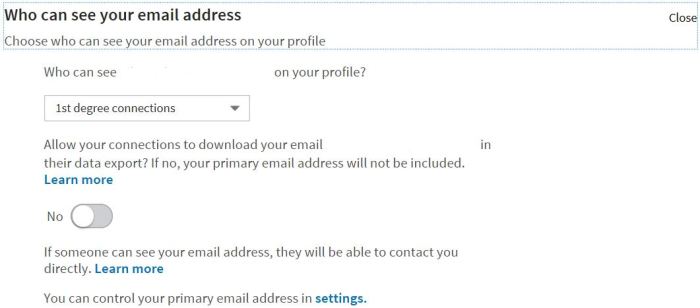
LinkedIn users can block connections from downloading their emails.
LinkedIn added the option to restrict downloading of emails by their connections. LinkedIn does not generally allow profile downloading or CRM synching except for permissioned connections. Users now have the option to permit connections to view their emails but block them from downloading emails. By default, emails are not downloadable unless users change their settings to permit downloads.
While the change is pro-privacy and consistent with GDPR, TechCrunch took a negative view of the new setting.
A win for privacy on LinkedIn could be a big loss for businesses, recruiters and anyone else expecting to be able to export the email addresses of their connections.…[The new option] could prevent some spam, and protect users who didn’t realize anyone who they’re connected to could download their email address into a giant spreadsheet. But the launch of this new setting without warning or even a formal announcement could piss off users who’d invested tons of time into the professional networking site in hopes of contacting their connections outside of it…
On a social network like Facebook, barring email exports makes more sense. But on LinkedIn’s professional network, where people are purposefully connecting with those they don’t know, and where exporting has always been allowed, making the change silently seems surreptitious. Perhaps LinkedIn didn’t want to bring attention to the fact it was allowing your email address to be slurped up by anyone you’re connected with, given the current media climate of intense scrutiny regarding privacy in social tech. But trying to hide a change that’s massively impactful to businesses that rely on LinkedIn could erode the trust of its core users.
Josh Constine,TechCrunch
TechCrunch overstates the loss. Member control their data, not LinkedIn or LinkedIn connections. Second, there are multiple ways to reach users from within LinkedIn including InMail, messaging, and PointDrive. Unless the email is blocked on the profile, connections still have access to emails from within LinkedIn. Finally, most emails in LinkedIn are personal emails, not business emails (an issue they should address by allowing both and setting privacy and messaging rules around multiple emails), so reaching out to individuals on their emails only makes sense for friends, family, and recruiters on LinkedIn, not businesspeople networking with colleagues and clients.
While LinkedIn wasn’t transparent about the privacy change, it enhanced the privacy of its members. As such, looking for nefarious reasons for the enhancement is a reach.
Sigstr recently announced the launch of its new relationship marketing platform and Sigstr Pulse application. The new cloud offering analyzes email and calendar patterns to determine the strength of relationships between employees and prospects. Instead of determining engagement as clickthroughs and web visits, Sigstr Pulse determines relationship strength based upon employee interactions with prospects. Data is collected passively with sales reps not required to take any action.
According to Sigstr, “Revenue lags relationships. When you understand the quality of relationships, marketers can provide better air coverage and sales can forecast better.”
Sigstr calls out relationships between employees, accounts, contacts, and location; scores the strength of those relationships; assesses relationship strength over time; and helps identify warm introductions. As a relationship marketing platform, Sigstr visualizes the relationships with key accounts and determines “which contacts you know best and which you need to know better.”
Sigstr argues that corporate inboxes and calendars are the best source for measuring relationships. Relationships “live and grow in the inbox,” said Sigstr CEO Bryan Wade.
“Relationships are the lifeblood of every business, and no other system tracks who has relationships with whom better than a corporate email system. Sigstr Pulse allows marketers to effortlessly solve a problem everyone knows they have, making it easy to understand your organization’s complex web of relationships and take action on them. One practical example is in event marketing, as brands can send invitations to potential attendees based on the hierarchy of relationships within an organization,” said Wade. “Our platform is already in the email flow of hundreds of thousands of employees at some of the world’s largest brands, which means they can flip a switch to turn on relationship marketing via Sigstr Pulse. As we’re marketing in the era of GDPR, tapping into coworkers’ existing business relationships means less cold calling and more productive marketing.”
Sigstr Location Intelligence analyzes the strength of connections at the metro level.
Sigstr provides location-based intelligence to help identify where contacts are located. This intelligence assists with on-site meeting planning, territory assignment, and assessing relationship strength at the location level. Location-based intelligence can also be employed for event planning and marketing.
Sigstr evaluates relationship strength based upon the frequency, recency, and directionality of communications along with the acceptance of calendar invites. Users are able to build targeted lists, identify strong relationships with the company for referrals, and evaluate how relationships are strengthening or atrophying at ABM accounts.
“Sigstr has expanded the opportunity for marketing and sales teams by allowing them to make the person-to-person connections they need through existing relationships within the organization. Email is at the center of nearly every professional’s daily workflow, and now they can use those interactions to build their business beyond just the conversations they’re having.”
Matt Heinz, President of Heinz Marketing
Sigstr does not yet have the functionality to exclude specific individuals or departments from your relationship data, but there are controls that manage which inboxes are integrated with Sigstr Pulse. Users cannot yet block access to relationships for teams involved in confidential communications such as litigation, M&A, and partnerships. Likewise, individuals cannot opt out if they wish to retain control over their relationships. As this is a V1 release, it is likely that their customers will demand such controls to be added.
Sigstr does have GDPR controls in place to modify or delete specific users, if users wish to remove their personal information.
Sigstr Pulse supports a Chrome Connector which provides on demand company and contact relationship insights while browsing the web.
Sigstr Chrome Connector.
Sigstr Pulse pricing is based on number of users (logging into the application and downloading the Chrome extension) and email volume.
Sigstr also offers an email signature marketing application which provides custom messaging and banners within employee email signature blocks.
LinkedIn redesigned its Account Profile display as part of their Q1 2018 release.
LinkedIn Sales Navigator formally announced their Q1 release last week. The new functionality, which is rolling out to admins and trainers first, will be unveiled to sales reps over the next few weeks. The release focuses on a redesigned Account page, but also includes self-service seat transfers, new sales email alerts, seniority preferences, and additional SNAP partners.
LinkedIn describes the refreshed Account page as “the most efficient way to get the information you need about your accounts.”
The new company profile page is laid out in a series of sections:
Company Summary – a company overview with employee count, industry, revenue, short description, URL, location, and contact information. The section also supports Add Tags, Add Notes, and Save Account functionality.
People Tab – three categories of people intelligence: saved leads, recommended leads, and connections into the account. The saved leads section is displayed in a list format with headshot, title, connections, geography, and recent activity. Recommended leads may be filtered by spotlights such as job changes, mentioned in the news, recent LinkedIn posts, shared experiences, and company followers. Recommended leads highlights job changes, news mentions, recent LinkedIn posts, shared experiences, and company followers. Connections are broken into three strata: first degree connections, TeamLink (co-workers) connections, and alumni connections based on the user’s college or university.
News & Insights Tab – company insights related to news mentions, LinkedIn posts, and executive hires. The section also includes recent headcount growth by department.
Head Count Growth – the headcount growth data has been available to premium users in core LinkedIn for over a year, but finally made it into Sales Navigator (see image on right). Employee estimates found in sales intelligence vendors are often difficult to obtain or out of date. LinkedIn has access to probably the most reliable employee analytics on the market. Not only can they provide current headcount data, but they also include this data by eight job functions (Art & Design, Business Development, Engineering, HR, IT, Operations, Program & Project Management, an Sales) and the change at the departmental and corporate level over the past six months, year, and two years. This data is invaluable to sales reps as they can determine the mix of employees by function at the firm, whether hiring has accelerated or decelerated over the past few months, and even which departments are hiring. Not only does this data provide talking points, but an acceleration or deceleration in hiring is a valuable signal in assessing whether a pipeline deal is likely to move forward or stall.Sales reps should be careful about taking LinkedIn employee counts as gospel. While the data is more accurate than other sources, it is likely to lag M&A activity and layoffs as members update their profiles. Thus, hiring (except for embargoed executive changes awaiting press release) will be more quickly reflected than layoffs. Employees of acquired firms may be slow to update their profiles, particularly if their subsidiary retains its brand. As such, the trend data is probably more important than the displayed employee count.For private investors and competitive intelligence professionals, the head count data can be invaluable for comparing peers and evaluating growth and hiring patterns across a segment.
Unfortunately, Sales Navigator does not yet display all of the employment analytics found in the LinkedIn service so sales reps may still wish to toggle between the core LinkedIn service and Sales Navigator to review New Hires data, Notable Company Alumni, and the Total Job Openings analysis.
Recent Senior Management Hires – The Recent Hires section lists Directors and higher that recently joined the firm. Both current and previous roles are displayed along with tenure in the current position. New hires may be saved as Leads without leaving the page.
People Also Viewed – This section lists similar companies which were viewed after the current account. While the firms may be in the same industry, this section could include partners, companies from which the firm has hired key execs, vendors, etc. Each company includes a logo, employee range, industry, and location. The companies may be saved as Accounts without leaving the page.
New content includes an expanded set of revenue estimates, headcount growth data, the Saved Leads module, Spotlights and Insights in the Recommended Leads module, alumni in the Connections module, and recent senior management hires. Previously, only public companies had revenue data, but LinkedIn is beginning to build out revenue estimates for private companies with at least $1 billion in revenue. LinkedIn plans on building down these estimates to smaller companies.
“Our redesigned account page experience streamlines the process of landing new accounts or building relationships within existing accounts, by giving you the information you need, when you need it. Now you can better understand whether the account is a good match, who you should be targeting, and how you can get a warm introduction.”
Doug Camplejohn, Head of Product at LinkedIn Sales Solutions
This is the first in a series of blogs discussing the Q1 2018 Sales Navigator release. Part two discusses additional enhancements.
LinkedIn hit the half billion member mark, continuing its pace of adding 50 million members every nine months. LinkedIn also supports ten million job listings and over nine million company profiles. Members continue to post 100,000 articles per week. However, the active monthly user rate remains around 25%.
In comparison, Facebook has 1.8 billion members and Twitter has 328 million. The top five countries are the United States (138 million), India (42 million), China (31 million), Brazil (29 million), and United Kingdom (23 million).
LinkedIn published connection data by country and region for the first time with the top five most connected countries (i.e. average member connections) listed as the UAE, Netherlands, Singapore, UK, and Denmark. UAE profiles average 211 connections. By metro area, London leads in average connections with 307 per member followed by Amsterdam, San Francisco, Jakarta, and Milan. Staffing and recruiting is LinkedIn’s most connected industry (unsurprisingly as the firm’s largest revenue source is their Talent Solutions products), and human relations its most connected job function.
LinkedIn connectivity rates by job function and level indicate a strong focus on staffing, consulting, and PE/VC roles.
LinkedIn connectivity rates by job function and level indicate a strong focus on staffing, consulting, and PE/VC roles.
The top five industries are all highly networked occupations including staffing and recruiting, VC/PE, human resources, management consulting, and online media. With respect to job functions, product management was the number two most connected occupation after human resources. It was surprising to see that sales reps did not even make the top five (outside of Business Development which is a senior level mix of partnership, licensing, and relationship management), but product managers had very high connectivity. Of course, the sales function would span both junior and senior sales reps along with business and consumer sales, while product management consists of more mid and upper-level management.
“The impact of half a billion professionals connecting and communicating is very real, and very accessible to anyone who wants to take part today,” said Aatif Awan, LinkedIn’s VP of growth and international products. “We’re excited to think about the potential of what a highly connected global community of professionals can do, and the value that is created for every member of the global workforce.”
LinkedIn, which is operated as an autonomous division within Microsoft, has over 10,000 employees.
Relationship Science (RelSci) from within the Salesforce AppExchange.
Relationship Science (RelSci) rolled out a freemium offering for their social networking service this week. A free edition provides ten profile views while the Professional edition is priced at $49.99 per month and supports contact synching, relationship finding, news alerts, power searching, and a mobile app. The full feature set is shown on their pricing page.
While the professional edition does not yet support networking, the feature is in development for single users.
RelSci is designed for investors (e.g. PE, VC, Wealth Managers), fund raisers, and business development professionals. It works best at companies where relationships are highly prized for reaching top executives, directors, and donors. The firm marries your contact network with a database of 5 million “movers and shakers” across 1 1/2 million organizations. The enterprise edition allows users to leverage the relationships across their firm, providing a powerful research and networking tool.
Along with standard company and executive profiles, you will find nonprofit board and association memberships, nonprofit and political donations, investments, and news alerts. What you won’t find is emails and direct dial phone numbers. The system is designed for introductions, not cold calling.
The product offers an elegant user interface combined with powerful prospecting tools. Along with standard prospecting, there are screens which assist with trip planning, donor searching, and identifying potential investors.
So how does RelSci stack up vs. LinkedIn Sales Navigator? A recent DiscoverOrg survey found that one quarter of top level executives are not LinkedIn members so RelSci has a distinct advantage there. Furthermore, RelSci brings in intelligence not found within LinkedIn such as rich company profiles (LinkedIn’s are basically warmed over marketing materials from the website and Facebook), donations, and investments.
However, Sales Navigator offers InMail with recommended names to drop while RelSci forces users to request introductions through their network. This could be a potential bottleneck at firms where the strongest networks go through top level execs and the firms’ rainmakers.
Also, if your focus is more directors and managers, you many not find sufficient depth within RelSci. An ABM strategy could stall out due to lack of executive depth in RelSci. For those companies, I’d recommend a full sales intelligence offering (e.g. Avention, Hoover’s, DiscoverOrg, RainKing) in conjunction with free LinkedIn.
RelSci offers powerful screening and visualization tools tied to an elegant user interface. For professional networkers aiming at the upper echelons of companies and boards, RelSci is a superior option to LinkedIn.