Crunchbase reporting on its funding rounds in Crunchbase Pro.
Funding intelligence vendor Crunchbase closed on a $50 million Series D led by Alignment Growth, with OMERS Ventures, Mayfield, and Emergence Capital also participating. The oversubscribed round raised total funding to $106.5 million.
“Investors we spoke with echoed the trends we’re seeing in Crunchbase data: We are in the middle of one of the most challenging times for startups to raise,” blogged Crunchbase CEO Jager McConnell. “So, the fact that we had more firms trying to invest in us than we were even looking for is a huge vote of confidence in our company, brand, and the products we’ve built.”
Jager noted that the firm has moved beyond funding data for PE and VC firms to a broader information platform that supports sales, recruiting, finance, and business development professionals. I would add Competitive and Market Intelligence professionals to their user list as I regularly use Crunchbase and Owler for deal intelligence.
Crunchbase began as a funding database at TechCrunch but was spun out as an independent organization in 2015 and has evolved into a sales intelligence service. The Crunchbase Pro offering supports company discovery, qualification, tracking, Salesforce syncing, and engagement (via contact data and email templates) at a low price ($49 per month billed annually).
Crunchbase Pro Build-a-List
“As difficult economic conditions impact more companies, knowing whether a target account is on the upswing or not gives prospectors the power to focus outreach on decision-makers with buying power,” McConnell said. “Our tools encourage account-based selling, which encourages deal-makers to prioritize their prospecting efforts based on the companies they should be contacting rather than the individuals. This is the opposite approach to ‘spray and pray,’ which relies on massive contact lists and leads to the kind of spammy outreach that no one likes.”
Recent enhancements include territory filters, diversity flags, machine-learning company recommendations, a Chrome extension, and email alerts for priority accounts, lists, and saved searches. They also added a contacts database and email templates.
Crunchbase has retained its focus on emerging (funded) companies. This focus is both an advantage and disadvantage. Emerging companies are often the fastest growing businesses with expanding needs and fewer incumbent vendors that need to be displaced. They are also more open to cutting-edge technology, encourage quick decision-making, and are less risk averse. Conversely, they represent a relatively small percentage of the overall economy, deals are smaller (but with significant upside at renewal), and they are more subject to economic volatility.
Another advantage of focusing on emerging companies is that the leading sales intelligence databases have weak coverage of these firms. When companies collect or ingest data on global companies of all sizes, they lack the editorial bandwidth to deliver detailed information on emerging companies. Specialist databases such as Crunchbase offer funding details, acquisition histories, editorially-written business descriptions, and more accurate sizing data.
“The Crunchbase SaaS platform combines rich and proprietary company data with direct access to decision-makers within a single intuitive interface—at compelling price points—making it a powerful tool for driving ROI across a variety of use cases, from sales to recruiting and more,” stated new Crunchbase Board member Alex Iosilevich from Alignment Growth. “We expect that Crunchbase will continue to gain accelerated industry adoption and are excited to support the company’s growth momentum alongside strong participation from the existing investor group.”
Crunchbase continues to grow its product and data. It supports 75 million unique annual users and over 60,000 customers. Furthermore, SaaS products drove a 5x year-over-year increase in new recurring revenue in Q1 2022.
“We took a step back from rapid growth in favor of a more measured, balanced approach,” stated McConnell, who noted that the firm has focused on capital-efficient growth. The firm dialed back its Burn Multiple from 3 ($3 spent to acquire $1 in new ARR) in 2019 to 0.22 in H1.
“The recent onslaught of down rounds and mass layoffs from companies who very recently hit unicorn status shows how outsized burn rates can be hidden behind oversized funding rounds, covering up the reality of weak business fundamentals,” McConnell said. “I’m especially proud of the fact that we have been able to generate growth while keeping our burn rate in check. In the first half of this year, we drove $9 million net new ARR at only $2 million burn — that’s best in class according to Bessemer’s efficiency benchmarks and puts us on the path to profitability…We plan to double our business-to-business software ARR this year, ending around $38 million in ARR just for this customer segment.”
Iosilevech argued that Crunchbase is well-positioned for ongoing growth and does not expect follow-on rounds. “They’re managing the business in a capital-efficient way so that the capital that they raise will really be the last round they need before a major milestone in the company’s history, whether it’s an IPO or something else.”
Funds will be deployed towards additional headcount and expanding platform functionality, beginning with a HubSpot connector. The firm is also looking to expand its machine-learning recommendations for sales, expand its data insights, and add usage tracking dashboards “to help customers track efficacy of activities on Crunchbase, along with the number of opportunities and ARR available to them.”
Crunchbase has grown to 220 employees with a remote-first operational model. It added seventy staff during the first half of the year and is aiming to add another fifty-five employees before year’s end. It was cash flow positive in Q1.
Crunchbase did not disclose its new valuation figures.
ABX PlatformDemandbase announced that it is the first sales intelligence and account engagement platform to integrate both services jointly into CRM. Demandbase offers a single view that combines first-party and behavioral data from the Demandbase ABX cloud and third-party datasets (firmographics, technographics, contact data, and news & social insights) from the Demandbase Sales Intelligence Cloud.
“Doing so gives B2B sellers access to all the information they need to spot and close larger deals faster,” stated the firm. “This first of its kind application guides sales teams to know where and when to engage with the right accounts and decision-makers, leading to higher win rates, shorter sales cycles, and bigger deals — boosting CRM adoption in the process.”
Demandbase brought firmographic, contact, and technographics databases in-house following the May 2021 acquisitions of InsideView and DemandMatrix. Intent data includes first and third-party intelligence, including Surging Intent, Demandbase Keyword Intent, Campaign Response, and Web Page Visits.
Revenue Operations can also select intent data from Bombora and G2, which are processed through the ABX platform’s predictive models.
The Demandbase Timeline provides current and historical intent data.
The Demandbase platform also supports activity timelines, product and competitor intent datasets, and persona-based engagement heatmaps, helping revenue teams assess account potential and determine where accounts stand in the buyer’s journey.
Heatmaps may be viewed by engagement, people, or journeys. Both preset and custom options are available. In addition, users can drill down to details by clicking on a row or column header.
The SFDC Heatmap is presented at the Account level with Engagement Minutes (Demandbase’s contact engagement model) displayed within the heatmap matrix.
Sales users can utilize this heatmap to find champions at an org via the highest engagement and understand with which roles they need to communicate.
The Demandbase Heatmap is available with both preset and customizable views.
The platform also supports long-running InsideView for Salesforce functionality, including
Company and contact profiles
Prospect list building for companies and contacts
Contact searching at accounts
A news viewer that combines company news, social posts, and blogs
Corporate family trees
Add to CRM with duplicate checking
CRM “stare and compare” updates
According to Demandbase, the unified UI lets customers “consolidate their tech stack, replacing ABM, sales intelligence, advertising, and other vendors with Demandbase One, the Smarter Go-To-Market solution.”
“The beauty of this unified sales UI is that all the data a salesperson needs is readily accessible, right in the CRM where they’re already working. It’s revolutionary for sales teams,” said Demandbase CRO Allison Metcalfe. “No more toggling between systems or wasting time in generic outreach that doesn’t drive sales. Instead, they’ll have deeper insights and greater visibility into prospective deals, gaining knowledge about what buyers are doing around the web, what they engage with, who to contact (and how), and what the most relevant messaging is. The actionability, productivity, and efficacy of such functionality is practically limitless.”
In other news, Demandbase was named to the Fast Company “100 Best Workplaces for Innovators.” The magazine noted that Demandbase reinvests 20% of its revenue in R&D.
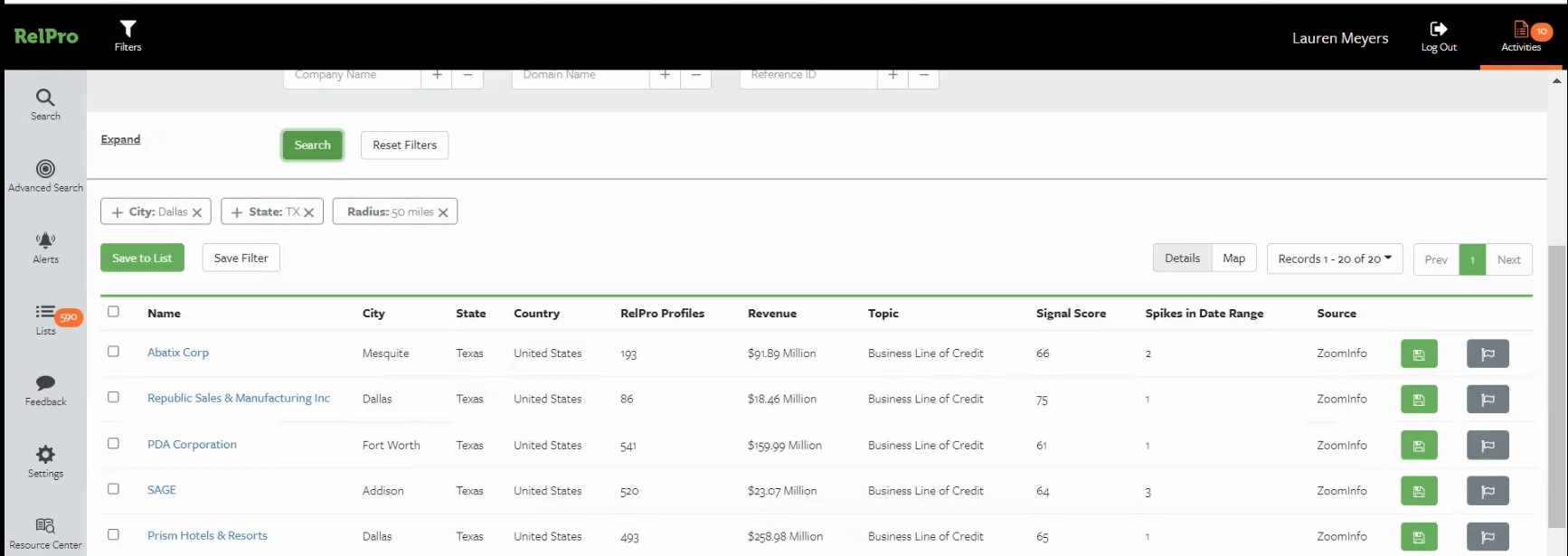
RelPro has limited the topical scope of its intent data to banking use cases.
Sales Intelligence vendor RelPro, which focuses on the financial services sector, added banking services intent data and Commercial Real Estate (CRE) title and mortgage intelligence to its platform. Both datasets are available as premium offerings.
The intent data, sourced from Zoominfo, contains 66 signals related to financial research and products. RelPro has removed the noise from thousands of non-relevant topics by limiting the topics to standard commercial banking services.
Intent Data search results include signal score and spikes across a date range.
Users may screen against the intent topics, spike period (last week to past three months), audience strength, signal score, minimum spikes in the date range, and standard firmographics. Audience strength and minimum spikes ensure that the research is broadly based and sustained, avoiding spurious spikes created by a single employee doing heavy research on a topic for a day or two.
Audience strength is an intent distribution score containing the volume of searches on a topic across a company’s IP addresses. Other variables include the number of IPs at a company, the number of days investigating a topic of interest, how many times they viewed the page, and company size.
The minimum score lets banking professionals dial up or down the precision. Intent data falls along a bell curve, with sixty being a twenty percent increase in topical activity. Sixty, the lowest signal score for screening and presentation, is a relatively low threshold, particularly if the search is being performed across multiple weeks or months.
An intent tab lets Relationship Managers view an account’s spiking topics and each topic’s signal score, audience strength, and spikes in date range, helping them determine which financial products may be of interest to the account. If there are multiple signal spikes over a date range, the signal score is the average of the spike scores.
The RelPro company Intent Tab details spiking topics, audience strength, frequency of spikes, and the last signal date.
A last signal date indicates the last time the topic spiked, while the spikes in date range indicate the frequency of spikes over the date range. These fields help determine the recency and frequency of interest, particularly if low signal thresholds or a long search period have been selected.
RelPro added eight million CRE loans to its platform, helping financial services companies target companies and assess risk. Mortgage fields include property type, lender, loan amount, assessed value, execution, and maturity dates.
CRE Title Records in a RelPro company profile.
Users can view mortgage data and screen against it in Build-a-List. Along with CRE data, RelPro provides UCC (US liens), PPP and PPS loans (pandemic), and 7A and 504 (Small Business Administration) loans.
RelPro did not disclose the source of its CRE mortgage data.
RelPro claims that 50% of the top US banks license its service.
Dun & Bradstreet continues to expand the content it publishes in D&B Hoovers. Recent enhancements include building out its companies, contacts, and technographics.
D&B Hoovers profiles nearly 250 million unique, active companies and over twenty million corporate linkages, including branch-level links. New fields include Site Sales, Global Sales, Site Employees, and Global Employees.
Contact coverage also continues to grow, hitting 290 million. In addition, email and direct-dial fill rates have significantly improved, both growing 9X since Q1 2021. As a result, D&B Hoovers now provides 40 million emails and 20 million direct dials.
Build-a-List now supports a Contact Accuracy Score when prospecting for contacts, letting reps “select the email accuracy that’s right for each outreach, lending flexibility for both precision and volume.” For example, for general campaigns, marketers would select emails with the highest levels of deliverability; still, reps may select lower-scoring contacts when reaching out to their target persona within their ICP.
Other recent enhancements include website content searching, a UI refresh with responsive design, and support for fifteen European and Asian languages.
D&B Hoover’s now provides a broader set of sizing variables for companies and locations.
D&B Hoover’s also expanded its technographics, with company coverage extended by 359% since Q1 2021. In addition, Dun & Bradstreet grew its technology vendor coverage by 54% and its tracked technology products by 5.3 million.
Along with a deep set of companies and contact profiles, D&B Hoover’s offers public company financials, US SEC filings, UK Companies House filings and DASH reports, European registered company financials, analyst reports, industry market research and overviews, corporate family trees, competitors, company news, intent data, and event triggers.
SNAP integrations support LinkedIn content display and functionality within partner platforms.
Gong is the latest RevTech company to join LinkedIn’s SNAP program of Sales Navigator integrations. Joint customers can view LinkedIn Sales Navigator Embedded Profiles directly in Gong. Functionality includes executive profile display, related leads, icebreakers, and introductions. Contacts may be viewed or Saved as Leads in Sales Navigator.
“Being a great seller requires two datasets – the quantitative data of when to reach out to whom and the qualitative data of, once you connect with those people, ensuring you have a full view of deal health and that you are employing sales best practices in all your interactions,” argued LinkedIn’s Head of Product and Solutions Marketing Nicole Desjardins. “Sales Navigator does a great job of providing the former, and Gong’s Reality Platform, the latter.”
The SNAP integration provides context around key accounts and the demand unit, helping them build broader relationships and leverage TeamLink (colleague) connections. Furthermore, Sales Navigator within Gong helps reps build credibility, establish rapport, and multithread.
“Integrating Gong’s Reality Platform with LinkedIn Sales Navigator is all about empowering revenue teams with actionable sales intelligence they need to build stronger relationships with prospects more efficiently. Bringing together these two powerful datasets will give sales reps insights and recommended next steps that result in more closed deals, faster,” commented Gong’s Senior Director of Market Strategy Craig Hanson. “Successful go-to-market teams understand that contact inspection and validation are paramount to successful deal management.”
The SNAP integration is only available to Gong customers with Sales Navigator Advanced or Advanced Plus licenses. SNAP integrations are also available across major CRMs and SEPs, including Salesforce, MS Dynamics 365, HubSpot, Salesloft, Outreach, and Groove.
Sales Navigator added M&A Alerts for saved companies. The alert is displayed on the Homepage and is shared for both acquired and acquiring companies. Another new feature is a Weekly Leads and Accounts List Digest that suggests the most relevant Leads (contacts) and Accounts for outreach. It highlights accounts showing interest in the rep’s company, recommended leads, past customers at a new company, and opportunities at risk due to headcount changes.
The new Sales Navigator search UI dynamically updates the results list as soon as a filter is added or removed.
LinkedIn began rolling out its Q2 Sales Navigator release to users earlier this month. As with previous releases, admins receive the release first, with general users following a few weeks later. New features include expanded data validation, a new SNAP integration with conversation intelligence leader Gong, and the continued rollout of Sales Navigator’s new Search and Lead Page experiences.
Companies have responded to the pandemic and Great Reshuffle by increasing channel noise, hoping to break through the din, but this strategy is flawed. Top-performing reps who heavily exceed their quota are “spending less time selling in the traditional sense — smiling-and-dialing and sending out mass outreach,” explained LinkedIn VP of Global Sales Solutions Alyssa Merwin Henderson. They aren’t increasing the volume but carefully targeting their prospecting and messaging, conducting buyer research, and focusing on skill development.
“In today’s virtual world, where there’s more noise than ever, the recipe for winning is clear – fewer things done better,” concluded Henderson.
LinkedIn Head of Product and Solutions Marketing Nicole Desjardins highlighted three problems facing sales reps that LinkedIn is working to address:
More virtual selling than ever, leading to more virtual noise than ever, with buyers being overwhelmed by irrelevant and generic outreach.
Job switching continues to be higher than normal, making a mess of CRM data and putting deals at risk.
A plethora of new sales tools have hit the market, many of which don’t integrate with each other, making it more confusing to choose the right tech stack.
Desjardins argued that the solution to these problems comes from real-time data fed into the CRM and “meaningful sales intelligence that helps you connect with and nurture the right buyers at the right time.”
The Great Reshuffle continues to create a “mess” of CRM data, resulting in inaccurate forecasts and irrelevant messaging. According to LinkedIn’s upcoming “State of Sales” report, 41% of sales reps said their biggest problem was inaccurate, out-of-date CRM data. To help address this issue, Sales Navigator now flags out-of-date contact and lead records and allows reps to update the CRM from Navigator to address this problem.
Sales Navigator Data Validation displays Update CRM badges and syncs updates to Leads and Contacts.
Data Validation displays an Update CRM badge on Sales Navigator member pages who have recently changed jobs, titles, or locations. After clicking on the badge, reps are shown the new title, account, location, contact owner, and most recent opportunity. Updates are made to matched Lead and Contact records, with the user controlling which fields are to be updated. Reps are also shown which open opportunities are linked to the executive, allowing them to quickly remove departed execs from live opportunities.
“Clearly, this will save you time. Instead of having to toggle back and forth between your CRM and Sales Navigator, you can do it all in our platform,” blogged Product Marketing Manager Austin Gray. “More importantly, because updating your CRM is now easier to do, you’ll have more accurate data within it. LinkedIn’s real-time first-party data means that you can have confidence that your CRM will have access to the most accurate and up-to-date information available.”
Data Validation is available for Sales Navigator Advanced Plus and supports record updates in Salesforce and MS Dynamics 365. The functionality was released to customers with fewer than 15 seats this week and will be rolled out to large customers on June 22.
The New Search and Lead Page Experiences were rolled out to accounts with fewer than fifty seats last quarter. The largest accounts will receive the updates this quarter.
The search feature has been streamlined to improve the time to “successful results.” In addition, the search includes a “larger collapsible, intuitive grouped view of filters” that improves search filter discovery. New and updated filters include TeamLink Connections of, Saved Leads, Saved Accounts, Previously Viewed, Current Company, Past Company, and Company Headquarter.
The search interface updates dynamically, providing results as each filter is added or removed.
The updated Sales Navigator Leads (Contact) Page
The new Lead Page (contacts) is designed for rapid lead qualification with “the most important info front and center,” including the most recent touchpoint, current role, and description. Other features include a sticky action bar, conversation starters, and introduction paths.
The Conversation Starter section displays recent posts for comments and commonalities.
The Get Introduced section has been redesigned and expanded.
The TeamLink section is now organized by seniority level so that reps can find “their best path in.” In addition, the section supports a pre-populated InMail to save reps time writing messages.
Sales Navigator is also adding a new Lead Panel for researching contacts in a prospecting list without having to open multiple windows.
“Prospecting in Sales Navigator often means using our powerful search to find your target buyer,” wrote Desjardins.” Once you’ve found that list of potential buyers, we’re betting you then open a tab for each individual, which can mean a lot of open tabs and a lot of switching back and forth. The new Lead Panel streamlines this process and keeps you on the same page the entire time.”
The new Lead Panel streamlines qualification and messaging from lead (contact) prospect lists.
The Lead Panel displays job title, job description, and conversation starters to assist with quick qualification and messaging.
The Lead Panel will be rolling out to accounts with fewer than fifty seats this quarter and enterprise accounts next quarter.
LinkedIn also added a Gong SNAP integration for viewing LinkedIn intelligence within Gong’s conversational intelligence platform.
Growth equity firm Great Hill Partners invested €180 million in Echobot and Leadfeeder, merging the firms into a Sales Intelligence and Go-to-market platform. Both firms are based in Europe (Germany and Finland) and will benefit from the roadmap set out by North American RevTech firms.
The merged firm will be based in Karlsruhe, Germany, with Echobot CEO Bastian Karweg continuing as CEO. Leadfeeder CEO Pekka Koskinen will become the CPO. The combined company has a headcount of 250 across six offices in Europe and the US. The new firm’s Annual Recurring Revenue (ARR) exceeds €20 million.
Leadfeeder serves around 7,000 customers and Echobot 1,500.
Echobot’s European data coverage
Echobot offers a Sales Intelligence and B2B DaaS platform for the D-A-CH region, UK, and France. Late last year, it added a broader European data pack. It supports a database of 20 million European companies and over 60 million GDPR-compliant contacts. Company and contact data is derived from both registered filings and open web sources and includes directors, shareholders, and financials.
Echobot takes a “True Compliance” approach which gathers data only from publicly accessible sources. Furthermore, it provides verification links to the source URLs that allow reps to answer the question, “where did my data come from?” All data is hosted in Germany.
Echobot’s products include TARGET (prospecting), CONNECT (Sales Intelligence), DATACARE (B2B DaaS), and an API. In addition, Echobot offers CRM integrations with HubSpot, Salesforce, Microsoft Dynamics, and SugarCRM.
“It is our goal to be the leading sales intelligence and go-to-market platform to our core European and North American markets,” said Karweg. “Thanks to Great Hill, we have now assembled the best data, AI / ML, talent, and operating experience to achieve just that. We are increasingly seeing organizations looking to take advantage of their own data and third-party data, and then to augment this intelligence with better, more personalized outreach. The combination of Echobot and Leadfeeder is uniquely positioned to capitalize on a massive market opportunity at the early stages of adoption.”
Leadfeeder IP-to-Account Visitor Intelligence
Leadfeeder offers website visitor intelligence that maps IP addresses to company intelligence. During the pandemic, it worked to identify remote workers and map them to their employers, helping refine which companies are in-market. It also supports connectors for Google Analytics, chatbots, audience retargeting, major CRMs, Zapier, and Slack.
“Integrating Leadfeeder’s web visitor identification system with Echobot’s data and prospecting solutions creates a unique platform upon which we can both enable organizations to identify and engage high-intent prospects as well as introduce incremental applications that enhance B2B sales and marketing operations,” said Koskinen.
Karweg envisions an ABM workflow that begins with an ICP analysis that identifies net-new accounts. The ICP is then mapped against Leadfeeder’s visitor intelligence and Echobot’s firmographics and event triggers to identify high-value, in-market accounts for programmatic marketing. While programmatic campaigns are not yet supported, they are in development.
Great Hill Partners has also committed an additional €50 million toward future acquisitions. In an interview with GZ Consulting, Echobot CEO Bastian Karweg indicated that the €50M in dry powder would be used towards acquiring talent, RevTech functionality, or expanded content.
The equity acquisition is a combination of primary and secondary funding, with Great Hill Partners buying out many of the original investors. It named Growth Partner Derek Schoettle Chairman of the Board and placed Great Hill Partners Managing Director Chris Gaffney and Vice President Greg Stewart on the board of the merged organization.
Schoettle is also on the board of ABX Platform Terminus, another Great Hill investment. He was the CEO of ZoomInfo when DiscoverOrg acquired it in 2019 (DiscoverOrg subsequently assumed the name ZoomInfo), so he and the new board members offer deep Go-to-Market domain expertise.
“Go-to-market is one of the fastest-growing areas of B2B software. Sales and marketing organizations need timely, accurate information and intelligent systems to identify and engage their prospects in an increasingly personalized, automated fashion. By bringing together Echobot and Leadfeeder, we can create the next-generation sales intelligence and go-to-market platform,” stated Derek Schoettle.
The transaction is a merger of equals bringing together two firms of roughly the same revenue and employee base. Both firms have over €10M in ARR and are growing rapidly. Echobot grew 70% last year, while Leadfeeder had a 50% growth figure. Echobot has long been profitable, and Leadfeeder is nearing profitability.
The firms will initially run as independent brands as they merge their operations and platforms. The deal closed a few weeks ago but was announced this morning. Thus, they have already begun combining finance and HR. The two brands will be maintained in the near term with rebranding under consideration for 2023 as Echobot is also the name of a Mirai malware variant.
Valuation figures were not disclosed, but the final price was determined before the recent valuation declines and did not change. The firms were both being advised by GP Bullhound, which suggested that packaging the two firms together would result in a more effective growth equity round. Furthermore, the two companies offered features on each other’s roadmap so were logical complements.
Europe has been tracking behind the US in the Sales Intelligence space, with several national champions now looking to offer European datasets and local UIs. European sales intelligence and B2B DaaS solutions must meet higher data compliance and privacy standards, incorporate registered data from national registers, support multiple currencies, and many languages.
Echobot covers the D-A-CH region (Germany, Austria, and Switzerland), the UK, and France, with a general European data package added late last year. A Nordic data package has been accelerated due to the merger, which would increase its competitiveness against Dun & Bradstreet and Vainu.
“One of the most requested developments for 2021 was to access data from the entire European market. That was not only requested from German customers with a strong export to European countries, but also from new, international users that want to expand into Europe,” explained Karweg last November when Echobot added coverage of over twenty European countries.
“Europe is not one country but many, and there are differences between them, whether it’s to do with culture or data compliance,” remarked Schoettle. “Having a platform that is unique and linguistic-specific, and serving its markets with high-quality data, is a differentiator.”
“It’s a dream match,” argued Koskinen. While previously the firm purchased contact data from multiple sources, “it has been difficult to get sufficiently up-to-date and accurate data.” With the merger, Leadfeeder will offer better data quality and “have all the expertise in-house” to expand its coverage.
Along with higher quality data, Leedfeeder will benefit from a broader set of firmographics, financials, and sales triggers for data enrichment and lead scoring. Leadfeeder will also be able to cross-sell Echobot’s sales intelligence, prospecting, and data enrichment services to its 7,000 customers.
“We want to be the biggest in Europe,” stated Koskinen. “It’s going to take a few years, but I think we’re succeeding…We have long had customers all over the world. After the merger, we will be able to offer something that no one else can.”
Echobot offers German and English-language Sales Triggers.
Technology Intelligence vendor HG Insights acquired fellow data vendor Intricately. The acquisition provides HG Insights with global cloud product adoption, usage, and spend data, “adding to HG’s market-leading optimization of the world’s top technology brands’ Go-To-Market.”
The entire Intricately team has joined HG Insights, including CEO Michael Pollack and CTO Fima Leshinsky. Pollack assumed the role of EVP of Market Innovation, and Leshinsky was named an SVP of Product.
HG Insights’ NLP gathers technology installation and spend intelligence for eleven million global companies, capturing 96% of the world’s total IT spend and intelligence on over 15,600 installed products.
“We started Intricately to provide decision-makers with actionable data and insights they could use to plot a course through the ever-expanding Cloud universe. At the time, we saw a world with individuals relying on gut instincts, teams making ‘best guesses,’ and organizations making big bets on circumspect data. We started this business with the goal of making the unknown known. Our vision was, and has always been, to be the authoritative source of truth for digital product adoption, usage, and spend.”
Intricately Founders Fima Leshinsky and Michael Pollack
Intricately’s proprietary sensor network gathers cloud product adoption, usage, and spend data for seven million global businesses across 21,000 cloud offerings. Data are collected from over 150 global Internet points of presence, helping Intricately map digital infrastructure. Its insights are delivered via an API, integrations, data snapshots, and web applications.
“Intricately provides unique and actionable insights that enable cloud sellers to increase velocity by focusing on the highest potential opportunities,” said Pollack. “As the workforces of global companies become increasingly distributed, cloud spend and product adoption have become key indicators when assessing potential buyers’ likelihood of purchasing and deploying new products. Intricately’s intelligence, now part of HG Insights, is uniquely positioned to lead the market on this trend.”
Intricately Cloud Intelligence
Intricately’s customers include the top three cloud companies. In addition, the acquisition provides “real-time visibility into a company’s cloud footprint and application tech stack.”
“Now, with the addition of Intricately, we can provide real-time visibility into a company’s cloud footprint and application tech stack to provide richer insights for better decisions and faster results,” said HG Insights CEO Elizabeth Cholawsky. “Our customers have come to rely on HG Insights as an indispensable input into their most strategic decisions such as market sizing, whitespace analysis, and territory planning as well as for fundamental activities including opportunity prioritization and account-based marketing intelligence.”
HG Insights and Intricately offer complementary spend data. HG Insights focuses on projected spend for forecasting and go-to-market planning while Intricately measures actual spend for benchmarking and plan measurement. Combined, the companies offer “unmatched spend insights in the Cloud Market that support the full lifecycle of Plan, Optimize, and Execute to empower sales and marketing organizations.”
HG Insights listed a series of technical benefits:
Richer combined datasets to operationalize the planning, targeting, and messaging to prospects based on technology adoption and usage
Improved precision of workload volumes, estimated spends, and the related technologies running on cloud-based infrastructure
Expansion of insights into customer-built cloud and self-hosted applications
Detailed location insights providing a view into both the location of consumption and/or physical infrastructure to power hyper-focused Go-to-Market strategies
Real-time detection of changes to a company’s cloud application and technology strategy
Business professionals can leverage HG Insights expanded intelligence to evaluate their TAM/SAM/SOM, prioritize ABM campaigns, establish “equitable and efficient” sales territories, and determine which prospects have the highest propensity to buy. In addition, sales reps can identify prospects evaluating other vendors or shifting their usage patterns, signals that an account is at risk.
“With this new intelligence in its offering, HG will provide game-changing insights that transform our customers’ Go-To-Market initiatives and accelerate growth,” HG Insights Product Marketing Director Darcy Moss told GZ Consulting. “Strategy, marketing, sales, and operations teams can leverage this insight to answer critical business decisions with greater confidence.”
The addition of Intricately Cloud insights helps answer the question, “What is Coming?”
“By adding Intricately’s market-leading workload and usage data, we’ll give our customers the most detailed, unique picture available of an account’s technology strategy; not just what they have, but why they have it, how they’re using it, and ultimately, what they’re likely to do next. It’s a competitive advantage unmatched in the market,” stated Moss.
Intricately was founded in 2014 and is based in San Francisco. LinkedIn states that it has 54 employees, having grown its headcount by 35% in the past year and 93% over the past two. However, its employment plateaued last November.
“At this time, we will be business as usual until the transition is completed,” stated Moss. “This includes retaining current office locations.”
HG Insights did not disclose any size or growth details. It also did not disclose the acquisition price. Intricately is HG Insights’ second acquisition. In 2018, the firm acquired Pivotal IQ, a curator of IT contract and spend intelligence.
The Siemens Company Profile as it would display in German.
D&B Hoovers, a global sales intelligence solution that has long been English-only, began a multi-phase process towards becoming a truly global, multi-lingual solution. Most sales intelligence vendors support only a single language, but European vendors Vainu and Echobot support multiple languages for their regional coverage. Last year, when Dun & Bradstreet bought Bisnode, a firm that serves Central Europe and the Nordics, it declared that it would be sunsetting Bisnode solutions. Internationalizing D&B Hoover’s then became a priority.
The D&B Hoovers’ UX already supports 17 languages:
Asian: Chinese (Simplified), Chinese (Traditional), Japanese
Adding international languages transforms D&B Hoovers from an Anglo-centric solution for multinationals and companies based in Anglophone countries to a localized version.
“In terms of personalization, we’re trying to switch this from being a US product that is sold globally to a fully local version of a global product,” explained International Product Development & Strategy VP Adam Leslie to GZ Consulting. D&B Hoovers needs to be a “local product” that supports sales reps selling to local customers, regardless of language. “Historically, it’s been a US product sold in the local market only where the local market user sells to the US and internationally. If the local market user only sells domestically, they haven’t bought Hoovers.”
D&B Hoovers greatly expanded its industry code standards, allowing users to filter companies by global taxonomies (e.g., ISIC), regional (e.g., NAICS, NACE 2.0, ANZ SIC), or national standards:
D&B Hoover’s also supports two proprietary taxonomies: Hoover’s industry codes and eight-digit SICs.
Country-specific industry code descriptions will be displayed in either English or the local language.
D&B Hoover’s Localization Options
Along with expanded taxonomies, D&B Hoovers recently added website searching to identify companies based on their self-descriptions across one hundred languages. Website search has gathered 247 million rows of structured data across 30 million websites and 300 million web pages.
This feature helps identify companies with emerging technologies or positioning (i.e., the evolving three-letter acronyms that firms use for classifying themselves). The feature echoes its Conceptual Search, but instead of identifying companies based on topical references in news articles, it searches global corporate websites.
D&B Hoovers and its predecessor service, OneSource Global Business Browser (GBB), have supported English-speaking multinational teams for two decades. Their content and functionality have always been the deepest for the US, UK, and Canada. Yet, they also provided a robust set of international content:
Global Public (Quoted) Company Financials, Segment Reports, Executive Bios, and Long Business Descriptions.
Financial statements for 15 European countries and global publics. The reports may be viewed in USD, EUR, GBP, and the As Reported currency, with currency conversion rates based upon the period or statement date. Thus, revenue from a 2020 income statement (a flow statement) would be based upon the average conversion rate for the year, while assets from the balance sheet would be based upon the applicable rate for the statement date.
Global family trees
Industry Codes, including US SIC, NAICS, EU NACE, UK SIC, ANZ SIC, and UN ISIC.
Regional screening, including city, postal code, and sub-regions (e.g., state, province, county)
Regional customization for distances (KM vs. miles) and numeric formats
D&B Hoovers expanded its company coverage to 180 million active firms and 216 million active contacts as part of its internationalization. Most of the new firms have between one and five employees. It also increased the number of countries with sub-divisional regions (e.g., counties, provinces), having recently added sub-divisional filtering for the Nordic countries, Denmark, Hungary, etc. Additional countries are planned.
Several enhancements came from local customer research. In many European countries, departmental emails are employed in sales and marketing outreach. These emails lack any personally identifiable information, so they are GDPR compliant. Dun & Bradstreet is adding over seven million “entity-level emails” for European countries, including over three million entity-level emails for the D-A-CH region, 1½ million for the Nordics, and 2½ million for Eastern Europe.
Text searching was enhanced to recognize accents and diacritical marks (e.g., when performing location searches). Leslie called synonymous search with or without special characters a “major ticket to the game.” While it “sounds like a simple fix,” it was “extremely complex.”
As Dun & Bradstreet began its localization research, it realized the importance of small companies and informational depth in the context of national sales vs. international sales.
“We speak to local markets and say, ‘Well, what is it that will help you sell your products and use our products?’” explained Leslie. Dun & Bradstreet’s research found that many customers and prospects sell locally to organizations with five or fewer employees. “That becomes really important now that you can reach them.”
Leslie listed other findings and subsequent upgrades: “We capped the number of contacts at eleven. That’s been changed. We were missing the middle name. That has been changed.”
When I was a product marketing manager at OneSource (2001 – 2010), I explained that we delivered the top N companies in each European country because “you aren’t selling to Polish abattoirs.” That logic made sense when selling to multinationals and exporters based in English-speaking countries. After all, they weren’t selling to Polish slaughterhouses. But this approach fails to meet the needs of sales reps based in Poland, EU industrial manufacturers, or logistics companies.
Localization requires local language support, content depth, national standards support (e.g., industry codes, geographic districts, GDPR), in-language news and triggers (coming in phase II), market knowledge, and in-market sales and support. Dun & Bradstreet also simplified the UI and improved its dynamic display for various screen sizes and devices. The new UI was implemented in September, and 96% of browser users and 98% of CRM users have switched to the updated format.
D&B Hoover’s old and new company profiles.
In-product tutorials also enhance the user experience. For example, if a user utilizes a feature inefficiently or has not used core functionality, the tutorial will provide on-demand coaching. This feedback is also provided to account representatives to provide guidance. The in-product tutorials were launched last summer, and Dun & Bradstreet continues to collect data for honing its training recommendations.
There is also a new onboarding virtual assistant for providing on-demand training. Tutorial translations should be available to users in Q2. Expanded in-product training and virtual onboarding are consistent with the emerging Work from Anywhere expectation of business professionals.
Dun & Bradstreet provided its internationalization roadmap through the end of the year. The firm intends to extend local content, expand time-dependent sales triggers, and support multi-lingual news. New content includes more digitally sourced data, detailed financials, and country-specific datasets such as country export data for Chinese companies, product codes, and expanded tech data for India.
Ostensibly, Phase I, which completed at the end of March, serves as a minimal viable product for localized products (or what Leslie called a “ticket to the game”), and Phase II continues internationalizing the content and expanding localized content.
“We are working with each local market to collect these [data requirements], source the data, transfer to D&B, and load into the product,” said Leslie. Finally, D&B Hoovers will continue to expand its email and direct dial coverage.
ZoomInfo provides a set of data-enabled services for sales, marketing, recruitment, and revenue operations under the RevenueOS brand.
ZoomInfo announced the immediate availability of its new MarketingOS ABM Platform. The service is part of a broader RevOS offering that supports marketing, sales, operations, and recruitment. MarketingOS consolidates ZoomInfo’s legacy marketing capabilities, bringing together two recent acquisitions, Insent and RingLead, with new programmatic and audience management functionality.
ZoomInfo also refined its positioning statement from Revenue Acceleration to Revenue Operating System. It stated that RevOS is “the World’s only revenue operating system of its kind.”
“Our comprehensive B2B database is the key differentiator that sets MarketingOS apart from other ABM solutions,” said ZoomInfo CEO Henry Schuck. “ZoomInfo’s unique data science algorithms allow marketers to connect with the right prospects at precisely the right time. No other solution on the market combines the power of data-driven insights and marketing-optimized workflows like ZoomInfo’s MarketingOS.”
“Marketers typically fail because the data in most ABM platforms is both inaccurate and incomplete. Current ABM solutions are designed to leverage companies’ own first-party data, which exists in their customer relationship management or marketing automation systems. Without quality data, marketers pour advertising dollars at the wrong prospects and companies, and, as a result, deliver fruitless leads to sales and waste time and resources. With ZoomInfo’s best-in-class data and intelligence at its foundation, MarketingOS enables marketers to effectively reach target accounts and drive qualified leads for sales.”
New functionality includes social and display advertising, abandoned from tracking, and audience targeting. Marketing can build audiences and track campaigns on Facebook, Instagram, and Twitter. Marketing can also build campaigns and manage them programmatically through Clickagy DSP (ZoomInfo) or TradeDesk.
Marketing OS looks to address the “Funnel Famine” suffered by traditional marketing teams. Several issues cause Funnel Famine: crowded B2B advertising channels, dirty data, leaky black-box marketing campaigns, siloed data, and sales’ longtime distrust of Marketing Qualified Leads (MQLs).
MarketingOS addresses the issue of leads created by “The Funnel Famine.”
“Most marketing programs begin with data, whether it’s for tailoring your communications, whether it’s for sending an email, whether it’s for sending a direct mail. It’s all about those accounts that you’re targeting and the professionals at those accounts,” explained ZoomInfo SVP of Product Strategy and Product Marketing Justin Withers to GZ Consulting. “And the reality is that a lot of data, especially if it’s pulled from the CRM or other systems, is outdated. It’s inaccurate. It’s incomplete, and that can actually pollute or even inhibit the lead flow at the top of the funnel, and [it] ultimately leads to poor conversion. It leads to leaks in the funnel, and all this hard work that marketers put in at every stage of the funnel ultimately spills out before it can even reach sales.”
The reality is that the sales and marketing funnels operate in parallel, not sequentially, as represented in traditional funnel diagrams. MarketingOS lets marketers run account-based programs in parallel with sales running account-based sales programs “so that everyone’s aligned at every step of the funnel.”
Under current processes, sales and marketing operate in parallel to each other with little coordination and a single point of handoff for MQLs, a situation that “really doesn’t set marketing up for success…and it leaves sales in a bind,” continued Withers. Thus, marketing complains that sales teams ignore its leads, and sales reps complain about the quality and quantity of marketing-sourced leads. As a result, there is an “acute misalignment between sales and marketing.”
With MarketingOS, handoffs can occur at different points along the marketing funnel, based on the channel and prospect response.
Sales and Marketing are aligned around a set of target accounts both within and beyond the ICP. Thus, an ICP account with spiking intent will be passed to sales, even if marketing has had limited conversations. Furthermore, the rep will know that multiple individuals from the firm have visited the website or that individuals have clicked through on ads or email campaigns.
Likewise, chatbot conversations with target companies can immediately route a chat to the sales rep or schedule a call.
New functionality for managing abandoned forms can revive a prospect. ZoomInfo claims a 60% increase in lead flow with its abandoned form tracking.
MarketingOS Audience Builder with Audience Segmentation
MarketingOS functionality includes
Expanded targeting that leverages the full set of ZoomInfo’s first and third-party intelligence for building and activating audiences. ZoomInfo selects include firmographics, technographics, biographics (e.g., Title, 192 Job Functions, Job Levels), web forms, and uploaded lists (e.g., tradeshow lists). Other selects include business events (e.g., funding data, executive changes, projects) and over 300 company attributes (advanced data-mined firmographics such as fleet size and company benefits). Targeting also ingests account, contact, and lead attributes from Salesforce, HubSpot, and Marketo.
First and third-party intent data time outreach while buyers are in-market, helping to improve marketing and sales efficacy. Marketers can track up to 500 intent topics, with up to 50 available at a time. In addition, chat-based targeting is coming soon.
An “in-market predictive score” that identifies each prospect’s buying stage, “informing how and when marketers should engage with prospects based on their ranking and helping them to prioritize their outbound efforts on prospects who are most likely to convert.”
Campaign Management and Analytics. Marketers upload their creative, build an audience, set the budget, and select their channels.
Webforms, infused with automated enrichment, support shorter forms with reduced abandonment rates
Abandoned form tracking, with Workflows passing the lead to sales or additional nurture steps
ZoomInfo Chat (FKA Insent), a conversational marketing chatbot that leverages ZoomInfo data to score and route leads. Chat immediately passes high-scoring, live leads to sales reps. The chatbot also automates meeting scheduling.
Visitor Intelligence, with pages scored differently (e.g., Product Pages are scored higher than Career or Investor Pages)
Automated workflows triggered by intent, custom intent, WebSights visitor intelligence, Scoops (e.g., business events, projects), Funding, Technologies, and FormComplete. Workflows can also be built to expand reach across the potential buying committee by persona.
RingLead data orchestration to dedupe, cleanse, enrich, and route leads
ZoomInfo Enrich, a set of DaaS enterprise platform integrations for data enrichment and hygiene.
MarketingOS is powered by ZoomInfo’s database spanning 100 million companies, 150 million executives, technographics, intent and engagement data, and event data.
“Marketing and sales funnels work in parallel, so everyone is aligned at every step of the funnel,” explained Justin Withers, SVP of Product Strategy and Product Marketing. With MarketingOS, “sales and marketing are working in lockstep at every stage of the journey.”
MarketingOS is one of four products branded under the RevOS banner.
Tying together intent and engagement data and processing them through ZoomInfo Workflows is the future of ABM. Intent data is employed at the top of the funnel when buyers are in the initial research phase. Once prospects have begun interacting with a vendor, most buyer behavior research falls under the engagement category (e.g., web forms, email responses, chatbots, conversational intelligence, etc.). Finally, intent data helps identify upsell and cross-sell opportunities at the tail end of the customer lifecycle.
Engagement and intent data are also valuable churn risk indicators, helping customer success and account managers detect potential cancelations or defections well before decisions have been made. In addition, intent data can show a spike in research related to product-associated topics and competitors. Engagement monitoring widens to include customer success interactions, training participation, platform usage, and general account health indicators.
“We can support your new customer acquisition with these signals,” stated Withers. “We can support your opportunity acceleration with these signals. We can also support your renewal, upsell, cross-sell motions based on different types of signals that are happening at those accounts. So, it really is a full customer lifecycle marketing solution.”
MarketingOS will be available as a pair of SKUs:
ABM Elite+: The full ABM Platform package, including RingLead Cleanse, Enrich, and Route
ABM Advanced+: Package includes everything except RingLead
“The purpose behind the two distinct offerings is to simplify our primary offering for those focused on ABM engagement and marketing programs, as opposed to the more operationally focused data orchestration capabilities,” explained ZoomInfo Analyst Relations Director Michael Basilio to GZ Consulting.
MarketingOS includes ten marketing seats and three administrative seats for RingLead routing and ZoomInfo Chat.
The broader RevOS branding consists of MarketingOS, SalesOS, OperationsOS, and RecruitingOS. ZoomInfo calls RevOS the “world’s first integrated go-to-market platform.” All four RevOS services are generally available.
ZoomInfo’s data cloud, orchestration tools (e.g., RingLead, B2B DaaS, Workflows), and engagement tools (advertising, sales engagement, web forms, chat, and conversational intelligence) are at the heart of RevOS.
“There’s nothing more important in business than successfully executing your go-to-market strategy,” states ZoomInfo in its product collateral. “Get it right, and your business flourishes. Get it wrong, and you’re toast. That’s why having one integrated go-to-market platform is so crucial. You can think of it as your revenue operating system.”
SalesOS bundles together a set of new and legacy sales tools:
Sales prospecting
Chorus, the conversational sales platform the firm acquired in July
Sales and Marketing Alignment has been a stated goal of the two functions for at least a decade, but they have operated with different datasets, metrics, objectives, and platforms. Thus, alignment was more vision than reality. By aligning ABM on a common platform and reference database, alignment is no longer impaired by an organization’s tech stack and data foundation.
“Crucially, MarketingOS lets marketing teams work from a common data foundation. Only 39% of sales and marketing teams share buyer signals, and half say it’s because their sales and marketing systems don’t integrate. The shared data foundation of SalesOS and MarketingOS tightens key handoffs and unlocks true marketing and sales alignment, eliminating conflicting records, wasted effort, and missed opportunities.”
ZoomInfo CEO Henry Schuck, “Introducing RevOS: The future of modern go-to-market software,” (Feb 8, 2022)
OperationsOS contains RingLead data orchestration (i.e., match, unify, dedupe, normalize, cleanse, enrich, score, and route data) and B2B DaaS services (e.g., APIs, webhooks, cloud data warehouse integrations).
Finally, RecruitingOS contains ZoomInfo Recruit, its recently launched prospecting and engagement service for HR departments and recruiters. RecruitingOS also includes a set of Applicant Tracking Service connectors.
“Recruiters can filter and reach more good-fit candidates, use pipeline management tools to collaborate and organize the hiring process, and automate the candidate outreach process,” explains Zoominfo. “This helps you source and connect with candidates faster, reducing the time to find and hire talent.”
Along with new product positioning, RevOS sports new logos, color palettes, styles, and a “unified in-app experience to create a singular, cohesive go-to-market solution that spans the entire suite of ZoomInfo products.” There are also redesigned data dashboards and reports that “offer a faster, more responsive experience that allows your sales, marketing, and recruitment teams to visually demonstrate ROI and how their work aligns with broader organizational objectives.”
In short, RevOS unifies sales, marketing, revenue operations, and recruitment on the same set of data, providing “the same source of truth” and “one integrated platform for every stage of the marketing and sales funnel.” “If data is the lifeblood of the modern sales organization, then go-to-market teams must have the technology to act upon that data. RevOS’ unified data tech stack gives sales, marketing, operations, and recruiting teams a single source of truth from which to launch their campaigns and go-to-market motions, simplifying internal workflows, reducing costs, and maximizing interoperability between teams,” blogged Schuck. “RevOS is the next chapter in ZoomInfo’s journey as the world’s leading go-to-market platform.”
MarketingOS supports a Campaign Manager for building, sizing, and tracking campaigns.