Outreach, Cognism, Drift, Alyce, and Sendoso Make LinkedIn’s Top Startups List

Five vendors covered in my newsletters and blog made LinkedIn’s Top 50 US or Top 10 UK startups list, an indicator to the economic vibrancy of SalesTech and MarTech solutions, particularly during the pandemic.

Sales Engagement vendor Outreach placed #6 in the US, its second year making the list.

“We work hard to be a great place to work and to create an environment where [the] top talent of any background feels welcome and can thrive,” said Outreach CEO Manny Medina.  “We’re always looking for passionate, tenacious employees who think differently and live and breathe our core value of having each other’s backs. I’m thrilled that we continue to attract the best of the best, and LinkedIn named us one of the top startups in the US.”

Outreach focused on “emerging and resilient startups that are navigating the ever-evolving nature of work in the wake of COVID-19.” The firm also focused on delivering sales management tools during the pandemic, helping “leaders closely monitor their team’s success and keep employees motivated and productive.”

Cognism that was named a top 10 UK Startup to Watch, placing at Number 9.  The firm which, was founded in 2015, has performed well during the pandemic and recently acquired German signature-block messaging firm Mailtastic.  They have already opened a UK Mailtastic office and closed their first UK deals.

According to CEO James Isilay, “We have just made a key hire in the US and will be expanding the offering there from October.”

Following a staff survey, Cognism will be moving to a smaller office presence and emphasize WFH options.

“Despite a challenging year with the pandemic, Cognism has continued its strong growth recently passing the key $10 million ARR mark,” wrote CEO James Isilay. “We see growth accelerating next year as we bring our go-to-market intelligence and engagement platform to new markets across Europe.”

Two tactile marketing companies, Alyce (35) and Sendoso (46), made the list.  Both firms positioned direct mail e-gifting as a method to connect with customers and prospects during the pandemic.

“While many companies and entire industries were dramatically impacted by the pandemic, the need to create personal bonds as the world moved almost fully digital in the age of no major trade shows, events, and public networking became ever more paramount,” wrote Alyce. “Alyce actually thrived as a company, and swiftly pivoted to deliver digital gifts for their enterprise customers looking to create personal experience moments for their audience.  Despite the market shifts, Alyce has experienced a milestone year of growth, with a vast percentage of its Annual Recurring Revenue (AAR) coming from its enterprise customer base and new use-case expansion, more than 5x-ing over last year.”

Conversational Marketing firm Drift, which recently broadened its vision to Revenue Acceleration, landed at #21 on the list.  Drift offers chatbots, email, video, and a new Prospector service for intent monitoring.

Firms were based upon four criteria: employee growth; jobseeker interest; member engagement with the company and its employees; and how well these startups pulled talent from LinkedIn’s Top Companies list.  Startups must be no more than seven years old and have at least 50 employees.

Seismic Interactive Content

Sales Enablement vendor Seismic released Interactive Content, a set of microapps and LiveContent presentations that lets remote sales reps “come close to mimicking an in-person environment, in which they are adapting to buyer reactions and feedback in near real-time.”  Interactive Content helps revenue organization deliver “immersive, engaging” digital experiences “with just a few clicks.”

A Tiled integration supports Seismic microapps that delivers “memorable evergreen content like digital brochures, pitch decks, 3D interactive visuals, and more.”

“Microapps unleash creative storytelling.  Organizations that deliver their messages in conversational, self-directed ways will win.  Those that don’t will be left behind,” said Tiled CEO Darrell Swain.  “Linear content will ultimately go the way of print.  We are moving into an experiential era that requires a new interactive content format that allows for the creation of rich, immersive experiences, without the need for code.”

Tiled microapps deliver “immersive experiences” with “evergreen content that captures buyers’ attention.”  The apps are interactive and drive engagement through stories “that resonate in a way buyers will remember.”

Seismic describes microapps as “a new content type that combines the interactivity of a mini-website or an app with the ease of document delivery.  Use cases include event invites, digital product brochures, buyer’s guides, and eBooks.

The microapp builder resides within Seismic’s Content Manager and supports drag n’ drop, interactive ‘tiles’ that deliver content as “scrollable image galleries and panes, in-line videos, quizzes, and more.”  The builder is a no-code service that supports adaptive display across mobile, desktop, and tablets.  Microapps may be reviewed and approved before publishing to targeted audiences.

While microapps support one-to-many interactive communications at the top of the funnel, LiveContent supports one-to-one, personalized communications at the bottom of the funnel.  LiveContent is built with familiar authoring tools that “easily transform traditional presentations into personalized, memorable, dynamic stories.”  Content is delivered in an “always-on” mode, as it is “intended to be.”

Seismic LiveContent converts standard presentations with embedded animations, transitions, videos, GIFs, and voiceovers “delivered remotely, exactly how a seller would deliver in person: in presentation mode.”  Seismic stores the original presentation file, allowing content creators to update LiveContent presentations based on page-by-page engagement analytics quickly.  The initial release supports Microsoft PowerPoint, but additional presentation formats will “follow soon.”

“Presentations are not intended to just be scrolled through,” said Seismic CEO Doug Winter.  “LiveContent allows a buyer to engage with a presentation remotely in a similar way that a seller would engage a buyer in person.  With our Summer 2020 release, we are bringing sales content to life.”

According to Seismic, interactive content is preferred to static material, with double the conversion rate of “passive” content.  91% of buyers prefer interactive/visual content and are twice as likely to share interactive content.  81% of marketers agree that interactive content grabs attention, and 45% believe that its effective for educating prospects (vs. 6% for static content).  88% contend that it is effective at differentiating the brand.

The CSO Insights 2019 Sales Enablement report found that 57.7% of buyers saw little difference between sellers with vendors blending together.  Only 31.9% of buyers felt that at least one vendor succeeded in differentiating itself.

Interactive content supports flexible navigation allowing reps to quickly transition to relevant use cases, products, or services during sales conversations.  “You can get a broad set of content—as large as any slide deck—and deep content that drills down into the details of your business solutions,” blogged Seismic Senior Content Manager Neicole Crepeau.  “But it doesn’t have to feel burdensome, and it can be easy to navigate in the middle of a meeting.”

Users can embed questionnaires, videos, assessments, and calculators.  They can let clients drive the discussion, “asking them to enter information or answer questions and choose what they want to know more about,” continued Crepeau.  “By flipping the conversation and putting the customer in the driver’s seat during a meeting, you ensure engagement and that you’re truly talking about topics that resonate with the prospect.”

“Buyer expectations are high, and if the content brands are serving them is not relevant or engaging, they will disregard it.  Today it’s not just about what you say; it’s also how you say it.  Content fatigue and information overload have become particularly pronounced in our new all-digital work environment.  Sellers and marketers are in need of content types that captivate their audiences and move them through the buyer journey faster.”

Seismic CEO Doug Winter

Interactive Content will be available as an add-on service.  Seismic does not disclose its pricing.

LeadSift Growing Despite Pandemic

Just before the pandemic hit, Canadian behavioral intent vendor LeadSift hit $1 million in revenue with a 6% per month growth rate.  As the firm began to absorb the recession, CEO Tukan Das adopted a policy of radical transparency with his team, providing them with daily updates on the company’s status and letting them know they had cash in the bank to avoid layoffs.

“I would say we have navigated COVID pretty well. Fortunately, we were in a position where there’s more of a tailwind in our industry, with more data needed, and data specifically for helping other B2B companies identify their buyers.”

LeadSift CEO Tukan Das

The firm did take an initial 8% revenue hit, but it is now growing at a 5% a month, bringing their run rate above pre-pandemic levels.

“When COVID hit…a lot of companies just went into a little bit of a freeze,” said Das.  “Some of our customers were B2B companies in the travel and event management space, and some of them, their whole marketing teams were fired.  So they obviously had to pause any other spend.”

The end of trade shows meant the loss of some customers, but they went on the offensive and added technographics as an alternative source of technology-specific leads.  LeadSift also added a full-time marketing manager and part-time social media manager, bringing their headcount to 14 (two part-time).  The firm is profitable.

LeadSift also worked a deal with Halifax-based Innovacorp to deliver six months of intent data to Nova Scotian firms at no charge, with Innovacorp picking up half the foregone revenue.

LeadSift is developing a new control panel for delivering intent data and technographics to its customers.  The new platform will support additional analytics and customization.  The Q4 platform release will be more scalable and will provide administrators with greater control over which companies and topics are to be tracked.

LeadSift generates intent data via web scraping across company websites, blogs, job boards, social channels, SEC filings, etc.  LeadSift looks for public actions such as likes, comments, job postings, executive hires, and technology implementations.  It then associates these events with contacts.

The LeadSift company universe spans 40 million contacts associated with 8 million companies and domains.  Contacts include emails with twenty percent also providing direct-dial phones.  LeadSift contacts are GDPR compliant.  The company universe focuses on English-speaking countries.

LeadSift Head of Growth Alex Field views their event intent data as complementary to other intent data sources, with LeadSift helping verify other intent signals such as visitor intelligence or third-party media site visits.  LeadSift scores accounts based on persona (who is active), event type, event recency, and size of the company.  These scores can be combined with other intent scores to provide greater confidence around buyer intent.

Leads are fed daily to CRMs and MAPs, including Salesforce, Pardot, HubSpot, Marketo, and Eloqua.  Pricing begins at $1,000 per month for company-level intent and $1,500 per month for contact-level intent. Das is not looking for his next funding round but isn’t ruling it out.  “We are going to be opportunistic.  If we continue to grow at the rate we are, even during COVID, if we see an opportunity and the terms are right, we would certainly consider raising capital. But it’s not something where I’m saying, ‘We need to raise capital or we are going to run out of money.’”

HubSpot Sales & Marketing COVID Activity Metrics

HubSpot has measured aggregated sales and marketing platform activity across its 70,000 customers since the pandemic began and benchmarking this activity against the pre-COVID level (January through early March).  Looking back at Q2, CMO Kipp Bodnar noted that “the data shows steady and sustained growth in buyer engagement, and that businesses with an online presence were ready to capture that interest.”

Marketing teams have risen to the challenge of keeping prospects interested in a messy, chaotic crisis and met an audience of buyers who suddenly spend all day at their computer,” commented Bodnar.  “While email volume has risen significantly — typically a no-no for teams hoping to keep their open rates up — open rates have risen faster than volume has grown, demonstrating that teams have been successful at providing relevant and helpful content.”

Marketing email open rates are up ten to twenty percent above pre-COVID levels, with the last week of June running 18% above the baseline.

Sales teams have been less successful in their outbound communications.  While sales emails have risen 60% since mid-March, “response rates have been dismal. Marketing teams have been able to connect, but sales teams haven’t. This is a huge area of opportunity for businesses as they enter the next quarter of COVID-19.”

Sales email open rates are down 25 to 30%.  “As sales teams increased email sends, customers began to tune these messages out or even mark them as spam in their inboxes,” warned Bodnar.  “So far, it seems if email send rates remain this high, we can expect response rates to trend in the opposite direction.”

“Volume and quality is a tradeoff — the time a team saves by sending out email blasts is wasted if that outreach isn’t personalized, relevant, and helpful. These gaps are clear in the data. At this point, sales teams should be working closely with marketing to understand how they can improve their email engagement rates, and sending far less email.”

HubSpot CMO Kipp Bodnar

Website traffic increased during the pandemic as decisionmakers and influencers began working from home.  Global site traffic is up 16% in Q2 vs. Q1 with it peaking at 24% above the benchmark on April 20th.  Software industry site traffic is running at 40% above pre-pandemic levels.

Customer-initiated chat levels have also risen sharply during the pandemic.  Total volume is up 31% over the pre-pandemic baseline, with every measured industry seeing increased volume.  “Sales teams have pivoted to chat to grow their pipelines, while customer service teams are leveraging this medium to manage the increased demand for support,” observed Bodnar.

Call prospecting has dropped significantly during the pandemic as it has become more difficult to reach individuals who are now working at home.  Call prospecting fell as much as 27% below baseline the week of April 6th and now is down around 9%.  Before COVID, there was a rough balance between phone and email prospecting, but in Q2, email activity doubled that of phone calls.  “Sales teams will need to return to their pre-COVID balance in order to see improvements in response rates,” argued Bodnar.

Deal Creation has improved in eight of the eleven weeks since April 6th, with deal creation up the past four weeks.  APAC deal creation was down 5% in Q2, North America down 6%, EMEA down 12%, and LATAM down 12%.  Large companies have recovered deal creation activity faster than small firms.  Computer Software deal creation was down 3% in Q2.

Deal Won has improved ten of the last eleven weeks, after dropping to 36% below baseline the week of April 6th.  For the full quarter, deals won were down 11%.  Smaller firms did best at closing deals, with larger firms posting the weakest performance, likely due to large firms selling a greater percentage of high-dollar, strategic deals that would have stalled in their pipeline.  Computer software Q2 was 14% above baseline, but this probably overstates industry performance due to Q1 often being the slowest month of the year and the loss of many “hockey stick” end of quarter deals at the end of Q1 as the pandemic struck.  Some of these likely slipped into Q2.

Bodnar provided three suggestions for Q3: invest in chat, shift from quantity to quality in sales prospecting and communications, and invest in online discoverability.

D&B: Pipeline Health Analysis for Risk Reduction and Targeting Ideal Customers

Dun & Bradstreet, which has been running pipeline health analyses for its clients over the past three weeks, assessed over 35 million accounts across 125 pipelines.  They found that 21% of accounts were subject to high financial risk based on several factors: slow payment, bankruptcy, unpaid debt, and business viability, a statistic which VP of Product Marketing, Dun & Bradstreet Sales & Marketing Solutions Dennis Olcay called “jarring:”

“We continue to keep a close eye on this number, but that is a jarring statistic that demands attention as it relates to go-to-market strategies,” wrote Olcay.

“The dominant theme of our customer conversations today is how to be both sensitive and impactful in the new environment.  We have found the new environment has unleashed entirely new forms of sales and marketing campaigns – far less driven by self-positioning and more characterized by seeking to meet customers where they are.”

Digital Marketing Solutions CRO Michael McCarroll

Dun & Bradstreet offered a high-level risk segmentation based upon SIC codes and each industry’s risk profile (see chart on the right).  Industries were stratified across five categories: Essential businesses (e.g. food supply, hospitals), Supports Remote (i.e. businesses which were able to transition to WFH), requires contact (e.g. hospitality, entertainment), delivery-based retail (e-commerce, e-delivery, logistics), and central production (e.g. manufacturing, natural resource extraction). 

Dun & Bradstreet cautions that simple SIC analysis is only the first pass in performing a risk assessment.  Firms may be in the same industry but have different go-to-market and operational strategies that impact their risk profile.  Another factor is their exposure to supply chain and customer risk.

“Despite the promise of MarTech to enable speed and scale for your go-to-market strategy, this is a time to hit the pause button and rethink your go-to-market approach,” cautioned Olcay.  “Don’t sacrifice tailored messaging for the sake of scale and speed to market – the additional thought you put in now to think about fit, intent, and risk will pay dividends when your audiences notice you’re empathizing with them and offering real value that aligns to the specific challenges they are experiencing.”

And Dun & Bradstreet isn’t the only firm that is promoting pipeline analyses for its clients. Zoominfo is offering a similar service which I will cover in my next blog. If you don’t know where to find revenue in June and Q3, a pipeline analysis is an excellent place to start.

Dun & Bradstreet and DueDil (UK) are offering industry barometers to help refine your targeting. Vertical IQ is offering industry-specific pandemic analysis as part of its industry overviews. Experian is providing a regional and industry analysis by risk level.

And on the marketing side, HubSpot has been publishing weekly marketing metrics for their 70,000 customers. Data includes deal open rates, deal close rates, email prospecting, site visit rates etc. Users can even drill down by segment and country to benchmark their sales and marketing performance against peers. The most recent analysis is for the week of May 18.

Zoominfo Reaffirms IPO Plans

I have put together a detailed analysis of Zoominfo as it prepares for its IPO. The analysis is based upon twenty years of experience in the Sales & Marketing Intelligence Space, the past eight as an independent analyst.

Topics include an Overview, COVID Impact, Risks, Market Overview, Key Industry Trends, Content & Functionality, Growth Strategy Analysis, SWOT Analysis, and Key Events. The 100+ slide presentation is bundled with a phone consult. If you are interested in licensing the analysis, please contact me.

I also publish a weekly subscription newsletter which covers Sales & Marketing, B2B DaaS, and B2B Data. Here is my article on the planned IPO:


Zoominfo reaffirmed its plans to IPO, possibly launching a virtual roadshow next month.  In Q1 2020, revenue nearly doubled to $102 million year-over-year.  The firm also significantly reduced its losses to $5.9 million in Q1 compared to $40.2 million in Q1 2019.  

Losses were driven by debt, much of it associated with the Zoom Information acquisition in February 2019.  EBITDA rose 55%, year-over-year, to $51 million in Q1.  At the end of Q1, long-term debt stood at $1,238.8 million.

Zoominfo included Annualized Contract Value (ACV) data in its amended prospectus.  They likely wanted to emphasize that they are doing well during the recession, and revenue figures, which are a trailing indicator of sales success at subscription services, were not going to make that case as strongly as the ACV data.

ACV grew 87% year-over-year in April, with the customer base now above 15,000.  As revenue is recognized over the life of a subscription contract, ACV increases precede revenue growth.  Prepaid subscription revenue is displayed as a Balance Sheet liability that is reversed over the lifetime of each deal.  

Paid users rose to 202,000.

Net ACV growth remains strong, with ACV increasing $9.9 million in March and $10.4 million in April.  The April growth was their best first month of any quarter, surpassing October 2019 by ten percent.

The number of customers with ACV greater than or equal to $100,000 grew from 580 on December 31, 2019, to 630 on March 31, 2020.  Over 25% of ACV is tied to multi-year contracts.

The size and date of the IPO were not disclosed.  In February, a placeholder value of $500 million was provided.  The Zoominfo NASDAQ ticker will be ZI.

“Because of our largely subscription-based business model, the effect of the COVID-19 pandemic may not be fully reflected in our results of operations and overall financial condition until future periods, if at all.”

Zoominfo Amended S-1, May 11, 2020

As the original S-1 was released before COVID-19 hit the US, this week’s amended prospectus contained the first mention of COVID as a business risk.  The pandemic has disrupted global business and could negatively impact Zoominfo’s stock price.  Zoominfo listed retail, restaurants, hospitality, airlines, oil, and gas as affected industries.  While none of these segments are part of their ICP (except for possibly their NeverBounce email verification subsidiary), they will be negatively impacted in recruitment (roughly ten percent of revenue) and event management.  Zoominfo lists recruitment as a targeted job function for ongoing development.

Furthermore, Zoominfo’s strategy is to expand beyond its moat of technology firms into broader sales intelligence and marketing services.  The recession reduces the number of favorable segments for executing this expansion strategy.

Zoominfo lists its Total Addressable Market (TAM) at $24 billion with a 2% penetration rate.

“As a result of the Covid-19 pandemic, we expect we will experience slowed growth or decline in new customer demand for our platform and lower demand from our existing customers for upgrades within our platform, as well as existing and potential customers reducing or delaying purchasing decisions.”

Zoominfo Amended S-1, May 11, 2020

A secondary impact of the pandemic and subsequent recession is increased buyer negotiating power.  Customers are expecting more significant discounts and more favorable contract terms.  They are also asking for early contract terminations and waivers of payment obligations.

However, Zoominfo’s core business is reasonably well protected from the recession.  In 2019, 39% of their ACV was generated in the software industry and 29% in business services.  These segments are less exposed than retail, travel, hospitality, and energy.  Software has heavily shifted to subscription models over the past few years, making revenue less volatile.  While their core industries are subject to layoffs in revenue operations, Zoominfo offers multiple features that make sales and marketing more efficient and effective in reaching WFH buying committee members.  Features and content sets that support WFH outreach include direct-dial and mobile numbers, org charts, deep contacts across the organization, data as a service for enriching and updating enterprise software platforms, the ReachOut Chrome plug-in, ICP/TAM tools, technographics, Scoops (sales triggers), Bombora intent data, and executive change alerts.  

New services such as Form Complete (web forms), WebSights (visitor intelligence), Komiko InboxAI (email insights), and Workflows (triggered sequences) help with collecting and enriching activity data.

Zoominfo, which has significant operations in Washington, Massachusetts, Maryland, and Israel, has fully transitioned to remote employment.  They have also implemented travel restrictions and shifted to virtual event marketing.


Continue on to a post-IPO follow-up article.

Marketing Technology Landscape

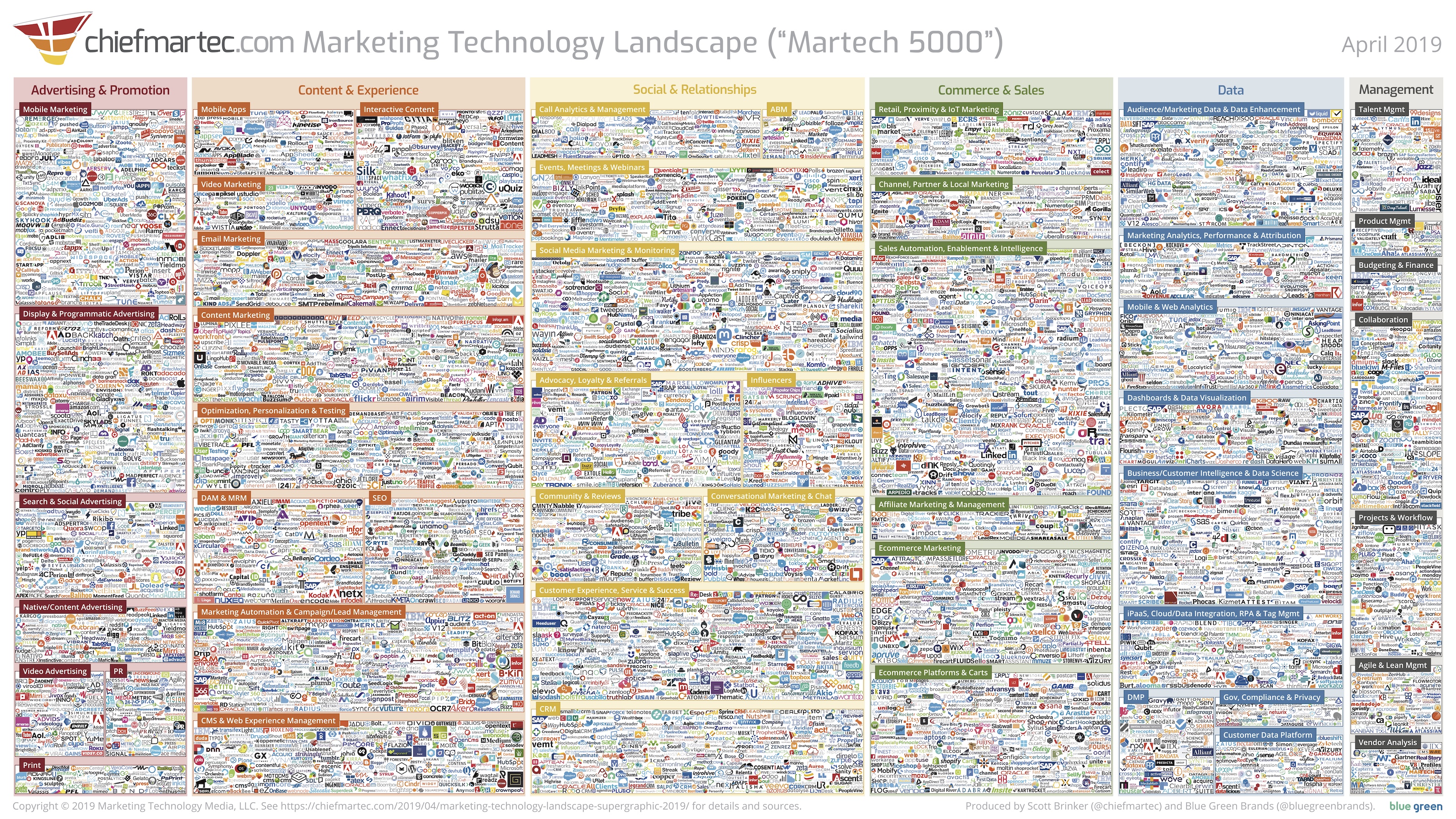
Scott Brinker and ChiefMartec published their annual eye chart of MarTech companies.  The list grew another 13.6% to 8,000 companies.  However, the attrition rate was 8.7% as one in twelve companies on last year’s list were either acquired or folded.

The Data category grew by 25.5% to 1,258 companies.  Within the data grouping, Governance, Compliance, and Privacy rose 68%.  Other sub-segments with rapid growth include Conversational Marketing and Chat (up 70%), Projects and Workflow (up 41%), Print Advertising and Promotion (up 35%), and Video Marketing (up 26%).

While MarTech continues to expand, Brinker contends that the industry has a long-tail with one to two dozen platforms that “dominate global market share.”  These are followed by a few hundred category leaders, each with tens or hundreds of millions of dollars in revenue.

Brinker argues that MarTech has evolved from suites to platform ecosystems that look to leverage the capabilities of long-tail builders and entrepreneurs, providing niche solutions integrated into their platforms.  “The stability of a major platform as the backbone of a marketing stack augmented with a set of specialized apps designed to plug deeply into that platform is a powerful combination.  A “point solution” — which used to be a negative label — isn’t a point solution any more when it seamlessly integrates into your primary platform.  It becomes part of the fabric of your stack.  Literally: it’s a feature, not a bug.”

“At the same time, these characteristics give long-tail Martech businesses a certain degree of robustness,” continued Brinker.  “By integrating deeply with a major platform, they overcome buyer objections to unintegrated software.  They tap network effects with other integrated apps that can benefit from each other’s data and services.  And they can focus their marketing and sales energies toward a well-defined target audience — customers of that platform — often through online marketplaces run expressly for that purpose.”

This logic is being replicated in newer categories such as Sales Engagement.  Outreach and SalesLoft have offered partner ecosystems for several years that augment their capabilities and provide flexibility to their offerings.  Just as Salesforce has acquired companies to extend its capabilities, SalesLoft has acquired partners (NoteNinja and Costello) to extend core capabilities.  Smaller vendors may not offer formal app directories, but usually partner with a few best-of-breed vendors in various categories (e.g. LinkedIn SNAP, Vidyard, Drift, Zoominfo).

Now, this year’s data was collected before the coronavirus pandemic exploded globally in March 2020.  The elephant-in-the-room question, of course, is what impact will this crisis have on the Martech industry?  What will the Martech landscape look like in 2021?

Scott Brinker, ChiefMartec

Brinker sees the pandemic as “more of a short-term hit than a long-term death” as “it’s going to be a tough time for their customers,” resulting in a culling of weaker vendors.  Certainly, business spending will be reduced due to economic uncertainty.  Brinker also cautions that marketing operations will be stretched thin, dealing with crisis operations, and a reduction in VC funding will increase the perceived vendor risk for startups.

But the pandemic is not entirely negative for MarTech companies.  On the positive side, businesses will “lean in to digital engagement / transformation,” focus on performance marketing, and benefit lower-priced products tied to platform ecosystems.

“The world is going to continue to become more digital.  If anything, this crisis will accelerate the motivation for firms to embrace digital operations and digital customer experience.  And that’s where MarTech thrives.”

Finally, Brinker noted market analysis conducted by Luma Partners.  While the S&P 500 was down 25% in Q1, MarTech public companies were down only 8%.  This mild decline is an indicator that MarTech is viewed more favorably by the market than other categories (and far better than AdTech, which declined 32%).


Hybrid Engagement Platforms

Cognism Intelligence within Salesforce. Hybrid Engagement Platforms Continuously update CRMs and MAPs.

The market is beginning to evolve a set of hybrid engagement vendors that deliver a broad set of sales and marketing services.  The boundary between sales and marketing is quickly crumbling.  Hybrid engagement services manage both data and workflows.  Features include

Future functionality will include Next Best Actions, Embedded 1:1 Video, SNAP (Sales Navigator) Integrations, and Programmatic Advertising.

No vendor provides all of these services and some provide them as separate offerings, but firms such as Dun & Bradstreet, Zoominfo, Infogroup (Salesgenie), Lead411, LinkedIn Sales Navigator, and Cognism have all taken steps over the past two years to meet the emerging requirements of the CRO.

For the moment, I’m calling these emerging offerings Hybrid Engage Platforms, but that is a placeholder name as the market evolves.

Drift Video Launched

Drift Video allows customers and prospects to immediately engage in a chat.

Drift, which has quickly established itself as a leader in the chatbot space, is upping the ante by integrating video and chat.  Users will be able to share and record videos via a Chrome extension or mobile app.  Recorded videos can then be dropped into emails and sent to customers or prospects.

Videos are “private and secure” with single sign-on functionality from Okta, OneLogin, and Microsoft Azure.  Users can restrict viewing to a specific email or email list and “everyone else will have to request permission, just like you would with a Google Doc.”

Drift suggests three sales use cases for video: as a conversation starter, as a second chance to refine a message after a call, and as a group selling tool (team share).

Drift Video provides real-time desktop and mobile notifications when viewed.  Users can immediately start a conversation while somebody is viewing their video “so you can reach out and say hello or follow-up at the perfect time.”

It is the immediate notification element which Drift claims to be its product differentiation.

“There are a few good software products out there that make it easy to capture and share videos.  But we took a look around the market and noticed one big thing missing: none of those products create a better buying experience because they don’t actually help you start conversations with potential customers.  You still have to make a video, send an email, and hope to get a response.  But with Drift Video, you can get a notification in real-time while someone is watching your video and then hop right in and say hello.”

Drift Website

“Since starting Drift, we’ve said there are two mega-trends that would shape the future of B2B sales and marketing: messaging and video,” said CEO David Cancel.  “Over the last few years we’ve built an industry-leading messaging platform used by over 150,000 businesses, and now we’re expanding our Conversational Marketing platform by adding video.”

Video is driving global IP demand.  According to Cisco, one million minutes of video will be crossing the Internet every second by 2020 and 82% of all Internet traffic will be video by 2021.

Drift video is available today as part of the Drift offering.  There is no surcharge for video functionality for up to ten videos per month with a chat option embedded into the video.  For $12 per seat per month or $120 per annum, reps are provided with a Pro license which includes unlimited HD quality video sharing and storage.  Only the Pro version restricts video sharing.

Future features include Team Analytics, Book Meetings from Video, and integrations with Salesforce, Pardot, and Marketo.

“We’ve spent the last year working on Drift Video and it was one of the main reasons for raising our Series C in April 2018,” stated Cancel.  “In looking at the market over that time, we saw that while there are many products that make it easy to create and share videos, none of them were built to help to start conversations and create a better buying experience.  After a private beta with some great early customers, that’s what we’re bringing to market today with Drift Video.”

Drift has integrated video in its own sales process with 50% of Drift revenue “influenced by video in the selling process.”

“Video is the greatest conversation starter in B2B buying,” said Alexa Nguyen in a Drift video.  “In a world of faceless phone calls and emails, video has helped us build trust, and video has helped us close more deals.”

Video is another way for salespeople to engage with their prospects outside of the norm.  Prospects are constantly bombarded with emails and phone calls asking for their attention.  But it’s hard to cut through that noise because they don’t trust easily.  In order to build that trust, you need to build a personal connection.  And all personal connections start with a conversation.  Video allows people to be personal, show that they’re human, and help build that connection that might be lost through text in an email. 

Lacey Berrien, Drift’s PR Senior Manager

According to research from Forrester and Boston Consulting Group, 75% of B2B transactions have little or no sales interaction.  Thus, video offers a valuable channel through which sales reps can avoid being disintermediated.  However, sales reps could push this functionality too far.  While chat functionality sounds like the next step for video, reps should be careful not to step over the line from personable to creepy. 

When prospects view an email, most understand that the act of opening an email triggers a notification to the sender, but they don’t expect that the viewing of a video will be treated as a real-time permission for a call or chat.  Immediately reaching out to customers and prospects may be viewed as a non-permissioned extension of an asynchronous communication into synchronous.  Drift does not discuss GDPR in the announcement, but this seems to cross the boundary into non-permissioned communications and the release of personally identifiable information (“John@B2BProspect.com is viewing your video.  Call immediately”).  The video privacy permissions are focused on the seller (ensuring they aren’t shared with others), but there does not seem to be any functionality to limit the “call me back” immediacy of the service.  If anything, the immediate messaging will drive down the open rate of all embedded video and kill its efficacy.

When I raised this concern to Drift, they offered a best practice to address this issue.  Lacey Berrien, Drift’s PR Senior Manager, suggested that sales reps could either wait for the contact to initiate the chat or use a message such as “Thanks for watching my video!  I’m here if you have any questions.”  This approach makes sense.  By utilizing a generic message that sounds automated, it feels less invasive.  This may be a situation where a generic message may be welcome as it serves as an invitation to chat while a personalized message may be off-putting.

The user can take one of two roads — proactively engage with the video viewer while they’re watching via the chat functionality OR not engage at all and allow the video viewer to chat with them at their own discretion…Other customers have gone the route of not messaging and just offering the viewer another channel to engage with them outside of email or a phone call.  Buyers have all of the power.  And the ultimate goal is to meet them where they are…and to always be available to help.

Lacey Berrien, Drift’s PR Senior Manager

There appears to be a Gresham’s Law of MarTech (“Bad money drives out good”); an effective channel or marketing tool quickly becomes overused or misused, resulting in lowered efficacy.  Embedded video could quickly convert a golden channel into chaff through overuse and perceived creepiness.  What makes embedded video so compelling today is its ability to personalize and deliver a relevant message on a 1:1 basis.  If embedded video overwhelms prospects or is seen as inviting immediate, unwanted contact, it will kill the golden goose.  A softer touch is likely the best practice.  If viewers maintain the control and opt into contact, then it will enhance the value of a video by providing a Call to Action that the prospect controls.

MarTech Industry Grows to 7,040

MarTech Growth Rate chart courtesy of Scott Brinker and Chief Martech
MarTech growth rate chart courtesy of Scott Brinker and Chief Martech

Scott Brinker published his 2019 Chief Martech eye chart and it now spans 7,040 companies, up 211 since last year.  While the industry continues to grow, the rate of growth appears to have moderated.  Between 2014 and 2018, the industry was adding over 1,000 companies each year with the biggest jump for the 2018 chart (1,800).  

The super-graphic is available to the public and may be reprinted at up to 1600 x 900.  Brinker has also made a spreadsheet available.

“That’s not so much a slowing down as a flattening out, a plateau,” said Brinker.  “At face value, it would seem that, indeed, we have achieved ‘peak martech.’ (pause for dramatic effect)”

While industry growth may have plateaued, Brinker admitted that 7,040 significantly underestimates the total number of Martech firms and joked that he may have hit “peak martech landscape.”  Brinker noted five areas where his chart is underweighted:

  • Regionally – When comparing to national MarTech landscapes, Brinker spotted hundreds of companies on the UK, Canadian, Chinese, German, Swedish, and Finnish country charts that were absent on the 2019 Chief Martech chart.
  • Vertical – Likewise, verticalized solutions are also underrepresented.
  • Apps built for specific MarTech platform ecosystems
  • Apps built by services companies (but packaged as products)
  • Apps built with low-code/no-code citizen developer platforms

“Each of these trends — the growth of platform ecosystems, the blending of software and services businesses, and the rise of citizen developer platforms — are birthing whole new galaxies of martech apps.

The major marketing suites have all embraced becoming true marketing platforms, with ever more open APIs and official marketplaces for third-party apps.”

Brinker lists Salesforce, Oracle, Adobe, Microsoft, and G Suite amongst the platform ecosystems, but one would also include browser extensions, mobile apps, and sales engagement platforms (technically, SalesTech, but there is a fair amount of overlap between MarTech and SalesTech these days) to the list.  Brinker noted that WordPress has 54,480 plugins.

Audience / Marketing Data & Data Enhancement (2018 MarTech Landscape)

Many of the DaaS and Sales Intelligence vendors covered in this newsletter are amongst the 204 vendors listed in the Audience / Marketing Data & Data Enrichment category and the 457 vendors listed in the Sales Automation Enablement & Intelligence grouping.